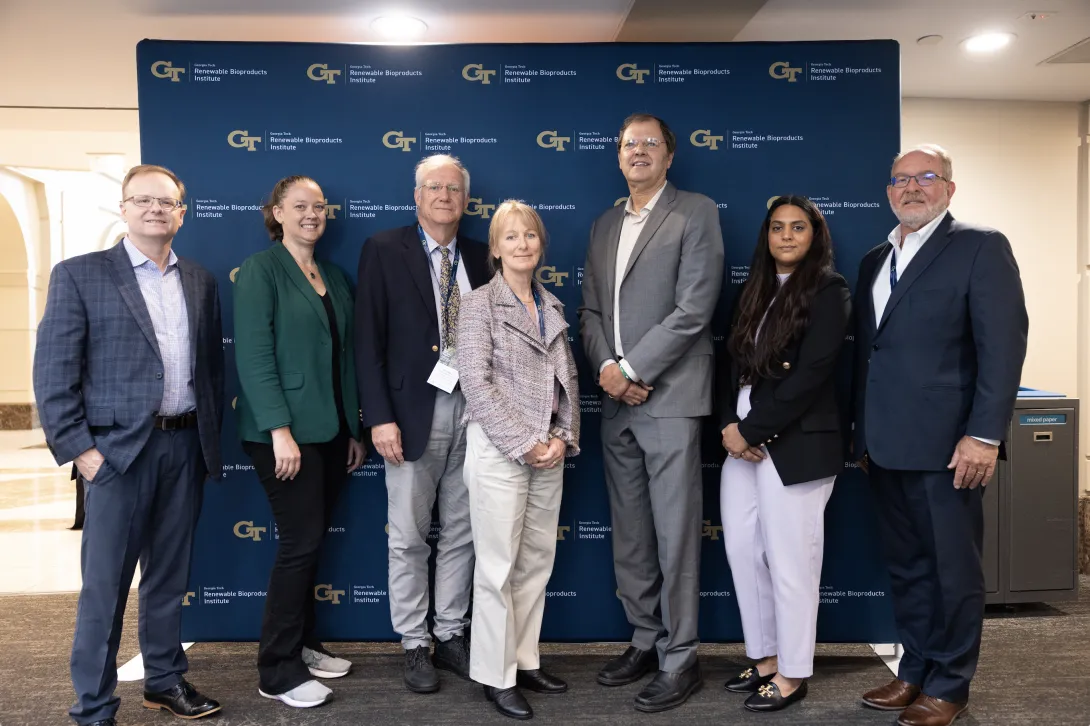
From left: Carson Meredith, Blair Brettmann, Andreas (Andy) S. Bommarius, Ulrika Egertsdotter, Joel Kostka, Titiksha Fernandes and Chris Luettgen.
The Renewable Bioproducts Institute (RBI) at Georgia Tech hosted its Spring 2026 Workshop, “Resilient Forests to Renewable Futures,” on May 11 and 12. The workshop brought together university researchers, scientists, and industry partners to discuss new developments shaping the future of the bioeconomy.
Preceded by an Industry Advisory Board meeting, the two-day workshop focused on how renewable materials, biotechnology, and advanced manufacturing can support more sustainable industrial systems. Discussions throughout the event explored topics ranging from forest health and biotechnology innovations to sustainable packaging and high-value biochemical products derived from forest resources.
Opening the workshop, RBI Executive Director Carson Meredith emphasized the institute’s focus on interdisciplinary collaboration and real-world impact.
“Our goal is to catalyze a community of researchers who focus on solving real-world challenges by investing in team building across interdisciplinary boundaries,” Meredith said.
Meredith also highlighted the growing need to create higher-value products from renewable resources in addition to traditional commodity materials.
That focus connected closely with updates on Georgia Tech’s Center for a Renewables-based Economy from Wood (ReWOOD). The center supports research aimed at turning sustainable plant-based materials into products such as aviation fuels, specialty chemicals, solvents, and pharmaceutical ingredients while strengthening connections between research and industry.
Several presentations focused on improving the long-term health and productivity of working forests. Caterina Villari from the University of Georgia and David Weston from Oak Ridge National Laboratory shared research aimed at protecting trees from diseases such as fusiform rust and brown spot needle blight. Their work combines biotechnology, genetic screening, and artificial intelligence tools to help identify tree varieties that are more resilient to disease and environmental stress.
The workshop also explored how forest fibers can be used to create more sustainable packaging materials. Patritsia Stathatou from Georgia Tech’s School of Chemical and Biomolecular Engineering presented research on manufacturing methods designed to reduce water and energy use in paper and packaging production.
Industry speakers discussed the challenges of bringing those materials into large-scale manufacturing. Michael Joyce, Senior Associate Principal Engineer at Mondelēz International, emphasized that paper-based alternatives must still meet the strength, durability, and performance standards required for existing packaging systems.
Additional discussions focused on how forest-derived materials can be used to create higher-value products beyond traditional paper and lumber applications. Speakers highlighted a growing interest in converting wood residues and byproducts into specialty chemicals, fuels, and biomaterials that can strengthen the long-term economics of renewable manufacturing.
Larissa Fenn from Rayonier Advanced Materials discussed the company’s work converting wood-derived materials into natural prebiotics for livestock. In collaborative studies with researchers at the University of Georgia, the products improved livestock gut health and feed efficiency while performing similarly to traditional antibiotics in certain diseased conditions.
The workshop also included a student poster session and networking event, giving attendees an opportunity to engage directly with RBI Fellows and researchers working across renewable materials and manufacturing research.
“What made the workshop especially valuable was having people from different backgrounds and sectors all in the same room looking at these challenges from different perspectives. Those conversations are what move ideas from research into real-world applications,” said Meredith. “RBI will continue to host these workshops as part of our commitment to interdisciplinary research advancing the bioeconomy.
News Contact
Yanet Chernet
Communications Officer