
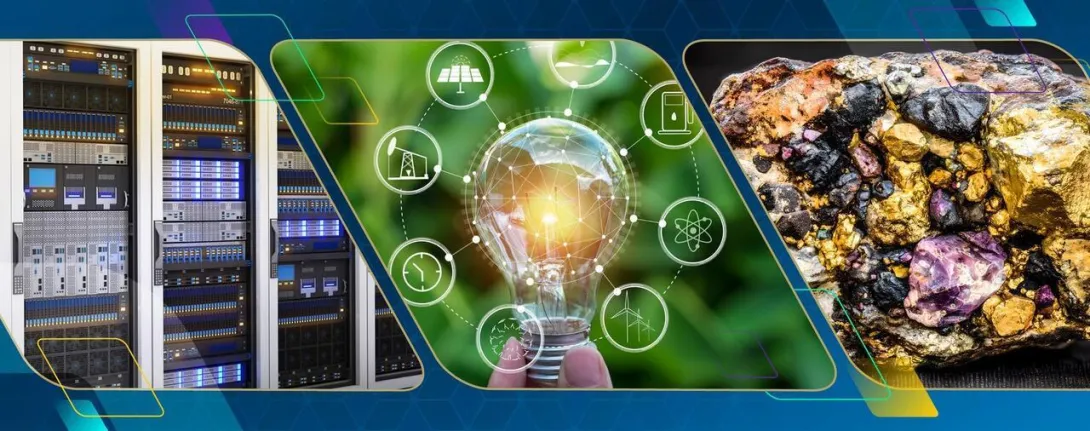
Georgia Tech Energy Day returns this year on March 19 with an expanded focus and a new collaborative momentum. Cohosted by the Georgia Tech Institute for Matter and Systems (IMS) and the Strategic Energy Institute, (SEI) with plenary session support from the Energy Policy and Innovation Center, Energy Day 2026 convenes leaders from academia, industry, government, and students to address the challenges associated with meeting the rapidly growing electricity demand driven by artificial intelligence (AI) and high-performance computing.
Set in the heart of Tech Square on the Georgia Tech campus, this year’s event explores how energy systems, materials, technologies, supply chains, and policy must evolve in response to AI’s accelerating impact. As digital infrastructure expands and computation intensifies, the need for reliable, resilient, and sustainable power has never been more urgent.
“Energy Day reflects Georgia Tech’s strength in connecting world-class research in materials and components with the infrastructure and partnerships needed to translate discovery into scalable energy technologies that serve industry, society, and the future economy,” said Eric Vogel, executive director of the IMS and the Hightower Professor in Materials Science and Engineering.
Energy Day 2026 also marks an important milestone with the introduction of its first group of corporate sponsors: GE Vernova, Southern Company, Georgia Power, ExxonMobil, Southwire Spark, Gems Setra, and Tektronix. Their support reflects a shared commitment to advancing energy solutions.
“Tektronix is excited to be part of Energy Day because advancing the future of energy starts with precise measurement and trusted insights,” said Christopher Bohn, president of Tektronix. “From power electronics and high voltage systems to grid scale renewables and AI driven control technologies, the breakthroughs discussed here directly align with the innovations we support through our products and solutions. Collaborating with Georgia Tech allows us to engage early with emerging research and the next generation of engineers—critical collaborators in building a cleaner, smarter, and more resilient energy ecosystem.”
The keynote address will be delivered by Vanessa Z. Chan, a nationally recognized leader at the intersection of innovation, commercialization, and emerging technologies. Chan will provide insights on accelerating technological discovery, emphasizing how AI is transforming energy and materials design. She will discuss how commercialization strategies must rapidly evolve across multidisciplinary energy domains from grid modernization to advanced batteries and clean manufacturing.
Building on the themes introduced in the keynote, the program transitions into a fireside chat with Georgia Tech EVPR Tim Lieuwen featuring Amit Kulkarni and Jim Walsh. Kulkarni is vice president of Product Management and Strategy for the Gas Power business within GE Vernova, where he oversees the world’s largest portfolio of power generation equipment. Walsh, vice president of GE Vernova’s Consulting Services, leads teams providing innovative solutions across the full spectrum of power generation, delivery, and utilization.
Next comes a policy-focused panel that will explore the surge in power demand driven by AI, how the United States is addressing today’s most urgent energy challenges, and the long-term implications of today’s decisions for a sustainable energy future. Bringing together leading voices in U.S. environmental and energy policy, the panel features Joe Aldy of Harvard University and former special assistant to the president for Energy and Environment; Al McGartland of New York University’s Institute for Policy Integrity and former Environmental Protection Agency lead economist and director of the National Center for Environmental Economics; and Kevin Rennert, fellow and director of the Comprehensive Climate Strategies Program at Resources for the Future and former staff member on the U.S. Senate Committee on Energy and Natural Resources.
The second panel focuses on critical materials — the foundation of advanced energy systems and digital technologies. As AI, data centers, and advanced energy technologies drive demand for critical materials, securing them now requires integration and coordination across the entire value chain. Panelists include Rachel Galloway, British consul general in Atlanta; Vijay Murugesan, head of Materials Intelligence and Digital Innovation at Amazon; Colin Spellmeyer, executive strategic sourcing leader at GE Vernova; Charles Sims, Tennessee Valley Authority Distinguished Professor of Energy and Environmental Policy at the University of Tennessee; and Nortey Yeboah, principal engineer at Southern Company. Together, they will offer perspectives on the policy and economic frameworks shaping the energy supply chain, from developing raw resources to manufacturing the technologies essential to future energy systems.
In the afternoon, participants can dive deeper into specialized topics through three focused technical tracks.
- “Meeting the Demand for Power” will examine how emerging technologies, advanced nuclear systems, and renewable integration can work together to deliver reliable, resilient electricity.
- “Data Center Infrastructure and Resources” will explore innovations in thermal management technologies, energy-efficient computing, and the broader resource impacts of expanding digital infrastructure.
- “Grid Technologies and Markets” will highlight strategies for strengthening grid capacity, incorporating demand-side management, and optimizing carbon performance as energy systems evolve.
“Meeting the rapidly rising electricity demand driven by AI requires bold ideas, coordinated action, and research that moves at the speed of innovation,” said Yuanzhi Tang, executive director of the SEI. “Energy Day 2026 brings together the people and expertise needed to shape resilient, sustainable energy systems for the future. At Georgia Tech, we see this event as a catalyst for new partnerships, new solutions, and a shared commitment to strengthening the nation’s energy foundation.”
Energy Day 2026 is designed for researchers advancing emerging energy technologies, policymakers navigating shifting regulatory and geopolitical landscapes, industry professionals seeking insight into emerging tools and supply chains, and students preparing to enter one of the most consequential sectors of the decade. It also welcomes anyone interested in AI, sustainability, electrification, and critical materials.
Join us to explore the future of energy. To learn more and register, visit: Energy Day 2026.
News Contact
Priya Devarajan | Communications Program Manager

A recent study by EPIcenter faculty affiliates Joe F. Bozeman III (School of Civil and Environmental Engineering, Georgia Institute of Technology) and Daniel C. Matisoff (Carter School of Public Policy, Georgia Institute of Technology), along with John D. Kim (Carter School of Public Policy, Georgia Institute of Technology) and co-authors Sanya Carley, David M. Konisky, Jeremy J. Michalek, and Destenie Nock, examines U.S. household electric vehicle (EV) ownership and adoption intent beyond upfront costs, focusing on charging access, travel behavior, housing, and demographics. The study utilizes a nationally representative survey of 2,870 households to examine how these factors shape both current EV ownership rates and consumers’ intentions to purchase or lease an EV in the future.
The study finds that EV ownership remains relatively low among households with “median” characteristics — approximately 1% of household vehicles are electric — but increases substantially when households report access to community charging infrastructure. In contrast, single‑vehicle households and households located in states without Tesla dealerships exhibit significantly lower EV ownership rates. When examining adoption intent, the authors find that access to community and workplace charging, trust in the federal government, more liberal political ideology, younger age, and urban residence are consistently associated with higher stated interest in EV adoption. Notably, single‑vehicle households express significantly greater intent to adopt one in the future, despite being less likely to own an EV today. The analysis also reveals that public transit users show elevated EV adoption intent at earlier stages of consideration, suggesting potential complementarities between transit use and personal vehicle electrification.
Read Full Story and listen to a related podcast on the EPIcenter Newspage
News Contact
Priya Devarajan | SEI Communications Program Manager
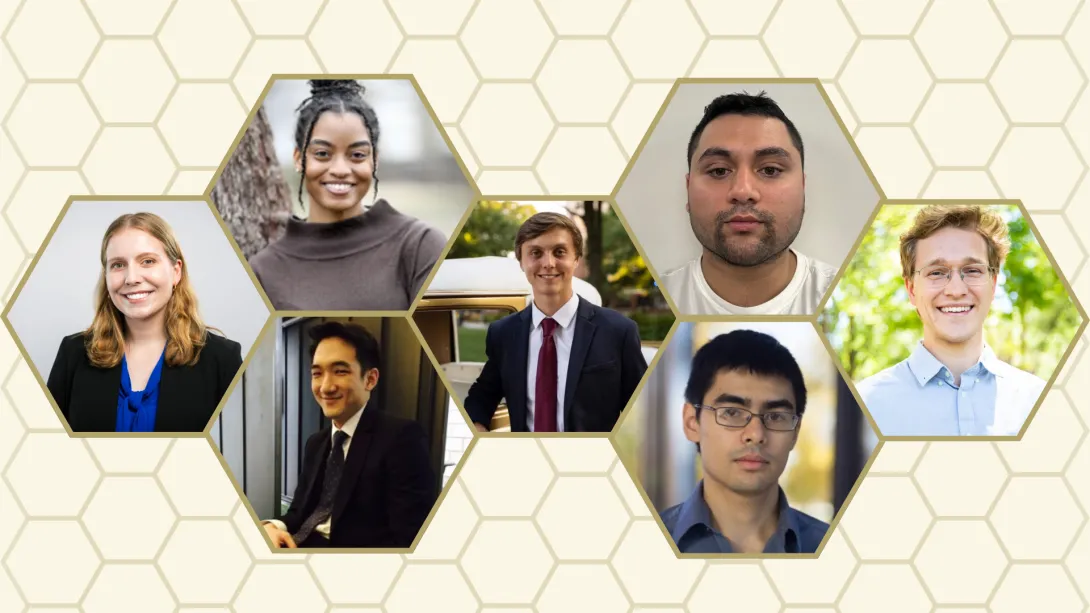
From the Left: Anna Raymaker, Talia Thomas, John Kim, Kristian Lockyear, Daksh Adhikari, Alex Magalhaes, and Douglas Lars Nelson.
The Strategic Energy Institute and the Energy, Policy, and Innovation Center at the Georgia Institute of Technology have announced the recipients of this year’s James G. Campbell Fellowship and Spark Awards.
Kristian Lockyear, a doctoral student in the Sustainable Systems Thermal Lab, received the Campbell Fellowship, which recognizes a Georgia Tech graduate student conducting outstanding research in renewable energy systems. Candidates are nominated by their advisors for exceptional academic achievement in the field.
Lockyear’s research, advised by Professor Srinivas Garimella in the George W. Woodruff School of Mechanical Engineering, centers on developing a biomass-powered adsorption cooling system to address food supply shortages in the cold chain and enable vaccine delivery to remote regions. He also holds a bachelor’s degree in chemical and biomolecular engineering from Georgia Tech and is committed to advancing sustainable cooling technologies that improve access in developing areas and promote global energy equity.
The Spark Award honors Georgia Tech graduate students who have demonstrated exceptional leadership in advancing student engagement with energy research, along with a strong record of service and broader impact. This year’s recipients are Daksh Adhikari, John Kim, Douglas Lars Nelson, Alex Magalhaes, Anna Raymaker, and Talia Thomas. “This year saw one of the largest pools of applications for the annual awards,” said Jordann Britt, SEI’s program coordinator, who led the selection process. “Awardees were thoughtfully chosen based on research excellence, a strong record of service, and projects demonstrating broader impact on advancing renewable energy. Through these scholarships, we hope to encourage and support students as they grow into future leaders in the energy industry.”
Daksh Adhikari is a second-year doctoral student in mechanical engineering working in the MiNDS Lab. His research focuses on increasing the adoption of two-phase thermal management techniques in artificial intelligence data centers to reduce water consumption. Adhikari is developing machine learning-based control systems to manage the unstable regions inherent in two-phase cooling processes. Outside of the lab, he enjoys playing guitar and exploring scientific topics related to space.
John Kim is a doctoral candidate in public policy, advised by Professor Daniel Matisoff. His research examines the distributional effects of environmental and energy infrastructure challenges, with a focus on grid resilience, public safety, and environmental justice. Kim’s broader research agenda includes analyzing inequities in power grid restoration, the economic impacts of EPA Superfund cleanups, and the socioeconomic drivers of electric vehicle adoption.
Douglas Lars Nelson is a fifth-year doctoral candidate at the School of Materials Science and Engineering, advised by Professor Matthew McDowell. His research uses advanced characterization techniques to quantify degradation in next-generation battery materials, contributing to the development of safer, high-energy batteries. Nelson earned his undergraduate degree in materials science and engineering from Clemson University.
Alex Magalhaes is a master’s student in computational science and engineering, advised by Professor Qi Tang. His research centers on developing scalable, high-fidelity numerical algorithms to simulate plasma confinement and equilibrium in nuclear fusion reactors. Magalhaes holds a bachelor’s degree in physics from Wesleyan University and previously worked as a data scientist at Quantiphi. He plans to pursue a doctorate in computational plasma physics. In his free time, he enjoys rock climbing, which he’s done at Yosemite and Grand Teton National Park.
Anna Raymaker is a doctoral student in the School of Electrical and Computer Engineering, advised by Professor Saman Zonouz. Her research focuses on securing critical infrastructure by identifying and mitigating cyber risks in systems, such as maritime networks and distributed energy resources. Raymaker leads a U.S. Department of Energy-aligned initiative to locate exposed solar inverters worldwide and assess their impact on operational power grids. She currently serves as president of the Graduate Student Association for the School of Cybersecurity and Privacy.
Talia Thomas is a doctoral candidate in mechanical engineering working in the McDowell Lab. Her research focuses on sustainable carbon materials for next-generation lithium- and sodium-ion batteries by using biomass precursors such as lignin and cellulose to develop high-performance anodes. Thomas also integrates life cycle and techno-economic assessments to evaluate scalability and environmental impact. She is an active leader in the graduate community, organizing initiatives that promote inclusion and student engagement. Before graduate school, she worked as a maintenance engineer at Dow and as a chemistry research associate at Zymergen.
Written by: Katie Strickland.
News Contact
Priya Devarajan || SEI Communications Program Manager

Isaiah Bolden

Jennifer Glass

Alex Robel

Yuanzhi Tang
The College of Sciences has named four faculty members — Isaiah Bolden, Jennifer Glass, Alex Robel, and Yuanzhi Tang — from the School of Earth and Atmospheric Sciences (EAS) to newly endowed positions. The awards recognize their leadership in climate, sustainability, and environmental sciences.
“These endowments are allowing stellar early and mid-career faculty to amplify their educational and research activities,” says EAS Chair Jean Lynch-Stieglitz. “We are grateful to reward their achievements and ensure they can continue to contribute at a high level to the ongoing growth of Georgia Tech’s new Environmental Science B.S. program and the School’s research profile in climate and sustainability.”
Jean “Chris” Purvis Early Career Award: Isaiah Bolden
EAS Assistant Professor Isaiah Bolden’s research focuses on providing foundational data needed for climate and sustainability science in vulnerable coastal environments. He and his team in the Chemical Oceanography – Observations and Outreach Lab study chemical fingerprints preserved in coastal waters, corals, and shells to provide early warning indicators and mitigation strategies to preserve biodiversity and ecosystem services.
“I am most excited by the award’s ability to provide the flexible, sustained support necessary to bridge the gap between academic discovery and community impact,” he says. “With this endowment, I can pursue high-risk, high-reward research questions and dedicate resources to long-term, community-based projects. It directly empowers my drive to put science to work as a tool for environmental policymaking and cultural preservation.”
Bolden plans to direct the funds to support marine science curricula for coastal Georgia middle and high school students, paid undergraduate internships, specialized sample analyses, and travel logistics.
New research: Bolden’s group is actively pioneering the use of coastal Georgia oyster shells as novel natural archives of environmental change. Similar to tropical corals, the oyster shells provide high-resolution data on local water quality, pollution, and climate shifts. This work is intended to dovetail with Bolden’s coastal community-based partnerships, including the Ladies and Lads in Lab Coats program, which provides students with STEM exposure and enables them to collect and analyze data that documents their region’s environmental history.
Jean “Chris” Purvis Professorship: Jennifer Glass
EAS Professor Jennifer Glass drives new research at the intersection of environmental microbiology and climate science. The Glass Lab investigates microorganisms that produce and consume greenhouse gases — focusing on the chemical-level mechanisms behind how these gases are created and destroyed — with the ultimate aim of harnessing biological processes to address some of the urgent environmental challenges facing humanity. One major focus of her research is the vast reserves of methane hydrate found beneath the continental margin seafloor, representing the largest natural gas resource on Earth.
“I’m incredibly thankful to the donor and the Institute,” says Glass, who is also the EAS associate chair for Undergraduate Affairs. “This support arrives at a critical time for environmental science and allows me to pursue new opportunities that would otherwise be out of reach.”
She plans to use the funds to attend key conferences, build new collaborations, and support student engagement in upcoming initiatives.
New research: The Glass Lab is exploring environmentally friendly ways to extract and recycle rare earth elements — critical minerals used in batteries and electric vehicles. By studying marine microbes, which are less understood than their soil counterparts, the team aims to develop green biotechnology alternatives to current mining practices.
Jean “Chris” Purvis Early Career Award: Alex Robel
EAS Associate Professor and Rising Tide Director Alex Robel combines physics, applied mathematics, and ocean sciences to understand how climate changes are impacting Earth’s largest ice sheets and glaciers. His research lab, the GT Ice and Climate Group, focuses on developing computational models of ice sheet melt to predict future sea level rise. In partnership with coastal communities, they leverage those predictions to help make city streets more resilient to flooding.
“This award helps me pursue more opportunities to engage closely with community partners, using climate information to make concrete improvements in their infrastructure,” explains Robel.
Specific plans for the funds include enhancing pilot projects in coastal resilience, including the Community Hubs for Optimizing Resilience (CHORUS) initiative. Using building-scale flood models, CHORUS will help communities select potential infrastructure interventions to mitigate future flooding that threatens valued community assets.
New research: Robel is launching a project to use machine learning methods to improve the representation of small-scale processes in ice sheet computational models. These methods will help his group blend an understanding of how ice flows and fractures, based on basic physical principles, with real-world measurements of crevasse formation on ice sheets.
Georgia Power Professorship: Yuanzhi Tang
EAS Professor Yuanzhi Tang is the founding director of the Center for Critical Mineral Solutions and associate director, Strategic Partnerships and Engagement for the Brook Byers Institute for Sustainable Systems. Her research integrates geochemistry, environmental engineering, and sustainability science to advance a circular economy for critical minerals, from resource discovery and recovery to recycling and reuse.
The Tang Research Group investigates the fundamental chemical, geological, and biological processes that control the transformation and mobility of critical elements across natural and engineered environments. Her work directly informs the development of low-impact extraction technologies and sustainable supply chains essential for clean energy transition.
“The Georgia Power Professorship provides support for building partnerships across academia and industry partners to accelerate innovation in critical minerals,” says Tang. “It enables us to link fundamental geochemical and geological science with real-world applications that strengthen both energy security and environmental stewardship.”
Tang plans to use the funds to expand student participation and interdisciplinary collaborations with academic and industry partners — positioning Georgia and the broader Southeast as a leader in sustainable mineral innovation.
New research: Tang’s research team is developing sustainable methods for the extraction and separation of critical minerals from alternative and waste resources. By coupling molecular-scale characterization with rational engineering design, her team aims to transform waste byproducts into valuable sources of critical elements while minimizing environmental impacts.
About the Purvis Endowment
The Jean “Chris” Purvis Endowed Awards are supported by the generosity of the late J. Chris Purvis, M.D. (Applied Biology 1969), a psychiatrist and neurologist who specialized in juvenile and adolescent behavioral psychiatry.
About the Georgia Power Professorship
The Georgia Power Professorship was established through the generosity of Georgia Power, which funds several endowed professorships at Georgia Tech to support faculty in fields like energy, science, sustainability, and engineering.
News Contact
Laura S. Smith, writer

AI rendering of a fast-charging battery.
Fast charging a battery is supposed to be risky — a shortcut that leads to battery breakdown. But for a Georgia Tech team studying zinc-ion batteries, fast charging led to a breakthrough: It made the battery stronger. This result could revolutionize how we power homes, hospitals, and the grid.
By flipping a foundational belief in battery design, Hailong Chen, an associate professor in the George W. Woodruff School of Mechanical Engineering, and his team found that charging zinc-ion batteries at higher currents can make them last longer. The surprising result, recently published in Nature Communications, challenges core assumptions and offers a path toward safer, more affordable alternatives to lithium-ion technology.
Why Zinc-Ion Batteries?
Zinc-ion batteries have several key advantages over lithium-ion batteries, the most commonly used rechargeable battery technology:
- Abundant: Zinc is one of the most abundant metals on Earth, and it’s mined in many countries.
- Low cost: Zinc is significantly cheaper than lithium and doesn’t rely on scarce materials.
- Nonflammable: Unlike lithium, zinc batteries won’t catch fire — a critical safety benefit.
- Environmentally safer: Zinc is less toxic and easier to recycle than lithium-based materials.
However, until Chen’s discovery, zinc-ion batteries had one major drawback. The growth of dendrites, the sharp metal deposits that form during charging, can eventually short-circuit the battery.
“We found that using faster charging actually suppressed dendrite formation instead of accelerating it,” Chen said. “It’s a very different behavior than what we see in lithium-ion batteries.”
With this approach, the zinc doesn’t build up into dendrites. Instead, it settles into smooth, compact layers — more like neatly stacked books than splintered shards — a structure that not only avoids short circuits but also helps the battery last longer.
“It goes against the conventional thinking that fast charging shortens battery life,” Chen said. “What we found expands people’s understanding of fast charging that could rewrite how we think about battery design and where they can be used.
Solving Half of the Problem
Even breakthroughs have limits. Chen was quick to point out that while his discovery solves a major issue, it only fixes one half of the battery.
A battery has two main ends, the anode and the cathode. Chen’s team made the anode last much longer. Now, the cathode must catch up. He is working to improve the cathode so the whole battery performs reliably over time. His team is also experimenting with mixing zinc with other materials to make zinc-ion batteries even more durable.
Testing Everything at Once
Chen’s team didn’t just stumble on these results. They built a novel tool that allowed them to watch how zinc behaved under different charging rates in real time, studying many samples simultaneously.
That real-time, side-by-side view was important. Traditional battery experiments usually test one variable at a time. But this novel approach allowed researchers to test hundreds of conditions at the same time, speeding up discovery and revealing patterns that would have been easy to miss.
“We weren’t just seeing whether the battery worked or not; we were watching the structure of the material evolve as it charged,” Chen noted. Using their new tool, he and his team uncovered for the first time why fast charging makes zinc settle into smooth, tightly packed layers instead of dangerous, needle-like spikes. No one had ever experimentally mapped out this process before.
It’s an approach that combines efficiency with insight.
Charging Into the Future
Chen’s team didn’t reinvent the battery. They challenged the status quo — and the data took them somewhere no one imagined. That unexpected result could redefine battery science.
“You can imagine these zinc-ion batteries being used to store solar energy in homes, or for grid stabilization,” Chen said. “Anywhere you need reliable, affordable backup power.”
With growing demand for clean energy, unstable lithium supply chains, and safety concerns over flammable batteries, the need for alternatives has never been more urgent.
If all goes well, Chen hopes zinc-ion batteries could be ready for everyday use in about five years.
Chen’s research was supported by Yifan Ma, ME 2024; Josh Kasher, associate professor in the School of Materials Science and Engineering; and the U.S Department of Energy National Laboratories. The study was funded by Novelis through the Novelis–Georgia Tech Research Hub, with additional funding from the National Science Foundation. Two Novelis researchers, Minju Kang and John Carsley, are co-authors on the paper.
News Contact
Michelle Azriel, Sr. Writer-Editor
mazriel3@gatech.edu

From the humble beginnings of the three-wheeled Benz Patent-Motorwagen in 1886, the automobile has been a continuous story of technological progress. Each era has seen cars push the boundaries of innovation, evolving from early mechanical systems into sophisticated, computer-driven machines.
We’re now in a new generation of automobiles, where roadways are increasingly shared by electric vehicles (EVs) and autonomous vehicles (AVs).
EVs are projected to dominate global car sales by 2030, according to an RMI report. Meanwhile, AVs are gradually entering the mainstream, with 37 percent of new passenger cars expected to be equipped with advanced driver-assistance technologies by 2035, according to McKinsey & Company.
Georgia Tech School of Electrical and Computer Engineering (ECE) researchers are at the forefront of advanced automotive technologies, working on everything from electric engines and computer vision, to modernizing the power grid to support EV charging.
Given current advancements and future possibilities, ECE is helping bring the future car into view, though many surprises and uncertainties remain. Learn what's on the horizon on the ECE Newspage.
News Contact
Zachary Winiecki (zwiniecki3@gatech.edu)