

Joby is one of more than a dozen companies worldwide that are developing the next generation of aircraft that could be whisking you around the city bypassing any traffic. (Courtesy of Joby)
Georgia Tech celebrates the opening of its new Aircraft Prototyping Laboratory, a facility dedicated to advancing research in electric and autonomous flight in collaboration with academic, government, and industry partners. The ribbon-cutting ceremony will take place on Sept. 25, marking an important step forward for the Daniel Guggenheim School of Aerospace Engineering and highlighting Georgia Tech’s role in strengthening the state’s aerospace sector through technical research, engineering expertise, and student training.
“This facility demonstrates Georgia Tech’s long-term commitment to pioneering the technologies that will shape the future of aviation,” said Ángel Cabrera, president of Georgia Tech. “Aerospace products are Georgia’s No. 1 export, and the Institute’s top-ranked Guggenheim School produces some of the nation’s top aerospace engineering talent. With this advanced laboratory, we’re making strategic investments that will grow our state’s and our Institute’s national leadership in aerospace innovation and advanced manufacturing.”
The 10,000-square-foot facility, located in Georgia Tech’s North Avenue Research Area, has been purpose-built to accelerate innovation in electric and hybrid-electric aircraft propulsion as well as autonomous flight systems. Designed as a hands-on research and teaching environment, the Aircraft Prototyping Laboratory includes a suite of specialized laboratories: an electric powertrain lab, a propulsion system test cell, an avionics lab, a composites fabrication area, and a high-bay integration space capable of housing prototype aircraft with wingspans up to 20 feet.
One of the facility’s first major projects is RAVEN (Research Aircraft for eVTOL Enabling techNologies), a collaboration with NASA to design, build, and fly an electric vertical takeoff and landing (eVTOL) research aircraft in the 1,000-pound weight class. The aircraft will serve as a research platform for electric propulsion reliability, flight controls, noise reduction, and autonomy. Systems integration and test activities for RAVEN will take place within the new lab, underscoring the facility’s central role in shaping the national agenda for advanced air mobility.
“The Aircraft Prototyping Laboratory is the centerpiece of an ecosystem of flight research that we are building at Georgia Tech, focused on eVTOLs, drones, and other advanced air vehicles,” said Brian German, professor of aerospace engineering at Georgia Tech. “We greatly appreciate the long-term partnership we’ve had with NASA in the development of RAVEN, and we’ve designed the facility specifically to support RAVEN and aircraft of a similar scale.”
Other projects underway in the Aircraft Prototyping Laboratory include a solar-electric aircraft demonstrator and SETTER, a subscale eVTOL testbed focused on developing software for safety-critical applications. These projects support Georgia Tech’s expanding ecosystem for flight testing and research, including collaborations with regional test facilities in the metro Atlanta area.
“These projects exemplify our commitment to advancing the technologies that will define the future of flight. Powered by the ingenuity of our faculty and students, the Aircraft Prototyping Laboratory ensures that Georgia Tech and the state of Georgia remain leaders in aerospace innovation and economic development,” said Mitchell Walker, William R.T. Oakes Professor and chair of the Daniel Guggenheim School of Aerospace Engineering.
Through the Aircraft Prototyping Laboratory, Georgia Tech continues to develop research in electric and autonomous aircraft, supporting both the Institute’s and Georgia’s role in the aerospace industry. The school educates more than 2,000 aerospace students and is ranked No. 1 among public universities for aerospace engineering.
News Contact
Angela Barajas Prendiville
Director, Media Relations
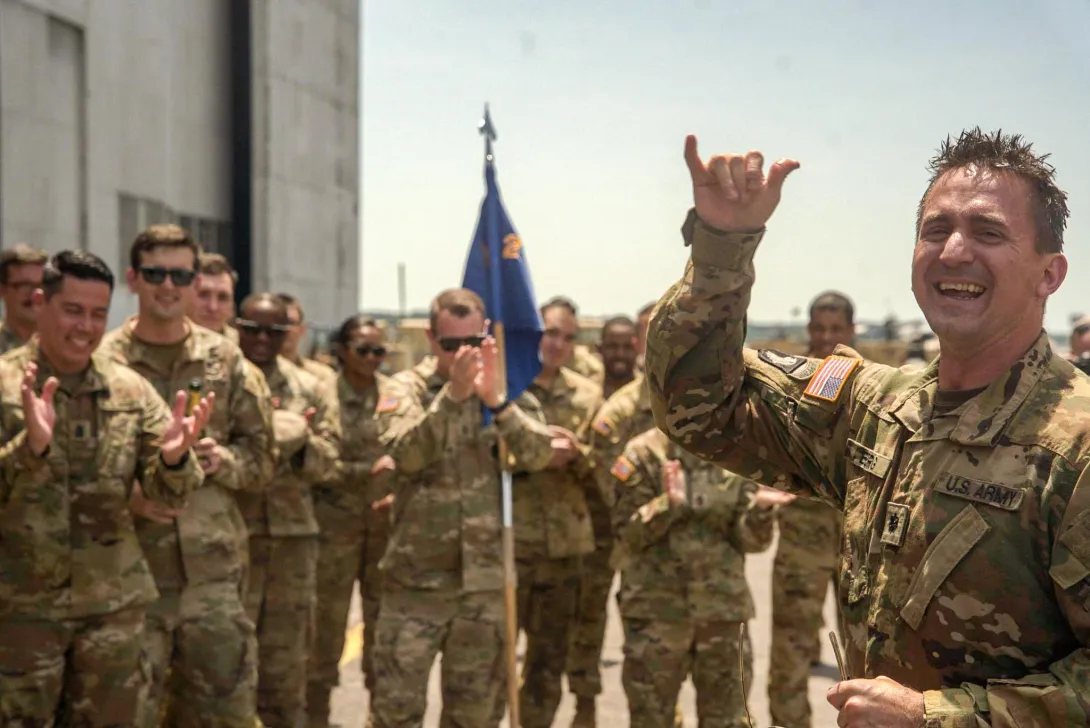
Lukas Berg (right), who flew several variants of the UH-60 Blackhawk over the course of his career, celebrated his final flight before joining the Georgia Tech Manufacturing Institute in August.
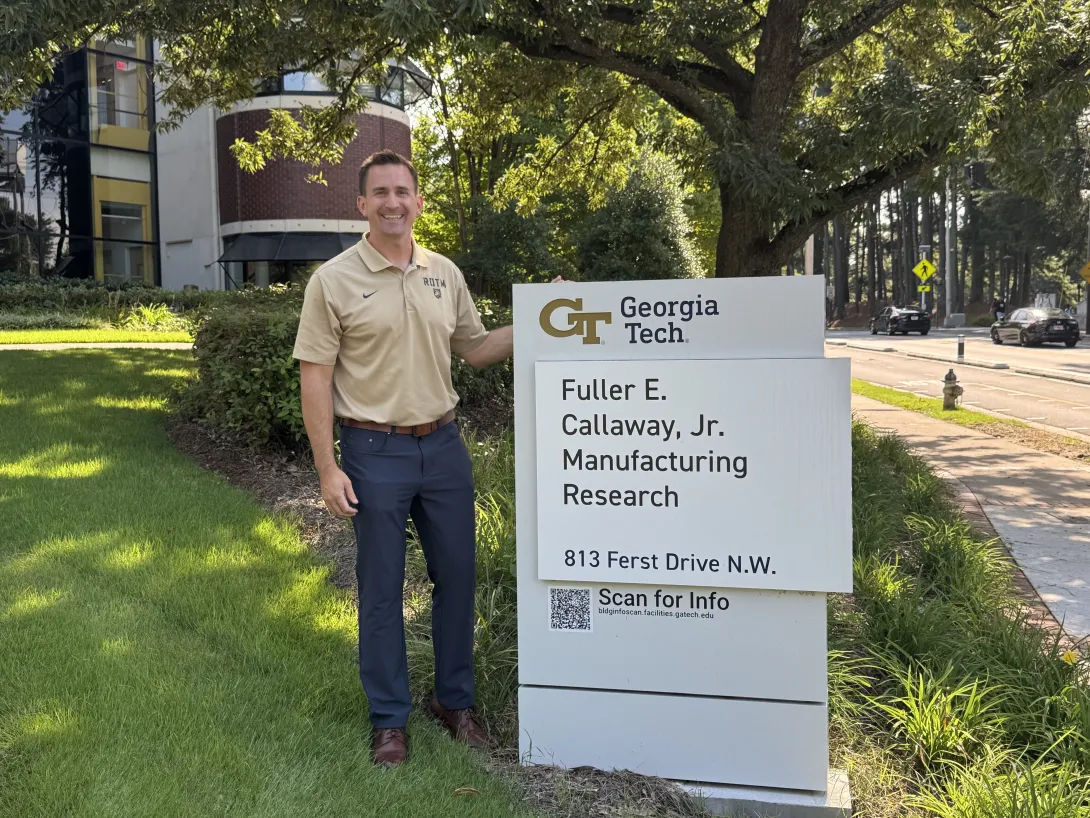
Berg will be working with GTMI for the course of his fellowship with the Hiring Our Heroes program.

Maria Venable, Berg's grandmother, joined the Georgia Tech faculty in 1963 as a 28-year-old native German speaker.

Berg and his family stand next to the model of helicopter frequently flown during his career.
As the U.S. works to strengthen its industrial base and reshore critical manufacturing capabilities, workforce development has emerged as a central challenge — and opportunity.
The Georgia Tech Manufacturing Institute (GTMI) recently welcomed its first Hiring Our Heroes (HOH) Fellow to help address this growing need. Lukas Berg, a retiring U.S. Army officer, will be working with GTMI to support new education and training programs aimed at preparing Georgians for careers in advanced manufacturing.
“Lukas Berg brings a unique blend of operational experience, academic insight, and a deep commitment to service,” said Thomas Kurfess, executive director of GTMI. “His perspective will be invaluable as we work to build stronger connections between Georgia’s communities and the advanced manufacturing sector.”
Hiring Our Heroes is a nationwide initiative led by the U.S. Chamber of Commerce Foundation that helps veterans and military spouses transition into civilian careers through short-term fellowships. Since 2021, Georgia Tech has hosted more than two dozen HOH fellows, beginning with U.S. Army veteran Erik Andersen, who now serves as interim deputy director for the Research, Electronics, Optics, and Systems Directorate at the Georgia Tech Research Institute (GTRI), where he also helps lead the HOH program.
Berg is the first fellow to be placed outside of GTRI, a sign of the program’s growing reach across campus and its potential to support a broader range of workforce development efforts.
“It’s been exciting to see how the Hiring Our Heroes program has grown at Georgia Tech,” said Andersen. “Berg’s placement at GTMI reflects the Institute’s commitment to connecting military talent with real-world innovation and workforce development. Veterans bring a unique perspective and skill set to these challenges, and I’m proud to see the program expanding to new parts of campus.”
Berg’s military career includes aviation command roles, teaching positions at West Point and the Joint Special Operations University, and deployments across multiple regions. At GTMI, he will be contributing to a new initiative that partners with rural school districts to introduce students to hands-on learning in advanced manufacturing, an effort designed to spark interest in high-potential career paths and support long-term workforce readiness.
With personal ties to Georgia Tech and a strong sense of purpose, Berg sees this fellowship as a meaningful next step. We spoke with him to learn more about what brought him to GTMI and how he views the role of manufacturing and workforce development in shaping the country’s future.
What inspired you to pursue a fellowship at the Georgia Tech Manufacturing Institute after your military service?
Last year, I visited Georgia Tech with many of the junior officers and pilots assigned to my helicopter battalion in Savannah. Our agenda included stops at the Georgia Tech Manufacturing Institute and the Advanced Manufacturing Pilot Facility, both of which struck me as being absolutely vital to maintaining the technological edge required to fight and win on the modern battlefield. Pursuing a fellowship at GTMI felt like a natural extension of my military service, and I suspected that it would put me back at the intersection of thinkers and doers (where I have always felt most at home).
You mentioned your grandmother taught at Georgia Tech for over 30 years — how has her legacy influenced your academic and professional journey?
My grandmother, Maria Venable, was the first woman to serve as a full-time faculty member in Georgia Tech’s School of Modern Languages. She poured herself into both her family and her students, and I was lucky to count myself in both populations, as she agreed to tutor me for the AP German exam in high school (but only if I behaved as well as her students at Tech). Her example inspired me to pursue a teaching assignment at West Point halfway through my Army career, and I experienced the same joy in teaching that she did. It’s something that I will continue to do for the rest of my life, whether in a formal or informal capacity.
Can you share more about the specific initiatives you'll be working on at GTMI related to advanced manufacturing education?
Most immediately, I am joining a new GTMI initiative that partners with rural school districts to deliver several weeks’ worth of curriculum and hands-on practice in advanced manufacturing. We just kicked off a pilot program with Bainbridge High School in Decatur, and it’s exciting to see their students leveraging sophisticated systems to design and build Pinewood Derby cars that would make Cub Scouts across the country green with envy. Beyond this initiative, I hope to contribute to other efforts that get young people excited about careers in manufacturing and that assist adult learners in re-skilling and up-skilling for this high-potential industry.
What are you most looking forward to as you begin your fellowship at GTMI?
Georgia Tech feels like a physical and intellectual crossroads of modern civilization. I’m excited to not only contribute as a member of GTMI but also to learn about the countless other departments, institutes, and programs that are convening talent to solve the world’s thorniest problems.
What skills or insights are you hoping to gain during your time at GTMI that will support your next career chapter?
As an Army officer, I’ve been stationed across the country and deployed around the world, but Georgia has always been home. (Gladys Knight’s “Midnight Train to Georgia” has been a fixture on my playlist since I left for West Point at the age of 17.) Now back with my family, I look forward to using my time at GTMI to learn about my home state and identify ways that I can contribute to its near and long-term prosperity, whether through roles in academia, government, or private industry. I also look forward to expanding my network in all these communities, as no single one has a monopoly on problem-solving.
Why do you believe rebuilding America’s industrial base and manufacturing workforce is critical to national security today?
As a career aviator, much of my professional life was spent agonizing over the availability of parts to repair my helicopters. It seemed like there were never enough, and they always took too long to get to me. This experience, coupled with lessons learned from our support of Ukraine’s self-defense, contrasted starkly with my recent study of America’s 20th-century role as the “arsenal of democracy.” I’m convinced that we need to regain that reputation, and I would like to see Georgia at the forefront of associated design, manufacturing, and education initiatives.
How do you see veterans playing a unique role in strengthening the U.S. manufacturing workforce?
I think veterans are the most natural candidates in the world for roles in the manufacturing workforce. They possess the knowledge, skills, and abilities to be successful in most endeavors, but most are looking for ways to extend their service beyond their time in uniform. What better way than to contribute to a field that is so vital to our national security and prosperity?
What does “Progress and Service” mean to you, and what does it mean to you personally to be contributing to that mission?
I love Tech’s motto. I grew up in a family and community that reinforced at every turn the idea that our highest potential as human beings is realized when we serve others. This motivated my choice to serve in the military for the past 20 years, and it remains my North Star for this next chapter. I also love the idea of technological progress being the vehicle by which Georgia Tech collectively serves others, and I hope to accelerate this progress during my time at GTMI.
If you could give one piece of advice to other service members considering a fellowship like this, what would it be?
Inventory your passions and define your purpose. Then start reaching out to people in related fields. I have been amazed at how generous people have been with their time and how eager they have been to help me find my second calling and related opportunities.
News Contact
Audra Davidson
Research Communications Program Manager
Georgia Tech Manufacturing Institute
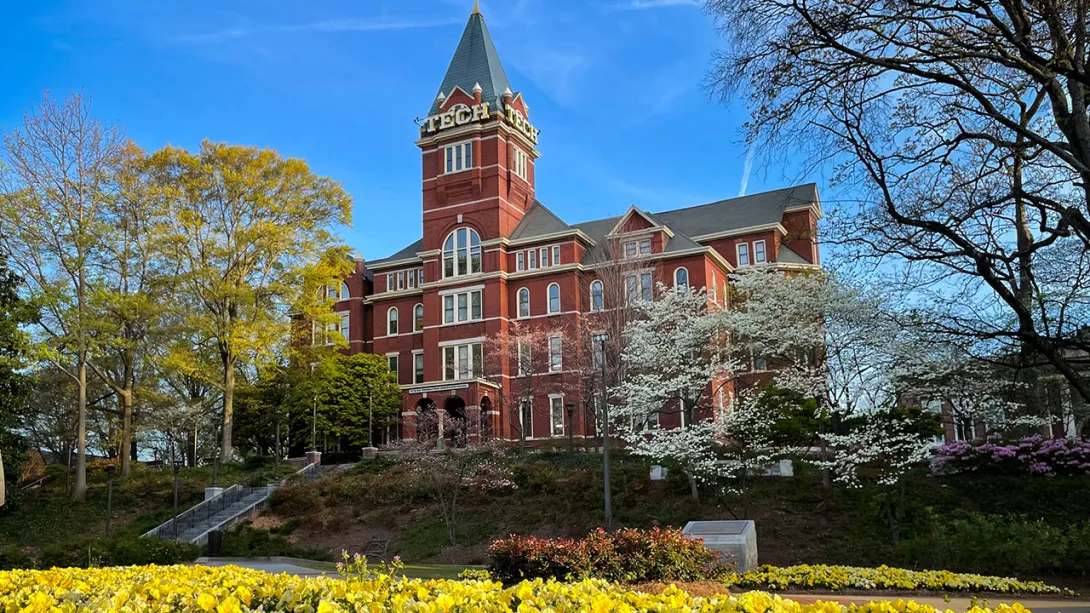
The Strategic Energy Institute and the Energy Policy and Innovation Center at Georgia Tech are pleased to announce that applications are now open for two graduate student fellowships this fall.
The James G. Campbell Fellowship is designed to support Georgia Tech graduate students conducting research in the field of renewable energy and provides a $1,500 award.
The annual SPARK award is given to current Georgia Tech graduate students who have demonstrated outstanding leadership in advancing student engagement with energy research and with evidence of broader impacts and service or leadership. The number of SPARK awards is variable, depending on funding.
To be eligible, student applicants must be U.S. citizens or permanent residents and currently writing a thesis or dissertation focused on renewable energy.
The application deadline is Sept. 4, 2025.
Applicants must submit the following materials to the Energy Comments Mailbox of the Strategic Energy Institute:
- A brief cover letter (one to two paragraphs) explaining their motivation for studying their academic discipline and what they hope to accomplish in the field.
- Their full name, GTID number, anticipated graduation date, and field of research.
- A current resume.
- In addition, a one-page letter of nomination from a faculty member must be submitted separately to the same mailbox. Graduate students are strongly encouraged to begin the process of securing this nomination letter as early as possible.
These fellowships offer a valuable opportunity to gain recognition and support for work in renewable energy. All eligible graduate students are encouraged to apply and take the next step in advancing their academic and professional goals.
News Contact
Priya Devarajan || SEI Communications Program Manager
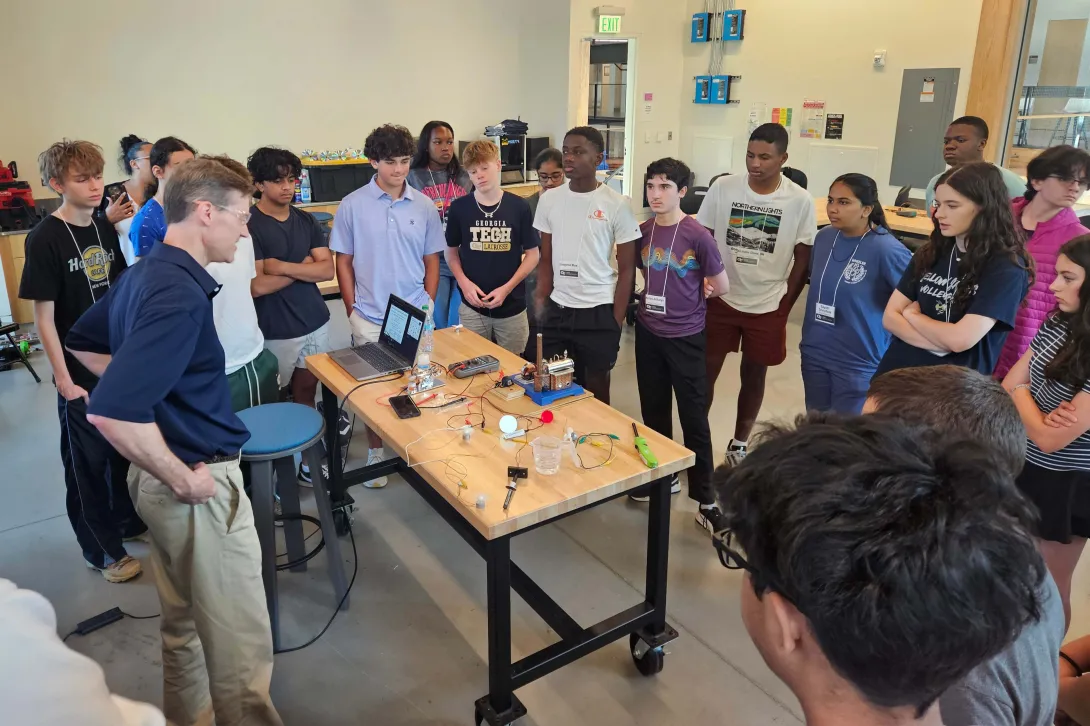
Rich Simmons and the Energy Unplugged participants during the final day presentations
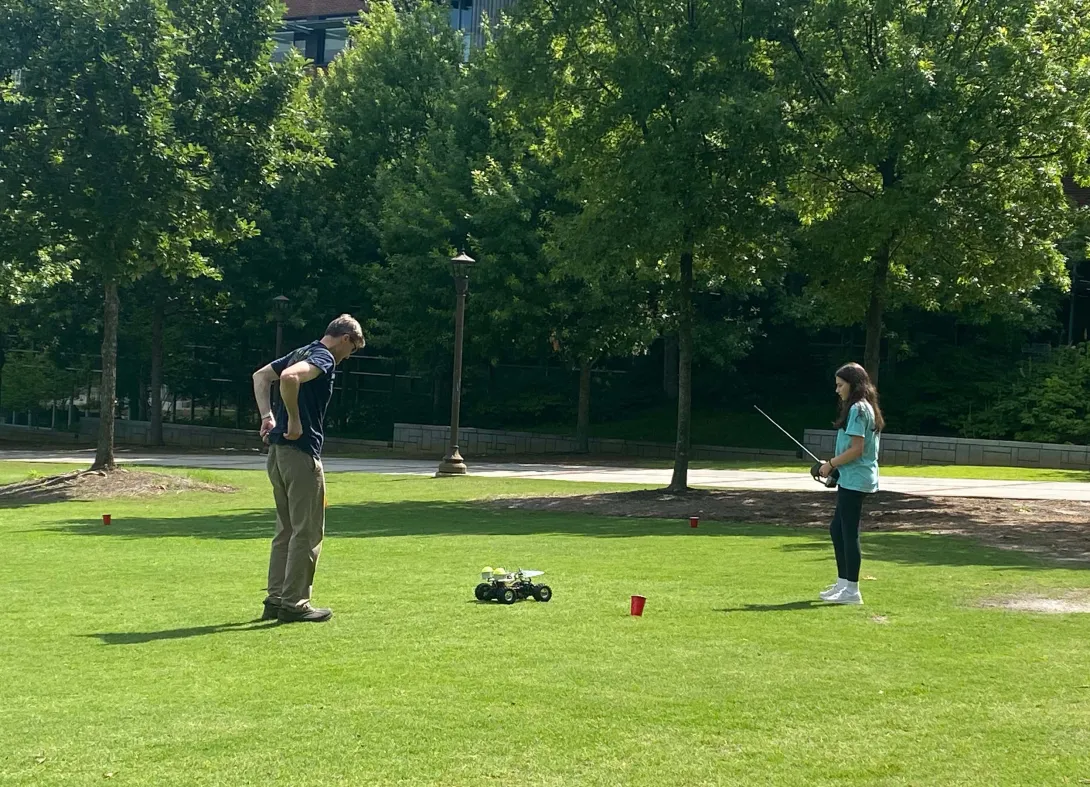
Energy Unplugged camper testing a remote car at Georgia Tech Green
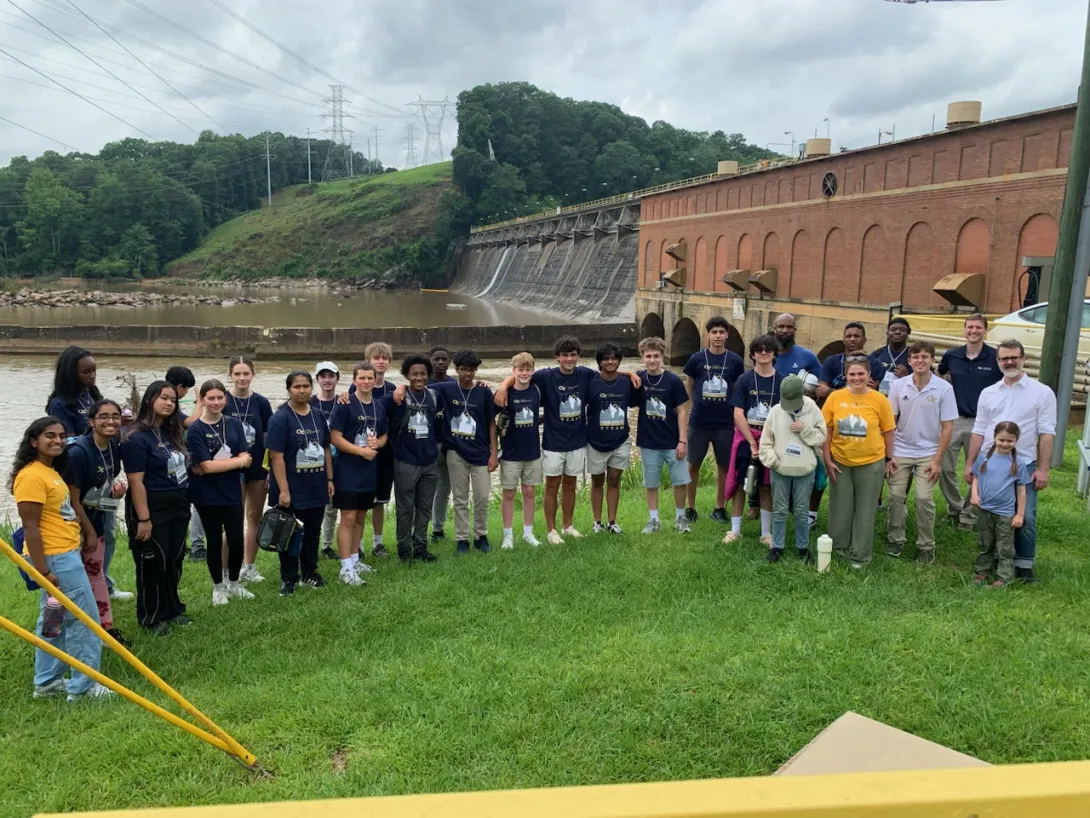
Energy Unplugged camp visit to the Morgan Falls hydroelectric plant
This summer, the Strategic Energy Institute (SEI) and the Energy Policy and Innovation Center (EPIcenter) hosted Energy Unplugged, an education and outreach program focused on science, technology, engineering, art, and mathematics (STEAM). The annual summer camp is organized through the Center for Education Integrating Science, Mathematics, and Computing (CEISMC), a unit of the College of Lifetime Learning at Georgia Tech. As one of Tech’s most sought-after programs for high school students, the weeklong summer camp continues to spark interest in energy innovation and develop foundational skills in science.
“Energy Unplugged introduces high school students to Georgia Tech’s vibrant innovation ecosystem, engaging young minds in shaping a more forward-thinking energy future,” said Christine Conwell, interim executive director of SEI.
Rich Simmons, SEI’s director of Research and Studies and a George W. Woodruff School of Mechanical Engineering faculty instructor, has led the camp’s curriculum since 2019. Under his leadership, students engage in applied learning experiences that introduce energy efficiency principles, foster creative thinking, and encourage real-world decision-making.
“Energy Unplugged features interactive activities and field trips which provide students tangible exposure to working energy facilities and STEM careers,” Simmons said. “As an integral part of our education and outreach efforts, the camp continues to inspire the next generation to think critically about energy and its impact on their communities and the world.”
“Collaborating with SEI on Energy Unplugged allows us to amplify CEISMC’s mission of expanding access to high-quality STEM experiences,” said Sirocus Barnes, director of Expanded Learning Programs at CEISMC. “By connecting students with real-world energy challenges and Georgia Tech’s research ecosystem, we’re helping them envision themselves as future innovators and problem-solvers.”
The week began with a hands-on workshop where students constructed mousetrap-powered cars, applying core physics concepts and the mechanics of energy conversion. In another activity, students raced remote-controlled cars to highlight the importance of swift decision-making while accounting for external variables. These experiments offered students a dynamic understanding of the relationship between energy and physics. Camp participants also explored electricity use in everyday life by experimenting with solar charging setups, learning how devices like cellphones can be powered through solar energy.
One participant, a rising high school senior, noted the program's differentiation from the typical classroom model: “We had a lot of experiences that aren’t typically offered in high school, which gave me a greater understanding of physics.”
The camp also featured site visits, including a tour of The Kendeda Building for Innovative Sustainable Design — the first building in the Southeast to meet the standards of the Living Building Challenge. Students explored the building’s facilities, including its rooftop garden and photovoltaic canopy. Additional field trips included tours of Oglethorpe’s Georgia System Operations plant and the Morgan Falls hydroelectric power plant, which offered students firsthand exposure to how energy is generated and managed across the state.
To conclude the week, students collaborated in teams on a mini design challenge: devising a sustainable taco business. They were tasked with cooking beans efficiently using either a slow cooker or a pressure cooker and learning how to balance time, energy use, and customer satisfaction. This final project reinforced lessons in energy trade-offs and problem-solving. Teams presented their findings to an audience of parents, faculty, and staff — a memorable opportunity that allowed them to develop public speaking and technical presentation skills as well.
“The presentation on the last day of camp encourages students to use their creativity in different ways to form new solutions and ideas,” said Jake Churchill, graduate student and former camp counselor, “which provides great exposure to an open-minded, nonlinear approach to engineering — and a great teacher, Rich Simmons.”
Contributed by: Katie Strickland
News Contact
Priya Devarajan || SEI Communications Program Manager
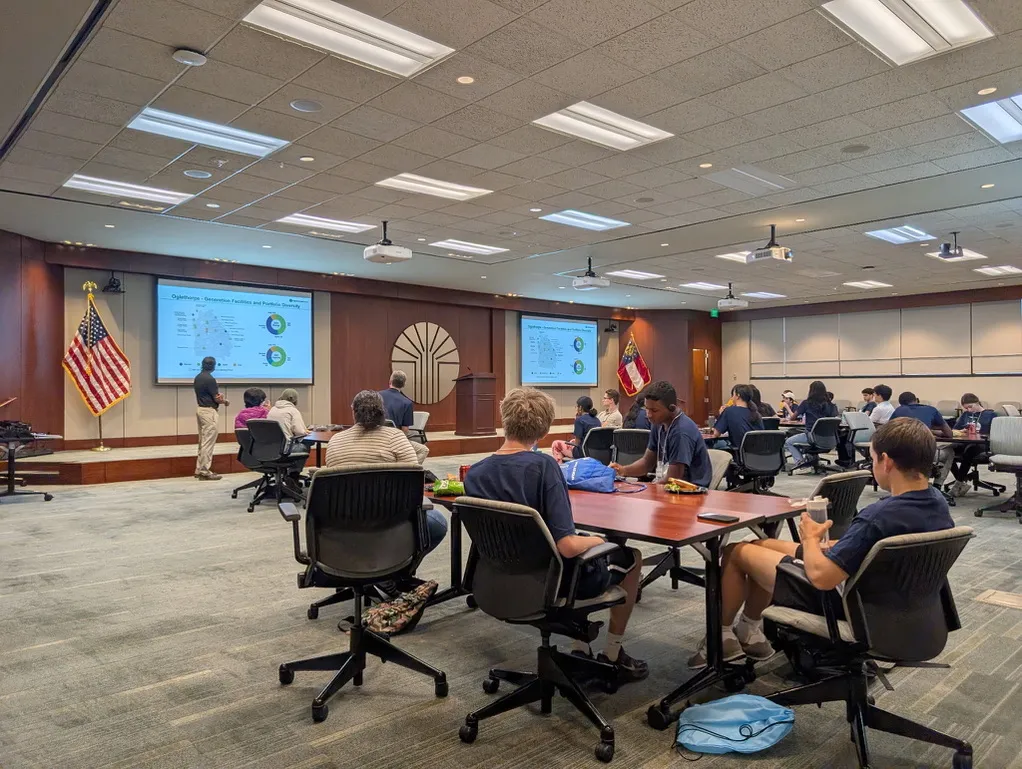
Oglethorpe Power’s George Mathai and Shane Tolbert, Green Power EMC’s distributed energy resources manager, discussing the roles of various generation sources and the benefits of a diverse portfolio with the campers.
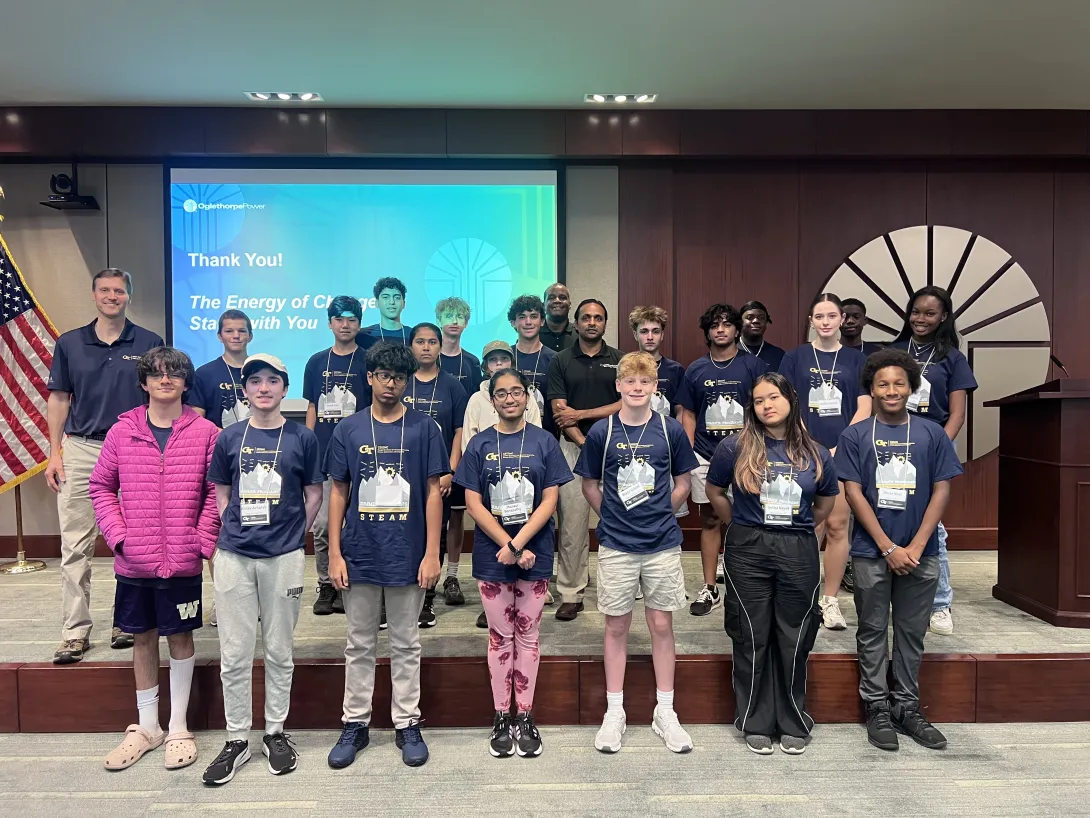
High school students, who participated in the Energy Unplugged Summer Camp at Georgia Tech during a field trip to Oglethorpe Power, Green Power EMC and Georgia Systems Operations Corporation in June 2025.
In June, Georgia Tech’s Strategic Energy Institute (SEI) and the Energy Policy and Innovation Center hosted Energy Unplugged, a weeklong summer camp focused on science, technology, engineering, art, and mathematics (STEAM) for high school students.
Led by SEI’s director of Research and Studies and principal research engineer, Richard Simmons, the camp introduced students to energy fundamentals and highlighted STEAM-related careers and undergraduate pathways valuable in today’s workforce. The curriculum included energy resources, energy production and consumption, conversion and delivery, electric circuits, battery storage, environmental impacts, and data analytics.
As a featured part of this year’s program, students visited the headquarters of Oglethorpe Power, Green Power EMC, and Georgia System Operations Corporation in Tucker, Georgia. The companies are owned by and serve 38 of Georgia’s not-for-profit electric membership cooperatives (EMCs), which provide retail electricity to approximately 4.7 million of Georgia’s more than 11 million residents.
“As electricity demand continues to rise, so does the need to grow a skilled and capable workforce for the future. We are proud to partner with Georgia Tech on this inspiring program, supporting the growth and development of the next generation of leaders who will help power Georgia’s future,” said George Mathai, Oglethorpe Power performance and reliability engineer.
The site visit included a tour of Georgia System Operations’ generation and transmission control centers and presentations by Oglethorpe Power and Green Power EMC experts.
The tour began in the generation control center, where students observed operators continuously monitoring demand to make real-time decisions to increase or decrease electricity generation. Students learned that Georgia System Operations dispatches a wide array of energy sources and generation technologies to ensure a stable, reliable, secure, and efficient power grid.
The group then visited the transmission control center, where a series of massive screens showed the web of transmission lines across the state. Students learned that the transmission system relies on extremely high-voltage lines to minimize loss across long distances. The voltages are then stepped down as they approach population centers at sub-stations, so they are suitable for use by residences, businesses, and industrial facilities. The operators in the transmission center monitor the grid for disturbances and respond to alarms, maintaining the integrity of the state’s power infrastructure.
The tour offered a behind-the-scenes look at how electricity generation and transmission are integrated and managed across the state.
Over lunch, Oglethorpe Power’s George Mathai and Shane Tolbert, Green Power EMC’s distributed energy resources manager, led discussions highlighting the roles of various generation sources and the benefits of a diverse portfolio in balancing cost, reliability, sustainable resources, and environmental impact.
“Learning about how Oglethorpe Power, Green Power EMC, and Georgia System Operations work together was a highlight of the Energy Unplugged camp, as it reinforced many of the tabletop demonstrations and hands-on activities we had conducted in the days leading up to the visit. When students then get a chance to visualize energy production, conversion, and delivery concepts at full scale, lots of light bulbs start clicking on,” Simmons said.
Jointly contributed by:
Oglethorpe Power Corporation
Georgia Tech Strategic Energy Institute (Destin Smyth)
News Contact
Priya Devarajan, Communications Program Manager,
Georgia Tech Strategic Energy Institute
Blair Romero, Director, Corporate Communications
Oglethorpe Power Corporation
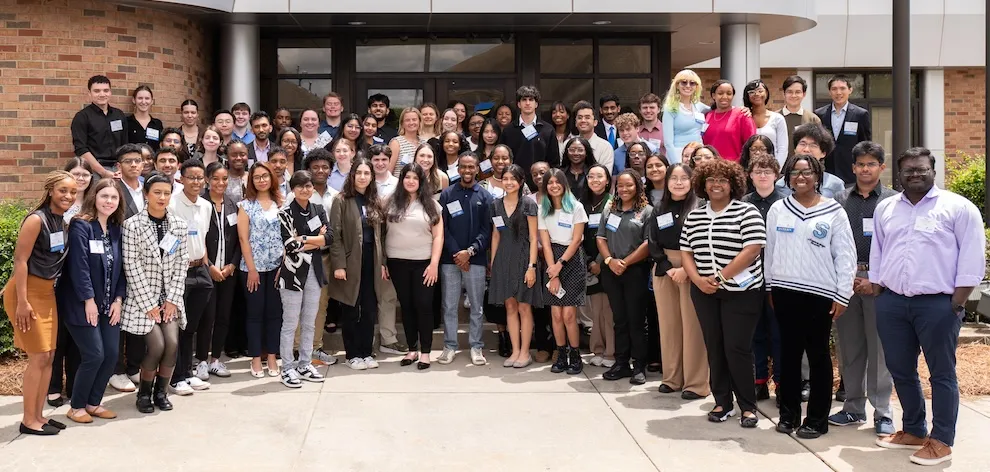
The PIN Summer Interns at the opening ceremony
The Partnership for Inclusive Innovation launched the sixth annual PIN Summer Intern (PSI) program in May with an event at Fort Valley State University’s location in Warner Robins, Georgia. The program is shaping up to be the biggest yet.
This summer, 103 students are working on 51 projects across 27 communities in Georgia, Alabama, Virginia, and Texas. Selected from nearly 700 applicants — a 73% increase over last year — these students are tackling real-world challenges ranging from AI applications in North Georgia to Native American initiatives in Whigham, Georgia, and Bracketville, Texas.
By pairing students from different years, majors and institutions, the PSI program gives the next generation of innovators hands-on experience addressing complex challenges while delivering practical solutions to communities across the region.
A collaboration with the Southeast Crescent Regional Commission (SCRC) has funded 17 projects in several counties in Middle and South Georgia and is a large part of the program’s expansion this year. The opportunity to make an impact across a broad swath of Georgia is part of why the SCRC was interested in working with PIN, said SCRC Executive Director Christopher McKinney.
News Contact
Karen Kirkpatrick (karen.kirkpatrick@innovate.gatech.edu)