

Matthew McDowell, Associate Professor, Woodruff School of Mechanical Engineering and Strategic Energy Institute Initiative Lead for Energy Storage
Associate Professor Matthew McDowell has been selected as the next Associate Chair for Research in the George W. Woodruff School of Mechanical Engineering. He will step into the role on January 1, 2025.
The Associate Chair for Research is responsible for working with the Woodruff School’s faculty to develop a strategic research plan for future growth and investments in the School, as well as identifying new research opportunities, helping to foster strategic relationships with government, industry, and foundations, and synergizing research efforts with other units in the College of Engineering and across the Institute.
“I am thrilled to be chosen for this role, and I look forward to working with the faculty, students, researchers, and staff of the Woodruff School to enhance and support our world-class research program,” said McDowell.
McDowell joined Georgia Tech in the fall of 2015 as an assistant professor with a joint appointment in the Woodruff School and the School of Materials Science and Engineering (MSE). He was named Carter N. Paden, Jr. Distinguished Chair earlier this year and serves as co-director of the Georgia Tech Advanced Battery Center (GTABC). Through this center, McDowell and Professor Gleb Yushin (MSE) are building community at the Institute, enhancing research and educational relationships with industry partners, and creating a new battery manufacturing facility on Georgia Tech’s campus.
“I am excited to work with Matt in advancing the research priorities and goals of the Woodruff School,” said Devesh Ranjan, Eugene C. Gwaltney Jr. School Chair and professor. “Through his exceptional leadership of the Georgia Tech Advanced Battery Center, Matt has demonstrated a deep commitment to excellence in scholarship and to fostering partnerships that drive innovative, collaborative research across the Institute. I am confident in the positive transformation he will bring to our program in this new role.”
Read More on the ME Newspage
News Contact

Johney Green
Johney Green Jr., M.S. ME 1993, Ph.D. ME 2000, has been chosen to serve as the new laboratory director for Savannah River National Laboratory (SRNL). A proud Yellow Jacket, Green received both his master’s and doctoral degrees in mechanical engineering from Georgia Tech and currently serves on the Strategic Energy Institute’s (SEI) External Advisory Board. He also served on the board of the George W. Woodruff School of Mechanical Engineering from 2017 to 2022.
“SRNL has truly found an exceptional leader in Johney. His vision and dedication are inspiring, and I am genuinely excited to see the remarkable contributions he will make in advancing SRNL,” said Christine Conwell, SEI interim executive director. “We look forward to his continued partnership with SEI and the positive impact he will bring to the energy community in 2025 and beyond.”
The Battelle Savannah River Alliance (SRNL’s parent organization) selected Green for this role, describing him as “a dynamic leader who brings deep, wide-ranging scientific expertise to this new position.”
With an annual operating budget of about $400 million, SRNL is a multiprogram national lab leading research and development for the Department of Energy’s (DOE) Offices of Environmental Management and Legacy Management and the National Nuclear Security Administration’s weapons and nonproliferation programs.
Green currently serves as associate laboratory director for mechanical and thermal engineering sciences at the National Renewable Energy Laboratory (NREL). In this position, he oversees a diverse portfolio of research programs including transportation, buildings, wind, water, geothermal, advanced manufacturing, concentrating solar power, and Arctic research. His leadership impacts a workforce of about 750 and involves managing a budget of more than $300 million.
At NREL, Green transformed the lab’s wind site into the innovative Flatirons Campus and transitioned the campus from a single-program wind research site to a multiprogram research campus that serves as the foundational experimental platform for the DOE’s Advanced Research on Integrated Energy Systems (ARIES) initiative.
"We are immensely proud to call Johney a Woodruff School alumnus. His achievements and service to Tech through advisory board engagement inspires us, and we are excited to see him step into this prestigious role at SRNL. We look forward to deepening our collaboration with him as he continues to make a powerful impact,” said Devesh Ranjan, Eugene C. Gwaltney, Jr. School Chair and professor in the Woodruff School.
Prior to his role at NREL, Green held several key leadership roles at Oak Ridge National Laboratory (ORNL). As director of the Energy and Transportation Science Division and group leader for fuels, engines, and emissions research, he managed a broad science and technology portfolio and user facilities that made significant science and engineering advances in building technologies; sustainable industrial and manufacturing processes; fuels, engines, emissions, and transportation analysis; and vehicle systems integration. While Green was the division director, ORNL developed the Additive Manufacturing Integrated Energy (AMIE) demonstration project, a model of innovative vehicle-to-grid integration technologies and next-generation manufacturing processes.
Early in his career, Green conducted combustion research to stabilize gasoline engine operation under extreme conditions. During the course of that research, he joined a team working with Ford Motor Co., seeking ways to simultaneously extend exhaust gas recirculation limits in diesel engines and reduce nitrogen oxide and particulate matter emissions. He continued this collaboration as a visiting scientist at Ford's Scientific Research Laboratory, conducting modeling and experimental research for advanced diesel engines designed for light-duty vehicles. On assignment to the DOE’s Vehicle Technologies Office, Green also served as technical coordinator for the 21st Century Truck Partnership. He also contributed to a dozen of ORNL's 150-plus top scientific discoveries.
Green was the recipient of a National GEM Consortium Master’s Fellowhip sponsored by Georgia Tech and ORNL, and he served as the National GEM Consortium chairperson from 2022-2024. He is a Fellow of the American Association for the Advancement of Science and an SAE International Fellow. He has received several awards during his career and holds two U.S. patents in combustion science.
News Contact
Priya Devarajan || SEI Communications Program Manager
Portrait of Tequila Harris
Tequila A.L. Harris, a professor in the George W. Woodruff School of Mechanical Engineering at Georgia Tech, leads energy and manufacturing initiatives at the Strategic Energy Institute. Her research explores the connectivity between the functionality of nano- to macro-level films, components, and systems based on their manufacture or design and their life expectancy, elucidating mechanisms by which performance or durability can be predicted. She uses both simulations and experimentation to better understand this connectivity.
By addressing complex, fundamental problems, Harris aims to make an impact on many industries, in particular energy (e.g., polymer electrolyte membrane fuel cells), flexible electronics (e.g., organic electronics), and clean energy (e.g., water), among others.
Harris has experience in developing systematic design and manufacturing methodologies for complex systems that directly involve material characterization, tooling design and analysis, computational and analytical modeling, experimentation, and system design and optimization. Currently, her research projects focus on investigating the fundamental science associated with fluid transport, materials processing, and design issues for energy/electronic/environmental systems. Below is a brief Q&A with Harris, where she discusses her research and how it influences the energy and manufacturing initiatives at Georgia Tech.
- What is your field of expertise and at what point in your life did you first become interested in this area?
In graduate school, I aimed to become a roboticist but shifted my focus after realizing I was not passionate about coding. This led me to explore manufacturing, particularly scaled manufacturing processes that transform fluids into thin films for applications in energy systems. Subsequently, my expertise is in coating science and technology and manufacturing system development.
- What questions or challenges sparked your current energy research? What are the big issues facing your research area right now?
We often ask how we can process materials more cost-effectively and create complex architectures that surpass current capabilities. In energy systems, particularly with fuel cells, reducing the number of manufacturing steps is crucial, as each additional step increases costs and complexity. As researchers, we focus on understanding the implications of minimizing these steps and how they affect the properties and performance of the final devices. My group studies these relationships to find innovative manufacturing solutions. A major challenge in the manufacture of materials lies in scaling efficiently while maintaining performance and keeping costs low enough for commercial adoption. This is a pressing issue, especially for enabling technologies such as batteries, fuel cells, and flexible electronics needed for electric vehicles, where the production volumes are on the order of billions per year.
- What interests you the most in leading the research initiative on energy and manufacturing? Why is your initiative important to the development of Georgia Tech’s energy research strategy?
What interests me most is the inherent possibility of advancing energy technologies holistically, from materials sourcing and materials production to public policy. More specifically, my interests are in understanding how we can scale the manufacture of burgeoning technologies for a variety of areas (energy, food, pharmaceuticals, packaging, and flexible electronics, among others) while reducing cost and increasing production yield. In this regard, we aim to incorporate artificial intelligence and machine learning in addition to considering limitations surrounding the production lifecycle. The challenges that exist to meet these goals cannot be done in a silo but rather as part of interdisciplinary teams who converge on specific problems. Georgia Tech is uniquely positioned to make significant impacts in the energy and manufacturing ecosystem, thanks to our robust infrastructure and expertise. With many manufacturers relocating to Georgia, particularly in the "energy belt" for EVs, batteries, and recycling facilities, Georgia Tech can serve as a crucial partner in advancing these industries and their technologies.
- What are the broader global and social benefits of the research you and your team conduct on energy and manufacturing?
The global impact of advancing manufacturing technologies is significant for processing at relevant economy of scales. To meet such demands, we cannot always rely on existing manufacturing know-how. The Harris group holds the intellectual property on innovative processes that allow for the faster fabrication of individual or multiple materials, and that exhibit higher yields and improved performance than existing methods. Improvements in manufacturing systems often result in reduced waste, which is beneficial to the overall materials development ecosystem. Another global and societal benefit is workforce development. The students on my team are well-trained in the manufacture of materials using tools that are amenable to the most advanced and scalable manufacturing platform, roll-to-roll manufacturing, with integrated coating and printing tools. This unique skill set equips our students to thrive and become leaders in their careers.
- What are your plans for engaging a wider Georgia Tech faculty pool with the broader energy community?
By leveraging the new modular pilot-scale roll-to-roll manufacturing facility that integrates slot die coating, gravure/flexography printing, and inkjet printing, I plan to continue reaching out to faculty and industrial partners to find avenues for us to collaborate on a variety of interdisciplinary projects. The goal is to create groups that can help us advance materials development more rapidly by working as a collective from the beginning, versus considering scalable manufacturing pathways as an afterthought. By bringing interdisciplinary groups (chemists, materials scientists, engineers, etc.) together early, we can more efficiently and effectively overcome traditional delays in getting materials to market or, worse, the inability to push materials to market (which is commonly known as the valley of death). This can only be achieved by dismantling barriers that hinder early collaboration. This new facility aims to foster collaborative work among stakeholders, promoting the integrated development and characterization of various materials systems and technologies, and ultimately leading to more efficient manufacturing practices.
- What are your hobbies?
I enjoy cooking and exploring my creativity in this space by combining national and international ingredients to make interesting and often delicious fusion cuisines. I also enjoy roller skating, cycling, and watching movies with my family and friends.
- Who has influenced you the most?
From a professional standpoint, my research team influences me the most. After I present them with a problem, they are encouraged and expected to think beyond our initial starting point. This ability to freely think and conceive of novel solutions sparks many new ideas on which to build future ideas. The best cases have kept me up at night, inspiring me to think about how to approach new problems and funding opportunities. I carry their experiences and challenges with me. Their influence on me is profound and is fundamentally why I am a professor.
News Contact
Priya Devarajan || SEI Communications Program Manager
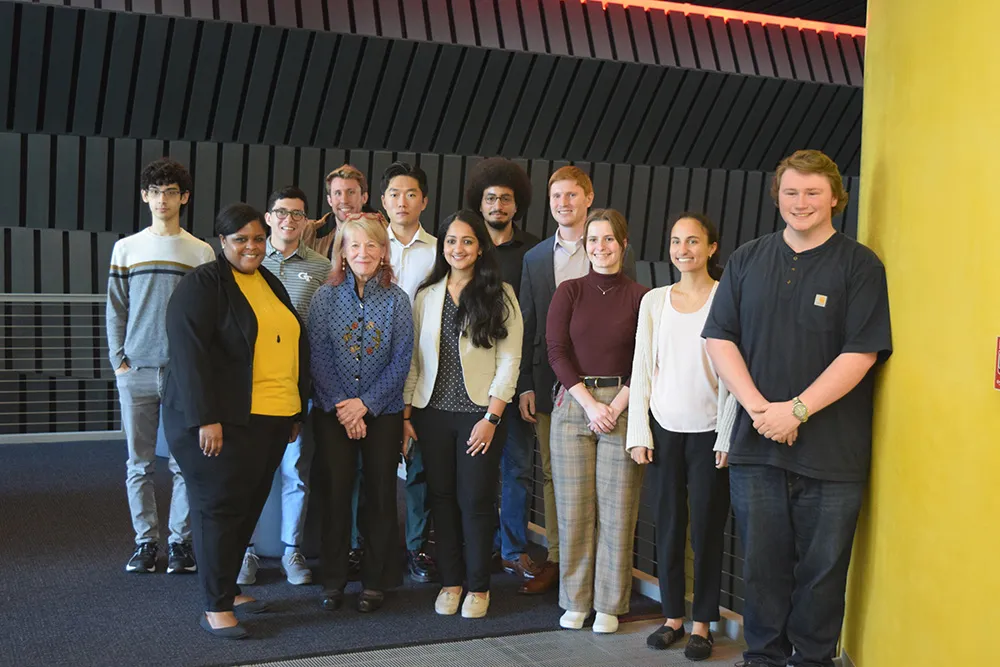
Department of Energy’s (DOE’s) Office of Science Under Secretary Geri Richmond with Georgia Tech Researchers
As head of the Department of Energy’s (DOE’s) Office of Science, the nation’s largest federal sponsor of physical sciences research, Under Secretary Geri Richmond understands the vital role of higher education in advancing U.S. science and innovation. On Monday, Nov. 18, she visited Georgia Tech with Chief of Staff in the Office of the Under Secretary for Science and Innovation Ariel Marshall, Ph.D. Chem 14, to meet with students and faculty and discuss future opportunities for collaboration.
During the visit, Richmond and Marshall toured Dr. Thomas Orlando’s electron and photo induced chemistry on surfaces lab; the Invention Studio; Dr. Akanksha Menon’s water-energy research lab; and the AI Maker Space.
Richmond also joined the Women+ in Chemistry student group for a roundtable discussion. An advocate for underrepresented groups in STEM fields, Richmond is the founding director of the Committee on the Advancement of Women Chemists (COACh). COACh is a grassroots organization dedicated to ensuring equal opportunities for all in science.
Georgia Tech’s longstanding partnership with the DOE is centered on research and technology development aimed at advancing energy systems and promoting sustainability. The Institute plays a key role in the DOE’s national initiatives, contributing to transformative work in energy efficiency, renewable energy, nuclear power, and environmental sustainability. Through joint research programs, grants, and initiatives, Georgia Tech continues to drive innovation and push the boundaries of energy solutions for a sustainable future.

The aviation industry’s commitment to meaningful carbon reduction underscores the need for investing in Sustainable Aviation Fuel (SAF), which provides the most promising solution to achieving net-zero carbon by 2050. According to the International Air Transport Association (IATA), with the right policy measures and financial instruments in place, SAF could help the industry achieve 65% of this reduction. As a key transportation center in the U.S., the Southeast holds immense potential to become a hub for SAF production and adoption.
This prospect was the focus of a recent workshop organized by three Georgia Tech units – the Ray C. Anderson Center for Sustainable Business and its initiative, the Drawdown Georgia Business Compact; the School of Public Policy; and the Strategic Energy Institute; along with the U.S. Department of Energy Bioenergy Technologies Office. The workshop gathered together multiple stakeholder groups representing federal, state, and local government, industry, academia, and the aviation sector to chart a path forward for the Southeast.
News Contact
Titiksha Fernandes | Ray C Anderson Center for Sustainable Business
Southern Company, Georgia Institute of Technology (Georgia Tech), Smart Wires, and other partners have announced that they are collaborating on a new U.S. Department of Energy-funded project. Scheduled for 2025, the project will jointly implement advanced power flow control (APFC) and dynamic line rating (DLR) technologies to support the connection of renewable energy sources and new demand more quickly.
This project, led by the Georgia Tech Center for Distributed Energy with professor Deepak Divan as Principal Investigator, was selected by the U.S. Department of Energy in November 2021 as one of four projects to receive funding for grid enhancing technologies (GETs) that improve grid reliability, optimize existing grid infrastructure, and support the connection of renewable energy. It will use Smart Wires’ APFC solution— SmartValve™—in a mobile deployment combined with its DLR software—SUMO—and also develop control algorithms that improve and fine-tune how these solutions can work in synergy to optimize use of the grid.
“The launch of this innovative project represents an important step toward more efficient and reliable integration of cleaner energy sources,” said Tim Lieuwen, interim executive vice president for Research at Georgia Institute of Technology. “This collaboration allows us to identify, develop and test new ways to manage the power grid in Georgia by co-deploying APFC and DLR technologies.”
While the effectiveness of these solutions is well documented in multiple third-party reports, such as RMI’s GETting Interconnected in PJM, this project will be the first large-scale implementation of both technologies together. It will specifically examine their combined impact and result in the development of design control algorithms to unlock the combined power of these solutions and maximize their efficiency.
SUMO identifies when lines have spare capacity based on real-time weather conditions, while SmartValves can redirect power flows to quickly utilize this spare capacity. This also applies in reverse, with SUMO identifying when the dynamic ratings of lines are less than the static rating. If it’s a hot day, for example, SmartValves can redirect power flows away from these circuits to others with capacity, reducing the risk of system faults while improving operational safety.
The mobile deployment of SmartValves can be installed and in-service within one week. This provides a rapidly deployable solution that avoids extended outages and can be easily moved between sites as system needs evolve over time.
“We’re delighted to provide both SmartValves and SUMO in this project to move the dial in terms of deploying multiple GETs in synergy and optimizing their use,” said Joaquin Peirano, General Manager for the Americas at Smart Wires. “The commitment of utilities like Southern Company to get the most from their existing grid with GETs, combined with the positive regulatory developments such as FERC’s recent Order 1920, positions the U.S. to capture the full value these technologies can provide on transmission grids.”
The project will be delivered in 2025 and will involve a one-year performance period to provide Southern Company with operational experience that can be shared with other utilities and pave the way for greater use of GETs in the U.S.
About Georgia Institute of Technology
The Georgia Institute of Technology is a leading research university, committed to improving the human condition through advanced science and technology. Georgia Tech’s engineering and computing colleges are the largest and among the highest-ranked in the nation. The Institute also offers outstanding programs in business, design, liberal arts, and sciences.
With $1.37 billion annually in research, development, and sponsored activities across all six colleges and the Georgia Tech Research Institute, Georgia Tech is an engine of economic development for the state of Georgia, the Southeast, and the nation. Georgia Tech routinely ranks among the top U.S. universities in volume of research conducted; In 2023, the Institute ranked 17th among U.S. academic institutions in research and development expenditures, according to the National Science Foundation’s Higher Education Research and Development Survey.
About Smart Wires
Smart Wires is the world’s leading grid enhancing technology and services provider. We help electric utilities unlock capacity and solve their critical grid issues, using our solutions to create a more flexible, reliable and affordable grid. This enables a faster, more cost-efficient path to meet growing electricity demand with clean energy generation, at lowest cost to consumers. Headquartered in the Research Triangle of North Carolina, Smart Wires has a global workforce of passionate and visionary industry-leading experts across four continents, who work every day to transform grids globally. In collaboration with our customers and partners, we’ve unlocked over 3.5 Gigawatts capacity—enough to power over 2.5 million homes—supporting the faster integration of clean energy and new demand, enhancing security of supply and delivering cost savings to consumers.
Together, we are reimagining the grid for net zero.
News Contact
Priya Devarajan | SEI Communications Program Manager

The U.S. Department of Energy (DOE) has awarded Georgia Tech researchers a $4.6 million grant to develop improved cybersecurity protection for renewable energy technologies.
Associate Professor Saman Zonouz will lead the project and leverage the latest artificial technology (AI) to create Phorensics. The new tool will anticipate cyberattacks on critical infrastructure and provide analysts with an accurate reading of what vulnerabilities were exploited.
“This grant enables us to tackle one of the crucial challenges facing national security today: our critical infrastructure resilience and post-incident diagnostics to restore normal operations in a timely manner,” said Zonouz.
“Together with our amazing team, we will focus on cyber-physical data recovery and post-mortem forensics analysis after cybersecurity incidents in emerging renewable energy systems.”
As the integration of renewable energy technology into national power grids increases, so does their vulnerability to cyberattacks. These threats put energy infrastructure at risk and pose a significant danger to public safety and economic stability. The AI behind Phorensics will allow analysts and technicians to scale security efforts to keep up with a growing power grid that is becoming more complex.
This effort is part of the Security of Engineering Systems (SES) initiative at Georgia Tech’s School of Cybersecurity and Privacy (SCP). SES has three pillars: research, education, and testbeds, with multiple ongoing large, sponsored efforts.
“We had a successful hiring season for SES last year and will continue filling several open tenure-track faculty positions this upcoming cycle,” said Zonouz.
“With top-notch cybersecurity and engineering schools at Georgia Tech, we have begun the SES journey with a dedicated passion to pursue building real-world solutions to protect our critical infrastructures, national security, and public safety.”
Zonouz is the director of the Cyber-Physical Systems Security Laboratory (CPSec) and is jointly appointed by Georgia Tech’s School of Cybersecurity and Privacy (SCP) and the School of Electrical and Computer Engineering (ECE).
The three Georgia Tech researchers joining him on this project are Brendan Saltaformaggio, associate professor in SCP and ECE; Taesoo Kim, jointly appointed professor in SCP and the School of Computer Science; and Animesh Chhotaray, research scientist in SCP.
Katherine Davis, associate professor at the Texas A&M University Department of Electrical and Computer Engineering, has partnered with the team to develop Phorensics. The team will also collaborate with the NREL National Lab, and industry partners for technology transfer and commercialization initiatives.
The Energy Department defines renewable energy as energy from unlimited, naturally replenished resources, such as the sun, tides, and wind. Renewable energy can be used for electricity generation, space and water heating and cooling, and transportation.
News Contact
John Popham
Communications Officer II
College of Computing | School of Cybersecurity and Privacy

An Adobe stock conceptual image of a lighted bulb in the dirt illustrating new technology that draws energy from dirt.
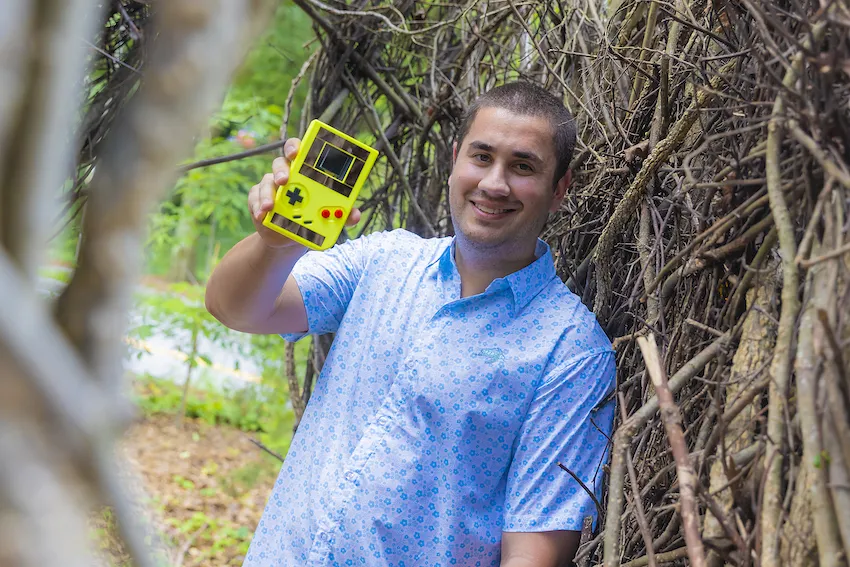
A newly designed soil-powered fuel cell that could provide a sustainable alternative to batteries was recognized as an honorable mention in the annual Fast Company Innovation by Design Awards.
Terracell is roughly the size of a paperback book and uses microbes found in soil to generate energy for low-power applications.
Previous designs for soil microbial fuel cells required water submergence or saturated soil. Terracell can function in soil with a volumetric water content of 42%
Terracell placed in Fast Company’s list of the best sustainability-focused designs of 2024.
Researchers at Northwestern University lead the multi-institution research team that designed Terracell.
Josiah Hester, an associate professor in Georgia Tech's School of Interactive Computing who previously worked at Northwestern, directs the Ka Moamoa Lab, where the project was conceived.
The team includes researchers from Northwestern, Georgia Tech, Stanford, the University of California-San Diego, and the University of California-Santa Cruz.
Their research was published in January in the Proceedings of the Association for Computing Machinery on Interactive, Mobile, Wearable, and Ubiquitous Technologies. The researchers will also present this work at the ACM international joint conference on Pervasive and Ubiquitous Computing (Ubicomp), Oct. 5-9.
According to the Fast Company website, the Innovation by Design Awards recognize “designers and businesses solving the most crucial problems of today and anticipating the pressing issues of tomorrow.” Winners are published in Fast Company Magazine and are honored at the Fast Company Innovation Festival in the fall.
“Terracell could reduce e-waste and extend the useful lifetime of electronics deployed for agriculture, environmental monitoring, and smart cities,” Hester said. “We were honored to be recognized for the design innovation award. It is a testament to the promise of sustainable computing and our hope for a more sustainable world.”
For more information about Terracell, see the story featured on Northwestern Now, or visit the project’s website.
News Contact
Nathan Deen, Communications Officer
Georgia Tech School of Interactive Computing
nathan.deen@cc.gatech.edu
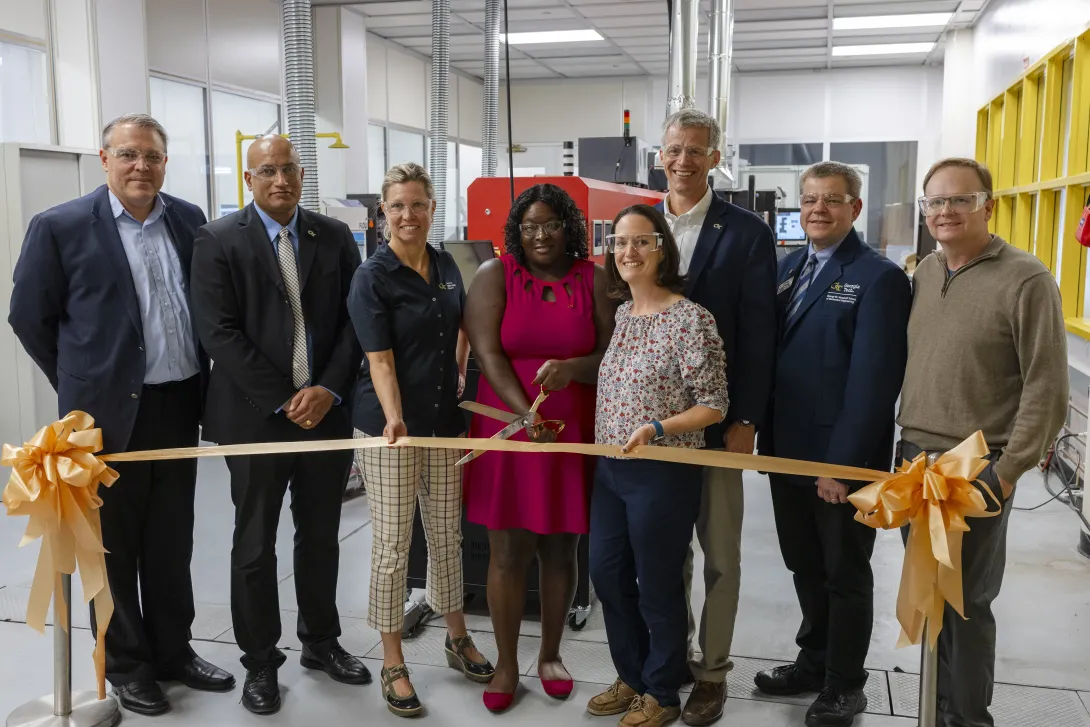
Partners of the facility gathered for an official ribbon cutting ceremony. From left to right: Eric Vogel, Hightower Professor in MSE, and executive director for the Institute for Matter and Systems; Devesh Ranjan, Eugene C. Gwaltney, Jr. school chair and professor in the George W. Woodruff School of Mechanical Engineering; Julia Kubanek, Vice President of Interdisciplinary Research; Tequila Harris, professor in the Woodruff School and facility leader; Christine Conwell, interim executive director for the Strategic Energy Institute; Tim Liewen, interim executive vice president for Research; Thomas Kurfess, Regent's Professor in the Woodruff School and executive director of the Georgia Tech Manufacturing Institute; J. Carson Meredith, professor and James Preston Harris Faculty Fellow in the School of Chemical and Biomolecular Engineering, executive director of the Renewable Bioproducts Institute. Photo: Christopher McKenney.
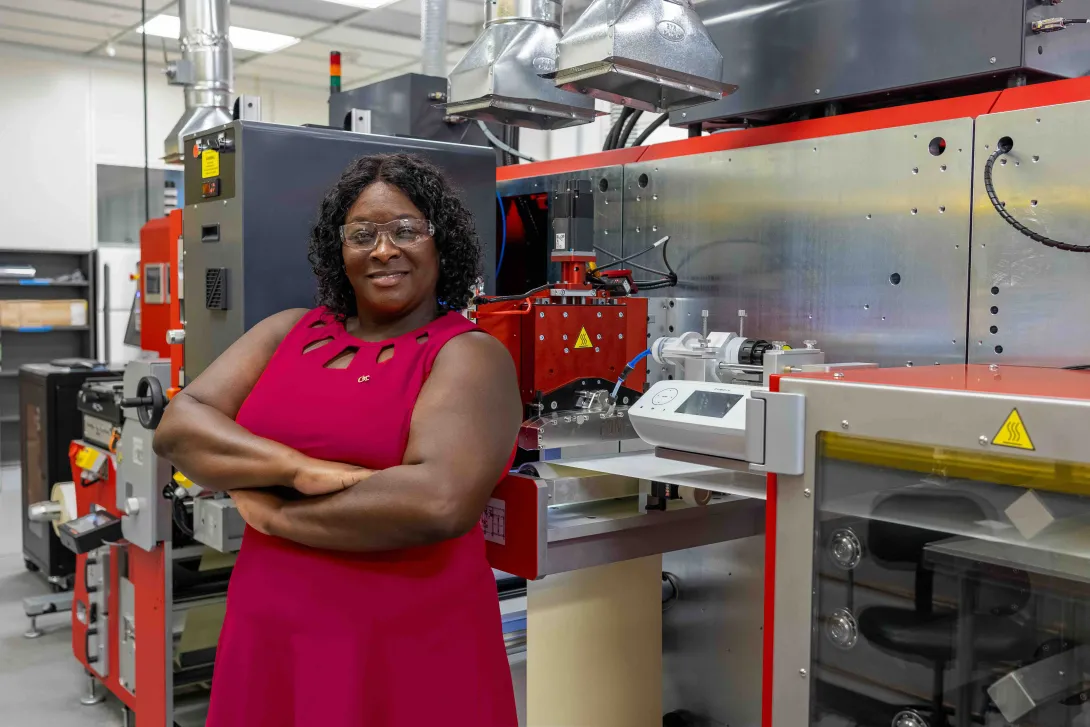
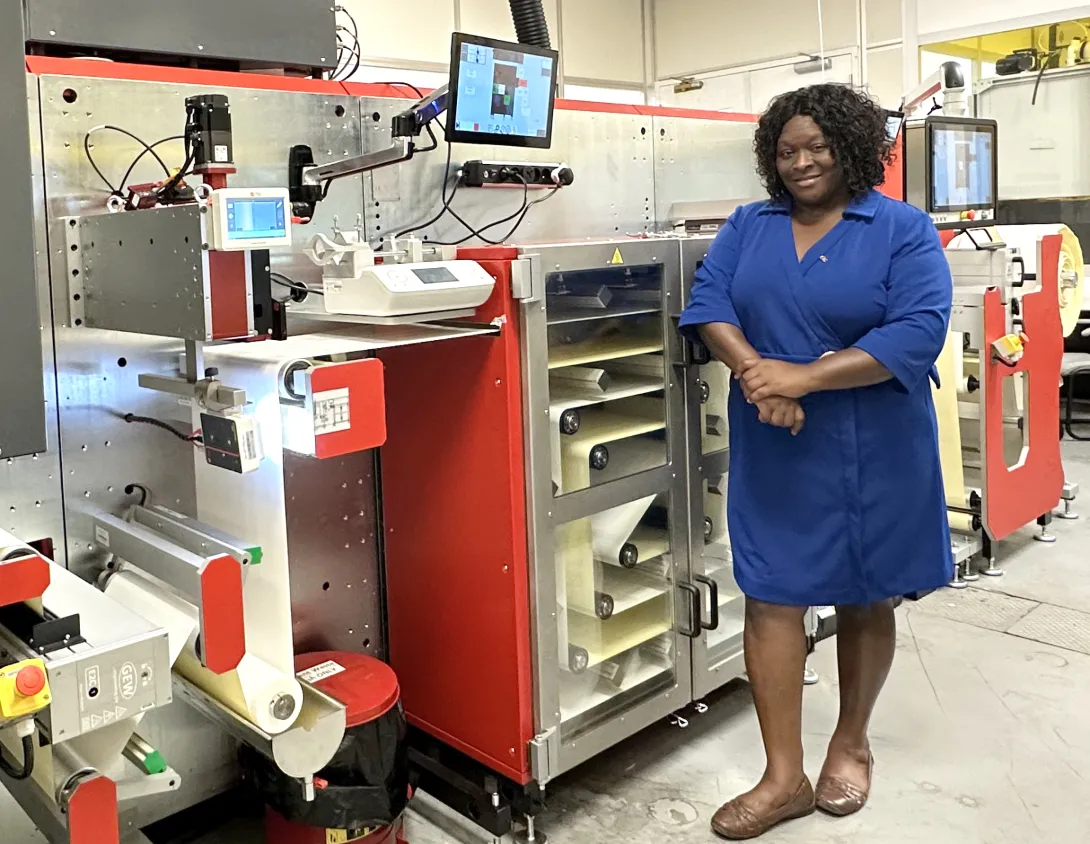
Tequila Harris, professor in the George W. Woodruff School of Mechanical Engineering, next to the modular R2R equipment. Photo: Christopher McKenney.
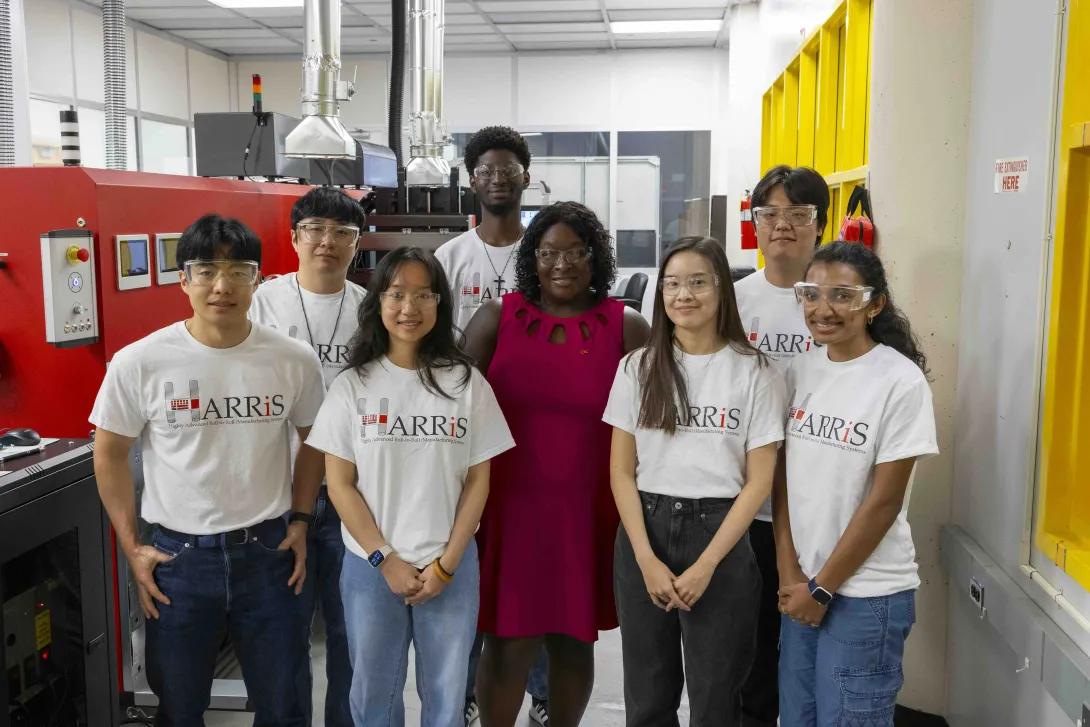
The Highly Advanced Roll-to-Roll iManufacturing Systems (HARRiS) research group in the new R2R facility. Photo: Christopher McKenney.
Whether it’s developing new products, reducing costs, or increasing accessibility, innovations in manufacturing stand to improve the lives of companies and consumers alike. Georgia Tech recently took another step toward ensuring those innovations make it from lab to market with the launch of a Modular Pilot Scale Roll-to-Roll Manufacturing Facility.
“As researchers develop new materials, one of the key aspects we’re missing is how to make them at scale. This is a major oversight because if we can’t make them at scale, we can’t transition from basic research to commercialization,” said Tequila Harris, a professor in the George W. Woodruff School of Mechanical Engineering. “With this new facility, we can prove our discoveries beyond lab-scale studies — and can go from materials innovation to product development at scale.”
Led by Harris, the new facility is the result of a partnership between the Georgia Tech Manufacturing Institute(GTMI), the Strategic Energy Institute, and the Woodruff School. As a pilot facility, it will serve as a testbed for scaling up manufacturing research open for Georgia Tech researchers as well as academic, government, and industry partners around the world.
“The larger vision I see at Georgia Tech involves innovation in manufacturing for large-scale industries,” said Georgia Tech’s Interim Executive Vice President for Research Tim Lieuwen at the facility’s unveiling event on Sept. 19. “It’s crucial that we’re innovating in basic science and technology, but we also need to be innovating in large-scale manufacturing.”
Roll-to-roll (R2R) manufacturing transforms flexible rolls of substrate materials, such as paper, metal foils, and plastics, into more complex, transportable rolls upon coating the surface with one or more fluids, such as inks, suspensions, and solutions, which are subsequently dried or cured on the base substrate. Its high yield and efficiency make R2R an ideal method for the sustainable, large-scale production of components for solar cells, batteries, flexible electronics, and separations — all industries that have expanded in Georgia in recent years.
“As a state institution, we’re ultimately here to serve our state,” said Lieuwen, who is also Regents’ Professor and David S. Lewis Jr. Chair in the Daniel Guggenheim School of Aerospace Engineering. “We’re seeing Georgia emerge as the national leader in terms of recruiting corporate investments in this space and in industries that will be served by this facility.”
Roll-to-Roll Innovations
The R2R process is similar to the production of newspapers, where a large roll of blank paper goes through a series of rollers printing text and photos. “The roll-to-roll aspect is the process of using a specialized tool to force fluid onto a moving surface,” says Harris. It’s one of the fastest-growing methods for producing thin film materials — photovoltaics used in solar cells, transistors in flexible electronics, and micro-batteries, for example — at a large scale.
Harris’s group works to develop novel manufacturing tools, with a particular focus on understanding and improving the dynamics of thin film manufacturing to increase efficiency and minimize waste. Her group is particularly interested in slot die coating, an R2R technique where a liquid material is precisely deposited onto a substrate through a narrow slot. With the new pilot facility, researchers like Harris will be able to take their work to the next level.
“Slot die coating on a roll-to-roll can handle the broadest viscosity range of most coating methods. Therefore, you can process a lot of different materials very quickly and easily,” says Harris. “It’s one of the fastest-growing technologies in the U.S. — and currently, this is the most advanced modular pilot scale facility at an academic university in the United States.”
“Georgia Tech is way ahead of the curve in terms of our facilities,” says GTMI Executive Director and Regents’ Professor Thomas Kurfess. “This will grow our capability in the battery area, membranes, flexible electronics, and more to allow us to support the development of new technologies.”
“As technologies around cleantech continue to advance at an unprecedented pace, pilot manufacturing facilities provide a critical bridge between innovative benchtop research and commercial-scale production and manufacturing,” says Christine Conwell, interim executive director of the Strategic Energy Institute. “We are excited about the opportunities this R2R facility will provide to the Georgia Tech energy community and our industry partners.”
News Contact
Audra Davidson
Research Communications Program Manager
Georgia Tech Manufacturing Institute
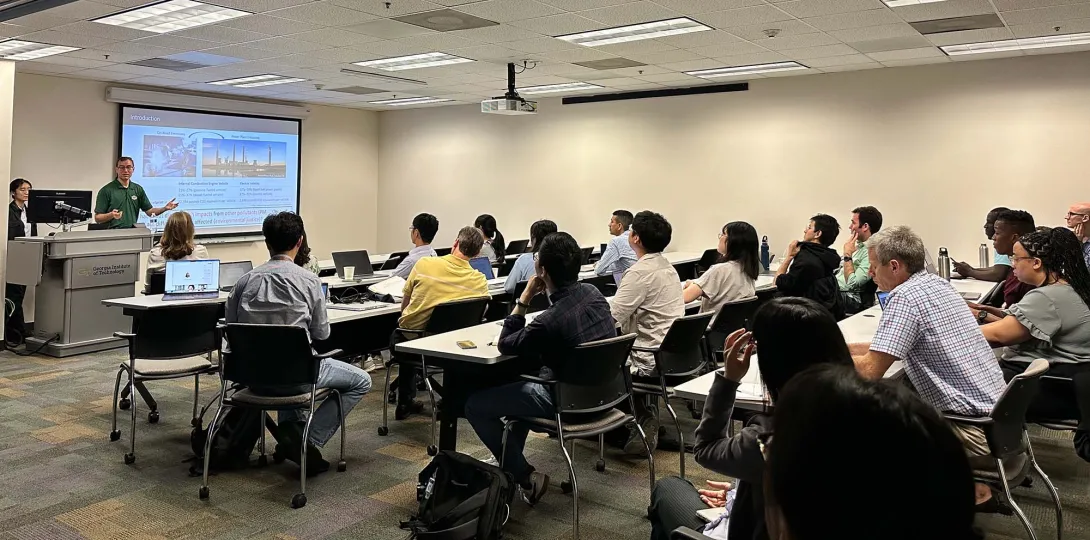
Dan Molzahn and his fellow researcher presenting at EPIcenter's Energy and Public Health Symposium
On Friday, May 10th, four Georgia Tech research teams, supported through the Energy, Policy, and Innovation Center ’s seed grant program presented their research findings to an engaged audience of fellow researchers and students.
The research teams included Georgia Tech faculty from across three colleges who presented their interdisciplinary research findings at the intersection of human health and energy systems.
The event began with a welcome address by Laura Taylor, the interim director of EPIcenter followed by EPIcenter’s director of Research Studies, Rich Simmons, who provided an overview of the vision behind the seed grant program. The seed grants were a culmination of a June 2020 workshop that invited researchers to proactively identify and mitigate new energy-health intersections and challenges by developing the knowledge to respond effectively to the interrelated challenges of public health and our current, and future energy infrastructure. The symposium included presentations from:
- Pengfei Liu, professor in the School of Earth and Atmospheric Sciences, on climate-induced air quality deterioration and its health risks in the Southeastern United States.
- Dan Molzahn, assistant professor in Electrical and Computer Engineering, and Xin Xie, professor in Civil Engineering on assessing the impacts of electric vehicle adoption and charging on air pollution and health
- Shuichi Takayama, professor in Biomedical Engineering on improving toxicology models that measure the impact of particulate matter on lung functioning to enhance energy and environmental policy-making
- Laura Taylor, on linking transit-related air pollution to health outcomes using the causal inference framework.
News Contact
Priya Devarajan || SEI Communications Program Manager