
Walk into any room Aleksandra Teng Ma’s been working in this summer, and you’ll probably hear a mix of experimental sounds, snippets of Amy Winehouse vocals, and the occasional Animal Crossing tune playing in the background. That’s just how her brain works—blending tech, artistry, and everyday play into something entirely her own.
Aleksandra is a master’s student in Music Technology at Georgia Tech, but “student” barely scratches the surface. This summer, she’s been everywhere—physically in Massachusetts and intellectually somewhere between a Pride performance and a human-AI jam session at MIT.
“I’m always with my microphone and MIDI keyboard,” she says, like it’s just second nature. “I love singing and coming up with tunes.”
Live from MIT — It’s Human + AI Jamming
Forget dusty textbooks and silent labs—Aleksandra’s research life is about real-time musical interactions between humans and AI. As a visiting researcher at MIT this summer, she’s digging into what it looks like when musicians "jam" with intelligent systems. Think futuristic band practice, but with algorithms joining in.
“It’s giving me a lot of exposure to co-design methodologies,” she explains, “and letting me observe how musicians respond to each other—and to AI.”
It’s not just code and theory, either. The insights come alive when she brings them to the stage. This summer, Aleksandra’s band performed at The Music Porch in Reading, MA for Pride Month. Their cover of Pink Pony Club turned into a moment she won’t forget.
“It was so fun seeing people—especially teenagers—singing and dancing together,” she says. “That’s one of those moments where I just thought, yep, this is why I picked music tech.”
From Winehouse Covers to Ableton Experiments
Despite her research chops, Aleksandra hasn’t lost touch with the joy of just making music. She sings and plays keyboard in a band, covers Amy Winehouse songs, and occasionally writes music just for fun. (Her dream studio partner? You guessed it: Amy herself.)
She’s also been expanding her technical toolkit this summer, diving deeper into sound design with Ableton and Serum.
“Still learning,” she says, “but I’m using them for sound design in songs—and loving it.”
And then there are the unexpected “whoa” moments. Like when she built a vocal patch for the Pixies’ Where Is My Mind? to use live during a performance.
“It was haunting,” she says. “And it worked so well live.”
Dream Tech and Georgia Tech
Ask Aleksandra what she’d invent if she could mash up two instruments, and she already has an idea:
“Automatic vocal effects through a microphone with a built-in amplifier,” she says, laughing. “Honestly, someone probably already made this, but I want it anyway.”
That kind of thinking is exactly what her time at Georgia Tech has sparked. Before the program, she saw music mostly through the lens of conventional instruments. Now? She’s all about how software and hardware can expand what music even is.
Her Summer, in Sound
If Aleksandra’s summer had a vibe, it’d be:
- A creek bubbling in the background
- A long, ghostly reverb trail on a siren vocal
- And the ever-cozy tones of Animal Crossing
Not exactly your typical lab soundtrack—but that’s the beauty of it.
This fall, she’s heading back to Georgia Tech after a gap year at Bose, ready to jump into research on multimodal music source separation (AKA teaching machines to pick apart and understand layers in music the way humans do).
And yes, she’ll still be singing.
Hits with Aleksandra
- Current summer jams: Rosebud by Oklou & the new Lorde album
- What people don’t “get” about her work: “How music signals work on a granular level”
Aleksandra Ma doesn’t just study music tech—she lives it. Whether she’s tweaking reverb patches, performing under porch lights, or teaching AI how to groove, she’s showing what it really means to be a 21st-century musician.
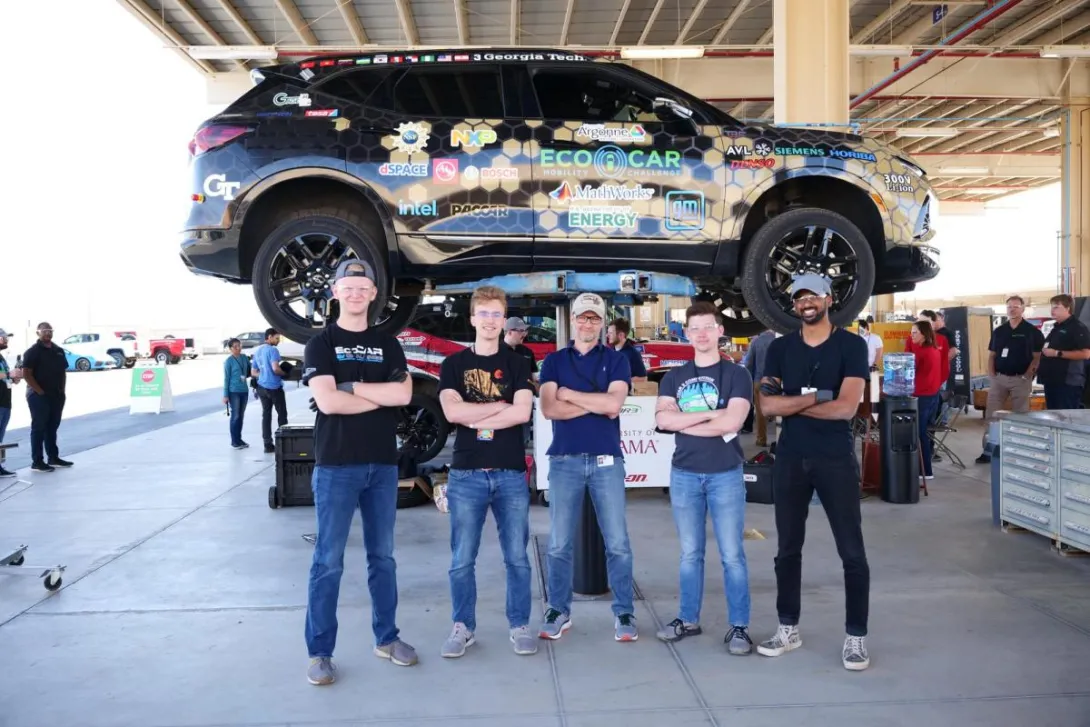
Multiple members of the School of Electrical and Computer Engineering (ECE) contributed to the four-year project.
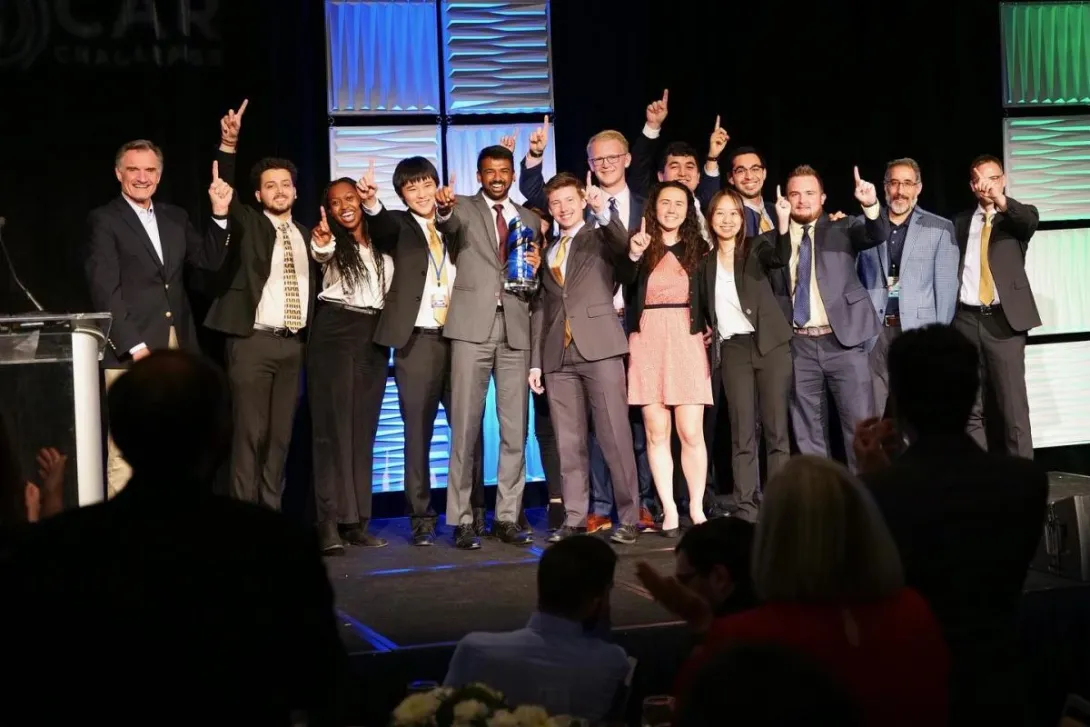
Georgia Institute of Technology has been named the EcoCAR Mobility Challenge Year Four champion by the U.S. Department of Energy (DOE). Tech’s award-winning interdisciplinary team consists of approximately 60 undergraduate and graduate students from the College of Engineering, College of Computing, Scheller College of Business, and Georgia State University.
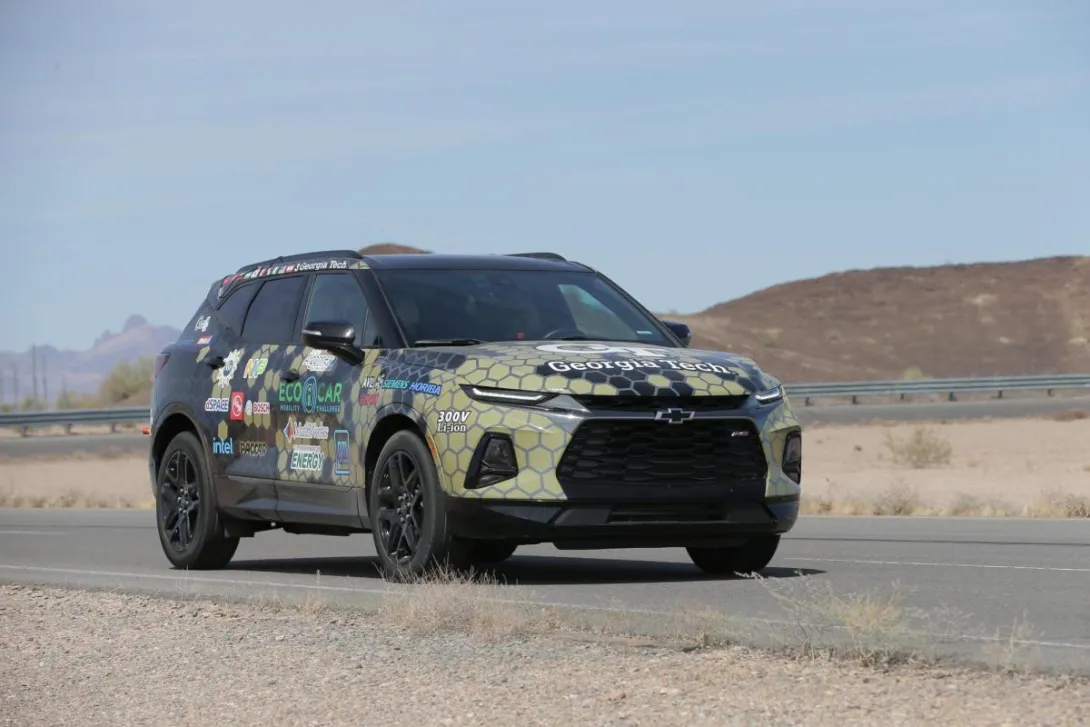
Eleven North American university EcoCAR teams gathered for the final challenge in Arizona from May 9-20, 2022. The event marked the culmination of the competition, which tasked the universities with applying propulsion system electrification, autonomous driving control, and vehicle-to-infrastructure connectivity, to improve the energy efficiency of a 2019 Chevrolet Blazer while maintaining safety, utility, and consumer acceptability.
Over the four-year competition — sponsored by the DOE, General Motors (GM) and MathWorks — each team transformed its vehicle from a design concept into a reality. The final year of competition challenged teams to test, prove, and refine their work from the previous three years, mimicking a real-world automotive product development cycle.
ECE professor David Taylor is a faculty advisor for Georgia Tech’s EcoCAR team, along with professors Michael Leamy in the George W. Woodruff School of Mechanical Engineering (ME), and Thomas Fuller in the School of Chemical and Biomolecular Engineering (ChBE).
“The role of ECE in this competition is significant, ranging from powertrain electrification to driving automation. Our team’s vehicle excelled in these areas, winning the events concerned with energy consumption and autonomous operation,” said Taylor. “The EcoCAR program provides valuable experiences for ECE students because the real-world challenges of the project effectively supplement classroom learning.”
Georgia Tech’s EcoCAR team is a $1 million research program housed under Georgia Tech’s Vertically Integrated Projects (VIP) Program. VIP allows undergraduate and graduate students to participate in ambitious, long-term, multidisciplinary project teams that are led by faculty. The VIP program originated in ECE under the leadership of professor Edward Coyle.
ECE graduate research assistant (GRA) Nicholas Hummel played a key leadership role on the team along with fellow GRA Nishan Nekoo in ME. Both Hummel and Nekoo received their master’s degrees this spring. Hummel also gave the first-place presentation on Connected and Automated Vehicle Systems with recent ECE bachelor’s degree graduate Joyce Zhao.
“I've been on the team for the past two years, and have seen it come from a nearly fully virtual format at the beginning of the pandemic to the success we've achieved this year,” said Hummel, who led the team’s driving automation efforts. “If I had not joined this team, I would never have had the opportunity to grow so much as a leader and increase my passion for automation and robotics.”
Additionally, recent ECE bachelor’s degree graduate Braeden Dickson, along with recent ME bachelor’s degree graduate Anna Cobb, gave the first-place presentation on Propulsion Controls and Modeling. Braeden worked on powertrain controls to convert the conventional Chevy Blazer to a hybrid electric vehicle architecture. With his efforts, Georgia Tech vehicle was the only vehicle of the competition to improve energy consumption over the stock Blazer.
Read more about the award-winning team, view pictures from the finale, and learn about future plans.
News Contact
Dan Watson
dwatson@ece.gatech.edu
By Frida Carrera
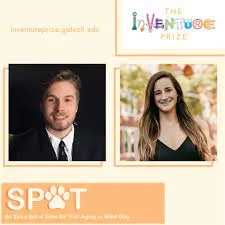
After almost a year since the completion of the 2021 InVenture Prize Competition, we caught up with Matt McMullen and Emma Bivings who competed as finalists on the SPOT Harness team, a harness that uses sensors and vibrators to help blind dogs navigate. Their experience in the competition exposed them to multiple experiences, environments, and demands necessary for startups for the first time. As a result, they were able to distinguish their areas of growth, gain valuable insights, and make potential changes in the direction of their product.
Today, Matt is currently a graduate student seeking a master’s in music technology and Emma is a full-time operations management trainee at McMaster-Carr. The team is still developing the SPOT Harness and has even grown its team to five members. Through funding and participating in Georgia Tech’s CREATE-X Startup Launch program, they have been able to launch their company Saving Grace Pet Solutions LLC. They plan to launch SPOT Harness under this company as well as develop other future products.
To future InVenture participants, Matt advises, “Don’t give up on your idea! The most important part of making it the distance is having a team with a passion for your product.”
The SPOT Harness team will be launching a kick-starter soon for preorders ahead of the official market launch of the SPOT Harness for blind dogs. They also advise anyone who has or knows someone who has a dog suffering from vision loss to visit their website to sign up for their newly refined prototype!
Visit their website here: www.savinggrace.tech
To learn more about the upcoming InVenture Prize Competition visit https://inventureprize.gatech.edu/ . Registration closes on Jan. 19.
Georgia Tech Arts is still seeking projects for the 2021 ACCelerate: ACC Smithsonian
Creativity and Innovation Festival in Washington, DC. All Georgia Tech students, faculty, and staff are invited to apply by May 1, 2020.
Even if you do not have a finished project exploring the intersection of science,
engineering, art, design, and technology, we encourage you to speak with Es
Famojure at esther.famojure@arts.gatech.edu about your concepts.
Learn about Georgia Tech's 2019 participants for some inspiration.
The festival brings together all institutions included in the Atlantic Coast Conference to
celebrate creativity and innovation with a specific focus on science, engineering, arts, and
design. It will be held April 9 -11, 2021 at the Smithsonian National Museum of American
History.
Submit your project for consideration by May 1, 2020 to be considered.
News Contact
Es Famojure
esther.famojure@arts.gatech.edu