

Neurons growing in a culture dish (NASA)

School of Psychology Assistant Professor Apurva Ratan Murty

Graduate Student Mayukh Deb
Researchers at Georgia Tech have taken a critical step forward in creating efficient, useful and brain-like artificial intelligence (AI). The key? A new algorithm that results in neural networks with internal structure more like the human brain.
The study, “TopoNets: High-Performing Vision and Language Models With Brain-Like Topography,” was awarded a spotlight at this year’s International Conference on Learning Representations (ICLR), a distinction given to only 2 percent of papers. The research was led by graduate student Mayukh Deb alongside School of Psychology Assistant Professor Apurva Ratan Murty.
Thirty-two of Tech’s computing, engineering, and science faculty represented the Institute at ICLR 2025, which is globally renowned for sharing cutting-edge research.
“We started with this idea because we saw that AI models are unstructured, while brains are exquisitely organized,” says first-author Deb. “Our models with internal structure showed more than a 20 percent boost in efficiency with almost no performance losses. And this is out-of-the-box — it’s broadly applicable to other models with no extra fine-tuning needed.”
For Murty, the research also underscores the importance of a rapidly growing field of research at the intersection of neuroscience and AI. “There's a major explosion in understanding intelligence right now,” he says. “The neuro-AI approach is exciting because it helps emulate human intelligence in machines, making AI more interpretable.”
“In addition to advancing AI, this type of research also benefits neuroscience because it informs a fundamental question: Why is our brain organized the way it is?,” Deb adds. “Making AI more interpretable helps everyone.”
Brain-inspired blueprints
In the brain, neurons form topographic maps: neurons used for comparable tasks are closer together. The researchers applied this concept to AI by organizing how internal components (like artificial neurons) connect and process information.
This type of organization has been tried in the past but has been challenging, Murty says. “Historically, rules constraining how the AI could structure itself often resulted in lower-performing models. We realized that for this type of biophysical constraint, you simply can’t map everything — you need an algorithmic solution.”
“Our key insight was an algorithmic trick that gives the same structure as brains without enforcing things that models don't respond well to,” he adds. “That breakthrough was what Mayukh (Deb) worked on.”
The algorithm, called TopoLoss, uses a loss function to encourage brain-like organization in artificial neural networks, and it is compatible with many AI systems capable of understanding language and images.
“The resulting training method, TopoNets, is very flexible and broadly applicable,” Murty says. “You can apply it to contemporary models very easily, which is a critical advancement when compared to previous methods.”
Neuro-AI innovations
Murty and Deb plan to continue refining and designing brain-inspired AI systems. “All parts of the brain have some organization — we want to expand into other domains,” Deb says. “On the neuroscience side of things, we want to discover new kinds of organization in brains using these topographic systems.”
Deb also cites possibilities in robotics, especially in situations like space exploration where resources are limited. “Imagine running a model inside a robot with limited power,” he says. “Structured models can help us achieve 80 percent of performance with just 20 percent of energy consumption, saving valuable energy and space. This is still experimental, but it's the direction we are interested in exploring.”
“This success highlights the potential of a new approach, designing systems that benefit both neuroscience and AI — and beyond,” Murty adds. “We can learn so much from the human brain, and this project shows that brain-inspired systems can help current AI be better. We hope our work stimulates this conversation.”
News Contact
Written by Selena Langner
Contact: Jess Hunt-Ralston
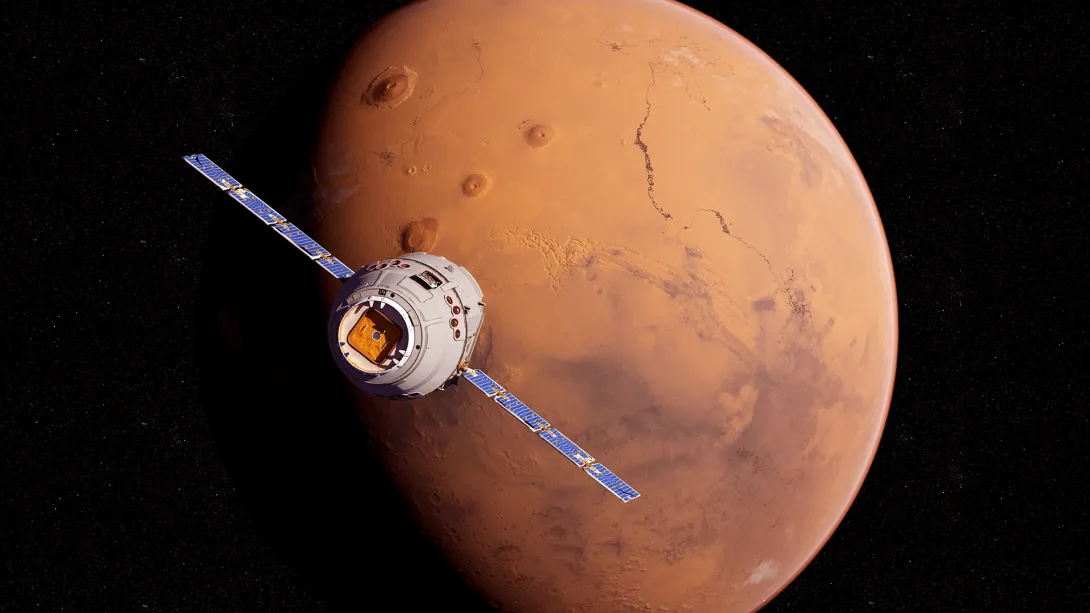
More than half a century after the United States won the race to the moon, the White House is setting its sights on a new frontier: Mars. In a move reminiscent of the Apollo era, the administration has proposed landing Americans on the red planet by the end of 2026 — a bold initiative that has reignited national ambition and drawn comparisons to the space race of the 20th century.
At Georgia Tech, researchers are already considering the mission’s implications, from engineering challenges to international diplomacy. While the White House has framed the mission as a demonstration of American leadership, experts say its success will depend on collaboration — across disciplines, sectors, and borders.
“This is more than a space race,” said Christos Athanasiou, an assistant professor in the Daniel Guggenheim School of Aerospace Engineering. “Mars isn’t just the next step for space exploration — it’s a stress test for everything we’ve learned about sustainability, resilience, and engineering under uncertainty.”
Engineering for the Red Planet
For Athanasiou, the Mars mission is a test of human ingenuity, creativity, and endurance. Unlike the moon, Mars is months away by spacecraft, with no quick return option. That distance introduces a host of engineering challenges that must be solved before a single boot touches Martian soil.
“Ensuring astronaut safety on such a long-duration mission requires us to understand how the Earth materials we will be using in our mission behave in extraterrestrial conditions,” he said.
In his recent TEDx talk, Athanasiou emphasized that the mission must also consider its environmental impact. Mars may be barren, but it is not immune to contamination. Athanasiou believes that strategies used for environmental remediation on Earth — such as waste recycling, habitat sustainability, and pollution control — can be adapted to protect the Martian environment.
“If we can build structures that survive Mars using recycled materials, AI, and Earth-born ingenuity, we’ll unlock entirely new ways to live — both out there and back here,” he said.
Reading the Martian Landscape
James Wray, a professor in the School of Earth and Atmospheric Sciences, has spent years analyzing Mars’ surface using data from orbiters and rovers. He sees the planet as both a scientific treasure trove and a logistical puzzle.
“Mars has vast lava plains, dust storms, and steep canyons that pose real risks to human settlement,” Wray said.
But beneath the challenges lies opportunity. Mars is home to significant deposits of water ice, especially near the poles and just below the surface in some mid-latitude regions. That water could be used not only for drinking but also for producing oxygen and rocket fuel — critical resources for long-term habitation and return missions.
“The presence of water ice near the surface is a game changer. It could support life, and more importantly, it could support us,” Wray said.
He also noted that Mars’ thin atmosphere — just 1% the density of Earth’s — complicates everything from landing spacecraft to shielding astronauts from cosmic radiation. “We’ve learned a lot from robotic missions. Now it’s time to apply that knowledge to human exploration.”
Diplomacy Beyond Earth
Lincoln Hines, an assistant professor in the Sam Nunn School of International Affairs, says that the Mars mission could have significant diplomatic implications. “The Mars mission has little to no bearing on space security; it has no military value,” he said. However, he noted that international cooperation could still play a valuable role in reducing the financial burden of such a costly endeavor.
Hines warned that shifting U.S. priorities from the moon to Mars could strain the international partnerships built through the Artemis program. He explained that some countries may view the Mars initiative as a distraction from the more immediate and economically promising lunar goals. Political instability in the U.S., he added, could further erode trust in its long-term commitments. “Countries may lose faith that the United States is a reliable partner to cooperate with for its lunar program if Mars seems to be the new priority,” he said.
He also pointed to existing legal frameworks like the Outer Space Treaty, which prohibits sovereign claims on celestial bodies, and the Rescue Agreement, which obliges nations to assist astronauts in distress. While these agreements provide a foundation, Hines emphasized that they don’t fully address the complexities of future Mars missions.
Establishing international norms for Mars exploration, he said, will be challenging. “Norms are really hard to develop,” Hines explained, noting that countries often hesitate to commit to rules without assurance that others will do the same. Still, he suggested that Mars — with its limited material value — might offer a rare opportunity for cooperation, if nations are willing to engage in good faith.
News Contact
Siobhan Rodriguez
Senior Media Relations Representative
Institute Communications
A longstanding mystery of the periodic table involves a group of unique elements called lanthanides. Also known as rare earth elements, or REEs, these silvery-white metals are challenging to isolate, given their very similar chemical and physical properties. This similarity makes it difficult to distinguish REEs from one other during extraction and purification processes.
The world has come to depend on lanthanides’ magnetic and optical properties to drive much of modern technology — from medical imaging to missiles to smart phones. These metals also are in short supply, and because they’re found in minerals, lanthanides are difficult to mine and separate. But that may change — thanks to a Georgia Tech-led discovery of a new oxidation state for a lanthanide element known as praseodymium.
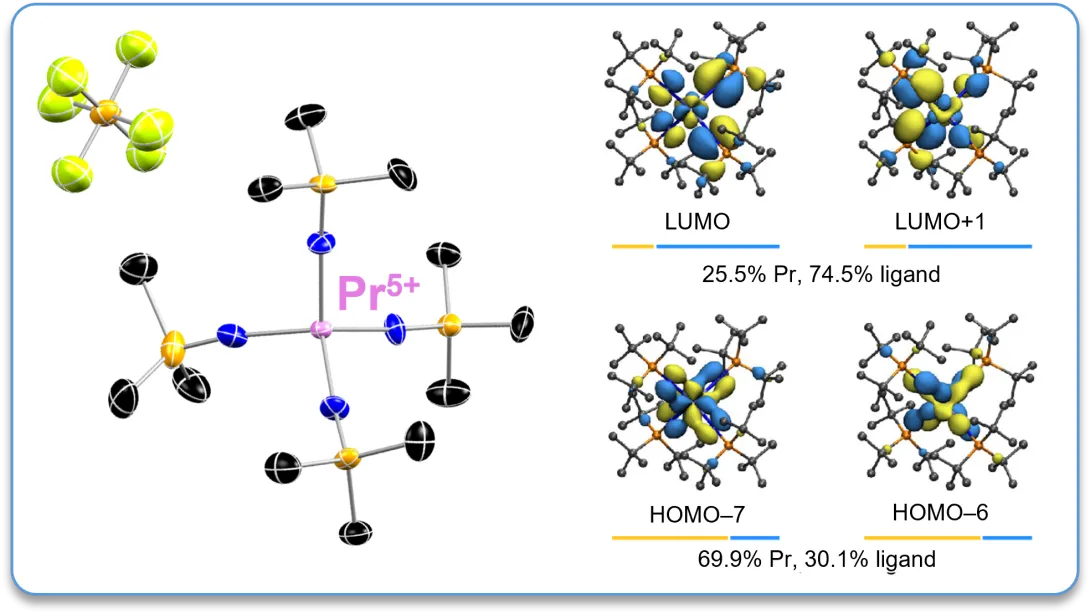
For the first time ever, praseodymium achieved a 5+ oxidation state. Oxidation occurs when a substance meets oxygen or another oxidizing substance. (The browning on the flesh of a cut apple, as well as rust on metal, are examples of oxidation.)
As far back as the 1890s, scientists suspected lanthanides might have a 5+ oxidation state, but lanthanides in that state were too unstable to see, said Henry ”Pete“ La Pierre, an associate professor in Georgia Tech’s School of Chemistry and Biochemistry. Discovering an element’s new oxidation state is like discovering a new element. As an example, La Pierre noted how plutonium’s discovery opened up a whole new area of the periodic table.
“A new oxidation state tells us what we don’t know and gives us ideas for where to go,” he explained. “Each oxidation state of an element has distinct chemical and physical properties — so the first glimpse of a novel oxidation presents a roadmap for new possibilities.”
La Pierre and colleagues at University of Iowa and Washington State University recently discovered the 5+ oxidation state for lanthanides.
“It was predicted but never seen until we found it,” said La Pierre, corresponding author of the study, “Praseodymium in the Formal +5 Oxidation State,” which was recently published in Nature Chemistry. “Lanthanides’ properties are really fantastic. We only use them commercially in one oxidation state — the 3+ oxidation state — which defines a set of magnetic and optical properties. If you can stabilize a higher oxidation state, it could lead to entirely new magnetic and optical properties.”
The researchers’ breakthrough will broaden the lanthanides’ technical applications in fields such as rare-earth mining and quantum technology and could lead to new electronic device architectures and applications.
“Research in lanthanides has already yielded significant dividends for society in terms of technological development,” La Pierre added.
The researchers hope to discover new tools for mining critical REEs, including improving lanthanide separation and recycling processes. When mining these elements, lanthanide elements are frequently mixed together. The separation process is painstaking and inefficient, generating a significant amount of waste. But with increasing global demand for REEs, the U.S. faces a supply issue. Figuring out how to improve lanthanides separation, potentially through oxidation chemistry, will ultimately enhance the supply of these critical elements.
— Anne Wainscott-Sargent
Funding: This research was supported by grants from the National Science Foundation and the U.S. Department of Energy.
News Contact
Shelley Wunder-Smith
Director of Research Communications

Anirban Mazumdar (Photo: Candler Hobbs)
Imagine boarding a jet in Atlanta and arriving in Japan in about the time it takes now to fly to Miami or Chicago.
That’s just one of the possibilities of research in an area of ultrafast flight called hypersonics. The term refers to traveling at roughly a mile a second, or about five times the speed of sound and faster.
Interest in hypersonics is growing, with early notions of high-speed passenger travel alongside defense and space applications driving questions about meeting the demands of Mach 5+ flight.
Such speeds introduce a host of new challenges for aerodynamics, thermal management, and rapid decision-making that Georgia Tech engineers are working to solve.
For Anirban Mazumdar in the George W. Woodruff School of Mechanical Engineering, aerospace questions have always been fascinating.
Hypersonics is an area where those questions are tough. Uncovering answers can have real impact on unlocking new capabilities for travel across the globe or to space, in addition to national security implications.
“It’s very challenging. We are trying to deal with very extreme scenarios, and we’re trying to do it, not just to advance science, but primarily because it matters to our country,” Mazumdar said. “That combination is incredible.”
News Contact
By: Joshua Stewart (jstewart@gatech.edu)
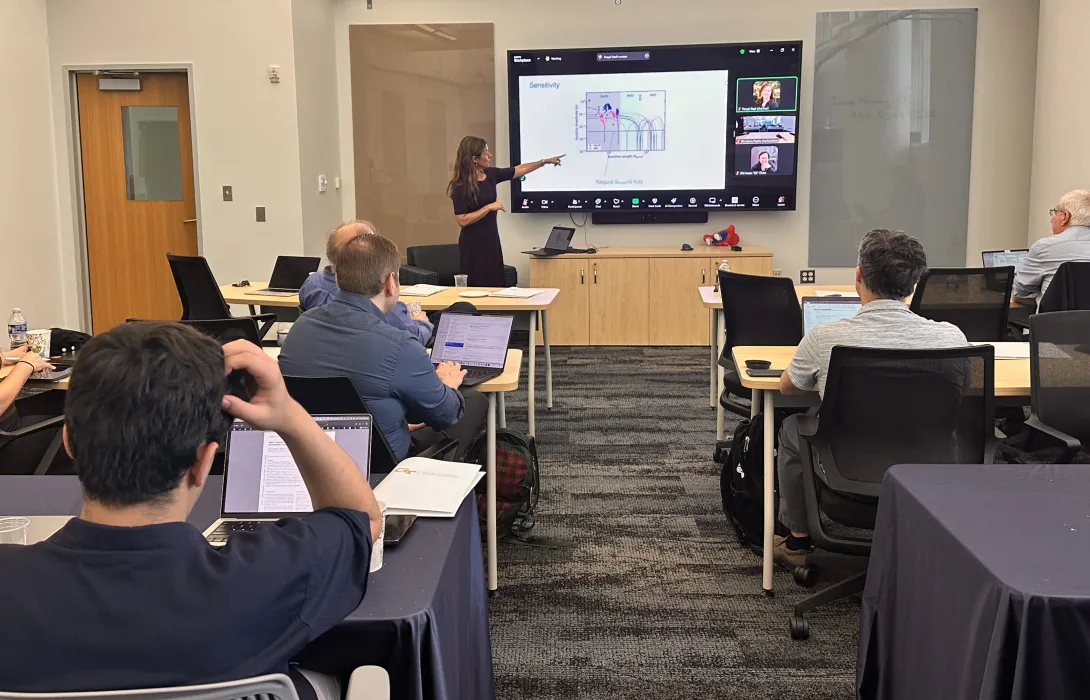
The kickoff meeting marked the first time that a large group of team members came together in person. Team members shared what they will bring to the mission and spent time refining the goals and requirements of the mission.

A new mission strives to take black hole imaging to space. Scientists from the Georgia Institute of Technology, the Georgia Tech Research Institute (GTRI), the National Aeronautics and Space Administration (NASA), and 12 universities from around the world recently convened for a three-day workshop to plan the launch of the Space-based Precision Millimeter Interferometry Telescope (SPRITE) project. The proposed NASA Medium-Class Explorer mission aims to revolutionize the understanding of black holes through space-based imaging.
From Earth to orbit: The next step
SPRITE builds on the groundbreaking achievements of the Event Horizon Telescope (EHT), a network of ground-based telescopes able to synchronize observations from around the globe. EHT is most well-known for capturing the first images of black holes, M87* and Sagittarius A*.
“We’ve done what we can from the ground; we’ve run out of Earth,” says Professor and Chair of the School of Physics Feryal Özel, SPRITE’s principal investigator and a well-known astrophysicist instrumental in EHT’s success and development. “SPRITE will send two telescopes into orbit – achieving better imaging than a dozen telescopes on the ground.”
By sending the telescopes into space, the mission will be able to overcome the limitations of Earth’s atmosphere, which blocks certain wavelengths of light and produces turbulence that can degrade image quality. Unlike Earth-based telescopes, which rely on the planet’s rotation to change viewing angles, SPRITE’s telescopes will rotate independently across the vastness of space with data continuously transmitted from the satellites to ground stations.
“I like to think of it as an MRI machine rotating around a patient,” explains Özel. “In space, our telescopes can perform this orbital dance from great distances – giving us multiple perspectives of a black hole and allowing us to build a much more complete image.”
Mission goals
SPRITE’s objectives are ambitious and far-reaching, specifically to:
- Create more images of previously unseen black holes at resolutions better than M87* and Sagittarius A*;
- Confirm the presence of binary black holes through visual imagery; and
- Study the hot gas dynamics around black holes.
This class of mission requires a three-year operational lifetime to achieve its main science goals – although planners estimate the project will be able to operate considerably longer.
Preparing for launch
SPRITE is being organized to reflect Georgia Tech’s commitment to advancing space science through interdisciplinary collaboration and innovation, and will work closely with the Institute’s new Space Research Initiative. Locating SPRITE at Georgia Tech allows the mission to benefit from the knowledge of leading experts from the Colleges of Sciences, Engineering, and Computing; and GTRI.
The recent kickoff meeting marked SPRITE’s first large-scale gathering of contributors from around the world.
“We had smaller meetings before, but this was the first time the full team came together to share expertise and collaboratively shape the mission,” says Özel. “Most importantly, this meeting showed us that we have a strong scientific case for our mission and its design.”
Over the next two to three years, the team will work to validate key technologies and prepare a compelling proposal for NASA. If selected, SPRITE is expected to launch in the mid-2030s, marking the beginning of a new era in space imaging.
News Contact
Laura S. Smith, writer

A view of Jezero Mons from the publication. The mountain is ~21 km across.

An image from the publication showing an oblique view from north-northeast of Jezero crater, with topography exaggerated ~3x
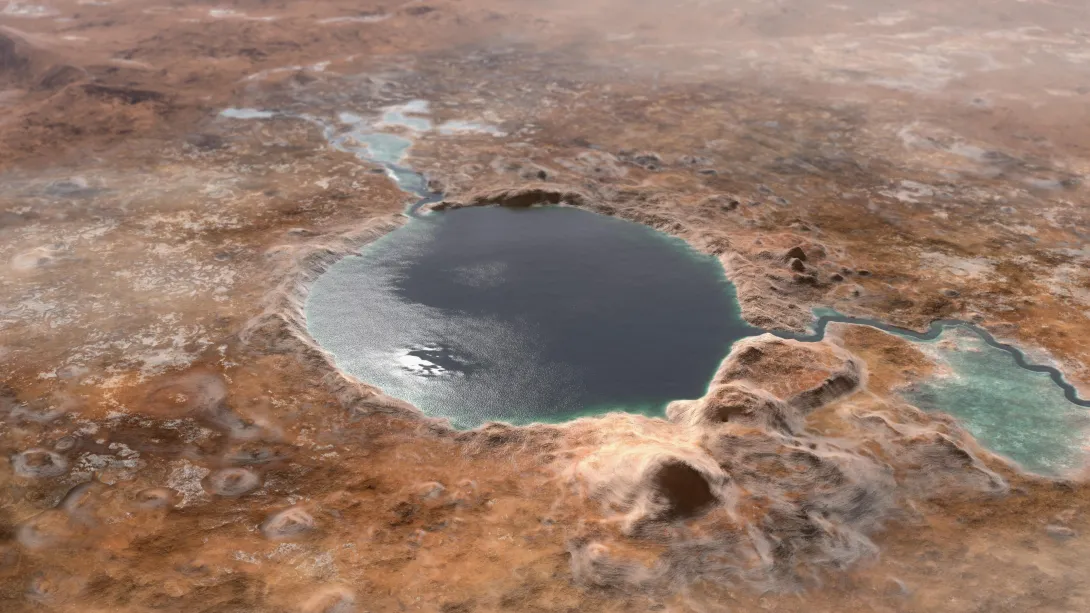
An illustration of Jezero Crater as it may have looked billions of years go on Mars, when it was a lake. Jezero Mons is visible on the front right-side of the crater rim. (Credit: NASA)
Georgia Tech scientists have uncovered evidence that a mountain on the rim of Jezero Crater — where NASA’s Perseverance Rover is currently collecting samples for possible return to Earth — is likely a volcano. Called Jezero Mons, it is nearly half the size of the crater itself and could add critical clues to the habitability and volcanism of Mars, transforming how we understand Mars’ geologic history.
The study, “Evidence for a composite volcano on the rim of Jezero crater on Mars,” was published this May in the Nature-family journal Communications Earth & Environment, and underscores how much we have left to learn about one of the most well-studied regions of Mars.
Lead author Sara C. Cuevas-Quiñones completed the research as an undergraduate during a summer program at Georgia Tech; she is now a graduate student at Brown University. The team also included corresponding author Professor James J. Wray (School of Earth and Atmospheric Sciences), Assistant Professor Frances Rivera-Hernández (School of Earth and Atmospheric Sciences), and Jacob Adler, then a postdoctoral fellow at Georgia Tech and now an assistant research professor at Arizona State University.
“Volcanism on Mars is intriguing for a number of reasons — from the implications it has on habitability, to better constraining the geologic history,” Wray says. “Jezero Crater is one of the best studied sites on Mars. If we are just now identifying a volcano here, imagine how many more could be on Mars. Volcanoes may be even more widespread across Mars than we thought.”
A mountain in the margins
Wray first noticed the mountain in 2007, while considering Jezero Crater as a graduate student.
“I was looking at low-resolution photos of the area and noticed a mountain on the crater’s rim,” he recalls. “To me, it looked like a volcano, but it was difficult to get additional images.” At the time, Jezero Crater was newly discovered, and imaging focused almost entirely on its intriguing water history, which is on the opposite side of the 28-mile-wide crater.
Then, Jezero Crater, due to these lake-like sedimentary deposits, was selected as the landing spot for the 2020 Perseverance Rover — an ongoing NASA mission seeking signs of ancient Martian life and collecting rock samples for possible return to Earth.
However, after landing, some of the first rocks Perseverance encountered were not the sedimentary deposits one might expect from a previously-flooded area — they were volcanic. Wray suspected he might know the origin of these rocks, but to make a case for it, he would need to show that the mountain on the edge of Jezero Crater could indeed be a volcano.
A new researcher — and old data
The opportunity presented itself several months after Perseverance landed when Cuevas-Quiñones applied to a Summer Research Experience for Undergraduates (REU) program hosted by the School of Earth and Atmospheric Sciences to work with Wray.
“A previous study led by Briony Horgan (professor of planetary science at Purdue University) had also suggested that Jezero Mons could be volcanic,” Cuevas-Quiñones says. “I began wondering if there was a way to home in on these suspicions.”
The team partnered with study coauthor Rivera-Hernández, who specializes in characterizing the surface of planets and their habitability. They decided to use datasets gathered from spacecraft orbiting Mars to compare the properties of Jezero Mons to other, known, volcanoes. “We can’t visit Mars and definitively prove that Jezero Mons is a volcano, but we can show that it shares the same properties with existing volcanoes — both here on Earth and Mars,” Wray explains.
“We used data from the Mars Odyssey Orbiter, Mars Reconnaissance Orbiter, ExoMars Trace Gas Orbiter, and Perseverance Rover, all in combination to puzzle this out,” he adds. “I think this shows that these older spacecraft can be extremely valuable long after their initial missions end — these old spacecraft can still make important discoveries and help us answer tricky questions.”
For Cuevas-Quiñones, it also underscores the importance of REU programs and opportunities for undergraduates. “I was an undergraduate student at the time, and this was my first time conducting research,” she says. “It was fascinating to learn how different data sets could be used to decode the origin of a landscape. After Jezero Mons, it became clear to me that I would continue to study Mars and other planetary bodies.”
The search for life — and determining Mars’ age
The discovery makes the crater even more intriguing in the search for past life on Mars. A volcano so close to watery Jezero Crater could add a critical source of heat on an otherwise cold planet, including the potential for hydrothermal activity — energy that life could use to thrive.
This type of system also holds interest for Mars as a whole. “The coalescence of these two types of systems makes Jezero more interesting than ever,” shares Wray. “We have samples of incredible sedimentary rocks that could be from a habitable region alongside igneous rocks with important scientific value.” If returned to Earth, igneous rocks can be radioisotope dated to know their age very precisely. Dating the Jezero Crater samples could be used to calibrate age estimates, providing an unprecedented window into the geologic history of the planet.
The take home message? “Mars is the best place we have to look in our solar system for signs of life, and thanks to the Perseverance Rover collecting samples in Jezero, the United States has samples from the best rocks in the best place on Mars,” Wray says. “If these samples are returned to Earth, we can do incredible, groundbreaking science with them.”
DOI: https://doi.org/10.1038/s43247-025-02329-7
Funding: Cuevas-Quiñones was supported by Georgia Tech’s 2021 Research Experience for Undergraduates program sponsored by NSF and 3M corporation. Wray was supported by NASA funding for Co-Investigators on HiRISE and CaSSIS. CaSSIS is a project of the University of Bern and funded through the Swiss Space Office via ESA’s PRODEX program. The instrument hardware development was also supported by the Italian Space Agency (ASI) (ASI-INAF agreement 2020-17-HH.0), INAF/Astronomical Observatory of Padova, and the Space Research Center (CBK) in Warsaw. Support from SGF (Budapest), the University of Arizona Lunar and Planetary Lab, and NASA are also gratefully acknowledged. Operation support from the UK Space Agency is also acknowledged.
News Contact
Written by Selena Langner
The Renewable Bioproducts Institute (RBI) 2025 Spring Workshop, held May 12–13, brought together leading researchers, industry professionals and students to explore innovations in pulp and paper manufacturing. Hosted at the Kendeda Building and the Paper Tricentennial Building, the event opened with remarks from Carson Meredith, RBI executive director, and featured presentations on energy and resource efficiency, carbon accounting and competitiveness.
Highlights included talks on membrane separations, electrochemical processing and low-carbon fuels, with contributions from experts such as Chris Luettgen, Jose Gonzalez, Sankar Nair, Marta Hatzell and Dave Beck.
Insights from the 2025 RBI Spring Workshop
- Revolutionizing Kraft Pulping with Graphene Oxide Membranes
Georgia Tech’s rGO membrane technology is transforming the kraft pulping process. These membranes enable efficient black liquor dewatering, organic acid recovery and lignin fractionation—leading to significant energy savings, water recycling and new revenue streams from bioproducts. - North America’s Dual Challenge: High Emissions, High Opportunity
While North America remains a pulp and paper powerhouse (15% of global capacity), it also has one of the highest carbon intensities. This presents both a challenge and an opportunity to lead in emissions reduction through asset renewal and innovation. - Biogenic CO₂: From Emission to Asset
Kraft pulp mills emit large volumes of biogenic CO₂—an untapped resource. With carbon capture and utilization (CCUS), mills could generate up to $300 million annually in carbon removal credits, turning emissions into economic value. - Integrated Biorefineries: The Future of Pulp Mills
The vision for pulp mills is evolving—from single-product facilities to multi-product biorefineries. Innovations like lignin-based materials, organic acid conversion to biofuels and advanced nanofiltration are paving the way for circular use of carbon in manufacturing. - Decarbonization Is a Strategic Imperative
With increasing regulatory and consumer pressure, especially from global brands targeting Scope 3 emissions, pulp and paper producers must act. Embracing technologies like rGO membranes and CCUS is not just sustainable—it’s essential for competitiveness. - Electrochemical Carbon Capture and Conversion for On-Site Fuel Production
Hatzell’s lab is pioneering the use of bipolar membrane (BPM) electrolysis to convert captured carbon (from bicarbonate solutions) into valuable fuels like CO and H₂. This approach enables:- 100% carbon utilization with more than 70% Faradaic efficiency for CO production.
- Integration with pulp and paper processes to valorize CO₂ emissions instead of storing them.
- Use of acid-stable single-atom nickel catalysts to improve selectivity and efficiency.
- The PAPER-ZERO Initiative
This initiative explores transformative pathways to decarbonize the pulp and paper industry by:- Evaluating scenarios that eliminate combustion of black liquor and waste wood.
- Investigating renewable energy integration and alternative uses for black liquor.
- Assessing the cost, energy and environmental trade-offs of emerging technologies.
The workshop also featured a student poster session, networking opportunities and updates on APPTI collaborative projects. The event concluded with a meeting of the RBI Industry Advisory Board, reinforcing the institute’s role as a hub for partnership and innovation in renewable bioproducts.
“We’re grateful to our industry member partners for sharing their time and expertise,” said Belinda Vogel, research engagement manager. “The advisory board meeting highlighted how essential collaboration is in advancing basic science and renewable bioproduct manufacturing.”
Cyrus Aidun has been a distinguished professor at Georgia Tech’s George W. Woodruff School of Mechanical Engineering since 2003. His career is marked by groundbreaking research and significant contributions to fluid mechanics and bioengineering, establishing him as a leading figure in these fields.
In particular, Aidun has focused on industrial competitiveness. His efforts to reduce energy and water consumption in fiber composite products have attracted significant attention and funding. This research is critical for developing sustainable and cost-effective manufacturing processes while reducing environmental impact.
As principal investigator, Aidun has received funding for major projects from the Department of Energy’s Office of Energy Efficiency and Renewable Energy (DOE-EERE, with Devesh Ranjan as co-principal investigator), the DOE’s Advanced Research Projects Agency-Energy, and the Defense Advanced Research Projects Agency (with Art Rangauskas at the University of Tennessee). These projects are affiliated with Aidun’s development of the Multiphase Forming Lab at Georgia Tech’s Renewable Bioproducts Institute (RBI).
The only one of its kind in North America, this innovative system significantly reduces the amount of water required to process paper. As a result, the heat and energy needed to dry the paper — typically an energy-intensive process — are also reduced. The Multiphase Former uses up to 70% less water, which substantially lowers the energy required for drying. This research, which began about five years ago, has drawn broad interest from industry. A more recent project, funded by DOE-EERE and led by Carson Meredith, combines Multiphase Forming with the latest technologies in refining and drying.
Aidun earned his bachelor’s and master’s degrees from Rensselaer Polytechnic Institute and completed his Ph.D. at Clarkson University in 1985. He joined the Woodruff School in 2003 after serving two years as a program director at the National Science Foundation. He began at Georgia Tech in 1988 as an assistant professor at the Institute of Paper Science and Technology. Previously, he was a research scientist at Battelle Research Laboratories, a postdoctoral associate at Cornell University, and a senior research consultant at the National Science Foundation’s Supercomputer Center at Cornell.
Aidun has received several national and international honors, including the National Science Foundation Presidential Investigator Award, the Gunnar Nicholson Fellowship, and the L.E. Scriven Award from the International Society of Coating Science and Technology.
Georgia Tech's Renewable Bioproducts Institute (RBI) is pleased to announce the appointment of Hanjiang (John) Xu as director of the Multiphase Forming Lab. This strategic selection leverages Xu's extensive experience in papermaking, new product and process development, fluid mechanics, and project management.
The only one of its kind in North America, this innovative system significantly reduces the amount of water required to process paper. As a result, the heat and energy needed to dry the paper—typically an energy-intensive process—are also reduced. The Multiphase Forming Lab uses up to 70% less water, which substantially lowers the energy required for drying.
Xu brings over 20 years of experience in managing laboratory paper machines and pilot testing equipment, along with a robust background in fluid mechanics, material science, and instrumentation development. His professional experience includes significant roles at International Paper, AstenJohnson, and Georgia Tech’s George W. Woodruff School of Mechanical Engineering.
"We are thrilled to have John lead the establishment and operation of this new facility," said Carson Meredith, RBI executive director. "His extensive knowledge and industry experience make him the ideal leader to partner with both RBI members and non-members to drive reduced energy consumption and costs.”
Xu's career is marked by innovative research and successful commercialization of new products and processes. At AstenJohnson, he served as a senior research scientist, specializing in forming and press fabrics used in the paper industry. His work led to the commercialization of several new forming and press products, and he managed pilot press stand at AstenJohnson and participated in papermaking trials at different pilot facilities to evaluate the performance of these fabrics.
Prior to AstenJohnson, Xu held positions at International Paper's Corporate Technology Center, where he managed the Microfinishing Lab and Humidity Resistant Liner Lab. His research provided critical insights that influenced the company’s major business decisions. He also developed various unique instruments for different paper mills at International Paper.
Xu earned his Ph.D. in paper science and mechanical engineering from Georgia Tech’s Institute of Paper Science and Technology. His doctoral research focused on the measurement of fiber suspension flow and forming jet velocity profile using Pulsed Ultrasonic Doppler Velocimetry (PUDV). He also holds a B.S. in Material Science and Engineering from Tsinghua University in Beijing, China.
For more information about the Multiphase Forming Lab, please contact: Hanjiang (John) Xu at hanjiang.xu@me.gatech.edu
On May 13, 2025, Georgia Tech celebrated a major milestone in sustainable manufacturing with the ribbon cutting of its new Multiphase Forming Lab in the Paper Tricentennial Building. The event, hosted by the Renewable Bioproducts Institute (RBI), marked the official launch of a pioneering system that promises to revolutionize the papermaking industry.
The Multiphase Forming System, the only one of its kind in North America, dramatically reduces the amount of water needed in the paper production process. By using up to 70% less water, the system also significantly cuts down on the energy required for drying — traditionally one of the most energy-intensive steps in papermaking. This innovation, developed by principal investigator Cyrus Aidun, not only enhances efficiency but also supports broader sustainability goals by lowering greenhouse gas emissions.
The grand opening event featured remarks from Georgia Tech President Ángel Cabrera, Executive Vice President for Research Tim Lieuwen, and Carson Meredith, executive director of RBI, among others. Attendees included industry leaders, researchers, and students, all eager to witness the unveiling of a technology that has been five years in the making.
The Multiphase Forming project has garnered widespread interest from the paper and packaging industries. A recent extension of the research, funded by the U.S. Department of Energy’s Office of Energy Efficiency and Renewable Energy (DOE-EERE), integrates this forming system with cutting-edge refining and drying technologies. Led by Meredith, this initiative aims to further reduce energy consumption and environmental impact in paper manufacturing. John Xu has been appointed to run the facility.
Meredith said, “Today is milestone in RBI’s history, as we continue to partner and innovate with the paper and pulp industry. We’d like to share our gratitude with our researchers, students and industry sponsors International Paper, Kimberly Clark and Solenis.”