
In 2015, nearly 200 countries agreed: they would reduce their emissions of carbon dioxide and other greenhouse gases to limit warming of the earth’s atmosphere to well below 2 degrees Celsius.
The Paris Agreement actually aims for 1.5 degrees above pre-industrial levels to avoid potential catastrophic changes to our climate. But it’s become increasingly clear to climate scientists and policymakers that just reducing emissions is not enough.
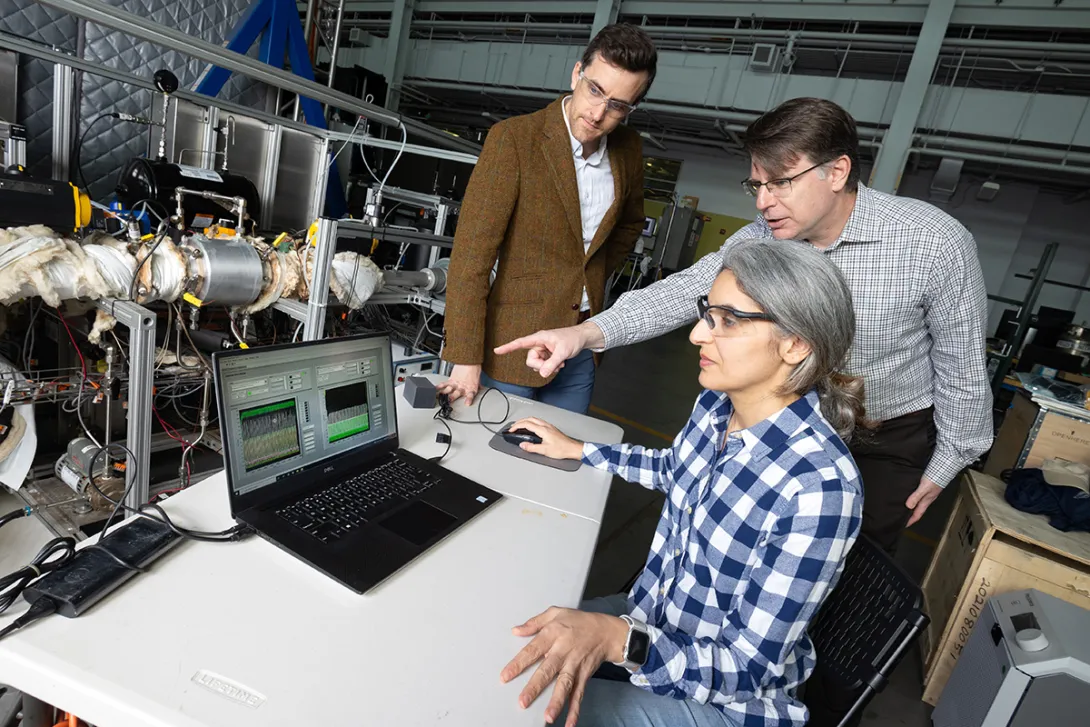
“We now know that we probably should have stopped putting massive amounts of CO2 in the air 10, 20, 30 years ago to prevent the climate from getting above 2 degrees C,” said Chris Jones, a chemical engineer at Georgia Tech. “Now we've waited so long to reduce our emissions that we need to develop technologies that are referred to as negative emissions technologies that remove CO2 from the atmosphere.”
Jones was one of a handful of scientists who co-authored a landmark National Academies report in 2018 that outlined a variety of approaches to negative emissions. Agricultural practices and forest management are options — essentially using nature’s ability to grab carbon dioxide out of the air and lock it away in plants and soil. But Jones said we’ll need quicker and more direct approaches.
“We could plant billions of trees to do this, but there's not enough available land. And the trees don't grow fast enough for us to do this quickly enough to slow global warming at the rate required,” said Jones, John F. Brock III School Chair in the School of Chemical and Biomolecular Engineering (ChBE). “That's where direct air capture comes in: It's a chemical engineering way of designing a process that takes CO2 out of the air.”
News Contact
Joshua Stewart
College of Engineering

A new eBook, "Climate Change and the Design of the Built Environment," written by Michael Gamble, Academic and Research Council Chair at the Kendeda Building for Innovative Sustainable Design and associate professor in the College of Design at Georgia Tech is now available!
Written as a series of dialogues with leaders from various disciplines, the book positions design as an essential component of entrepreneurial approaches which explore the sociocultural and eco-political dimensions of climate change. Economist, Architects, Planners, Sociologist, Lawyers, Policy Makers, Landscape Architects, and MBA’s contribute to a spirited discussion around climate change and design.
Global climate change has already resulted in a wide range of impacts across every region of the country. Many sectors of the economy are expected to grow related to climate and health in the coming decades. The design and retrofit of buildings, infrastructure and cities will be a major part of future efforts.
All interviews are Kendeda Building based on Georgia Tech’s Atlanta campus with experts participating from around the world.
News Contact
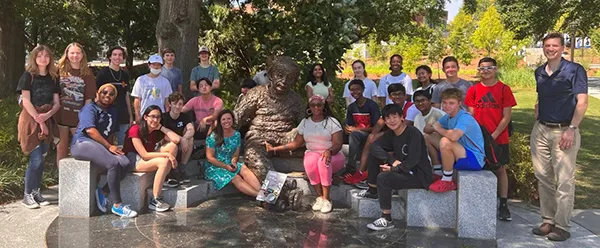
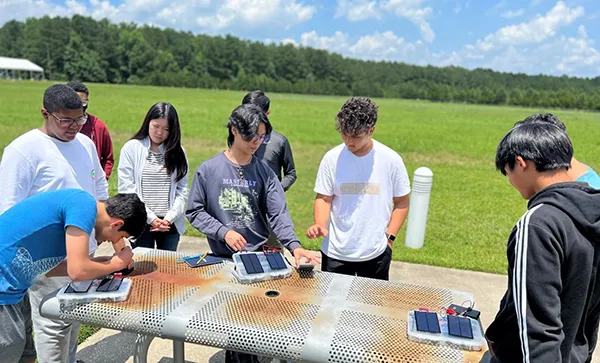
The Summer of 2022 is off to an energetic start! The Energy, Policy, and Innovation Center (EPICenter) hosted two week-long cohorts of "Energy Unplugged," an energy-themed STEAM camp for 35 high school students. Dr. Rich Simmons and Strategic Energy Institute fellow Azell Francis engaged with collaborators from around the state, and led the campers in hands-on interactive demonstrations and experiments involving solar panels, batteries, catapults, water rockets, and remote-control cars. The first camp was held on the Georgia Tech Savannah campus, and the second on the Georgia Tech main campus in Atlanta. Both camps covered both renewable and non-renewable energy sources, energy production and delivery, environmental impacts, and global electricity access. Campers gained insights into how a STEAM-oriented education can be a path that leads to an exciting and successful career in energy.
During the week of June 13 - 17, 2022, GT Savannah was host to a very engaged group of campers. Launching right into activities, the students built and tested catapults, integrating important physics and math concepts into hands-on fun. Next up was the water rocket design challenge, where they showcased their creativity to achieve maximum height and distance. The City of Savannah’s Office of Sustainability displayed their electric vehicle, and shared perspectives on local sustainability initiatives. A highlight of both summer camps was field trip day! The campers visited Georgia Power’s Plant McIntosh, which is a combined cycle gas turbine plant, and the Gulfstream Aerospace Corporation, where the G6 and G7 aircraft are assembled. The week ended too soon, but not before the camp students raced to the finish line driving a re-engineered remote-control electric car, and in true Georgia Tech fashion, hearing the steam engine whistle blow.
Simmons and Francis brought the Energy Unplugged fun to GT Atlanta during the week of June 21 – 24, 2022. The Kendeda Building for Innovative Sustainable Design served as an ideal instructional backdrop for the camp. The Living Building, as it is often called, is certified to generate more energy than it consumes, collect, capture, and process more water than it consumes, and, to the greatest extent possible, be regenerative, rather than consumptive. Hands-on learning remained a key pillar of the camp, conducting experiments with micro-grids and solar panels. The group also had the opportunity to visit Georgia Power’s Morgan Falls Hydroelectric Plant which began commercial operations in 1904, and GE Power’s Monitoring and Diagnostics Center, where more than 500 GW of gas turbine power plants are monitored. The week wrapped up with “shark-tank” style team presentations where campers took an entrepreneurial approach to delivering basic energy services to off-grid communities in the developing world.
Energy Unplugged is administered by Georgia Tech Summer P.E.A.K.S. (Program for Enrichment and Accelerated Knowledge in STEAM) at CEISMC (the Center for Education Integrating Science, Mathematics, and Computing). CEISMC serves as the primary connection point between Georgia Tech faculty and students and the preK-12 STEAM education community, reducing the barriers between kids and higher education. Annually, CEISMC programs impact more than 39,000 students, 1,700 teachers, 200 schools in over 75 school districts throughout the state of Georgia.
News Contact
Brent Verrill, Research Communications Program Manager, SEI
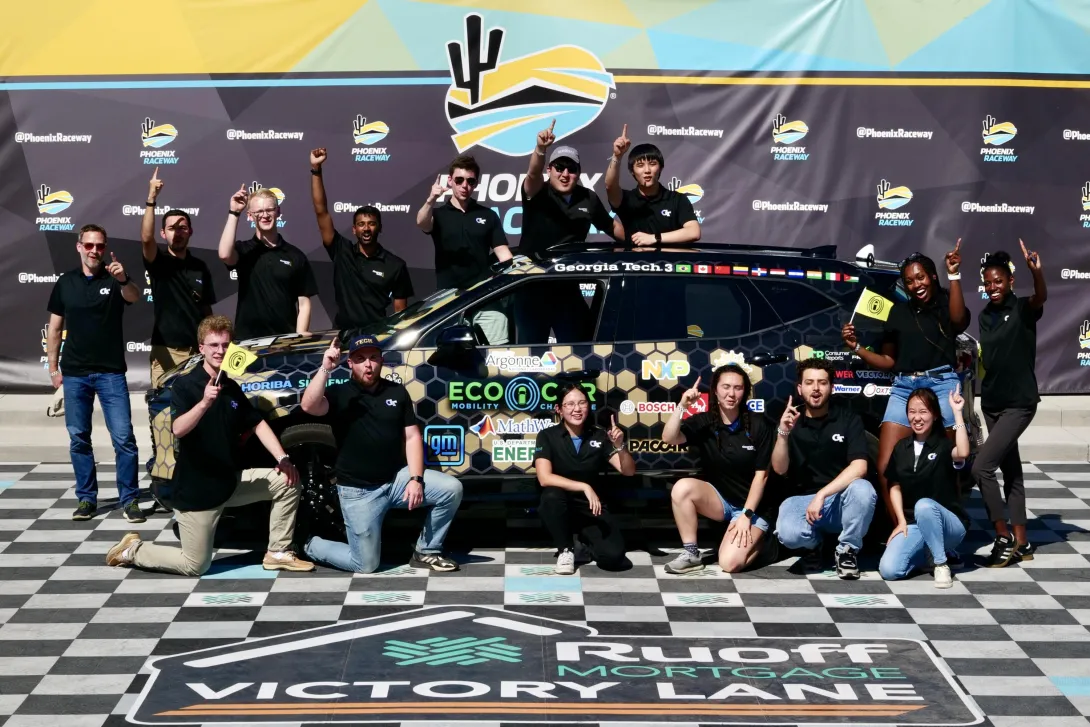
A team of Georgia Tech students and faculty members has won the U.S. Department of Energy’s (DOE) EcoCAR Mobility Challenge. The four-year competition tasked 11 universities with transforming a 2019 Chevrolet Blazer by adding advanced propulsion systems and automated vehicle technology. The goal was to improve the car’s energy efficiency while balancing emissions, safety, and consumer acceptability factors.
Originally a six-cylinder, the Georgia Tech team converted its Blazer to a four-cylinder hybrid vehicle with adaptive cruise control. Its vehicle-to infrastructure communication technology allows it to “talk” to stoplights and adjust its speed for optimization.
The team of approximately 60 graduate and undergraduate students represent six of the College of Engineering’s eight schools. The group also includes students from the College of Computing, Scheller College of Business, and Georgia State University.
Read the entire story on the College of Engineering website.
News Contact
Jason Maderer
College of Engineering
maderer@gatech.edu
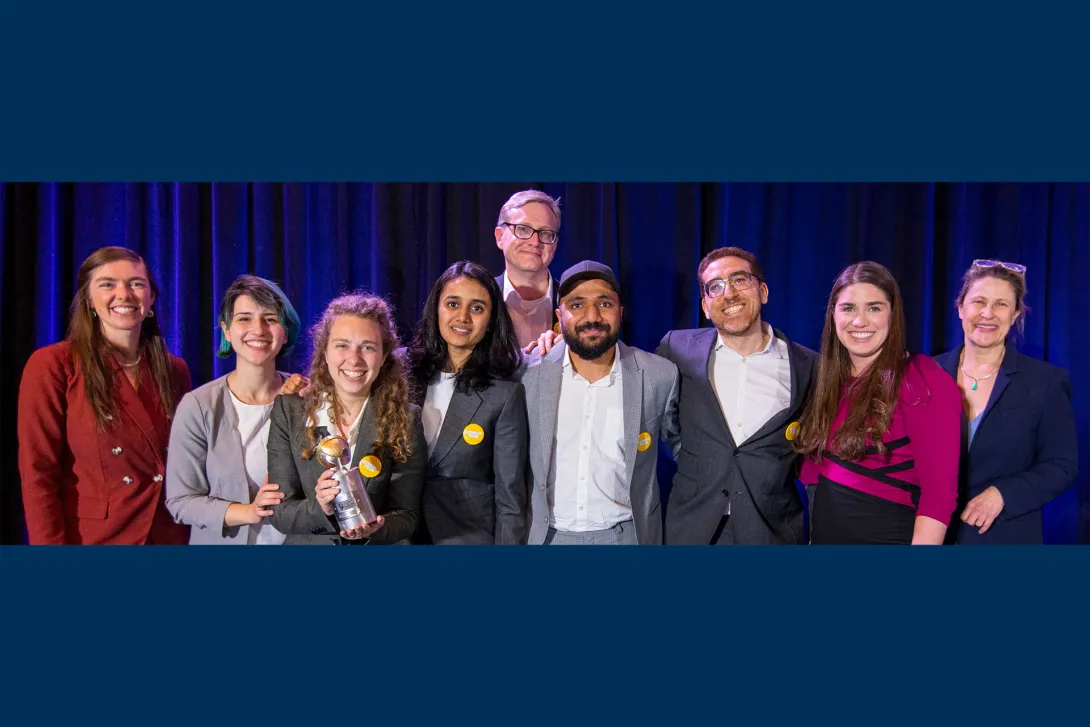
The Georgia Tech student team, "English Avenue Yellow Jackets", is the 2022 Design Challenge Residential Division Grand Winner for the Department of Energy's Solar Decathlon. They also took home first place in the contest's new Retrofit Housing division. Their winning entry retrofitted a 102-year-old house in Atlanta's English Avenue neighborhood.
"The target was to retrofit an existing house to net zero," Aayushi Mody, the team lead said. "And, well, we exceeded the target by making it net positive. The house basically generates more energy than it utilizes." But, Mody explained, that's just the beginning.
In addition to a net positive retrofit, the English Avenue Yellow Jackets provided solutions for rainwater harvesting and graywater reuse, a financial model that included land trust subsidies, and an additional 60 years' worth of projected weather data that proved the house would stay net positive even in cases of extreme weather.
Full Story...
News Contact
Ann Hoevel, Director of Communications, College of Design

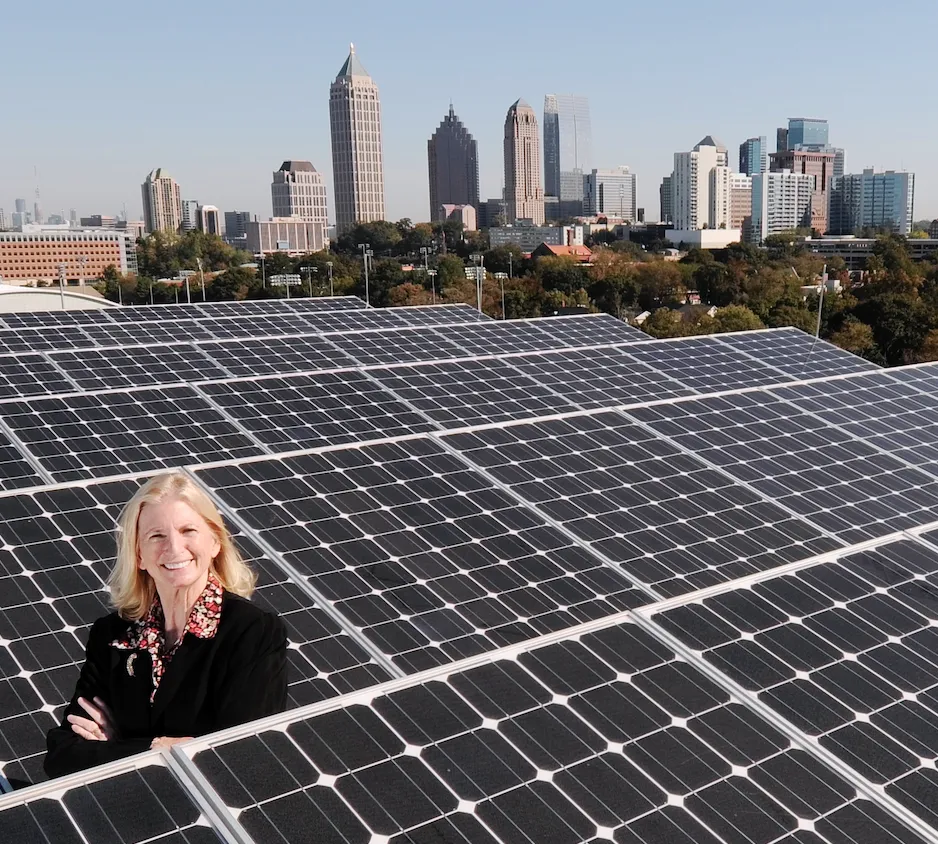
Marilyn Brown is a world-leading expert on renewable energy and energy efficiency, a transformative intellectual thinker, and one of the founders of the field of energy and climate policy.
Her research has shaped energy policy in the U.S. and globally. Over the past two years, she has been tapped for several prestigious honors, including being elected to both the U.S. National Academy of Engineering and the National Academy of Sciences, and receiving the 2021 World Citizen Prize in Environmental Performance. Now, she is the first woman to receive the Georgia Tech Class of 1934 Distinguished Professor Award in the 38 years of its existence. It is the highest honor given to a Georgia Tech professor. The award is presented to a professor who has made significant, long-term contributions to teaching, research, and public service.
Brown is the Regents and Brook Byers Professor of Sustainable Systems in the School of Public Policy. She joined Georgia Tech after 22 years at Oak Ridge National Laboratory, where she directed several national climate change mitigation studies and became a leader in the analysis and interpretation of energy futures.
At Oak Ridge National Laboratory, she was the joint highest-ranking female manager. Brown was attracted to Georgia Tech after working with a high-level group of scientists from Oak Ridge, the Imperial College of London, and Georgia Tech on a project involving next-generation energy, including advanced broadband. “I really liked the people from Tech who I worked with on the project,” said Brown. “They had a can-do attitude. At other universities, they might say, ‘That can’t be done.’ The people from Georgia Tech said, ‘We’ll find a way.’” In 2006, she was encouraged to apply for the position of — and was chosen as — a full professor in the School of Public Policy in Georgia Tech’s Ivan Allen College of Liberal Arts.
Throughout her career, Brown has been known for her transdisciplinary, action-based research and linking behavior to policy. “I started my career in the physical sciences at Rutgers. “From the beginning, I brought sciences into my work and have been quantitative. It has given me the ability to span sciences and related fields,” said Brown. “I tell my students they have to be quantitative in math and the physical sciences to be effective in energy.”
The focus of her research has been on the clean energy transition — bridging engineering, social and behavioral sciences, and policy studies to advance the design, adoption, and diffusion of clean energy technologies and policies. She is particularly interested in energy disparities and work to strengthen energy infrastructure, especially in areas of financial need. “It is all about the diffusion of innovation to the benefit of all,” she said.
Drawdown Georgia
Brown also leads the research program Drawdown Georgia, which she helped to create with the inspiration and funding of the Ray C. Anderson Foundation. Georgia Tech alumnus Ray C. Anderson was founder and chair of Interface Inc., and a pioneer in sustainability.
Drawdown Georgia was created and is being conducted in partnership with Emory University, the University of Georgia, and Georgia State University, as well as the Southface Institute, the Partnership for Southern Equity, and Greenlink Analytics.
Drawdown Georgia has identified a roadmap to significantly cut Georgia’s greenhouse gas emissions and achieve carbon neutrality. The Drawdown Georgia study, localized for Georgia’s urban and rural areas, was published in the Proceedings of the National Academy of Sciences in 2021. The plan identified technology and practices that could resonate with individuals, towns, and corporations throughout the state, including ways to bring more clean energy resources and technologies to rural Georgia and help people use limited resources more efficiently.
Through collaboration with the Scheller College of Business, 25 Georgia CEOs from throughout the state agreed to join Drawdown Georgia. The project includes a dashboard of emissions by Georgia’s 159 counties, tracked monthly. The next step will be to track implementation of the 20 solutions in the plan, measuring investments by counties, and the use of electric vehicles, rooftop solar systems, alternative transportation, recycling, composting, afforestation, and silvopasture — the integration of trees and livestock operations on the same land.
Sustainability as a Way of Life
When asked what she wishes people knew about sustainability, Brown said, “Sustainable technologies and behaviors are not costly. They can be good for your pocketbook. Consider the home refrigerator. Twenty-five years ago, it consumed 2,000 kilowatt hours a year. Today it requires less than 600 kWh, and they don’t cost any more than they used to. People just have to be smart about what they choose and pay attention to cradle-to-grave resource issues.”
Brown also lives her values. At her home, she grows vegetables and composts, has rooftop solar, a Tesla Powerwall battery, and uses heat pumps for water heating, air conditioning, and heat. Her family has an energy focus. Her husband, Frank Southworth, is an adjunct professor in the School of Civil and Environmental Engineering at Tech, and an accomplished transportation planner. Their daughter, Katie Southworth, is an attorney with Southface Energy Institute.
Working with Students
Brown created and co-leads the Climate and Energy Policy Lab in the School of Public Policy at Tech. She developed the Master of Sustainable Energy and Environmental Management degree. She has advised 19 Ph.D. students, many of whom have gone on to leading roles in government agencies, academia, and industry.
She is known as an excellent mentor, communicator, and educator, inside and outside of the classroom. She challenges students to expand their knowledge and excel in their project work while developing their confidence and leadership skills. She has been described as generous with her time in providing students with guidance on professional development. As she was one of very few women in her field when she began her career, she has been purposeful about mentoring women.
Background
Brown earned her Bachelor of Arts degree in political science from Rutgers University, and a Master of Regional Planning degree from the University of Massachusetts. She holds a Ph.D. from The Ohio State University in geography, with a minor in quantitative methods. Before joining Oak Ridge National Laboratory, she was an associate professor of geography at the University of Illinois, the first woman to earn tenure in geography there. Previously, she was a lecturer in the Department of Geography and Geology at Ohio Wesleyan University.
She has authored six books and more than 250 publications, and contributed to the United Nations 2007 Intergovernmental Panel on Climate Change (IPCC), a joint winner of the Nobel Peace Prize that year. Her work has had significant influence and visibility in the policy arena as evidenced by her impact on policies and programs, such as the Kyoto Protocol and the U.S. Department of Energy’s Weatherization Assistance Program, and briefings and testimonies before state legislative and regulatory bodies, committees of both the U.S. House of Representatives and Senate, and numerous international organizations.
Brown served two terms (2010-2017) as a presidential appointee and U.S. Senate-confirmed regulator on the board of directors of the Tennessee Valley Authority (TVA), the nation’s largest public power provider. At TVA, she contributed to reducing TVA’s CO2 emissions by 60% over a 15-year period. She also chaired for eight years the Nuclear Oversight Committee, which was responsible for bringing the most recent nuclear unit into commercial operation in the U.S., in 2016 at Watts Bar in Tennessee.
Reflecting her commitment to the role of demand-side management, Brown co-founded the Southeast Energy Efficiency Alliance (SEEA), chaired its board of directors for several years, hired its first executive director, and provided SEEA’s first office space at Georgia Tech.
Quotes from Colleagues and Former Students
“In her work, she conceptualizes the coevolution of technology and society, with an emphasis on how to change unsustainable systems for the provision of energy, food, mobility, water and other areas. Rather than adhering to a narrow interpretation and application of geography and economics, her disciplinary background, she uses sociotechnical insights to inform her research and sheds light on the complex processes of societal transformation needed for addressing the climate and biodiversity crises as well as steep inequalities. In short, she draws on science to make extremely compelling, insightful, and even beautiful contributions to addressing contemporary challenges.”
Benjamin Sovacool
University Distinguished Professor of Business and Social Sciences – Aarhus University, Denmark
Professor of Energy Policy, Science Policy Research Unit – University of Sussex Business School, United Kingdom
Professor of Earth and Environment – Boston University, United States
“Dr. Brown’s contributions to the school and Institute extend beyond her own record to also include those of her students, who are excelling and driving important work both in and out of academia. Her students have founded startups in the explosive new climate tech field, lead energy and climate policy for major corporations like Google, work at multiple energy commissions at the state and federal level in regulatory staff roles, lead new areas of research in economics and policy in research centers across the world, and recently, one of her students was appointed as a deputy assistant secretary at the U.S. Department of Energy. I don’t believe that it is a coincidence that this group of exceptional people all happened to emerge from the same lab at Georgia Tech. Dr. Brown played a formative role in helping develop the attitudes and thought processes that have enabled her students’ success and grown the influence of Georgia Tech around the globe.”
Matt Cox
CEO and Founder, Greenlink Analytics
“Marilyn challenges students to reflect on what can be done to show impact and relevance. She challenges students and collaborators to identify gaps in research that need to be addressed to advance science and discovery. Marilyn has had an exemplary career in teaching, research, and service, and her impact is significantly amplified by the hundreds of students and collaborators she has developed into the current and future generation of research and policy leaders and mentors.”
Melissa V. Lapsa
Building Technologies Program Manager
Energy Science and Technology Directorate
Oak Ridge National Laboratory
“Marilyn led by example as a Clean Energy and Education Empowerment (C3E) ambassador who sought to inspire the next generation of clean energy practitioners and researchers. I have always been impressed by the way Marilyn brought her intellectual acumen, strong moral compass, and sound judgement to bear on the deliberations and decision making with the wide range of different stakeholders involved in C3E. Moreover, Marilyn always made it a point to recognize the work of women researchers in academia and national laboratories in terms of the impact and importance of their contributions.”
Ellen Morris
Director, University Partnerships
NREL (a national laboratory of the U.S. Department of Energy)
“The regularly scheduled Friday meetings of students and faculty at Dr. Brown’s direction were among the most innovative and rigorous discussions of clean energy policy and economic analysis anywhere.”
“Through both her body of work and numerous former students who work at or with the [Georgia Public Service Commission], she has a major indirect influence on the direction of utility regulation in this state and around the country.”
Benjamin H. Deitchman
Utility Analyst, Georgia Public Service Commission
Georgia Tech, Ph.D. in Public Policy, 2014
News Contact
Patti Futrell
Faculty Communications Program Manager