

Daniel Yue, assistant professor of IT Management
Daniel Yue, assistant professor of IT Management at the Scheller College of Business, has been awarded the prestigious Best Dissertation Award by the Technology and Innovation Management Division of the Academy of Management. The recognition celebrates the most impactful doctoral research in the field of business and innovation.
Yue’s dissertation, developed during his Ph.D. at Harvard Business School, explores a paradox at the heart of the AI industry: why do firms openly share their innovations, like scientific knowledge, software, and models, despite the apparent lack of direct financial return? His work sheds light on the strategic and economic mechanisms that drive this openness, offering new frameworks for understanding how firms contribute to and benefit from shared technological progress.
“We typically think of firms as trying to capture value from their innovations,” Yue explained. “But in AI, we see companies freely publishing research and releasing open-source software. My dissertation investigates why this happens and what firms gain from it.”
News Contact
Kristin Lowe (She/Her)
Content Strategist
Georgia Institute of Technology | Scheller College of Business
kristin.lowe@scheller.gatech.edu
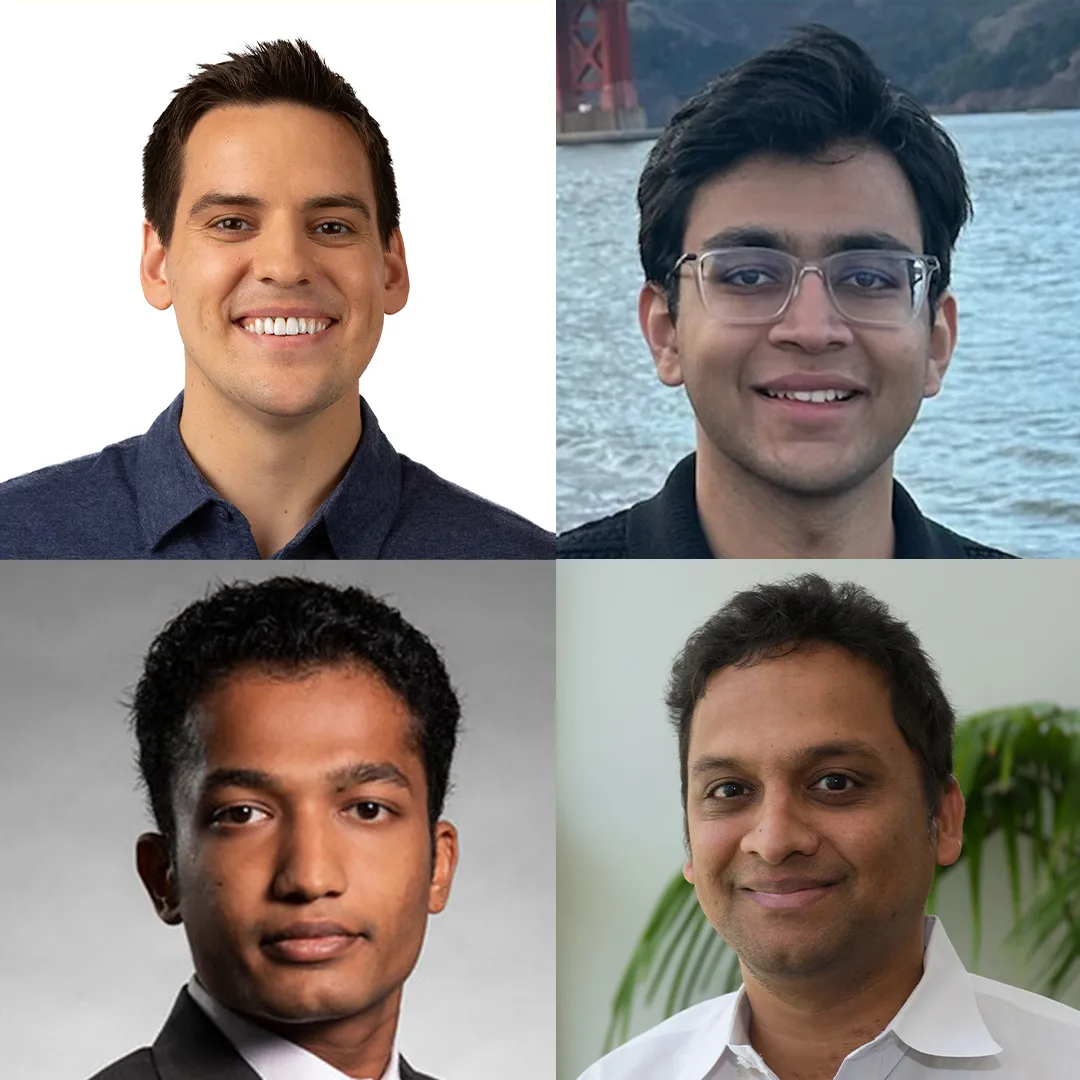
Michael Galarnyk, Ph.D. Machine Learning ’28; Veer Kejriwal, B.S. Computer Science ’25; Agam Shah, Ph.D. Machine Learning ’26; and Sudheer Chava, Alton M. Costley Chair and professor of Finance at Georgia Tech
Georgia Tech researchers have designed the first benchmark that tests how well existing AI tools can interpret advice from YouTube financial influencers, also known as finfluencers.
Lead author Michael Galarnyk, Ph.D. Machine Learning ’28, joined lead authors Veer Kejriwal, B.S. Computer Science ’25, and Agam Shah, Ph.D. Machine Learning ’26, along with co-authors Yash Bhardwaj, École Polytechnique, M.S. Trustworthy and Responsible AI ‘27; Nicholas Meyer, B.S. Electrical and Computer Engineering ’22 and Quantitative and Computational Finance ’24; Anand Krishnan, Stanford University, B.S. Computer Science ‘27; and, Sudheer Chava, Alton M. Costley Chair and professor of Finance at Georgia Tech.
Aptly named VideoConviction, the multimodal benchmark included hundreds of video clips. Experts labelled each clip with the influencer’s recommendation (buy, sell, or hold) and how strongly the influencer seemed to believe in their advice, based on tone, delivery, and facial expressions. The goal? To see how accurately AI can pick up on both the message and the conviction behind it.
“Our work shows that financial reasoning remains a challenge for even the most advanced models,” said Michael Galarnyk, lead author. “Multimodal inputs bring some improvement, but performance often breaks down on harder tasks that require distinguishing between casual discussion and meaningful analysis. Understanding where these models fail is a first step toward building systems that can reason more reliably in high stakes domains.”
News Contact
Kristin Lowe (She/Her)
Content Strategist
Georgia Institute of Technology | Scheller College of Business
kristin.lowe@scheller.gatech.edu
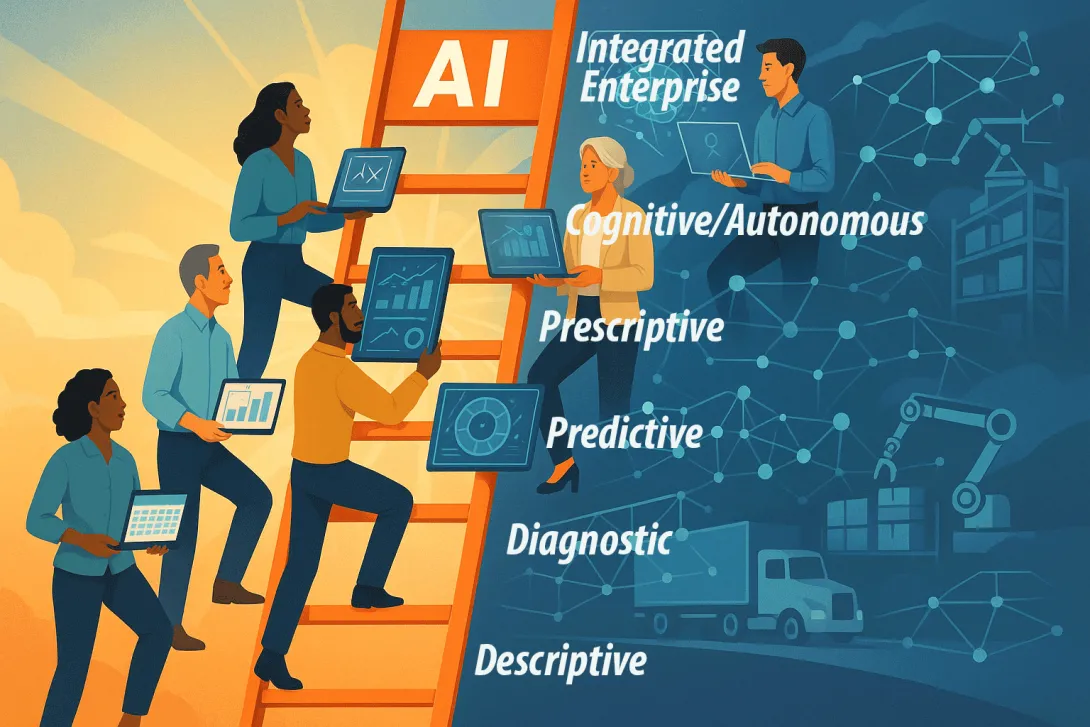
In this special episode, guest host Brian Kennedy sits down with Chris Gaffney to explore how supply chain professionals can take control of their careers by embracing artificial intelligence. Chris introduces the “AI Maturity Ladder,” a step-by-step roadmap that helps individuals and teams evolve from foundational tools like Excel to advanced capabilities like predictive analytics, machine learning, and AI agents.
Chris Gaffney
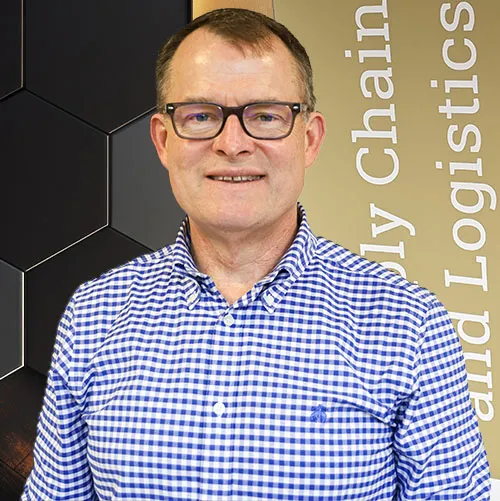
By Chris Gaffney, Managing Director, Georgia Tech Supply Chain and Logistics Institute | Supply Chain Advisor | Former Executive at Frito-Lay, AJC International, and Coca-Cola
Introduction
Artificial intelligence has entrenched itself in almost every aspect of the professional world. From copywriting tools to search engine optimization and image generation, professionals and laypeople alike use this new technology to streamline daily activities. But, before AI, there was high-level analytics and machine learning in supply chain. Analysts across the supply chain used machine learning to interpret high volumes of data and turn it into predictive algorithms for inventory planning, demand planning, and more. Now, AI is generating these analytics at a much faster, real-time pace.
This shift raises important questions. What does this mean for technology professionals in the supply chain world who once made a living doing these jobs? And what can we expect for aspiring supply chain pros or mid-career professionals who want to increase their value to the team in an age of accelerated technological advances?
The fact of the matter is that AI is now everybody’s job. Standing still will ensure that you get left behind by your peers or the talent pipeline from colleges and universities. The question then becomes, how can I upskill and use what I already know to add value to my role and ensure that my AI competencies allow me to compete in today’s supply chain workforce?
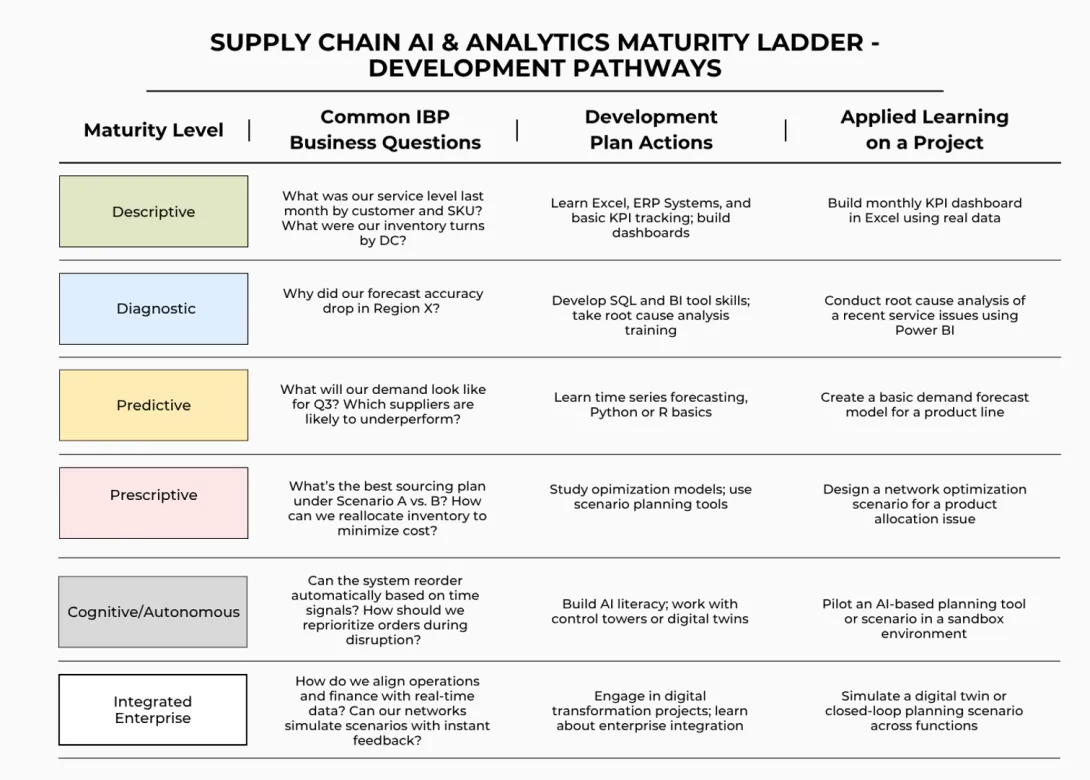
We’ll look at the ladder as a series of increasing levels of complexity and AI activity—what we’ll call ‘maturity levels’: descriptive, diagnostic, predictive, prescriptive, cognitive/autonomous, and integrated enterprise.
Some things to bear in mind as we progress through this topic:
- Everybody is somewhere on the ladder, so everyone has the opportunity to climb the ladder.
- Analytics are no longer just for specialists. AI allows analytics to be an access point to the ladder. You no longer have to rely on someone else higher up on the ladder, and it’s in your best interest to climb higher, regardless of your job description.
- There are lots of resources freely available to allow you to climb the ladder. But in most companies, you can find a mentor who is further along on a ladder, and perhaps they can help you up-skill your operational knowledge and help you advance your capabilities to ascend the ladder.
We’re here to discuss to what degree you should so you can optimize your career opportunities and not be left behind.
How Did We Get Here?
In the field of supply chain we’ve always been ahead of the curve when it comes to these types of innovations. Before AI, we were using machine learning and predictive analytics to enhance our understanding of real-time supply issues. We worked a lot on optimizations at Coke and started utilizing machine learning tactics almost 10 years ago. While I wasn’t the hands-on user of the technology, I took it upon myself to try and understand exactly what was happening and how it was working.
That was a large corporate machine–one of the biggest brands in the world–utilizing the latest in predictive analytics technology. And now we have a democratization of this technology being spread across industries. You no longer need to be part of such a high-powered team to make use of these tools.
We have now entered into an era where artificial intelligence has become omnipresent across almost every supply chain practice and industry, or any other career discipline. The key is understanding best practices is making use of AI in your field, and how you can add value and incorporate it into your everyday work-life.
Descriptive Level: From Rearview Mirror to Forward Thinking Decisions
“If you have some proficiency in Excel, then you’re on the ladder.” - Chris Gaffney
The lowest rung on the AI ladder is the descriptive level. Excel knowledge and experience resides here and can be the access point for most people. This level helps us describe what is happening with numbers and data. Reporting dashboards can be crafted here, and we can run trend analysis using basic inference to see what is happening and where to make adjustments, if necessary.
Excel tells us what did happen - not what could happen. These are important functions, to be sure. However, they only look behind us. They tell us what and why. Today’s supply chain landscape requires tools that allow us to make decisions based on what could happen in the future. We don’t have the power to make proactive decisions or to navigate uncertainty and factor in variables of change.
Our competitive edge is sharpened by having the capability to shape the future, not just explain the past. In order to do so, we need to move up into predictive and prescriptive AI territory.
Up until very recently, this descriptive capability was enough. Analysts, planners, and buyers were all able to produce data that helped others to understand what was happening. The data then required synthesis and analysis. The whys and so whats were human functions performed by different team members and used to measure the efficacy of various inputs and outputs throughout the supply chain. As one moves up the chain of command, so to speak, the ability to interpret the data and findings becomes even more important. However, the numbers crunching and analytics were more siloed.
And now, everyone has access to AI’s ability to synthesize and analyze raw data. But very few “off-the-shelf tools” can answer the why, let alone the ‘what should we do about it’ questions. Planners and managers need to upskill and ensure that they are up to speed on the capabilities and deficiencies of these platforms and insert themselves and their skillsets to close those gaps.
Roles at this level:
- Transportation analysts
- Warehouse supervisors reviewing daily throughput metrics
- Demand planners tracking forecast accuracy from the last quarter
Working in hindsight by monitoring and measuring data is important, albeit limiting. This looking backward in the world of supply chain decision making at a time when forward thinking is essential for future proofing your supply chain organization. Staying here too long limits your ability to prevent problems before they escalate.
What to do next?
- Learn Power BI or Tableau for interactive dashboards
- Get comfortable using large data sets from your ERP or WMS
- Start asking, “why” and “so what”
Diagnostic Level - Information into Insight
“This is where you start to become more valuable because now you can help the team avoid repeat issues.”
So you’ve now measured what happened. The next logical question is why? Here’s where many companies fall short by relying on only internal historical data. The real learning happens when you bring in external variables like weather, economy, labor, or competitive actions. Diagnostics help uncover root causes and patterns across time and systems. What does this mean for you and the AI ladder?
This could mean combining two different datasets using SQL to pull deeper reports or identifying correlations between variables. You need to be able to get inside of your supply chain to see what’s really going on, much like a physician will draw blood or perform various scans to get a more vivid and comprehensive picture of what’s happening.
Examples from the field:
- A demand planner diagnosing why forecasts were consistently off by adding external factors outside your control.
- A transportation analyst finding route disruptions correlated with labor strikes and weather trends - kinda like WAZE.
What you can do
- Add layers of internal and external factors
- Use Power BI or Excel to show the impacts of external events
- Start to track leading indicators, not just lagging ones.
Predictive - Seeing What’s Coming
“Most of the tools we have heavily leverage your own history. But your ability to sell a product next year is different because you don’t control everything.”
Predictive analytics enables supply chain professionals to see trends, forecast disruptions and plan proactively.
As we mentioned earlier, most forecasting tools rely too much on internal history. Predictive power comes from adding things like economic trends, labor availability, weather, etc., to your forecasting models.
My first exposure to the broader umbrella of machine learning, falling under AI, was while working at Coke. Every night, our machines processed enormous volumes of data to track how much of each type—across countless product combinations—was being used. This data was being used to predict when the fountain machines would fail so that we could prepare a replacement without losing time or operational capacity. Basically, this meant we could allocate maintenance resources proactively instead of reactively.
This machine learning doesn’t have to be intimidating. In fact, machine learning was the #1 skill in supply chain job postings in 2024. Python and machine learning are much more accessible tools than they once were, and many professionals are teaching themselves the basics using online resources that are much more prevalent than they once were. Again, the democratization of AI tools means everyone can level up a lot faster.
Roles Seeing This Shift
- Demand planners and sourcing managers are combining historical sales information with things like inflation, trade wars, and taste evolutions.
- Transportation teams are integrating weather trends and traffic data to reroute loads
What Can You Do:
- Learn the basics of Python’s forecasting libraries
- Pull in a single external variable, like weather or labor availability, into your demand forecast.
- Track model accuracy over time to see where it succeeds and, most importantly, fails.
Prescriptive: Deciding What to Do About It
"We don’t want analytics experts. We want people who are applied analytics or applied AI experts.”
It’s not just identifying the risk. The key is choosing a more effective path forward. And this requires modeling scenarios in a way that lets you take action rather than just be an observer.
A lot of companies stop at prediction. The ones that get ahead of the pack are those that are able to simulate outcomes and use this logic in daily decisions. Just remember that context is everything. Those with very impressive technical skills can sometimes miss the mark because they didn’t understand the business. There are also supply chain planners with moderate technical skills who can make major contributions because they knew what mattered and where to apply it.
The supply chain AI ladder is crucial, but only as effective as the depth of the supply chain knowledge base.
Cognitive and Integrated is When AI Starts to Work With You
This is the very top of the ladder or the tip of the AI ladder iceberg, if you will. This is the realm of AI agents that are learning and acting in an intelligent and sometimes autonomous manner. The cognitive tier blends into the integrated enterprise, where systems and data are connected. Warehouses talk to the forecast, which communicates with sourcing, which can adjust production. This is kind of futuristic, but based on how AI has evolved, it will likely be ubiquitous within a couple of years.
How to Apply Cognitive and Integrated AI:
- Learn how to build a basic GenAI or logic-based agent using online tutorials or sandbox tools
- Make sure the AI Agent’s work is sound before turning it loose on our business. The human element is still crucial in these cases.
Role of Leadership in Deploying the Supply Chain AI Ladder
“This can’t be a black box to you.”
Leaders need to know just enough about AI to advocate for it. If you’ve hired the right people, then you trust them to do the job that you hired them to do. If they’re telling you that AI tools will help them do their jobs better, then listen to them. Find out what your team needs and get them to explain to you how AI can unlock more benefits for your business.
Encourage them to pursue professional development courses and to experiment in a safe environment until they feel confident integrating the tools into regular operation.
Conclusion: Don’t Stand Still and Be Left Behind
The supply chain AI ladder is real, and it’s climbable. You are not too late to get on board and begin using AI to increase your personal value at your company. It doesn’t matter how old you are - whether you’re an entry-level professional with an MBA, a mid-career professional, or a seasoned C-suite executive. There is a place on the ladder for you.
The most valuable assets that employees can bring to bear right now in this tech immersion context. Those who have been in the workforce for a few years are able to mix their experiential knowledge with the tools and assets available through AI to translate technology into real-world wins for your supply chain teams. Your value increases significantly if you pair your knowledge with proactive learning tools.
Take the time to self-assess and figure out where you are on the ladder.
Don’t try to jump too high up on the level. Take it one rung at a time. Then reassess.
Commit to the 70/20/10 rule. 70% on-the-job learning, 20% learning from peers and mentors, and 10% formal training.
Apply what you’ve learned and stay curious. Just don’t get complacent. This is not the time to rest on your laurels because someone who is hungry for knowledge will be on your heels.
This content was developed in collaboration with SCM Talent Group, a supply chain recruiting and executive search firm.
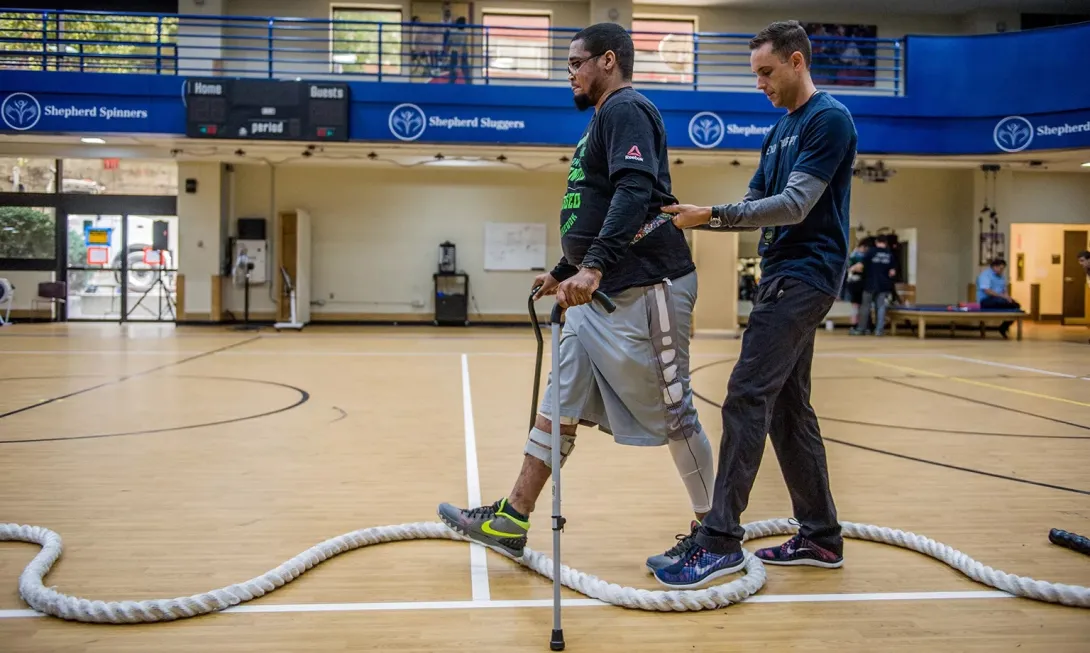
The seed grants will fund projects focused on enhancing wheelchair seating surfaces, supporting stroke patients as they transition home from rehabilitation, assessing lower limb exoskeleton technologies, and exploring the use of AI in remote rehab settings. Photo: Shepherd Center.
Georgia Tech and Shepherd Center recently awarded four seed grants totaling nearly $200,000 to researchers focusing on projects that will advance discoveries in neurorehabilitation, including acquired brain injury, spinal cord injury, multiple sclerosis, chronic pain, and other neurological conditions.
The Georgia Tech-Shepherd Center Seed Grant Program is part of an ongoing partnership between the two institutions that started in 2023 with the goal of advancing rehabilitative patient care and research.
“The seed grant program is intended to stimulate new interdisciplinary research collaborations by providing seed funding to obtain preliminary data or prototypes necessary for the submission of an external grant or industry opportunities,” says Deborah Backus, vice president of Research and Innovation at Shepherd Center. “As two leading research institutions, we know the potential for advancing rehabilitation therapies is even greater when we work together. We look forward to the solutions, treatments, and therapies that emerge from these initial seed grants.”
Experts from both institutions evaluated and scored seed grant applications based on the research’s innovation, approach, and potential for training opportunities, as well as its anticipated impact, prospects for commercial translation, and strategy for securing continued funding. This year, each awardee team received close to $50,000.
“We are very excited to launch this new seed grant program, which will spur ideas and propel research forward,” said Michelle LaPlaca, professor in the Coulter Department of Biomedical Engineering and the Georgia Tech lead of the Collaborative. “The complementary expertise of Georgia Tech and Shepherd Center researchers, combined with the motivation to find solutions for individuals with neurological injury and disability, is a winning formula for innovation.”
"Offering new hope for neurorehabilitation patients requires bringing together interdisciplinary researchers to explore new and creative ideas,” adds Chris Rozell, Julian T. Hightower Chaired professor in the School of Electrical and Computer Engineering and the inaugural executive director of the Institute of Neuroscience, Neurotechnology, and Society (INNS) at Georgia Tech. “I'm excited to see the talent at these world class institutions coming together to develop new solutions for these complex problems."
This year’s seed grants were awarded to the following projects:
- Proof of Concept Development of the Recovery Cushion – Stephen Sprigle, professor, School of Industrial Design and School of Mechanical Engineering, Georgia Tech; Jennifer Cowhig, research physical therapist, Shepherd Center.
- Paving a Smooth Path from Hospital to Home: A Feasibility Study of an Integrated Smart Transitional Home Lab to Support Stroke Rehabilitation Patients’ Transition to Home – John Morris, senior clinical research scientist, Shepherd Center; Hui Cai, professor in the School of Architecture, executive director of the SimTigrate Design Center, Georgia Tech.
- A Comparative Analysis of Lower-Limb Exoskeleton Technology for Non-Ambulatory Individuals with Spinal Cord Injury – Maegan Tucker, assistant professor, School of Electrical and Computer Engineering and School of Mechanical Engineering, Georgia Tech; Nicholas Evans (AP 2023), clinical research scientist, Shepherd Center.
- Improving Accessibility and Precision in Neurorehabilitation at the Point of Care with AI-Driven Remote Therapeutic Monitoring Solutions – Brad Willingham, clinical research scientist, director of Multiple Sclerosis Research, Shepherd Center; May Dongmei Wang, professor, Wallace H. Coulter Department of Biomedical Engineering, Georgia Tech.
News Contact
Kerry Ludlam
Director of Communications
Shepherd Center
Audra Davidson
Research Communications Program Manager
Institute for Neuroscience, Neurotechnology, and Society
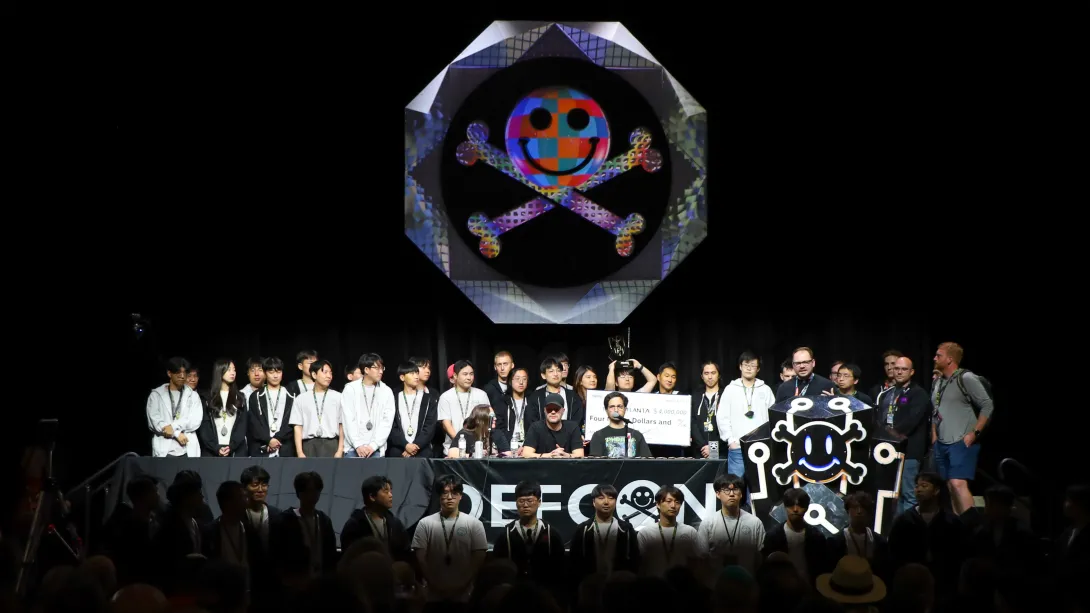
Team Atlanta, a group of Georgia Tech students, faculty, and alumni, achieved international fame on Friday when they won DARPA’s AI Cyber Challenge (AIxCC) and its $4 million grand prize.
AIxCC was a two-year long competition to create an artificial intelligence (AI) enabled cyber reasoning system capable of autonomously finding and patching vulnerabilities.
“This is a once in a generation competition organized by DARPA about how to utilize recent advancements in AI to use in security related tasks,” said Georgia Tech Professor Taesoo Kim.
“As hackers we started this competition as AI skeptics, but now we truly believe in the potential of adopting large language models (LLM) when solving security problems."
The Atlantis system was Team Atlanta’s submission. Atlantis is a fuzzer- or an automated software that finds vulnerabilities or bugs- and enhanced it with several different types of LLMs.
While developing the system, Team Atlanta reported the heat put out by the GPU rack was hot enough to roast marshmallows.
The team was comprised of hackers, engineers, and cybersecurity researchers. The Georgia Tech alumni on the team also represented their employers which include KAIST, POSTECH, and Samsung Research. Kim is also the vice president of Samsung Research.
News Contact
John Popham
Communications Officer II at the School of Cybersecurity and Privacy
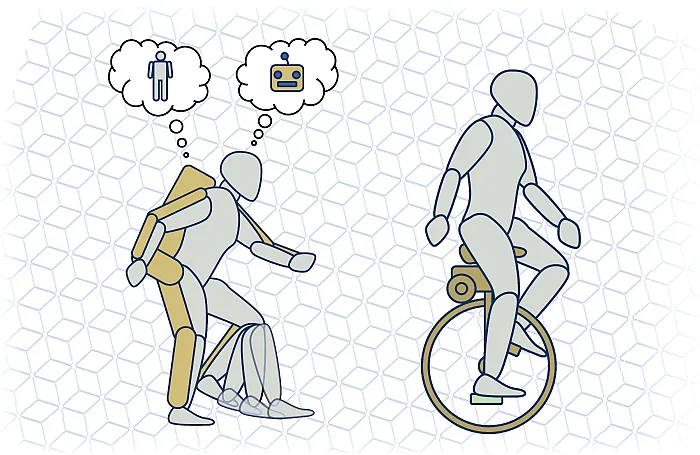
Research into tailored assistive and rehabilitative devices has seen recent advancements but the goal remains out of reach due to the sparsity of data on how humans learn complex balance tasks. To address this gap, a collaborating team of interdisciplinary faculty from Florida State University and Georgia Tech have been awarded ~$798,000 by the NSF to launch a study to better understand human motor learning as well as gain greater understanding into human robot interaction dynamics during the learning process.
Led by PI: Taylor Higgins, Assistant Professor, FAMU-FSU Department of Mechanical Engineering, partnering with Co-PIs Shreyas Kousik, Assistant Professor, Georgia Tech, George W. Woodruff School of Mechanical Engineering, and Brady DeCouto, Assistant Professor, FSU Anne Spencer Daves College of Education, Health, and Human Sciences, the research will use the acquisition of unicycle riding skill by participants to gain a better grasp on human motor learning in tasks requiring balance and complex movement in space. Although it might sound a bit odd, the fact that most people don’t know how to ride a unicycle, and the fact that it requires balance, mean that the data will cover the learning process from novice to skilled across the participant pool.
Using data acquired from human participants, the team will develop a “robotics assistive unicycle” that will be used in the training of the next pool of novice unicycle riders. This is to gauge if, and how rapidly, human motor learning outcomes improve with the assistive unicycle. The participants that engage with the robotic unicycle will also give valuable insight into developing effective human-robot collaboration strategies.
The fact that deciding to get on a unicycle requires a bit of bravery might not be great for the participants, but it’s great for the research team. The project will also allow exploration into the interconnection between anxiety and human motor learning to discover possible alleviation strategies, thus increasing the likelihood of positive outcomes for future patients and consumers of these devices.
Author
-Christa M. Ernst
This Article Refers to NSF Award # 2449160
News Contact
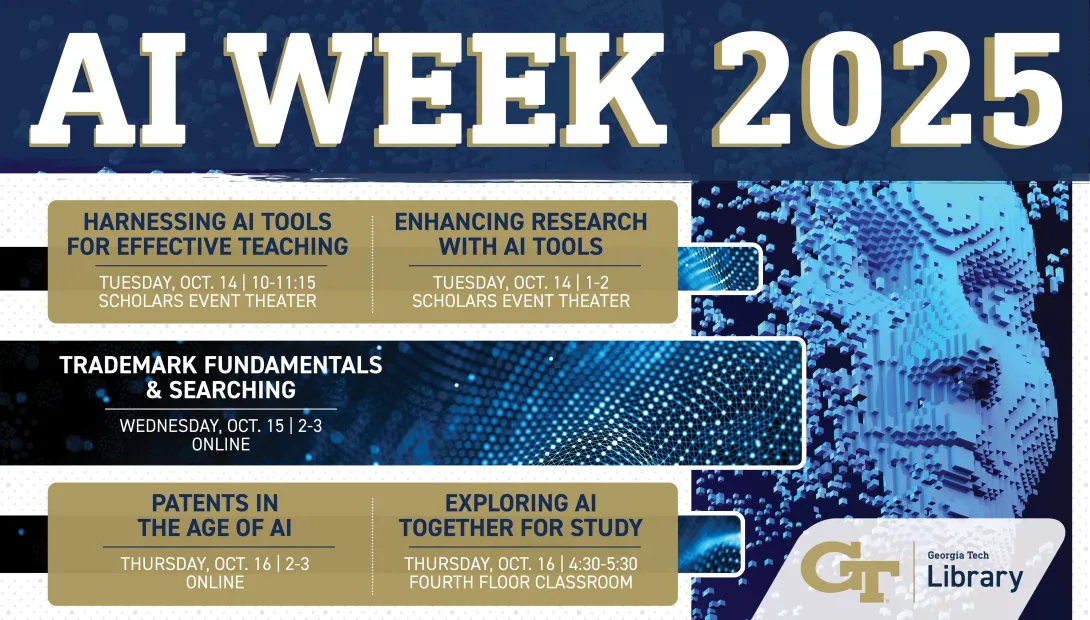
Join the Georgia Tech Library in person and virtually Tuesday Oct. 14 through Thursday, Oct. 16 for our Inaugural AI Week, a mix of panel discussions and seminars aimed at celebrating and investigating the myriad ways researchers, students and faculty harness the burgeoning technology.
“We’re thrilled to bring this slate of events, discussions and learning opportunities to campus focused on the game-changing use of artificial intelligence happening across the Institute,” said Dean Leslie Sharp. “The Library has brought together industry experts, student practitioners and research faculty to offer a varied and intriguing set of learning opportunities for our community.”
AI Week 2025 will include five separate in-person and online events, including:
- Faculty Panel Discussion: Harnessing AI Tools to Make Teaching More Effective and Engaging
Oct. 14 | 10:30-11:15 a.m.
Scholars Event Network, first floor Price Gilbert
- Panel Discussion: Enhancing Research with AI Tools
Oct. 14 | 1-2 p.m.
Scholars Event Network, first floor Price Gilbert
- Trademark Fundamentals and Searching (ONLINE)
Oct. 15 | 2-3 p.m.
Online
- Patents in the Age of AI: Navigating the Changing Landscape (ONLINE)
Oct. 16 | 2-3 p.m.
Online
- Exploring AI Together for Study, Copilot and Firefly
Oct. 16 | 4:30-5:30 p.m.
Crosland Tower Fourth Floor Classroom
Chris Gaffney
By Chris Gaffney, Managing Director, Georgia Tech Supply Chain and Logistics Institute | Supply Chain Advisor | Former Executive at Frito-Lay, AJC International, and Coca-Cola
A Personal Wake-Up Call
I’ve always considered myself a reasonably strong critical thinker—someone who asks good questions, challenges assumptions, and doesn’t adopt a viewpoint just because it’s popular. But a recent experience humbled me. I took an open-source critical thinking test and didn’t do nearly as well as I expected.
This led me down a deeper path of inquiry. I was already concerned about how two decades of social media have shaped the way we consume and respond to information—short, sensational content delivered by algorithm. And now, with the rapid rise of generative AI, I worry we may be trading our thinking for speed and scale.
I use AI tools daily, and I advocate for their use—especially in supply chain applications. But I’ve also come to believe this: if we’re not careful, we risk outsourcing the very thinking that makes us human and effective decision-makers.
Why Critical Thinking Matters More Than Ever—Especially in Supply Chain
Critical thinking isn’t just a defense mechanism—it’s a differentiator. In a world where AI can generate answers instantly, the professionals who ask the right questions will stand out.
Supply chain professionals operate in environments where second and third-order consequences matter. We are called on to make decisions under uncertainty, weigh risks, balance competing priorities, and understand interdependencies.
Judgment—tempered by experience, structured analysis, and humility—is the edge. Tools can help you scale, but they cannot replace the human responsibility to challenge, reflect, and adjust.
What Is Critical Thinking?
Critical thinking is the ability to think clearly and rationally about what to do or believe. It involves:
- Questioning assumptions
- Evaluating evidence
- Recognizing biases (ours and others’)
- Drawing reasoned conclusions
- Reflecting on one’s own thought process
Said simply, it’s self-awareness of your thinking style—how you form your views, test them, and revise them when new evidence emerges.
It requires effort. It requires slowing down. It requires, at times, being wrong.
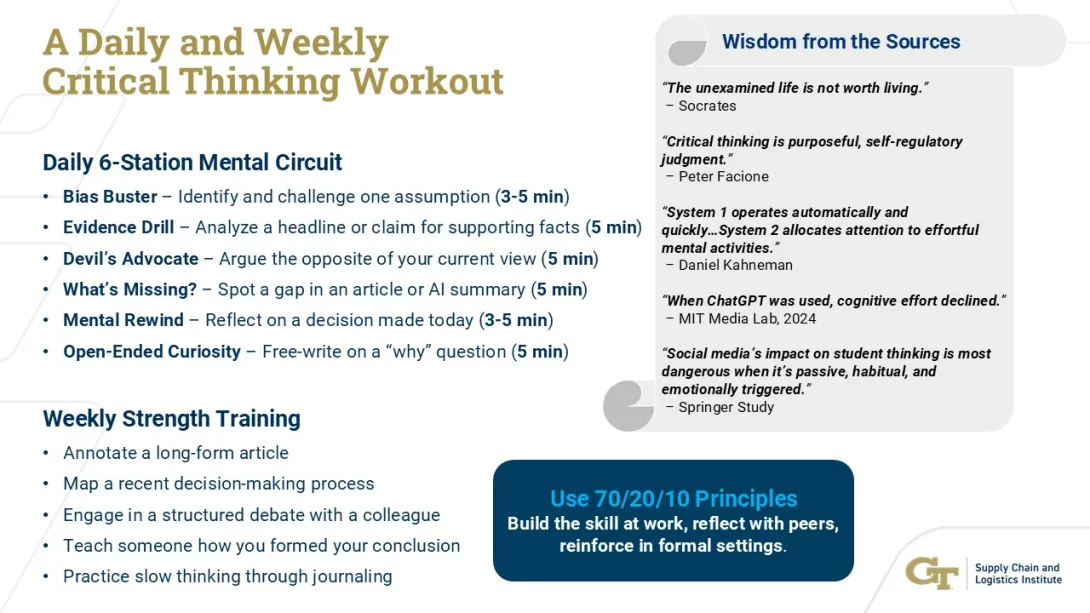
Facione, in his Delphi Report, defines it as "purposeful, self-regulatory judgment."
Kahneman reminds us that our brains are wired for shortcuts—“System 1” thinking is fast and efficient but often error-prone. True critical thinking requires “System 2” effort: slow, reflective, and disciplined.
Are We Losing It?
There’s growing evidence we are.
Social media echo chambers reduce exposure to opposing views. Short-form content conditions us to expect fast answers. And according to the MIT Media Lab (Kosmyna et al., 2024), students using ChatGPT retained less, showed reduced cognitive effort, and had lower originality.
“When ChatGPT was used, cognitive effort declined.”
And yet—this is not a moment for despair. It’s a call to discipline. Because critical thinking, practiced intentionally, can become a personal and professional superpower.
Applying Critical Thinking in Supply Chain Decisions
Supply chain professionals face complexity daily—inventory tradeoffs, supplier uncertainty, resource constraints, policy risk. Many of these decisions can’t be answered by tools alone—they require judgment. Critical thinking lives in that judgment.
Whether you're building a forecast, evaluating a supplier, responding to a disruption, or modeling risk exposure, structured thinking provides a path. The steps are familiar:
- Define the problem clearly
- Clarify what information is available—and what’s missing
- Analyze root causes or future implications
- Generate multiple options
- Establish decision criteria
- Choose a path—and test it before launch
- Monitor and adjust as feedback arrives
This process resembles A3 thinking or supply chain analytics. But what makes it powerful is doing it intentionally—even under pressure.
The best professionals I’ve worked with practice it on small decisions as well as large ones. They don’t confuse speed with clarity.
Practicing Critical Thinking When Using Generative AI
AI tools are powerful—but without deliberate use, they can dull our thinking. Here's how to make AI work with your brain—not instead of it:
- Document your assumptions before prompting
- Journal your intent: What are you trying to decide or explore?
- Ask AI to provide counterarguments or alternative views as well as sources for you to research and draw your own conclusions
- Look for what’s missing or oversimplified
- Summarize AI output in your own words
- Track and reflect on how AI influenced your decisions
Treat AI like a research assistant—not a strategist. Use it to extend your reach, not replace your reasoning.
Final Thought and Your Next Steps
Critical thinking is no longer optional. Not in business. Not in education. Not in leadership.
It is a skill. A discipline. And a mindset that pays dividends over a lifetime.
If you’ve read this far, take this challenge seriously:
- Write out how you form your opinions—on paper.
- Practice structured thinking on small problems weekly.
- Use AI with intention—never outsource your judgment.
- Teach someone else how you reached a conclusion.
- Be humble. Ask yourself: what if I’m wrong?
- Keep a thinking journal for 30 days.
The goal isn’t to be right all the time. It’s to be reflective, rigorous, open to challenge, and consistent over time. That’s what the world needs more of. That’s the edge AI can’t replicate.
So think before you automate.
And never stop questioning.

Walk into any room Aleksandra Teng Ma’s been working in this summer, and you’ll probably hear a mix of experimental sounds, snippets of Amy Winehouse vocals, and the occasional Animal Crossing tune playing in the background. That’s just how her brain works—blending tech, artistry, and everyday play into something entirely her own.
Aleksandra is a master’s student in Music Technology at Georgia Tech, but “student” barely scratches the surface. This summer, she’s been everywhere—physically in Massachusetts and intellectually somewhere between a Pride performance and a human-AI jam session at MIT.
“I’m always with my microphone and MIDI keyboard,” she says, like it’s just second nature. “I love singing and coming up with tunes.”
Live from MIT — It’s Human + AI Jamming
Forget dusty textbooks and silent labs—Aleksandra’s research life is about real-time musical interactions between humans and AI. As a visiting researcher at MIT this summer, she’s digging into what it looks like when musicians "jam" with intelligent systems. Think futuristic band practice, but with algorithms joining in.
“It’s giving me a lot of exposure to co-design methodologies,” she explains, “and letting me observe how musicians respond to each other—and to AI.”
It’s not just code and theory, either. The insights come alive when she brings them to the stage. This summer, Aleksandra’s band performed at The Music Porch in Reading, MA for Pride Month. Their cover of Pink Pony Club turned into a moment she won’t forget.
“It was so fun seeing people—especially teenagers—singing and dancing together,” she says. “That’s one of those moments where I just thought, yep, this is why I picked music tech.”
From Winehouse Covers to Ableton Experiments
Despite her research chops, Aleksandra hasn’t lost touch with the joy of just making music. She sings and plays keyboard in a band, covers Amy Winehouse songs, and occasionally writes music just for fun. (Her dream studio partner? You guessed it: Amy herself.)
She’s also been expanding her technical toolkit this summer, diving deeper into sound design with Ableton and Serum.
“Still learning,” she says, “but I’m using them for sound design in songs—and loving it.”
And then there are the unexpected “whoa” moments. Like when she built a vocal patch for the Pixies’ Where Is My Mind? to use live during a performance.
“It was haunting,” she says. “And it worked so well live.”
Dream Tech and Georgia Tech
Ask Aleksandra what she’d invent if she could mash up two instruments, and she already has an idea:
“Automatic vocal effects through a microphone with a built-in amplifier,” she says, laughing. “Honestly, someone probably already made this, but I want it anyway.”
That kind of thinking is exactly what her time at Georgia Tech has sparked. Before the program, she saw music mostly through the lens of conventional instruments. Now? She’s all about how software and hardware can expand what music even is.
Her Summer, in Sound
If Aleksandra’s summer had a vibe, it’d be:
- A creek bubbling in the background
- A long, ghostly reverb trail on a siren vocal
- And the ever-cozy tones of Animal Crossing
Not exactly your typical lab soundtrack—but that’s the beauty of it.
This fall, she’s heading back to Georgia Tech after a gap year at Bose, ready to jump into research on multimodal music source separation (AKA teaching machines to pick apart and understand layers in music the way humans do).
And yes, she’ll still be singing.
Hits with Aleksandra
- Current summer jams: Rosebud by Oklou & the new Lorde album
- What people don’t “get” about her work: “How music signals work on a granular level”
Aleksandra Ma doesn’t just study music tech—she lives it. Whether she’s tweaking reverb patches, performing under porch lights, or teaching AI how to groove, she’s showing what it really means to be a 21st-century musician.
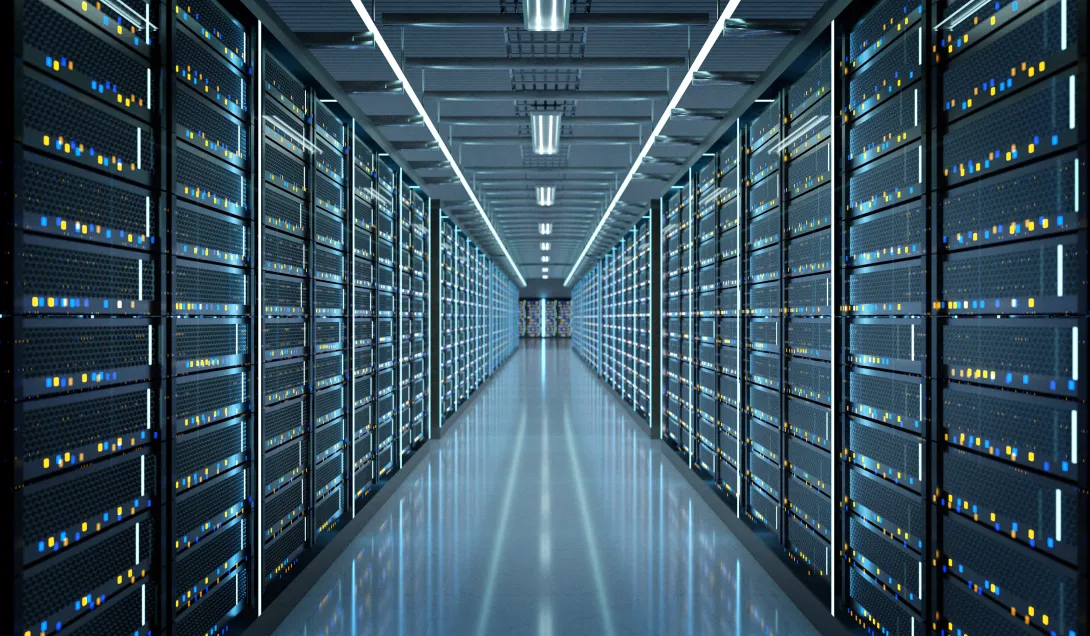
As Georgia positions itself as a hub for digital infrastructure, communities across the state are facing a growing challenge: how to welcome the economic benefits of data centers while managing their significant environmental and infrastructure impacts. These facilities, essential for powering artificial intelligence, cloud computing, and everyday internet use, are also among the most resource-intensive buildings in the modern economy.
While companies like Microsoft and Google have pledged to reach net-zero emissions, experts say more transparency and smarter policy are needed to ensure that data center development aligns with community and environmental priorities. That means ensuring adequate energy infrastructure, investing in renewables, training local workers, and mitigating water and carbon impacts through innovation.
A New Kind of Energy Crunch
The rapid rise of AI is fueling explosive demand for computing power — and in turn, energy.
“The proliferation of AI workloads has significantly increased data center energy requirements,” says Divya Mahajan, assistant professor in the School of Electrical and Computer Engineering. “Large-scale AI training, especially for language models, leads to elevated and sustained power draw, often nearing the thermal and power envelopes of graphics processing units systems.”
This sustained demand is particularly challenging in hot, humid regions like Georgia, where cooling systems must work harder. “Training these models can cause thermal instability that directly affects cooling efficiency and power provisioning,” Mahajan explains. “This amplifies reliance on external cooling infrastructure, increasing water consumption and grid strain.”
Environmental and Economic Pressure
“Each new data center could lead to greenhouse gas emissions equivalent to a small town,” says Marilyn Brown, Regents’ and Brook Byers Professor of Sustainable Systems in the School of Public Policy. “In Georgia, the growth of data centers has already led to plans for new gas plants and the extension of aging coal plants.”
There’s an environmental cost to this growth: electricity and water. A single large data center can consume up to 5 million gallons of water per day.
Rising demand has a price. “It’s simple supply and demand,” says Ahmed Saeed, assistant professor at the School of Computer Science. “As overall power demand increases, if supply doesn’t keep up, costs will rise and the most affected will be lower-income consumers.”
Still, experts are optimistic that policy and technology can help mitigate these impacts.
Innovation May Hold the Key
Despite the challenges, experts see opportunities for innovation. “Technologies like direct-to-chip cooling and liquid cooling are promising,” says Mahajan. “But they’re not yet widespread.”
Saeed notes that some companies are experimenting with radical ideas, like Microsoft’s underwater Project Natick or locating data centers in Nordic countries where ambient air can be used for cooling. These approaches challenge conventional infrastructure norms by placing servers underwater or in remote, cold regions. “These are exciting, but we need scalable solutions that work in places like Georgia,” he emphasizes.
What Communities Should Ask For
As communities compete to attract data centers, experts say they should push for commitments that go beyond job creation.
“Communities should ensure that their power infrastructure can handle the added load without compromising resilience or increasing costs,” Saeed advises. “They should also require that data centers use renewable energy or invest in local clean energy projects.”
Training and hiring local workers is another key benefit communities can demand. “Deployment and maintenance of data centers require skilled workers,” Saeed adds. “Operators should invest in technical training and hire locally.”
Policy Can Make the Difference
Stronger policy frameworks can ensure growth doesn’t come at the expense of Georgia’s most vulnerable communities. “We need more transparency from companies about their energy and water use,” says Brown. “And we need policies that prevent the costs of supporting large consumers from being passed on to residential ratepayers.”
Some states are already taking action. Texas passed a bill to give regulators more control over large power consumers. In Georgia, a bill that would have paused tax breaks for data centers until their community impact was assessed was vetoed — but experts say the conversation is far from over.
“Data centers are here to stay,” says Saeed. “The question is whether we can make them sustainable — before their footprint becomes too large to manage.”