
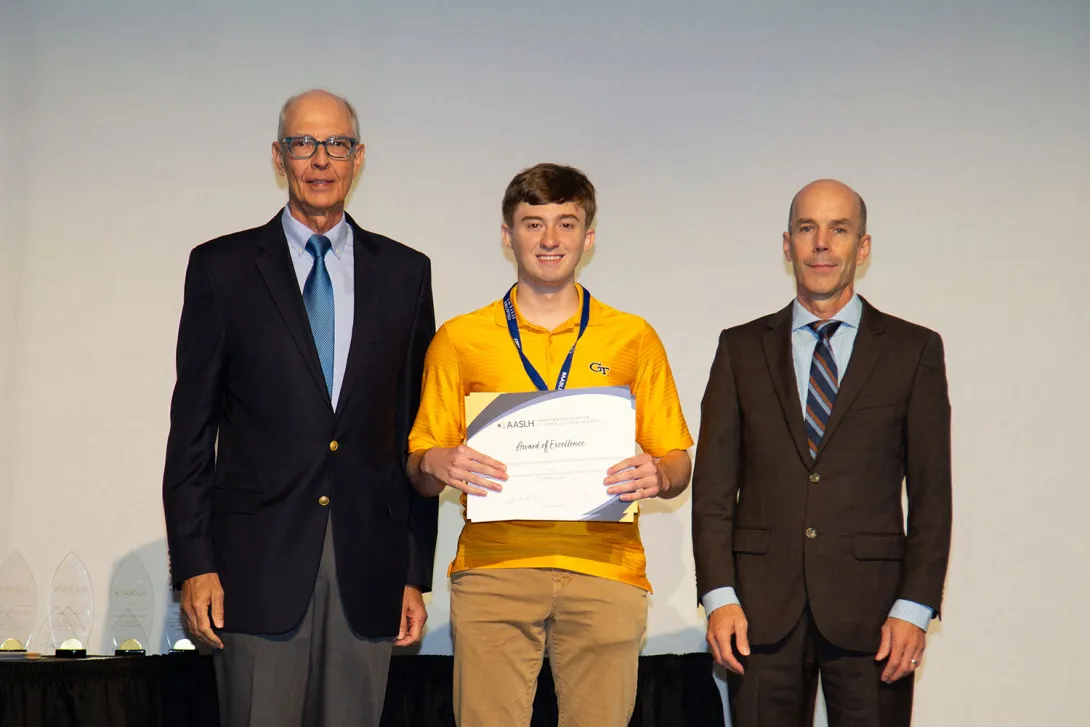
Georgia Tech student Bruce Minix accepts Award of Excellence from the American Association of State & Local History in September 2023.
Georgia Tech students played a pivotal role in the award-winning Coffee County Memory Project, an oral history initiative that preserves the stories of school desegregation in rural Georgia.
Launched in 2016, the project was supported by the Institute’s Sustainable Communities Summer Internship Program, run by the Center for Serve-Learn-Sustain (now the Center for Sustainable Communities Research and Education), in which students work full time with community partners across Atlanta and Georgia.
Beginning in 2017, trusted advisers contributed to the success of this work, including Vernon E. Jordan Jr., Christopher Lawton, Ann McCleary and G. Wayne Clough. Clough, who served as Georgia Tech’s president from 1994 to 2008, long advocated for public service, community-engaged research, and interdisciplinary teaching and learning.
In 2019, Georgia Tech students and participating interns Brice Minix and Nabil Patel combed through decades of local newspapers, digitized school board records, and conducted interviews with community members who lived in Coffee County during desegregation. In 2020, Kara Vaughan Adams and Bennett Bush transcribed countless interviews. Samina Patel’s contributions in 2020 and 2021 included graphic and web design.
All their work laid the foundation for two virtual museum exhibits: emergingVOICES of Coffee County and Overcoming Segregation: A Journey Through Coffee County’s Forgotten Stories. The latter received the 2023 Award of Excellence from the American Association of State and Local History. Further recognition came this year when the project earned the 2025 Georgia Association of Museums’ Special Project Award for the PLAYBACK & FASTFORWARD seminar series.
T. Cat Ford, Project Director said, “The Serve-Learn-Sustain interns we partnered with from Georgia Tech were all graduates of Coffee High School. Their efforts turbo-charged our work—not only because they worked tirelessly but also because, as they preserved their own history, they offered valuable insights into their lived experience of this legacy.
Click here to learn more about SCoRE’s Sustainable Communities Internship Program.
News Contact
Jennifer Martin, Assistant Director of Research Communications Services
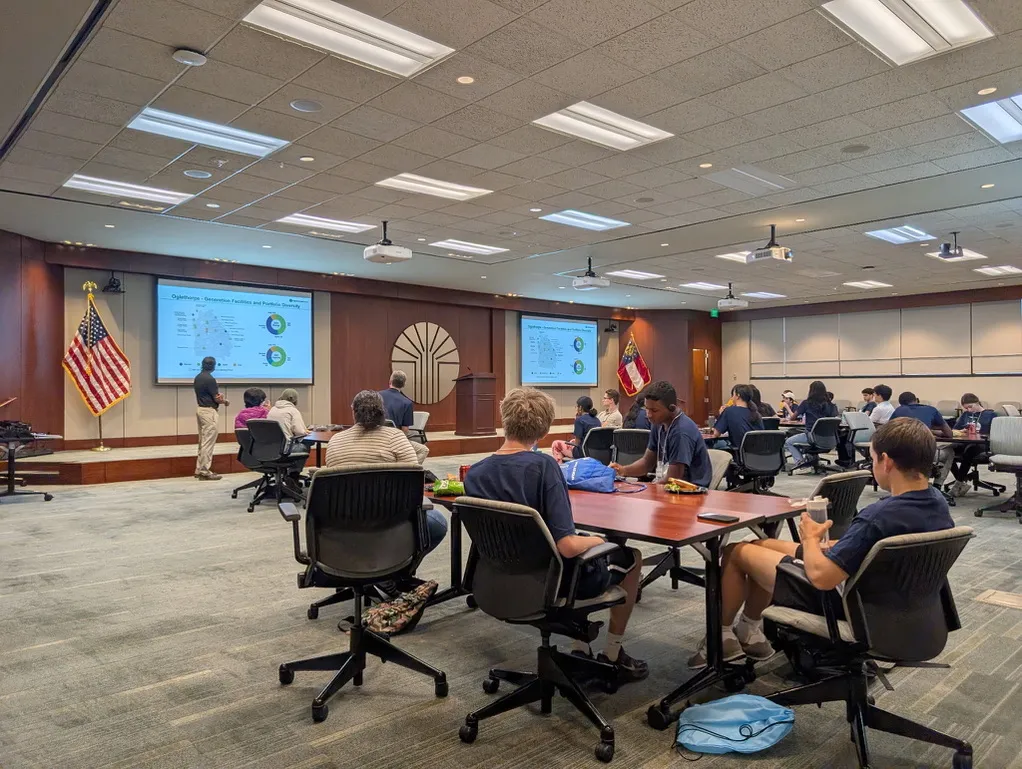
Oglethorpe Power’s George Mathai and Shane Tolbert, Green Power EMC’s distributed energy resources manager, discussing the roles of various generation sources and the benefits of a diverse portfolio with the campers.
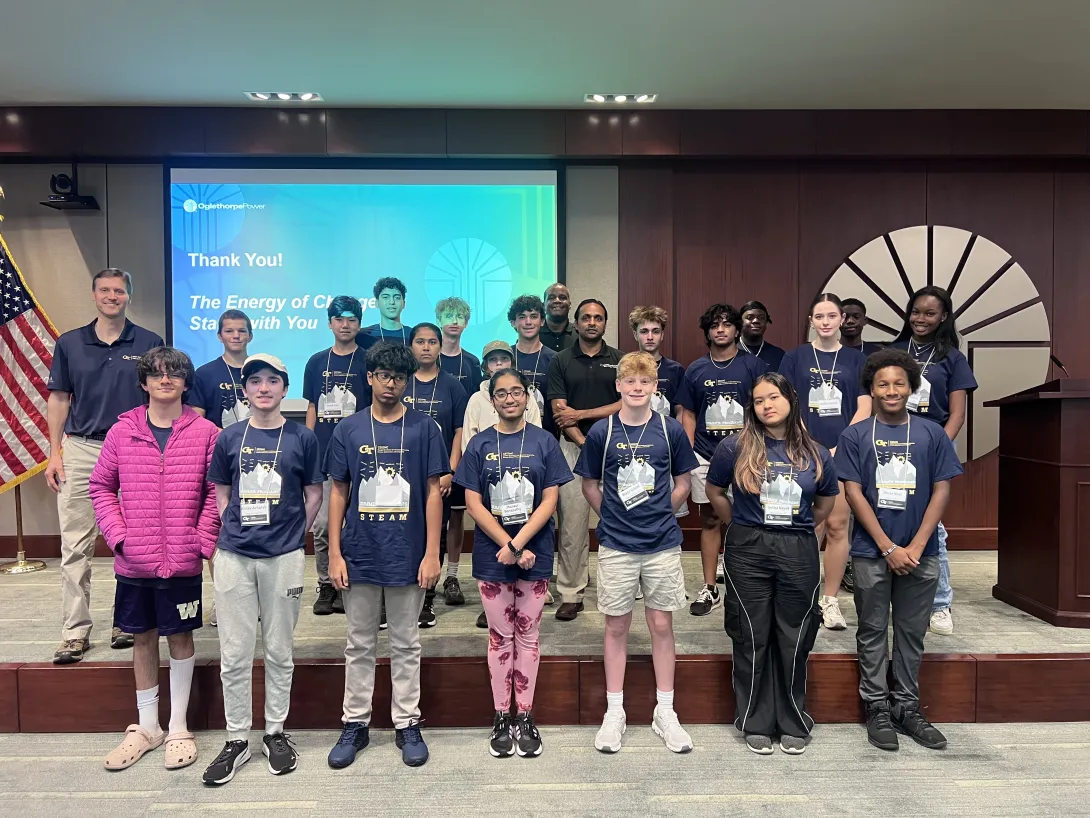
High school students, who participated in the Energy Unplugged Summer Camp at Georgia Tech during a field trip to Oglethorpe Power, Green Power EMC and Georgia Systems Operations Corporation in June 2025.
In June, Georgia Tech’s Strategic Energy Institute (SEI) and the Energy Policy and Innovation Center hosted Energy Unplugged, a weeklong summer camp focused on science, technology, engineering, art, and mathematics (STEAM) for high school students.
Led by SEI’s director of Research and Studies and principal research engineer, Richard Simmons, the camp introduced students to energy fundamentals and highlighted STEAM-related careers and undergraduate pathways valuable in today’s workforce. The curriculum included energy resources, energy production and consumption, conversion and delivery, electric circuits, battery storage, environmental impacts, and data analytics.
As a featured part of this year’s program, students visited the headquarters of Oglethorpe Power, Green Power EMC, and Georgia System Operations Corporation in Tucker, Georgia. The companies are owned by and serve 38 of Georgia’s not-for-profit electric membership cooperatives (EMCs), which provide retail electricity to approximately 4.7 million of Georgia’s more than 11 million residents.
“As electricity demand continues to rise, so does the need to grow a skilled and capable workforce for the future. We are proud to partner with Georgia Tech on this inspiring program, supporting the growth and development of the next generation of leaders who will help power Georgia’s future,” said George Mathai, Oglethorpe Power performance and reliability engineer.
The site visit included a tour of Georgia System Operations’ generation and transmission control centers and presentations by Oglethorpe Power and Green Power EMC experts.
The tour began in the generation control center, where students observed operators continuously monitoring demand to make real-time decisions to increase or decrease electricity generation. Students learned that Georgia System Operations dispatches a wide array of energy sources and generation technologies to ensure a stable, reliable, secure, and efficient power grid.
The group then visited the transmission control center, where a series of massive screens showed the web of transmission lines across the state. Students learned that the transmission system relies on extremely high-voltage lines to minimize loss across long distances. The voltages are then stepped down as they approach population centers at sub-stations, so they are suitable for use by residences, businesses, and industrial facilities. The operators in the transmission center monitor the grid for disturbances and respond to alarms, maintaining the integrity of the state’s power infrastructure.
The tour offered a behind-the-scenes look at how electricity generation and transmission are integrated and managed across the state.
Over lunch, Oglethorpe Power’s George Mathai and Shane Tolbert, Green Power EMC’s distributed energy resources manager, led discussions highlighting the roles of various generation sources and the benefits of a diverse portfolio in balancing cost, reliability, sustainable resources, and environmental impact.
“Learning about how Oglethorpe Power, Green Power EMC, and Georgia System Operations work together was a highlight of the Energy Unplugged camp, as it reinforced many of the tabletop demonstrations and hands-on activities we had conducted in the days leading up to the visit. When students then get a chance to visualize energy production, conversion, and delivery concepts at full scale, lots of light bulbs start clicking on,” Simmons said.
Jointly contributed by:
Oglethorpe Power Corporation
Georgia Tech Strategic Energy Institute (Destin Smyth)
News Contact
Priya Devarajan, Communications Program Manager,
Georgia Tech Strategic Energy Institute
Blair Romero, Director, Corporate Communications
Oglethorpe Power Corporation
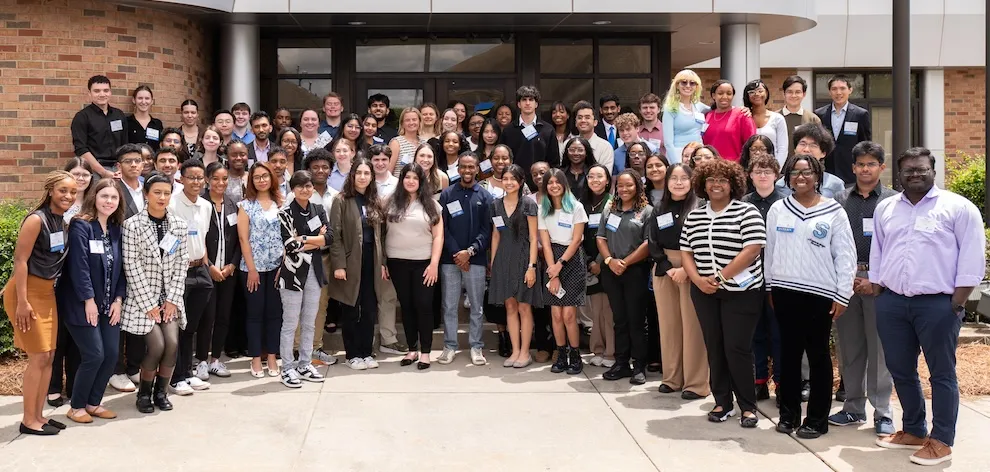
The PIN Summer Interns at the opening ceremony
The Partnership for Inclusive Innovation launched the sixth annual PIN Summer Intern (PSI) program in May with an event at Fort Valley State University’s location in Warner Robins, Georgia. The program is shaping up to be the biggest yet.
This summer, 103 students are working on 51 projects across 27 communities in Georgia, Alabama, Virginia, and Texas. Selected from nearly 700 applicants — a 73% increase over last year — these students are tackling real-world challenges ranging from AI applications in North Georgia to Native American initiatives in Whigham, Georgia, and Bracketville, Texas.
By pairing students from different years, majors and institutions, the PSI program gives the next generation of innovators hands-on experience addressing complex challenges while delivering practical solutions to communities across the region.
A collaboration with the Southeast Crescent Regional Commission (SCRC) has funded 17 projects in several counties in Middle and South Georgia and is a large part of the program’s expansion this year. The opportunity to make an impact across a broad swath of Georgia is part of why the SCRC was interested in working with PIN, said SCRC Executive Director Christopher McKinney.
News Contact
Karen Kirkpatrick (karen.kirkpatrick@innovate.gatech.edu)

For the third consecutive year, Georgia Tech has been named the best value public college by The Princeton Review.
The Institute earned the top spot in the public school rankings, based on 40 metrics that measure academics, affordability, and career outcomes, as well as survey data from administrators at over 650 schools.
Additionally, Tech ranked No. 1 for career placement.
The publication also surveys students, who praised Georgia Tech’s innovative and hands-on learning approach, which “leaves them well prepared to face the job market” after graduation. A similar opinion was shared by nearly 400 C-suite executives, whose feedback helped land Tech on the 2025 Forbes New Ivies list.
The Princeton Review’s rankings further showcase Georgia Tech’s strong return on investment. According to the most recent data from the Department of Education’s College Scorecard, the Institute ranks first among public universities when measuring ROI 15, 20, and 30 years after graduation.
Tech has maintained its position as a top-value school even in the midst of record levels of growth. In April, full-time enrollment reached 42,872, a 24.6% increase from the previous year, while total enrollment has surpassed 50,000.
News Contact
Steven Gagliano – Institute Communications