
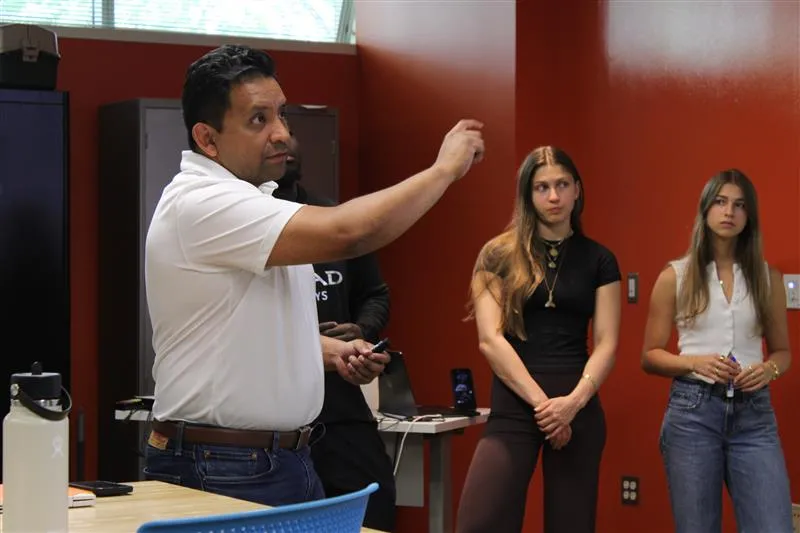
Omar Garcia, associate director of CREATE-X Learn, teaches Startup Lab.
You don’t need an idea to begin. You don’t need a co‑founder, a pitch deck, or a perfect plan. What you need is curiosity, a willingness to talk to real people, and a place where it’s safe to learn by doing. That’s exactly what CREATE‑X Startup Lab delivers.
Omar Garcia Urdiales, CREATE‑X’s associate director of Learn, brings a global entrepreneurial experience to Georgia Tech: founder and CEO of a startup operating in the AWS Accelerator Loft, longtime startup coach in Europe’s major innovation hubs, lecturer across multiple universities, and an external doctoral researcher in entrepreneurship and digitalization. He brings this background to his teaching of Startup Lab’s latest iteration – a significant redesign developed by VentureLab’s Director Keith McGreggor. McGreggor created the course and has evolved it over many years, building on its initial success.
“This new iteration of Startup Lab allows us to meet students exactly where they are,” said McGreggor. “By doing this, we give them the strongest foundation possible, providing them with the tools to grapple with uncertainty and build their confidence.”
Startup Lab has long anchored the Institute’s entrepreneurial pathway with clearer structure, a unified language, and a deeper focus on reflective growth, so more Georgia Tech students can discover (and trust) their own entrepreneurial judgment.
Startup Lab is expanding responsibly, with six sections in Atlanta and additional global sections in France and Asia-Pacific taught by faculty trained in the curriculum. Students here benefit from a program that’s learning across borders and bringing that learning back to campus.
“Startup Lab is not about becoming an entrepreneur, but about engaging in the unknown and adopting entrepreneurial behavior, which can be applied to all career paths,” Urdiales said. “Students become better equipped to identify problem spaces and solve them through evidence-based building.”
Start Where You Are
Urdiales emphasized that Startup Lab is built for students who are still exploring, uncertain, or are simply curious.
“Many students tell us they’re curious about entrepreneurship but feel not ready,” he said. “They worry they’re too introverted for customer interviews or assume Startup Lab is only for people with fully formed ideas. In fact, those are the most common misconceptions.”
The course’s first few weeks focus on training students to see struggles and patterns in the world. Then, they apply those skills on a team, exploring, designing, and testing a concept with real people. The nonnegotiable outcome isn’t the best idea; it’s a more confident, evidence-driven version of you.
“Startup Lab is strengthening that self-awareness. All of us who are entrepreneurs, we don’t grow linearly. We have various iterations of how we see things,” Urdiales said. “This ability to see patterns or to see problems with customer discovery, it’s a learning process and a growth process.”
Building Muscle Memory
Urdiales said that students won’t have a passive experience in the lab.
“To become an entrepreneur, you need to do it. You need to engage with customers. You need to get out of the building,” he said. “It gives you the ability to incorporate theoretical frameworks into practical solutions and then understand these more practical outcomes.”
Aligning with CREATE-X’s culture of continuous iteration, Startup Lab is tightening the hands-on core of the course around four simple, repeatable tools so that entrepreneurial thinking becomes muscle memory, not a one-off assignment. The new iteration of the curriculum, developed by McGreggor, helps students learn to:
- Elicit grounded problem stories from real people (and separate observations from interpretations).
- Make explicit strategic decisions — who you serve, what you offer, how you deliver, how you get paid — and back them with discovery evidence.
- Externalize your logic with clear Business Model Canvas snapshots (hypotheses ≠ decisions ≠ open questions).
- Design minimum viable experiments (MVEs) that can falsify assumptions, not just confirm them.
“What we have is a frontier model in entrepreneurial education,” said McGreggor. “The result is a course that teaches sound decision making and builds entrepreneurial confidence that rewards authentic discovery and iteration over performative polish. It creates a more solid foundation for entrepreneurial thinking and sets students up to engage more deeply with everything that follows in their CREATE-X pathway.”
Reflection as a Feature
As a part of Startup Lab, instructors integrate reflection throughout the semester, which helps students notice patterns of work, make small experiments, and adjust based on what’s learned. Students often worry they’re not the founder type or that their introversion will hold them back; Startup Lab reframes those worries as raw material for growth, including communication skill building and one-on-one interactions you won’t always get in higher-level courses.
Startup Lab integrates HaradaLite — McGreggor's adaptation of the Japanese Harada Method — as a weekly reflection practice in which students keep a reflection log, helping them notice patterns of work, run small experiments, and adjust based on what's learned. With this approach, educators are able to measure the growth of entrepreneurial confidence by self-report, leading to a more quantitative approach to teaching.
A Common Language Across CREATE‑X
There’s no mandated order for CREATE-X courses. Startup Lab simply makes the next steps clearer by providing a shared language and milestone structure across sections and instructors, so whatever comes next (I2P, Capstone, Launch, or an internship), you can carry forward a coherent, evidence- aware story of your work.
“All CREATE‑X Learn sections will work with the same milestone objectives,” Urdiales said. “Students trained in Startup Lab are already trained in the muscles of entrepreneurship. They’re more equipped to go into Make and Launch or be a leader within their industry.”
Built To Be Inclusive Across Disciplines and Needs
Startup Lab is about becoming the kind of person who can see opportunities, reason from evidence, and make better decisions when the path isn’t obvious.
- You do not need an idea or a pre‑built team — curiosity is enough.
- You do not need special permits to enroll. Startup Lab is open to anyone ready to explore.
- You can benefit from the course before or after I2P or Capstone, since there’s no fixed order to the CREATE‑X pathway.
- Introverts are welcome. The course intentionally builds communication skills through structured, low-pressure interviews and guided interaction.
“Startup Lab helps students see the world’s problems and fill the gaps with fresh ideas, teaching them to see and understand the important difference between evidence and inference,” said McGreggor. “This lays the foundation that leads to good founders, and builds the entrepreneurial confidence needed to succeed.”
What You’ll Actually Do
Students in Startup Lab can expect a workshop-heavy, conversation-rich semester with weekly artifacts, scenario-based decision prompts, startup reports, and quizzes that keep you honest about what you’re learning. You’ll assemble a Continuity Pack near the end: a compact bundle of your best discovery evidence, decisions, MVEs, economics, and final story slides so your future self (or your I2P/Launch application) can pick up right where you left off.
The course also sets norms for modern tool use. AI is welcomed as a coach and organizer, after your own baseline thinking and research, and as an enhancement of the real conversations you have. That matters because Startup Lab’s promise is that you build solid judgment under the test of uncertainty, critical to the world of today and the future that is being built.
Jump Into Startup Lab
You don’t have to have it all figured out. If you’re a first-year student still exploring, a junior craving real-world projects, or a senior looking to stand out in interviews, Startup Lab is for you.
Seats fill quickly across all sections — and for good reason.
This course gives you the clearest, most supportive on‑ramp into CREATE‑X, with a global methodology, a unified curriculum, and instructors who believe deeply in your potential to grow. Learn how to think entrepreneurially. See the world differently. Build the confidence that will follow you long after the semester ends.
News Contact
Breanna Durham
Marketing Strategist

Karthik Ramachandran, Dunn Family Professor, Operations Management
Pioneering development teams behind innovative products like the Dyson Supersonic hair dryer and SpaceX’s reusable Falcon 9 rocket rely on complex interdisciplinary collaboration among engineers, designers, and project managers. Karthik Ramachandran, Dunn Family Professor of Operations Management, knows that breakthrough products often don’t emerge from the solitary efforts of a lone genius.
In a new research article, “Help or Hindrance? The Role of Familiarity in Product Development Teams,” Ramachandran and his co-authors Necati Tereyagoglu and Murat Unal, show the crucial role familiarity plays in team dynamics.
“Every creative organization deals with a fundamental tension,” Ramachandran said. “People love working with teammates they know well, but innovation often depends on fresh perspectives.”
There is a lot to be said about familiarity. Famously, it breeds contempt. Previous studies have shown that repeat collaboration helps teams execute smoothly. But smooth operations don’t always translate to commercial success. Ramachandran’s research shows that it can breed a different kind of trouble — an environment free from friction, debate, and novelty. Those conditions may be comfortable, but they don’t help creativity thrive. Video game development, it turns out, provides the perfect setting for productive tension.
“Video games require both bold creative ideas and flawless execution,” Ramachandran shared. “They blend art, engineering, storytelling, and software into a single product. We were curious about how familiarity impacts team dynamics within this industry. When does it help and when does it quietly get in the way?”


Daily routines such as brushing teeth, preparing meals, and getting ready for work can be challenging for individuals who need cognitive support. For many people with developmental disabilities, autism, or other cognitive challenges, completing everyday tasks typically requires additional guidance and structure.
MapHabit is a digital platform that visually maps routines, breaking complex tasks into manageable steps that build users’ confidence and independence.
Founded in 2018 by entrepreneur Matt Golden and co-founder Stuart Zola, a former Emory University neuroscientist, the company has developed technology that enables users, caregivers, and therapists to easily create visual task guides using photos, short videos, and prompts. Those guides are then used to help individuals through each step of a routine. The platform draws on established cognitive and behavioral research, showing that task analysis, visual cues, and structured routines can help individuals learn and retain daily living skills.
From Family Challenge to Startup
The idea for MapHabit grew from a challenge Golden saw within his own family. His cousin with Down syndrome often needed help completing everyday routines, and family members created visual guides using photos and written instructions to help her move through tasks independently. After trying different methods for months, the visual approach proved remarkably effective.
“When we tried the visual method, she was able to learn the routine within a couple of days,” Golden said. Additionally, it was “more accessible and affordable than in-person support. That’s when we realized this approach could help many more families.”
Golden also had an uncle with early-onset Alzheimer’s disease whose caregiver faced similar challenges navigating daily routines. Those two experiences reinforced a broader insight: Many families were already creating visual support on their own, but no scalable digital solution existed to make that approach accessible to everyone.
How It Works
A typical routine on the platform might include getting ready for the day, preparing for school, or heading to work. The app allows users to break an activity into simple steps, such as choosing clothing, packing a bag, or completing morning hygiene tasks. Users check off each step as they complete it, reinforcing habits and reducing reliance on constant reminders from caregivers. This form of task analysis taps our procedural memory, also known as the “muscle memory” of the brain, and allows people to build routines faster and more organically.
The platform is designed so that individuals, caregivers, and therapists can create and customize it to fit individual needs.
From Prototype to Market
Over the span of seven years, the platform has evolved through multiple iterations informed by user feedback and research. Early versions of MapHabit focused primarily on individuals with dementia. However, the team discovered that caregivers and individuals with disabilities achieve faster outcomes and adopt mobile technology more frequently in daily life. That shift in adoption patterns prompted the team to refocus its strategy.
Today, MapHabit’s primary users include individuals with developmental disabilities and autism, as well as therapists, educators, and caregivers who support them. Community-based organizations, healthcare providers, managed care organizations, schools, and individual families use the platform.
Building a Startup With Support From ATDC
As the company grew, in 2019, MapHabit joined the Advanced Technology Development Center (ATDC), Georgia Tech’s statewide startup accelerator, now part of the Office of Commercialization’s broader venture support ecosystem.
Golden said the ATDC community has played an important role in helping the company move from an early prototype to a growing business.
“ATDC gives founders access to experts, mentors, and other entrepreneurs who have faced similar challenges,” he said. “When you run into a roadblock, there’s usually someone who has experienced it before and can help you move forward faster.”
Through ATDC, MapHabit gained access to coaching, office space, networking opportunities, and industry connections that helped the company refine its strategy, accelerate commercialization, and strengthen its approach to grants. Through ATDC’s Small Business Innovation Research program, MapHabit received guidance on preparing competitive funding applications and identifying new non-dilutive funding opportunities.
“ATDC helped us become more aware of resources and how to position our applications, so they have a stronger chance of getting funded,” Golden said.
Funding and Growth
Since launching commercially in 2020, MapHabit has secured research funding from the National Institutes of Health and raised several million dollars from investors and strategic partners. The company generates revenue across healthcare, education, and community-based organizations, while continuing to expand its reach.
Looking Ahead
Today, MapHabit continues to refine its platform and is leveraging AI in more aspects of the user experience. For Golden, the impact of the technology remains closely tied to the insight that inspired the company’s creation. Through ATDC and Georgia Tech’s broader commercialization ecosystem, founders like Golden can transform early insights into technologies that improve everyday life.
“We’re trying to give individuals the tools to do things on their own,” he said. “That sense of independence is incredibly important.”
News Contact
Lacey Cameron

When Olufisayo “Fisayo” Omojokun joined Georgia Tech, his teaching followed a familiar cadence. His courses were highly structured and consistent. Lectures, exams, office hours, and semester breaks were always known months in advance. The goals were clear, the outcomes known, and the educational journey largely mapped. Then, he heard about CREATE-X.
A Spark of Curiosity
In 2017, faculty conversations began circulating about a new kind of capstone experience, one driven by student discovery and entrepreneurial thinking rather than predetermined client requirements. The idea intrigued Omojokun.
“I remember thinking, this is really different from anything I’ve ever taught,” he said.
In his previous courses, Omojokun took pride in providing the structured, rigorous framework students needed to master complex concepts. While those interactions were dynamic, the curriculum required a specific, focused trajectory. CREATE-X offered a different kind of challenge: the "X" of the program, representing undefined, endless potential.
“CREATE-X is full of unknowns. You don’t know what industry the students are diving into, what roadblocks they’ll run into and navigate out of, or what small- to large-scale successes they’ll achieve throughout the semester. It really had my blood pumping,” he said. As someone who loves the challenge of academia, it was an invigorating way to help the next generation apply what they’ve learned in a new context.
Omojokun co-taught the first CREATE-X Capstone section with College of Computing students in fall 2018 alongside Craig Forest, associate director of the Invention Studio. While the initial computer science cohort was small, the experience was immediately powerful.
“It was humble beginnings but deeply eye-opening,” he said.
In this new environment, students weren't just solving problems; they were seeking them and sometimes pivoting. Traditional client-driven capstones offer students invaluable experiences in delivering high-quality products, responding to clients’ often evolving needs, and adhering to professional standards. CREATE-X added a layer of venture-validation, requiring students to identify a gap in the market and build something with commercial viability.
As the semesters continued, CREATE-X grew from a program with an interesting capstone course Omojokun enthusiastically co-taught to a professional inflection point for him. He found himself talking about it frequently, with colleagues, with students, even with prospective undergraduates who may not see a capstone for years.
He began encouraging prospective and incoming students to take CREATE-X pathways.
“I would tell students, down to first-year students, when you get that opportunity to engage with CREATE-X, take it. You don’t even have to wait until capstone, as there are multiple pathways; in fact, Startup Lab has no prerequisites. Whatever path you take, you’ll remember it for years to come. Whether you officially take a problem solution to market or not, the entrepreneurial confidence gained is priceless.”
Spreading CREATE-X Into the College of Computing
By 2020, when the first Jim Pope Faculty Fellowship cohort opened, applying felt natural. He had already become an unofficial ambassador for CREATE-X, helping students navigate options, promoting programs in classes, and rallying colleagues to engage.
“It was an opportunity to become more connected to this thing that I felt was changing the game on campus,” he said. “It cemented my affiliation with CREATE-X.”
The fellowship gave name and weight to the work he was already doing, while also expanding what was possible.
The Jim Pope Faculty Fellowship provides faculty with $15,000 in discretionary funding, which can support a one-semester break from teaching, along with structured training in evidence‑based entrepreneurship, dedicated mentorship, and the opportunity to work closely with students launching startups.
The fellowship also equips faculty to become entrepreneurial instructors and mentors through the CREATE‑X ecosystem, giving them tools to integrate entrepreneurship into their coursework and curricula. Each cohort of fellows is trained to embed entrepreneurial methods, develop new innovation‑focused assignments, and serve as advisors within programs like Startup Lab, Idea‑to‑Prototype, and Startup Launch.
For faculty across Georgia Tech, the fellowship offers something rare: institutional backing, resources, and formal recognition for bringing entrepreneurship into their teaching and shaping how students learn to become problem‑solvers.
Omojokun said he sees CREATE-X as the apex of applying technical fundamentals.
As part of the fellowship, Omojokun brought the program’s ethos into his courses, even a foundational course like CS 1331: Introduction to Object Oriented Programming, where he created a CREATE-X–branded final project. Students built a “problem database” application as their final homework assignment, cataloging real issues they encountered in daily life, assessing their skills to solve them, evaluating markets and metrics, and then deciding potential pathways forward.
“It’s an innovation diary,” he said. “A tool that can get them closer to thinking like a founder.”
The response from students, including many non-computing majors who take his section each semester, has been overwhelmingly positive. While the project is challenging, the open-ended nature and real-world relevance motivate deeper engagement.
“When students believe their work will solve a meaningful problem for a meaningful population, they bring passion to it,” he said. “They start observing the world differently.”
The more Omojokun saw, the deeper his enthusiasm grew.
Shaping the College of Computing
Even as he stepped into the role of inaugural chair of the School of Computing Instruction in 2022, CREATE-X remained at the forefront of Omojokun’s conversations. Interest in the program continued to grow significantly. Students stopped him in the hallways to talk about their ideas. Faculty reached out to ask about mentorship opportunities. And he continued championing the program in the many settings he entered.
“It turns out that the most engaged group of students in CREATE-X is computing undergraduates,” Omojokun said. “I wanted to make sure that high involvement continued, no matter what size we are,” he said.
Over time, Omojokun strengthened the partnership between the College of Computing and CREATE-X, weaving entrepreneurship deeper into the College's curricular fabric.
Last January, Omojokun was appointed as the associate dean for Undergraduate Education in the College of Computing. One of his priorities was highlighting CREATE-X’s curricular impact. In coordination with key stakeholders — including Kelly Ann Fitzpatrick (computing), Craig Forest (mechanical engineering), and Raul Saxena (CREATE-X) — he nominated the program for the ABET Innovation Award. The award honors programs that challenge the status quo in technical education and demonstrate a measurable impact on student learning in ABET-accredited disciplines, such as natural sciences, computing, engineering, and engineering technology. CREATE-X won.
The CREATE-X Advantage With Faculty
When faculty are considering something like the Jim Pope Fellowship, Omojokun said the biggest barrier he hears about from them is time. With courses that can enroll 300 students per section and extensive responsibilities beyond the classroom, time is a scarce resource.
He could relate.
“There are always lots of things on my physical and virtual desktop. I always warn people before they enter my office,” he said.
However, Omojokun argued that participating in the fellowship program was time well spent because it helps them rediscover the most exciting parts of teaching.
“It’s worth the time. One of the goals of teaching is to see students passionate about what they’re learning, and CREATE-X makes that happen consistently,” he said.
The Future With Technology
As AI reshapes industries, Omojokun believes that CREATE-X equips students to navigate the unknown and forge new paths as existing ones shift, providing a versatile skill set that transfers to employment, potentially self-employment, and beyond.
“There’s a lot of uncertainty with AI in the workspace, but CREATE-X gives students the confidence and skills to succeed at whatever comes,” he said. “We are putting students through this process of finding a problem that’s meaningful and matters to the world; mastering that allows them to lead in any environment.”
Applications Now Open: Become a Jim Pope Faculty Fellow
The 2026 Jim Pope Faculty Fellowship is now accepting applications. For faculty who want to explore integrating entrepreneurship into their teaching, mentoring student founders, and helping shape a culture of innovation across campus, this fellowship offers resources and a supported pathway to begin. Faculty from all disciplines are encouraged to apply to the Jim Pope Fellowship. Priority deadline: July 1; final deadline: Aug. 11.
News Contact
Breanna Durham
Marketing Strategist
Georgia Tech

Victor Espinosa, Founder of Loto Punto, stands in front of his product, pitching it on Columbia's Shark Tank
When Victor Espinosa was an undergraduate student in Bogotá, he kept running into the same problem every time he tried to order books or basic items online: He didn’t have a credit card. Instead, he had to give cash to someone who had a credit card and ask them to purchase for him. This wasn’t strange in Colombia.
“It was frustrating, but it showed me how many people were being left out of the digital world,” Espinosa said. “In Colombia, only about two out of 10 people have a credit card. Cash is the main form of payment, but everything online requires digital access.”
That gap sparked the idea that would evolve into Loto Punto, a fintech startup building self-service kiosks to bridge the physical and digital worlds for unbanked communities.
From a Single Problem to a Scalable Platform
Espinosa began his startup as an online platform for buying lottery tickets. He saw that customers didn’t trust the idea of a digital receipt because they were used to a printout, so he pivoted to a kiosk similar to the ones in U.S. grocery stores. Customers could walk up, insert cash, and print a lottery ticket instantly.
“It worked, but it had a ceiling,” Espinosa said. “It only served people buying lottery tickets. We knew it wouldn’t scale.”
To address this, he expanded the kiosks to handle mobile phone top-ups, bill payments, and basic banking services. Then, in 2024, the company incorporated advanced technologies such as biometric recognition and blockchain. Stellar Blockchain, first a partner, later became an investor of the startup, which helped Loto Punto to enable low-cost, real-time digital transactions and remittances.
Now, users can convert physical cash into digital value or withdraw cash from digital wallets through a single machine.
A Global Solo Founder
Espinosa is the sole founder of Loto Punto, supported now by a 10‑person team of highly specialized engineers, designers, and manufacturing experts. He is currently pursuing his master’s degree in computer science at Georgia Tech while leading the company through its next chapter as part of the CREATE-X Startup Launch Spring 2026 cohort.
Finding CREATE-X and Finding a Community
Espinosa learned about CREATE-X during his first semester at Georgia Tech. In 2024, CREATE-X widened its Startup Launch program to include a spring cohort to give founders, particularly graduating seniors, another chance to go all-in on developing their startup.
Espinosa admits he didn’t expect much when he first learned about the program.
“I didn’t know universities had programs like this. In Colombia, we don’t have accelerators embedded inside universities with venture support and dedicated staff,” he said. “So, I assumed CREATE X would be small, maybe one office helping a few students.”
What Espinosa found was different.
“They’re leveraging every resource that Georgia Tech offers. They can help with any challenge by tapping the doors of the network they already have established,“ he said. “It’s an ecosystem.”
As a part of the Startup Launch program, CREATE-X brings in founders from its ecosystem to speak to participants and give them actionable insights — founders who have raised funds, been acquired, and have had other successes as entrepreneurs.
“That’s different,” Espinosa said. “They’ve brought successful founders who have walked the talk. It’s different to interact with somebody who was already successful in doing what you’re doing.”
Testing, Measuring, and Learning Through Startup Launch
Even as a remote participant, Espinosa has connected well with his mentor, who meets with him weekly, and his mini-batch. During the program, startup teams are grouped together. They share their strategies, successes, and struggles as they develop throughout the program. Teams have weekly sprints where they focus on one or two activities and then measure those activities, which Espinosa said is helpful for maintaining focus and actually executing on ideas.
“If you, as an entrepreneur, start thinking of the whole world of activities that you must do to get somewhere with your startup, you won’t start,” he said. “By creating attainable goals, step by step, that’s how it compounds to reach bigger goals. But, you have to begin with something.”
Teams are also encouraged to take calculated risks.
“CREATE-X gives us a safe environment to test ideas,” Espinosa said. “As an entrepreneur, it’s a lonely road, but having someone who has been in your shoes before, it makes you brave to try things.”
One of the first major tests he shared with the cohort was an ad campaign timed around the Super Bowl. In Startup Launch, Espinosa learned how to structure the experiment: defining KPIs, iterating audiences, and evaluating performance compared to industry benchmarks.
“We got around 45,000 views and above-average click-through rates,” he said. “But the biggest lesson was that brand awareness alone can’t be our only marketing strategy.”
Espinosa said his mentor helped open doors for him and kept him accountable, and the program itself kept him from being overwhelmed by all that a founder has to do.
“In Startup Launch, you see how different approaches fit different phases,” he said. “They’re creating a path to grow and execute on your goals as a founder.”
Why Now Is the Easiest Time to Build
Espinosa also emphasized that the tools to build and test ideas have never been more accessible.
“When I started, we didn’t have AI. You had to do everything by hand. It was harder, and it took more resources,” he said. “Right now, it’s a matter of prompting. In one hour, you can file for a grant. Before, it took at least a week to get your documents together.”
He said the ability to test quickly and learn has also become inexpensive.
“You don’t need millions of dollars to do this,” Espinosa said. “It's very cheap to fail, right? If that doesn't work, you can just try again in the morning.”
Above all, Espinosa encouraged budding founders to take advantage of the opportunities around them.
“As a founder, you must tap every door that you have available to you. You have to explore different paths,” he said. “Some of those are networking, some are physical space, some are interest. Get your hands on every single resource that comes your way.”
Looking Ahead: The Future of Payments
As he thinks about where the finance world is going, Espinosa said the payments industry is rapidly converging toward blockchain, stablecoins, and faster, frictionless user experiences.
“We’re seeing a lot of movement around stablecoins. We’re seeing resource flow from one country to another. We believe things are converging to leverage blockchain and driving down the cost of moving money,“ he said. “That’s how we see the future of our industry.”
Meet Loto Punto and the Spring Cohort at Startup Launch Showcase
Espinosa will travel to Atlanta for the first time in May to present Loto Punto at the CREATE-X Spring Startup Launch Showcase, where the public can meet founders and see their ventures firsthand. The event will be held in The Biltmore Ballrooms on Thursday, May 21, from 5 to 7 p.m.
The showcase will feature dozens of startups built by Georgia Tech students and alumni. Tickets are free but limited. Register for the showcase today to grab your spot.
News Contact
Breanna Durham
Marketing Strategist

Dr. Nikhil Shah and Dr. Hiep Nguyen, are cofounders of Nephrodite, an ATDC startup.

Jonathan Schwartz, OrthoPreserve’s founder and CEO.
It’s uncommon for any startup to receive the Food and Drug Administration’s (FDA) Breakthrough Devices designation. For the roughly 40% of applicants who receive the designation, it shows that the technology has real potential to improve patient outcomes and should get priority attention from the agency.
The Advanced Technology Development Center (ATDC) in Georgia Tech’s Office of Commercialization announced two of its health technology (HealthTech) portfolio companies, Nephrodite and OrthoPreserve, earned the designation.
Achieving this rare milestone underscores the caliber of founders, science, and support in ATDC’s 30-company HealthTech portfolio, the incubator’s largest focus area. It’s also a win for Georgia because it reflects the strength of the state’s health innovation ecosystem.
“This designation is one of the strongest signals the FDA gives that a technology could change the standard of care,” said Greg Jungles, HealthTech catalyst at ATDC. “For ATDC to have two in the same year is remarkable.”
The Breakthrough Device Program doesn’t waive evidence requirements, but it accelerates learning with the FDA, ATDC’s Jungles said. “That means shorter response times, more frequent meetings, and prioritized review. Teams avoid dead ends and align earlier on study designs and endpoints.”
For the founders of both startups, their technologies come one step closer to moving their innovations to market. Nephrodite’s technology improves the lives of dialysis patients. OrthoPreserve’s device addresses challenges faced by those who suffer from chronic knee pain.
Nephrodite: Advancing Continuous Artificial Kidney Technology
Dr. Nikhil Shah and Dr. Hiep Nguyen, cofounders of Nephrodite, aim to improve care for dialysis patients with end-stage kidney disease who need transplants. These patients often spend three to four hours in a dialysis clinic up to three times a week. Being tethered to stationary machines with needles drawing blood via arm grafts complicates everyday activities — from work tasks to the ability to travel.
Dialysis addresses chronic kidney disease, which means kidneys no longer work properly. The treatments filter out toxins, waste, and other fluids in the blood. Kidney disease costs Medicare $124.5 billion every year, according to the Centers for Disease Control and Prevention. And those costs are expected to rise because of increasing rates of kidney failure and chronic kidney disease.
“Dialysis, while lifesaving when it was pioneered in 1952, is incredibly burdensome,” Shah said. Besides being a long process that keeps the patient in a fixed location, it’s physically tiring. “Taking out your blood continually many, many times over, and over the course of four hours is the equivalent of running the Boston Marathon, hitting the finish line, and then someone saying, ‘You're not done; go do it again,’ ” he said.
A surgeon by training, with expertise in transplantation and oncology, Shah is also an adjunct associate professor in Tech’s School of Interactive Computing. He worked with Nguyen to develop a continuously functioning mechanical artificial kidney, leading to Nephrodite’s formation.
The FDA’s breakthrough designation on its artificial kidney allows the company to pursue approvals to begin tests in human trials.
The company traces its beginnings to a German aerospace facility outside Munich, where Nguyen and Shah watched engineers demonstrate a pediatric artificial heart — the Berlin Heart.
“That’s how we got started,” Shah said. “Seeing an artificial heart that led us to think about doing this for kidneys — because the kidney space has been largely ignored for 70 years.”
Backed by a German federal grant, Nephrodite grew, moving from Germany to Boston, Massachusetts, then to Austin, Texas, before calling Atlanta home. The company joined ATDC and tapped into other Georgia Tech programs. This included the Center for MedTech Excellence and the Georgia Manufacturing Extension Partnership. Nephrodite also drew on student talent as the researchers quietly worked on their continuous mechanical artificial kidney.
Nephrodite began interviewing patients to find out what they wanted the artificial kidney needed to solve.
They learned patients want the ability to be mobile. Patients also desire an alternative therapy to large needles being inserted into arm grafts because the injection sites are prone to infection and the grafts can fail. In addition, the process can be painful and disfiguring. Finally, patients want a quality of life independent of machines.
“Those quality-of-life needs, especially being free and mobile, were absolutely universal,” Shah said.
Nephrodite began developing the technology to build its device — a filter surgically implanted in the pelvis area.
“We developed an implant designed to run constantly, connected to larger blood vessels in the pelvis to avoid arm graft failures, and paired with an external interface that lets patients sleep at night while the system removes toxins and excess fluid,” Shah explained.
The device also has built-in sensors, with data uploaded to the cloud, enabling medical care teams to remotely monitor their patients while freeing patients from frequent in-clinic visits.
Shah said Nephrodite’s device could restore everyday independence, while potentially lowering infection risk.
“It's like having an actual kidney, but without all the issues of an unhealthy one,” Shah said.
OrthoPreserve: Innovating a Minimally Invasive Meniscus Implant
OrthoPreserve’s technology aims to address issues from people have with their meniscus, the C‑shaped piece of cartilage in a knee joint that acts as a shock absorber between the thigh bone and shin bone.
Though patients undergo a now-routine surgery to address it, incomplete recoveries are also common. An estimated quarter of patients later experience recurring knee pain. No FDA-approved implant currently exists for this population. Now, OrthoPreserveis developing a minimally invasive, artificial meniscus implant to restore cushioning, relieve pain, and delay — or even prevent — knee replacement for some patients.
“There are a million meniscus surgeries every year, and 25% of those patients still live with recurring pain,” said Jonathan Schwartz, OrthoPreserve’s founder and CEO.
Patients can face daily pain from ordinary activities, such as prolonged standing or walking a dog. Other activities like jogging and recreational sports can trigger flares that can lead to swelling and prolonged discomfort, Schwartz said. “Those patients have no reliable options today,” he said. “We’re building a minimally invasive implant to restore cushioning and help people get back to the activities they love.”
OrhoPreserve’s durable implant restores cushioning, and it could help people return to normal activities and delay invasive knee replacement. Along with this comes potential cost and recovery benefits for the healthcare system.
Schwartz created the implant as his Georgia Tech master’s thesis in the lab of David Ku in the Lawrence P. Huang Endowed Chair for Engineering Entrepreneurship and Regents' Professor in the George W. Woodruff School of Mechanical Engineering. After industry experience, Schwartz returned to further develop the technology, building on Georgia Tech’s translational expertise
OrthoPreserve has completed mechanical testing and a successful study. The company is raising a $2 million seed to complete validations and begin human trials, which Schwartz expects to start in 18 months.
“The FDA breakthrough designation validates that nothing like this technology exists, and that it has the potential to disrupt the standard of care,” Schwartz said, adding the U.S.’ market opportunity is roughly $1.5 billion. “We finally have a minimally invasive option to bridge the gap between meniscus surgery and knee replacement.”
What FDA Breakthrough Designation Means for ATDC’s HealthTech Startups
Having a faster and clearer path is a derisking milestone for investors who are evaluating capital intensive medical device technologies, Jungles said.
“This breakthrough device designation is a really big deal for medical device companies,” Jungles said, adding that startups often fear navigating the FDA approval process. “But this designation adds to the legitimacy of their technologies and the problemsthey are solving. The designation will help them get to market faster, assuming their data continues to meet expectations.”
ATDC launched its HealthTech vertical in 2018, which is now sponsored by Catalyst by Wellstar ATDC’s HealthTech portfoilo companies include medical devices, biotech, and digital health, among other segments.
ATDC’s Role in Accelerating HealthTech Innovation
Nephrodite and OrthoPreserve’s founders noted ATDC’s coaching and programming as critical in navigating fundraising and regulatory milestones. Another factor, they said, was ATDC’s connection to Georgia Tech’s labs and facilities and prototyping support and clinical advisors from across metro Atlanta.
“We meet with ATDC coaches every two to four weeks to troubleshoot and plan,” Schwartz said. “Having that level of seasoned guidance, all without consultant-level costs, has been huge.”
Jungles added that two Breakthrough device designations in the same year reflects ATDC’s selection rigor, noting he’s evaluated hundreds of technologies since the HealthTech vertical launched.
“It reflects the caliber of the companies in ATDC, specifically in the medical device space,” Jungles said. “It’s the strength of their teams, the persistence of the founders, and the collaboration of the ecosystem in Georgia and Atlanta.”
News Contact
Péralte C. Paul
peralte@gatech.edu
404.316.1210

Alison Sizer started as someone who loved innovation and problem-solving. For 14 years, she worked at Apple and Nike, where she learned how to blend innovation with customer insight: how to spot patterns, translate problems into opportunities, and turn ideas into strategies for growth.
Applying what she’d learned along the way, Sizer started Growth Impact to support startups and stakeholders in the innovation ecosystem. As a part of her business, she created partnerships and networks between the U.S. and South Africa, bridging the gap between startups and corporations to encourage co-creation and pilot projects. During this time, she saw how much early‑stage founders needed clear frameworks, honest guidance, and hands‑on support.
“I started Growth Impact to support startups and stakeholders such as venture studios, investors, and accelerators. I support early-stage startups in finding product-market fit, customer understanding, go-to-market strategy, and business model development,” she said. “I also help startups with fundraising readiness and enterprise readiness. I support stakeholders by helping to assess viability, and de-risk new ventures, as well as connecting startups to enterprises.”
Eventually, her work brought her in contact with Georgia Tech. She was working with a South African innovation lab to enable pilot projects between startups and enterprises with the goal of facilitating the co-creation of digital solutions, which led her to Rahul Saxena, director of CREATE-X.
Sizer said she reached out to see if any potential CREATE-X startups or enterprises would want to connect to the companies she was working with in South Africa.
“Over the last few years, there's been quite a lot of interest in Georgia Tech and Atlanta in terms of a tech and innovation hub in the U.S., and there's a lot of investment happening too, in both the city of Atlanta and in Georgia Tech, in entrepreneurship and innovation and technology,” she said. “I think it's an interesting market.”
Once connected, she kept meeting Georgia Tech founders, many from CREATE‑X.
Quietly, she began helping where she could, making introductions for CREATE-X founders outside of Atlanta. For Augment Health, she made investor and potential partner introductions. For the founder of Strapt, she made introductions to investors, shared market insight, and highlighted the company in her own newsletter, which has an audience of innovation ecosystem stakeholders, including more investors. And for ZenVR, she made a connection to WeFunder for funding, which resulted in $250,000 raised.
Collaborating with CREATE-X on a webinar, Sizer also taught Startup Launch alumni about customer understanding and segmentation, value proposition, and other topics for health and wellness founders. Beyond connecting, Sizer shaped mindsets.
In her business, one founder she worked with was building non‑toxic performance apparel for women — a product selling through Amazon, REI, and even the U.S. military. The founder had ambition but struggled to balance DTC (direct to consumer) sales, retail, and B2B opportunities. Sizer helped her analyze her data, identify her real early adopters, and rebuild her value proposition and messaging. With a clearer customer understanding and stronger brand direction, the founder revamped her website and refined her pitch.
“I love that thrill of them being excited about implementing some of the ideas and things we talk about, seeing the growth in their business, and the positive change in their business. That really excites me,” she said.
Atlanta is an enterprise-heavy city with Fortune 500 companies, SaaS (Software as a Service) companies, and a growing biotech sector. The startup ecosystem is growing in Atlanta, and with that comes advantages.
“I have noticed that there's a lot of strong support for Atlanta and Georgia entrepreneurs from other Atlanta and Georgia entrepreneurs,” she said. “They all support each other.”
Over the years, Sizer has advised or mentored over 100 startups and built investor connections.
“My business is Growth Impact, because growth and impact are part of my core values. I'm glad to give back and support early entrepreneurs, sharing knowledge, tools, and resources,” she said.
As a founder, Sizer went through her own learning curve. When she first launched her company, she assumed her target customers would be venture capital firms and spent months talking to pre‑seed and seed investors, only to discover that VCs either didn’t fund the kind of operational support she offered or they expected founders to pay for it themselves. Meanwhile, the founders she spoke with said they needed her help but didn’t have the budget. She said it was a classic chicken‑and‑egg problem.
“I said, OK, this is not my target customer. The target customer is the startup,” she said. “That's where the pivot point was for me.”
That shift reshaped her entire business and reinforced the same advice she now gives students: Talk to customers, listen deeply, and don’t be afraid to adjust when the data points you in a new direction.
She officially joined the CREATE‑X mentor community last year to help more founders, guiding them in finding product-market fit, and understanding who needs this solution and why.
One thing Sizer emphasized, however, is the need for founders to continue to take initiative and be resilient in the face of challenges.
“A mentor can guide you or ask the right questions, but the founder has to find the path,” she said.
Ready to build something real?
Meet mentors like Alison Sizer in Startup Launch, where you can develop a startup to solve real-world problems and build entrepreneurial skills. Apply to Startup Launch today; applications close Tuesday, March 17.
Interested in mentoring?
Want to mentor and support the next generation of Georgia Tech founders?
Fill out our engagement form to join CREATE‑X’s mentor network.
News Contact
Marketing Strategist

The city of Augusta is a major hub for health and life sciences, boasting five hospitals and the Medical College of Georgia.
The Georgia Institute of Technology and Augusta University have launched a collaborative effort to boost the city’s medical device innovation ecosystem.
The Augusta region is already a major hub for health and life sciences, boasting five hospitals and the Medical College of Georgia, the nation’s 13th oldest medical school and one of its largest.
Additionally, the advocacy nonprofit Georgia Life Sciences designated the region a BioReady Gold community. This ratings system recognizes its existing bioscience assets and its commitment to expanding infrastructure and commercialization, marking Augusta as a desired choice for biotech companies looking for suitable sites to expand.
Leading the work at Georgia Tech are the Georgia Manufacturing Extension Partnership (GaMEP) and Advanced Technology Development Center (ATDC).
GaMEP is a program of the Enterprise Innovation Institute, Tech’s chief economic development arm. It brings a dedicated team with the unique skills required to help innovators clearly understand the requirements needed to bring medical devices to market.
“When entrepreneurs gain insight into the regulatory and quality requirements early in development, they can make informed, strategic decisions that can significantly reduce both time and cost,” said Sarah Jo Tucker, industry manager for GaMEP’s medical device group. “We partner closely with innovators throughout the process and bring deep expertise in the regulatory requirements while they bring expertise in their technology. Together, we can move products efficiently and confidently from concept to commercialization.”
ADTC, part of Georgia Tech’s Office of Commercialization, is the state’s premier technology incubator and the oldest university-based incubator in the country. ATDC provides guidance and resources for entrepreneurs and founders to successfully launch and scale their technology companies.
Since its founding in 1980, ATDC’s startup graduates have attracted more than $6.2 billion in investment and generated over $14 billion in revenue in Georgia. Through the partnership with Augusta University, ATDC uses its expertise to serve entrepreneurs in the medical device field.
"Medical innovation across the state of Georgia is critical for our health tech industries to thrive,” said Chris Dickson, ATDC’s startup catalyst in the Augusta region. “We identify investment-ready medical technology startups and provide the support needed while they are scaling their businesses.”
A major hub for the life sciences, Augusta University is home to a wealth of researchers in the biomedical and related fields. This makes the institution ideally situated to help facilitate medical device commercialization.
Guido Verbeck understands this dynamic firsthand. A professor of chemistry and biochemistry at Augusta University, he is also an entrepreneur and medical device innovator.
“Academia is a fantastic platform for launching ideas, but there must be an understanding of how to bring a device to market,” said Verbeck. “Physicians and practitioners who are also academics are solving problems in real time, but they often lack the resources and support to get their ideas to production and commercialization.”
Lynsey Steinberg, director of innovation for Augusta University’s strategic partnerships and economic development team, summed up collaboration’s goal.
“When we tap our depth of talent, innovation, and community collaboration, this region has what it takes to become a launchpad for medical device startups — a place where bold ideas find the purpose they need to succeed to solve real-world problems,” she said.
News Contact
Eve Tolpa
eve.tolpa@innovate.gatech.edu

A production of the Perry Players, in Perry, Ga.
Beginning this March in Perry, Georgia, the Georgia Arts Innovation Network (GAIN) will support arts‑related nonprofits and small businesses in Perry, Houston County, and surrounding counties in Middle Georgia. The six‑month pilot is funded by a National Endowment for the Arts (NEA) Our Town grant and is the first EI² program dedicated specifically to the arts.
“Arts organizations contribute so much to the vibrancy of a community,” said Caley Landau, program manager for GAIN and marketing strategist at EI². “They help create a sense of place and provide the ‘something to do’ that small cities and towns want to offer residents, new workers, and prospective businesses. Our hope is to enhance the arts and cultural ecosystem in Middle Georgia by providing training and technical assistance to the organizations that produce art in the region.”
A Rural Community Already Investing in Placemaking
Perry was selected as the pilot location in part for its active downtown revitalization work and commitment to placemaking. Through the Georgia Economic Placemaking Collaborative, Perry city staff partnered with EI²’s Center for Economic Development Research to develop strategies for arts‑based community development.
“Working alongside the Georgia Tech team has been a wonderful experience,” said Alicia Hartley, downtown manager for the City of Perry. “We hope that participants walk away from the cohort inspired and empowered to activate their organizations in creative and meaningful ways.”
Listening First, Then Providing Targeted Support
The program will begin with a listening session to understand participating organizations’ needs. EI² will then design tailored workshops drawing from experts at Georgia Tech and beyond. Every other month, cohort members will meet for sessions on business practices, digital tools, operational efficiency, marketing, placemaking partnerships, and other areas that support long‑term sustainability.
“They sound like great ideas — murals, pop‑up exhibits, outdoor performances — but how do you really get down to the nuts and bolts of making them happen?” Landau said. “And how do you bring the right partners to the table? That’s what we’ll explore together.”
A Statewide Mission, Strengthened Through the Arts
As Georgia Tech’s economic development arm, EI² administers programs that support entrepreneurs, manufacturers, communities, and municipalities across the state and around the world.
“GAIN represents an important part of EI²’s comprehensive approach to economic development,” said David Bridges, vice president of EI². “It gives us another way to create impact in Georgia by applying our expertise to serve arts organizations that are vital to Georgia communities.”
Jason Freeman, associate vice provost for Georgia Tech Arts, noted that the pilot aligns with the Institute’s broader commitment to supporting arts, culture, and creativity statewide.
“Through GAIN, I’m excited to learn more about the arts ecosystem in Middle Georgia,” Freeman said. “The lessons we learn will inform both statewide collaborations and new initiatives emerging through our Creative Quarter innovation district on campus.”
Program Funding and Support
The pilot is funded through the NEA’s Our Town program, which supports projects integrating arts, culture, and design into community development. The Georgia Council for the Arts is partnering with EI² on cohort recruitment, curriculum development, and arts‑based placemaking strategies.
Recruitment has begun. Arts nonprofits and arts‑based businesses in Middle Georgia may apply at innovate.gatech.edu/gain/.
News Contact
MEDIA CONTACT
Péralte Paul
peralte@gatech.edu
GAIN PROGRAM CONTACT
Caley Landau
caley.landau@innovate.gatech.edu

At the start of 2025, forecasts were confident: Automation would accelerate, artificial intelligence (AI) adoption would surge, and the economic picture would clarify. A year later, the report card is mixed. Predictions were directionally right but overly optimistic about the speed of change.
Consumer Behavior: Confidence Lagged; Spending Did Not
Grade: C
Consumer forecasts were among the least accurate.
“Consumer confidence started the year at low levels,” says Samuel Bond, associate professor of marketing in the Scheller College of Business. Many analysts expected households to pull back, particularly on discretionary spending. Instead, consumers kept spending — especially on travel, dining, and entertainment.
Bond notes a persistent gap between sentiment and behavior. “People expressed worry, but they did not significantly reduce spending.”
He also points to a major 2025 shift: the rise of AI “shopping assistants.” Rather than using search engines or retailer sites, consumers increasingly turned to tools like ChatGPT, Gemini, and other bots that consolidate search, comparison, and advice.
Automation Expectations: Progress Without the Breakthrough
Grade: B-
Supply chain automation was expected to leap forward in 2025, but progress came in targeted pockets.
“2025 did not deliver a broad, step-change leap in automation performance,” says Chris Gaffney, professor of the practice in the H. Milton Stewart School of Industrial and Systems Engineering (ISyE). “Instead, it delivered selective progress.”
Automation delivered the most value in tightly scoped environments with clear ownership, particularly in new distribution and manufacturing facilities. Semi-automated systems that supported human judgment and stabilized throughput outperformed complex retrofits that promised full automation.
Forecasts missed by assuming technology alone could overcome workforce readiness, data gaps, and organizational complexity. “The gap between expectation and reality was less about technology and more about readiness to operate automated systems day-to-day,” Gaffney says.
Still, Gaffney gives 2025 a B-, calling it “a healthy, if humbling, outcome” that reset expectations and clarified what actually matters heading into 2026.
Artificial Intelligence: Adoption Advanced; Hype Outran Reality
Grade: Hard to define
No trend attracted more hype in 2025 than AI, and predictions routinely overshot reality.
“There’s been so much hype around AI that keeping track of specific forecasts is difficult,” says Jorge Huertas, a researcher in the ISyE. “AI has grown in many different areas and scopes, but not at the pace it was hyped.”
Some applications matured quickly, particularly code generation and AI tools embedded into existing platforms. “Claude has grown very well with code generation, and Gemini has grown by integrating across the Google ecosystem,” Huertas says.
Other highly touted areas lagged. “Agentic AI was hyped, only to see many cases where engineers spent two or three times longer fixing errors from AI-generated code,” he adds.
AI delivered the most value when narrowly applied to the right problems. Looking ahead, Huertas points to accuracy, guardrails, and regulation, rather than model capability, as the key constraints shaping AI’s 2026 trajectory.
Alex Hsu, associate professor in the Scheller College of Business, notes that business adoption is accelerating regardless. “The AI revolution is here to stay,” he says. “Tech companies are investing hundreds of billions in large language models and data centers, while companies outside tech are using models to improve margins. This will heighten competition and put downward pressure on the labor market.”
Economic Outlook: Forecasts Tested by Policy Volatility
Grade: C+
Economic predictions faced unusual turbulence in 2025, driven largely by rapid policy shifts.
“2025 was a difficult year to forecast gross domestic product (GDP) growth given the immense number of changes in policy at the federal level,” says Danny Woodbury, lecturer in the School of Economics.
Early forecasts projected solid growth in the first quarter, but GDP instead contracted slightly as government spending fell and imports surged following tariff announcements. “Forecasters did not foresee the magnitude of the shift in trade policy,” Woodbury says, noting that projections only converged with reality weeks before official data releases.
Later in the year, export growth pushed GDP forecasts sharply higher, again catching analysts off guard.
Hsu adds that inflation and unemployment will be the key indicators to watch in 2026 as the Federal Reserve balances price stability with employment amid rising bond yields and global fiscal pressures complicating the outlook.
What Forecasters Should Adjust Going Forward
Across sectors, 2025 revealed a common blind spot: Predictions assumed smoother execution than reality allowed.
For 2026, experts point to discipline over hype, operational readiness over technology promises, policy risk over static models, and actual behavior over stated intentions.
As Gaffney puts it: “2026 will reward operators who treat automation as a system to be run, not a solution to be bought.”
News Contact
Ayana Isles
Senior Media Relations Representative
Institute Communications