
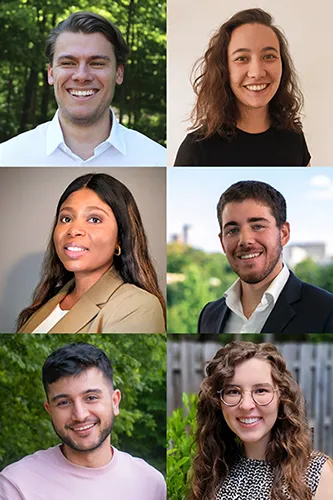
The second class of Brook Byers Institute for Sustainable Systems (BBISS) Graduate Fellows has been selected. The BBISS Graduate Fellows Program provides graduate students with enhanced training in sustainability, team science, and leadership in addition to their usual programs of study. Each two-year fellowship is funded by a generous gift from Brook and Shawn Byers and is additionally guided by a Faculty Advisory Board. The students apply their skills and talents, working directly with their peers, faculty, and external partners on long-term, large team, sustainability relevant projects. They are also afforded opportunities to organize and host seminar series, develop their professional networks, publish papers and draft proposals, and develop additional skills critical to their professional success and future careers leading research teams.
The 2022 class of Brook Byers Institute for Sustainable Systems Graduate Fellows are:
- Oliver Chapman - Ph.D. student, School of Public Policy, Ivan Allen College of Liberal Arts
- Megan Conville - Ph.D. student, School of City and Regional Planning, College of Design
- Carlos Fernandez - Ph.D. student, George W. Woodruff School of Mechanical Engineering, College of Engineering
- Sarah Roney - Ph.D. student, School of Biological Sciences
- Olianike Olaomo - Ph.D. student, School of History and Sociology, Ivan Allen College of Liberal Arts
- Vishal Sharma - Ph.D. student, School of Interactive Computing, College of Computing
The Faculty Advisory Board for the BBISS Graduate Fellows is composed of the faculty who submitted the students' nominations. Nominations for Class III of the BBISS Graduate Fellows program will open in the Spring 2023. It is expected that 6 to 8 scholars will be selected for next year’s group.
The Faculty Advisory Board for the inaugural class are:
Updates and outcomes will be posted to the BBISS website as the project progresses. Additional information is available at https://research.gatech.edu/sustainability/grad-fellows-program.
News Contact
Brent Verrill, Research Communications Program Manager

The Georgia Tech student team, "English Avenue Yellow Jackets", is the 2022 Design Challenge Residential Division Grand Winner for the Department of Energy's Solar Decathlon. They also took home first place in the contest's new Retrofit Housing division. Their winning entry retrofitted a 102-year-old house in Atlanta's English Avenue neighborhood.
"The target was to retrofit an existing house to net zero," Aayushi Mody, the team lead said. "And, well, we exceeded the target by making it net positive. The house basically generates more energy than it utilizes." But, Mody explained, that's just the beginning.
In addition to a net positive retrofit, the English Avenue Yellow Jackets provided solutions for rainwater harvesting and graywater reuse, a financial model that included land trust subsidies, and an additional 60 years' worth of projected weather data that proved the house would stay net positive even in cases of extreme weather.
Full Story...
News Contact
Ann Hoevel, Director of Communications, College of Design

The rising sea levels along Georgia’s Savannah coast and an uptick in more severe storms during hurricane season are bellwethers to looming ecological challenges stemming from climate change.
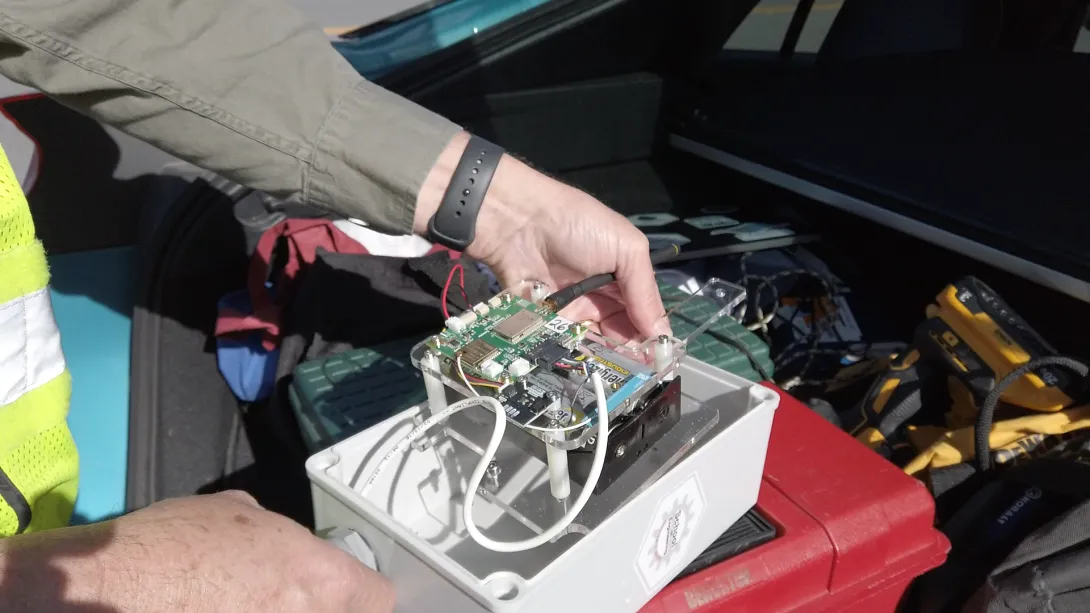
Ongoing research to study sea level rise led by Georgia Tech researchers, a coalition of universities, Savannah and Chatham County government leaders, and local community groups is creating what could be a national model for coastal regions across the country facing similar challenges.
Launched in 2018 with a Georgia Smart Communities Challenge Grant, the data collected from the sea level sensors is used to inform city and county planners and emergency responders on resource deployment following major weather events.
Now in its fourth year, the sea sensor project is now slated to receive $5 million from Congress. It is secured by U.S. Sens. Jon Ossoff and Raphael Warnock, and U.S. Rep. Earl L. “Buddy” Carter to expand the network of sensors — currently 50 are deployed off Chatham County’s coast — to blanket Georgia’s 11-county coastal region.
“With this new funding, we are recognizing a new phase of our project which has evolved,” said Kim Cobb, former director of Georgia Tech’s Global Change Program and a professor who studies climate, oceanography, and weather in the School of Earth and Atmospheric Sciences.
Cobb and Russell J. Clark, senior research scientist in the School of Computer Science at Georgia Tech’s College of Computing, co-lead the project. Allen Hyde, assistant professor in the School of History and Sociology in Georgia Tech’s Ivan Allen College of Liberal Arts, leads a National Science Foundation project focused on youth disaster resilience as part of the effort.
The funding will support expansion of building out more hyperlocal flood forecasting models, resilience planning tools for underserved communities, and further development of a K-12 education curriculum, paid internships, and other workforce development programs.
Georgia Tech and its partners — which includes Savannah State University, the University of Georgia, and the University of South Carolina — is using these low-cost sensors to gain real-time data that over time will help inform the policies on infrastructure design and retrofitting, Cobb said. It will also further expand first responders and emergency planners’ ability to forecast extreme rainfall and storm surge events on a neighborhood-by-neighborhood specific basis.
“It's going to translate into a saved lives and saved infrastructure,” Cobb said.
A National Model
Hub researchers say the data being collected from the sensors and additional information gleaned from the sensor expansion has immediate applications in terms of flood disasters and hurricanes. Those findings over the long-term could also help frame the national dialogue and help inform policy as leaders in Washington shape it to tackle rising sea levels and climate change.
The award is part of a broader federal push, including a $12 billion funding package, to help Georgia and other states along the Eastern Seaboard, as well as the West and Gulf coasts, develop resiliency and flooding plans and protocols to mitigate damage from future floods.
Cobb said this new funding allows the Hub to further efforts in its research that further expands education and workforce development — particularly in underserved minority communities — as components of the broader strategy.
“Our project started out anchored on the sensors and trying to provide real-time data to emergency planners and emergency response responders, but it’s no longer just a small team of people who are interested in sensors or physical scientists, engineers and researchers on the science and technology side,” she said, explaining the research team of some 30 people also includes policy and planning experts, along with community advocates.
“We're trying to think about solutions in the context of history, geography, — the history of people, cultures, and economies down on the coast,” Cobb said. “There’s no waving a magic wand and making this all right, especially for the most vulnerable communities.”
Community Voice
In broad terms, the project touches flooding, infrastructure, property, and pollution. But this newer phase brings in aspects that go beyond scientific modeling of risk, said Dean Hardy, an assistant professor in the University of South Carolina’s Department of Geography.
It’s what he calls the “human dimension” phase.
“There are disaster plans, there's resiliency plans, and there's community level thinking. But what we need is systemic change,” said Hardy, whose research expertise is in geography and integrative conservation, which marries preservation and social and community goals with public policy.
“So, what I hope partially comes out of this is not just a bunch of scientific publications or better scientific understanding of these issues, but capacity-building with community organizations that leads to the capacity for self-determination.”
That acknowledgement is important to marginalized communities, said Dawud Shabaka, interim director of Harambee House, in Savannah. The organization, which is involved in the sensor project, promotes and advocates for civic engagement from the coastal city’s Black residents and youth.
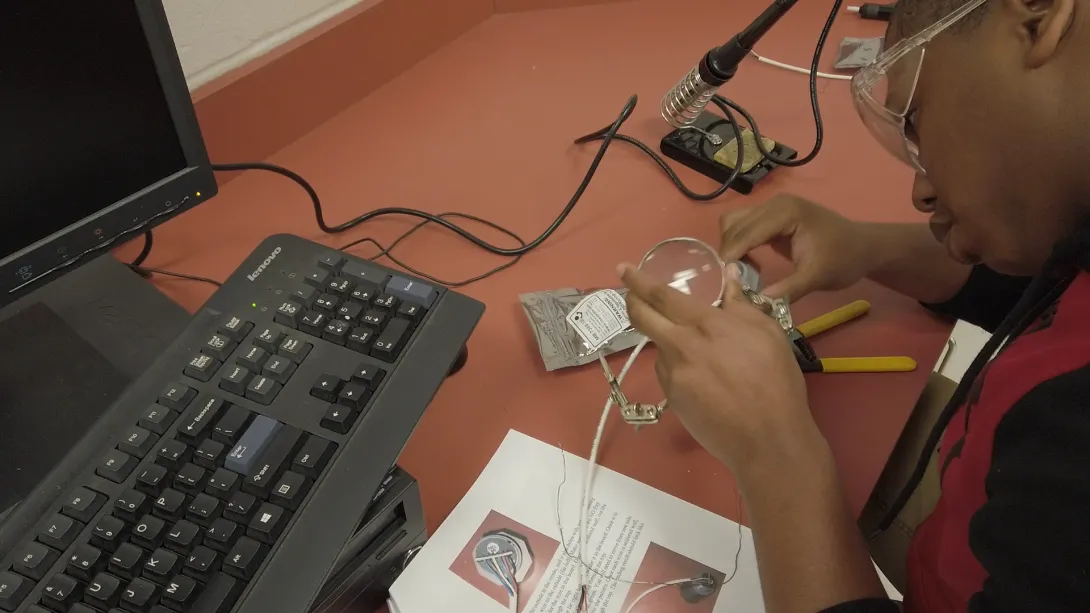
Shabaka noted that the engagement component, particularly local high school and middle school students working on the sensors and coding, has allowed the participants to see themselves not only as budding scientists, but as future community leaders.
“When you’re dealing with or managing or mitigating an issue that’s affecting society, it’s got to involve research and dialogue with the community. This project is allowing us to recognize that the community themselves are the subject matter experts,” said Shabaka. “Having the students involved at an early age, benefits society as a whole and lets them know that the work they’re doing is having a much wider impact. This is the type of community engagement that needs to happen to make people feel like they’re worthwhile.”
News Contact
Péralte C. Paul
peralte.paul@comm.gatech.edu
404.316.1210

Since June, Lalith Polepeddi and Akhil Chavan have been using their skills in computer science and machine learning to help study biodiversity in Georgia Tech’s new EcoCommons.
Both research staff at the Georgia Tech Global Change Program, Polepeddi and Chavan teamed up to apply for a micro research grant from the Kendeda Living Building last summer. The grants empower research and innovation at a student, staff, and faculty level through small, accessible, amounts of seed funding.

Supply chain disruptions are not new, but the current disruptions have not only been persistent but have also impacted several industries – and consumers – at the same time. The result has ranged from empty shelves at retail stores to prolonged lead times for consumer products and automobiles.
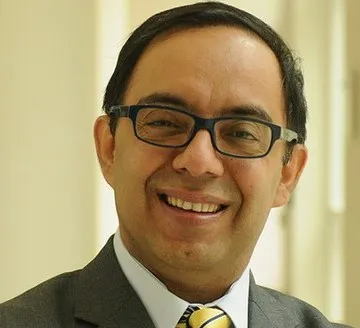
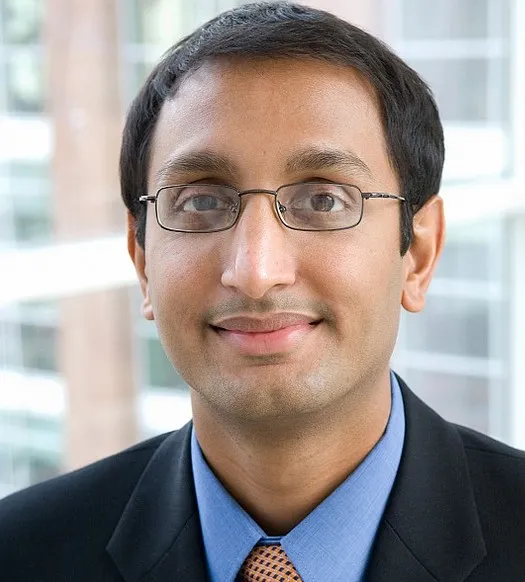
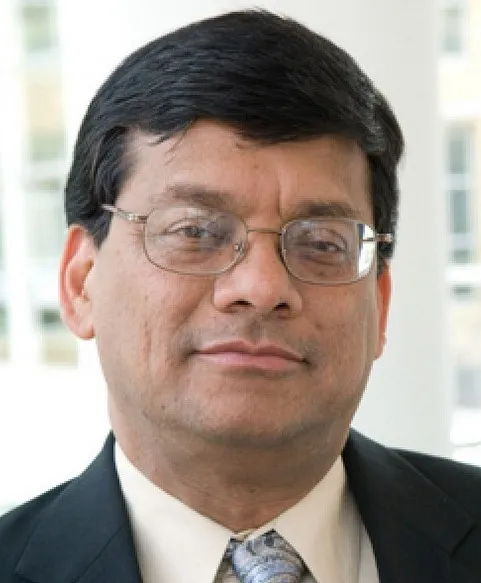
We sat down with three Georgia Tech Scheller College of Business faculty experts in operations management: Vinod Singhal, Charles W. Brady Chair; Manpreet Hora, associate professor; and Ravi Subramanian, professor. The discussion centered around overarching causes, financial ramifications, and multi-pronged approaches to mitigate the impact of supply chain disruptions in the coming months and year.
1. What caused the supply chain and logistical issues to arise? What effect did Covid-19 play in all of this? Did the influx of stimulus checks and the extension of additional aid to U.S. citizens (rent deferment, etc.) affect the purchase of goods enough to cause the current situation?
All three experts agree there are several factors on both the supply side and the demand side of the supply chain, and logistical challenges that companies and customers are currently facing.
On the supply side, there are issues in global supply chains that are beyond the control of individual companies. A significant one is the congestion at the ports of Los Angeles and Long Beach in the U.S. Nearly 40 percent of imports into the U.S. flow through these two ports. There are stranded containers that have not been unloaded due to labor shortages, limited unloading capacity, and warehouse space constraints.
For example, a CBS news report on November 11, 2021, indicated that at the ports of Los Angeles and Long Beach, about 80 ships carrying more than half a million containers were waiting to unload. Clearing this backlog will take some time. Another related issue that has added to the congestion is the growing number of empty containers that are sitting on ports to be returned back to exporters.
The congestion at ports is being further exacerbated by trucker shortages that could pose a more persistent and long-term challenge for supply chains.
“Moving products from ports to distribution centers, manufacturing plants, and further downstream to retailers was already a concern for many companies even before the pandemic. Now the combination of port congestion and trucker shortage is further delaying the process of bringing products to the right place at the right time,” said Hora.
Shortages of critical components, such as semiconductor chips, have created additional delays for a range of industries. Shutdowns in chip production during the early stages of the pandemic, coupled with increased demand for products such as computers, smartphones, and automobiles has resulted in fierce competition for acquiring chips across industries. For example, the professors noted that during the initial period of the Covid-19 pandemic, semiconductor companies prioritized chip manufacturing to meet the increasing demand for consumer electronics. This, in turn, diverted supply away from automotive production, resulting in substantial delays in cars rolling off assembly lines
The pandemic either amplified the above-mentioned supply chain and logistical issues or brought in unexpected new ones. It necessitated the closure of borders at the national level, and of plants and warehouses at the company level. These closures, in the initial months of the pandemic, followed by new requirements such as social distancing during the opening of facilities affected and slowed down production, warehousing, distribution, and transportation of products.
On the demand side, explained Subramanian, two phenomena occurred that have led to a surge in demand for goods that were already in short supply.
First, during the pandemic, many people were working from home. This curtailed spending on travel, vacations, and demand for experiential goods and services. People had more disposable income, which they diverted to consumer products that were already in short supply.
Second, the global economy and the US, in particular have been turbocharged by trillions of dollars in stimulus during the pandemic. This stimulus, while necessary to deal with the hardships during the pandemic, enhanced the surge in demand for products.
2. Why are some retailers able to deliver goods without an issue?
“Many large retailers, including Walmart Inc., Home Depot Inc., and Target Corp., do not seem to have supply chain and product shortage issues like their counterparts, because they ordered and took delivery of goods earlier than usual this year. They have not only built-up inventories but have enhanced their inventory management practices. Some retailers have also chartered their own ships to counteract delays in transportation,” said Singhal.
They have also moved the unloading of their goods from the ports on the west coast to other ports in the U.S. that are less congested. These retailers have used their clout and deep pockets to get suppliers and logistics companies to prioritize their orders. Their far-flung supply chain networks can identify and work with several suppliers to find options to source items that are out of stock.
3. What are the financial ramifications to the U.S. and to the world for this supply chain issue?
The professors note that large companies have used their clout to deal with the current supply chain issues. Although their costs of procuring supplies have increased, they may be able to pass on some of the cost increase to customers. Some of these companies may see an increase in total sales and total profits in nominal terms although they may experience thinner profit margins. The stock market seems to have incorporated these factors in the valuations and the rising stock market suggests that large companies are expected to do fine financially. For example, the Dow Jones Index has jumped 18 percent this year, S&P 500 is up 25 percent, and Nasdaq has risen 24 percent.
The financial ramifications to smaller retailers and manufacturing firms may be quite negative. As Subramanian explained, these firms do not have the clout and financial resources to work around the supply issues. Often their sales during the holiday season are critically dependent on receiving a container or two of goods from overseas suppliers. Given the long and uncertain transportation and delivery times, and the high cost of transportation, many small firms may not be able to receive supplies in time for the holiday season and may be left holding unsold inventory or unfinished products. Overall, small firms may take a big hit from the current supply chain issues.
4. Are there any additional issues that consumers may face that they may not be aware of? How will the shortage of goods to retailers affect consumers shopping during the holidays? Is there anything individual consumers can do to help solve the problem?
Consumers can do certain things so that they are not disappointed, said the panel. They should start shopping earlier, expect to pay closer to full price on many products, and not wait for promotions or discounts to make their purchases. They will need to be flexible in their shopping habits and look for substitute products if their desired products are not available. Consumers may also want to prioritize their shopping decisions – for example, ensuring they have the gifts for young children who expect Santa to deliver irrespective of supply chain issues! Likewise, for older parents and relatives, for whom the holiday season is a very special time. For others, they may want to consider giving gift cards.
5. When do you think this issue will be resolved and how?
“Supply chains getting back to normal will be contingent upon the nature of the underlying supply chain issues. Shipping and retail executives indicate that they expect the West Coast port backlogs to clear in early 2022, when the Lunar New Year shuts many factories for a week in February, thus slowing output and shipments from Asia,” said Singhal. However, chip shortages may last until 2022 or even extend into 2023. Many chip manufacturers have announced plans to significantly increase their level of capital expenditure but bringing new capacity online can take several years.
This storm of collective issues has brought the importance of supply chain resilience to the forefront. Companies emerging from the pandemic are revisiting or will have to revisit their past approaches to managing supply chains.
Having flexibility and slack in supply chains has been a persistent strategy for several companies but this strategy will now need to be more holistic. For example, companies will need to re-think where to source their critical and irreplaceable components. Companies are already deliberating to not only near-shore suppliers of their critical components but also expand this supply base. This may also entail carrying more inventory of such components to meet demand variability and hedge against supply chain disruptions. Another development is manufacturers vertically integrating to design and produce critical components in-house.
Even before the pandemic, companies were investing in technology to digitize their supply chains. This long-term imperative will be prioritized even more as companies aspire for more transparency and traceability of products in their supply chains. Moreover, advanced automation in manufacturing plants and warehousing could ease some of the pain of labor shortages.
“Despite the current supply chain issues, we believe that supply chains will remain global and complex, but there will be renewed thinking in companies to recognize that Black Swan events such as the Covid-19 pandemic can create a multitude of interrelated and cascading supply chain issues that have serious financial implications. And companies will need to blend flexibility, adaptability, and efficiency to develop capabilities to mitigate impacts and remain resilient during such supply chain disruptions,” stated Hora.
News Contact
Lorrie Burroughs

Georgia Tech Arts is still seeking projects for the 2021 ACCelerate: ACC Smithsonian
Creativity and Innovation Festival in Washington, DC. All Georgia Tech students, faculty, and staff are invited to apply by May 1, 2020.
Even if you do not have a finished project exploring the intersection of science,
engineering, art, design, and technology, we encourage you to speak with Es
Famojure at esther.famojure@arts.gatech.edu about your concepts.
Learn about Georgia Tech's 2019 participants for some inspiration.
The festival brings together all institutions included in the Atlantic Coast Conference to
celebrate creativity and innovation with a specific focus on science, engineering, arts, and
design. It will be held April 9 -11, 2021 at the Smithsonian National Museum of American
History.
Submit your project for consideration by May 1, 2020 to be considered.
News Contact
Es Famojure
esther.famojure@arts.gatech.edu


WHEN: June 7-9, 2017
WHERE: UN City, Copenhagen
WHAT: Panels and interactive sessions focusing on topics such as:
- Global Health Emergencies
- Innovation and Influencing Markets
- Strengthening Health Supply Chains
TO REGISTER ONLINE please visit chhs.gatech.edu/conference/2017/registration.
*As the 2017 conference will be hosted at the United Nations City, it will be free of charge. All attendees must be registered online prior to the event and must present an official form of government-issued photo ID to enter the UN City conference venue.
OVERVIEW:
The HHL Conference is pleased to announce the opening Keynote address from Dr. Richard Brennan, Director of Emergency Operations, Emergencies Programme, World Health Organization (WHO) in geneva, who led the Ebola Response from October 2014 to January 2016 as the Director at the WHO HQ. Dr. Brennan now oversees WHO’s response to health emergencies globally as part of the new Emergencies Programme which brings together several departments to streamline WHO’s role in emergencies globally, from prevention and preparedness to response, and from humanitarian emergencies to disease outbreaks. See full bio here.
Each year the Conference on Health & Humanitarian Logistics (HHL) provides an open forum for the discussion of challenges and new solutions in disaster preparedness and response, long-term development and humanitarian aid, and global health delivery. This neutral platform encourages learning and collaboration within and across institutions; promotes system-wide improvements in organizations and the sector as a whole; identifies important research issues; and establishes priorities in terms of strategies, policies and investments.
Speakers and participants in the event come from across global health and humanitarian sectors, from governments, NGOs, foundations, private industry, and academia, and share diverse perspectives in health and humanitarian challenges. The agenda features keynote addresses, panel discussions, focused interactive workshops, oral presentations, lunchtime group discussions, and interactive poster sessions covering a broad set of research topics and applications.
Submissions were accepted for 3 categories this year: interactive workshops, oral presentations, and posters, which explore challenges and solutions for building efficient and effective supply chains for health and humanitarian challenges. Particular topics of interest include public private partnerships, innovative uses of data or technology, and creating sustainable supply chain systems.More information about these sessions is available here. The final list of presentation, workshop sessions, and posters will be online at the links here as they are confirmed.
2017 Conference Co-organizers:
- Özlem Ergun, Northeastern University
- Jarrod Goentzel, Humanitarian Response Lab, MIT
- Etleva Kadilli, UNICEF Supply Division, Copenhagen
- Pinar Keskinocak, CHHS, Georgia Tech
- Julie Swann, CHHS, Georgia Tech
- Luk Van Wassenhove, Humanitarian Research Group, INSEAD
2017 Speakers and presenters include representatives from:
Bill & Melinda Gates Foundation, Centers for Disease Control & Prevention, (CDC), Central Medical Stores Trust of Malawi, Chemonics International, DHL, Earthquake Reconstruction & Rehabilitation Authority (ERRA) Pakistan, GS1 Nigeria, Global Scientific Solutions for health, Imperial Health Sciences, John Snow Inc., Laerdal Global Health, Logistimo India, Medecins Sans Frontieres, National Medical Stores Uganda, National Primary Health Care Development Agency of Nigeria, Nexleaf Analytics, North Star Alliance, Partnership for Supply Chain Management, UCLA, Vienna University of Economics and Business, UNICEF Supply Division, UN World Food Programme, UPS, World Health Organization, USAID, and more.
News Contact
Meghan Smithgall
Center for Health & Humanitarian Systems (CHHS)