
By Frida Carrera
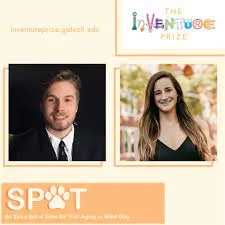
After almost a year since the completion of the 2021 InVenture Prize Competition, we caught up with Matt McMullen and Emma Bivings who competed as finalists on the SPOT Harness team, a harness that uses sensors and vibrators to help blind dogs navigate. Their experience in the competition exposed them to multiple experiences, environments, and demands necessary for startups for the first time. As a result, they were able to distinguish their areas of growth, gain valuable insights, and make potential changes in the direction of their product.
Today, Matt is currently a graduate student seeking a master’s in music technology and Emma is a full-time operations management trainee at McMaster-Carr. The team is still developing the SPOT Harness and has even grown its team to five members. Through funding and participating in Georgia Tech’s CREATE-X Startup Launch program, they have been able to launch their company Saving Grace Pet Solutions LLC. They plan to launch SPOT Harness under this company as well as develop other future products.
To future InVenture participants, Matt advises, “Don’t give up on your idea! The most important part of making it the distance is having a team with a passion for your product.”
The SPOT Harness team will be launching a kick-starter soon for preorders ahead of the official market launch of the SPOT Harness for blind dogs. They also advise anyone who has or knows someone who has a dog suffering from vision loss to visit their website to sign up for their newly refined prototype!
Visit their website here: www.savinggrace.tech
To learn more about the upcoming InVenture Prize Competition visit https://inventureprize.gatech.edu/ . Registration closes on Jan. 19.
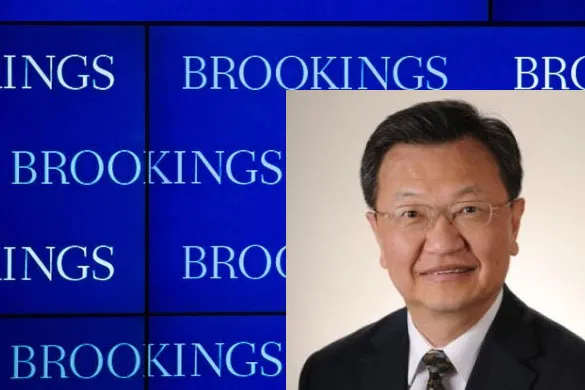
From Washington D.C., the Brookings Institute recently convened a virtual panel of manufacturing experts that included Ben Wang, executive director of the Georgia Tech Manufacturing Institute. Wang holds the Gwaltney Chair in Manufacturing Systems and is a professor both in the H. Milton Stewart School of Industrial and Systems Engineering and the School of Materials Science and Engineering. He served as the previous chair of the National Materials and Manufacturing Board.
The panel’s topic: “Can the Biden Administration Improve the Manufacturing Sector?”
Other panelists included: David Cicilline, member of the U.S. House of Representatives; Monica Gorman, deputy assistant secretary, manufacturing industry & analysis, U.S. Department of Commerce; Elisabeth Reynolds, special assistant to the President for manufacturing and economic development, National Economic Council, the White House; Darrell West, vice president and director governance studies, the Brookings Institution; and John Hazen White, Jr., executive chairman, Taco Family of Companies Trustee, the Brookings Institution.
During the panel’s second session, Wang emphasized, “advanced manufacturing is foundational to our [nation’s] economic prosperity, resilience and the national security.” He was previously involved with President Obama administration’s advanced manufacturing partnership from 2011 to 2013.
“Building a strong manufacturing base in the U.S. is a national imperative,” said Wang. “We know that technology-based innovation is the dominant driver of economic growth in the 21st century. Our national security, standard of living, and rebuilding the middle class in our society all depends on a strong globally competitive manufacturing base.”
Wang stressed the need to have a vibrant innovation value chain tightly coupled with a strong manufacturing ecosystem. “We cannot separate innovation from manufacturing,” said Wang.
“Some policymakers believed that we could continue to innovate and leave manufacturing to other nations. As it turned out, not only did we lose our ability to produce high tech products, we began to lose our ability to innovate.”
“If we want to compete well globally, we must maintain both the technological innovation leadership and advance manufacturing leadership [in the United States],” said Wang.
The need was also stressed to support small and medium-sized manufacturers who contribute to the nation’s supply chain and overall GDP in a significant way, but lack resources to evaluate and adopt new, state of the art manufacturing technologies.
National and state Manufacturing Extension Partnerships (MEP) can play a critical role in helping these smaller entities with technology adoption.
According to Wang, regional ecosystem actors must work together to identify common manufacturing challenges and common opportunities. And then co-innovate around those common challenges and opportunities. This type of regional approach will push local companies to rethink how they should interact with one another and help ensure that benefits are shared by all.
Wang’s entire presentation and the full panel discussion which was sponsored and moderated by the Brookings Institution can be found here.
News Contact
From Washington D.C., the Brookings Institute recently convened a virtual panel of manufacturing experts that included Ben Wang, executive director of the Georgia Tech Manufacturing Institute. Wang holds the Gwaltney Chair in Manufacturing Systems and is a professor both in the Stewart School of Industrial & Systems Engineering, and School of Materials Science and Engineering. He served as the previous chair of the National Materials and Manufacturing Board.
The panel’s topic: “Can the Biden Administration Improve the Manufacturing Sector?”
Other panelists included: David Cicilline, member of the U.S. House of Representatives; Monica Gorman, deputy assistant secretary, manufacturing industry & analysis, U.S. Department of Commerce; Elisabeth Reynolds, special assistant to the President for manufacturing and economic development, National Economic Council, the White House; Darrell West, vice president and director governance studies, the Brookings Institution; and John Hazen White, Jr., executive chairman, Taco Family of Companies Trustee, the Brookings Institution.
During the panel’s second session, Wang emphasized, “advanced manufacturing is foundational to our [nation’s] economic prosperity, resilience and the national security.” He was previously involved with President Obama administration’s advanced manufacturing partnership from 2011 to 2013.
“Building a strong manufacturing base in the U.S. is a national imperative,” said Wang. “We know that technology-based innovation is the dominant driver of economic growth in the 21st century. Our national security, standard of living, and rebuilding the middle class in our society all depends on a strong globally competitive manufacturing base.”
Wang stressed the need to have a vibrant innovation value chain tightly coupled with a strong manufacturing ecosystem. “We cannot separate innovation from manufacturing,” said Wang.
“Some policymakers believed that we could continue to innovate and leave manufacturing to other nations. As it turned out, not only did we lose our ability to produce high tech products, we began to lose our ability to innovate.”
“If we want to compete well globally, we must maintain both the technological innovation leadership and advance manufacturing leadership [in the United States],” said Wang.
The need was also stressed to support small and medium-sized manufacturers who contribute to the nation’s supply chain and overall GDP in a significant way, but lack resources to evaluate and adopt new, state of the art manufacturing technologies.
National and state Manufacturing Extension Partnerships (MEP) can play a critical role in helping these smaller entities with technology adoption.
According to Wang, regional ecosystem actors must work together to identify common manufacturing challenges and common opportunities. And then co-innovate around those common challenges and opportunities. This type of regional approach will push local companies to rethink how they should interact with one another and help ensure that benefits are shared by all.
Ben Wang’s entire presentation and the full panel discussion which was sponsored and moderated by the Brookings Institution can be found here.
News Contact
Walter Rich
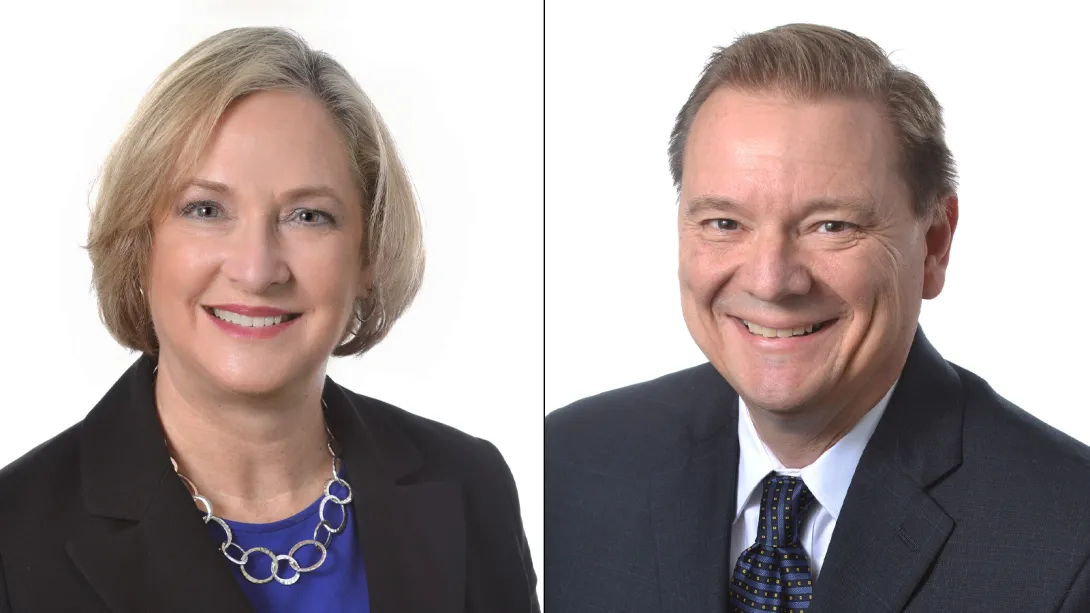
Karen Fite, who, for the past 18 months has led the Georgia Institute of Technology’s economic development efforts as interim vice president and director of the Enterprise Innovation Institute (EI2), has retired after more than 27 years of service.
David Bridges, director of EI2’s Economic Development Lab (EDL), will assume the interim vice president role effective Jan. 1, 2021.
EI2 is the largest and most comprehensive university-based program of business and industry assistance, technology commercialization, and economic development in the United States.
Prior to leading EI2, Fite ran the unit’s Business & Industry Services group of programs, comprised of the Georgia Manufacturing Extension Partnership (GaMEP), EI2’s largest economic development offering. The group also includes the Safety, Health, and Environmental Services (SHES), Atlanta MBDA Centers, Contracting Education Academy, Georgia Tech Procurement Assistance Center (GTPAC), and the Southeastern Trade Adjustment Assistance Center (SETAAC) programs.
Before taking on that role, Fite was GaMEP director.
“Over the years at Georgia Tech, I have been privileged to serve in a wide variety of capacities — assisting companies with government procurement, their implementation of quality management systems and Lean Manufacturing protocols, the launch of a Lean Healthcare initiative, creating community economic development research and strategic plans, and directing the GaMEP,” Fite said.
“As interim vice president, I have had the opportunity to interact with virtually every EI2 employee. Working with such a talented group of employees of EI2 has been an honor because across the board they are passionate about their work, dedicated to Georgia Tech’s mission of progress and service by serving clients, and continually looking to innovate, improve, and expand our services to help create long lasting and meaningful impact not only in Georgia and across the country, but around the world.”
Chaouki T. Abdallah, Georgia Tech’s executive vice president for research said Fite was a valued member of his leadership team.
“She has been a very effective and engaging leader,” Abdallah said. “She’s brought me solutions, given me critical feedback and has been an invaluable partner. Georgia Tech is lucky to have had her contributions for so long.”
Fite has a master’s degree in business administration from the University of Miami and a bachelor’s in health systems from Georgia Tech. In 2018, she achieved the faculty rank of principal extension professional, Georgia Tech’s highest professional extension faculty rank.
“We are fortunate to have someone of David Bridges’ caliber who can not only build on Karen’s legacy but also brings a wealth of experience and economic development successes,” Abdallah said.
Bridges, who joined EI2 in 1994, authored, co-authored or contributed to more than 100 economic development grants totaling more than $40 million. He assisted in the formation of the two proof-of-concept units — the Global Center for Medical Innovation, a Tech affiliate in the medical device space, and I3L, a health information technology innovation hub.
Beyond Georgia, Bridges helped catalyze the development of the Soft Landings program to bring companies from overseas to the United States. He also helped to establish the I-Corps Puerto Rico program as the National Science Foundation’s first I-Corps program ever offered to teams from that community.
He also supported the expansion of technology extension programs in Chile and Colombia, built a new program in professional development around innovation and technology commercialization, and expanded Georgia Tech’s presence by helping to build startup ecosystems around the Institute’s international campuses and in Latin America.
Bridges and his EDL team have also implemented ecosystem building projects for numerous countries including Colombia, Chile, Ecuador, Peru, Panama, Costa Rica, Argentina, Guatemala, South Africa, China, Korea, and Japan.
- Péralte Paul
News Contact
John Toon
Research News
(404) 894-6986

Dr. Christine Ries has been invited to serve on a Review Panel for the New NSF Future Manufacturing Program on Eco-Manufacturing.
This new multidisciplinary NSF program supports fundamental research and education of a future workforce that would enable the types of manufacturing that are not existent yet or are at such early stages of development they are not yet viable (Future Manufacturing). Reviews considered impacts on the economy, workforce, human behavior, and society at large.
News Contact
Professor Christine Ries
christine.ries@econ.gatech.edu
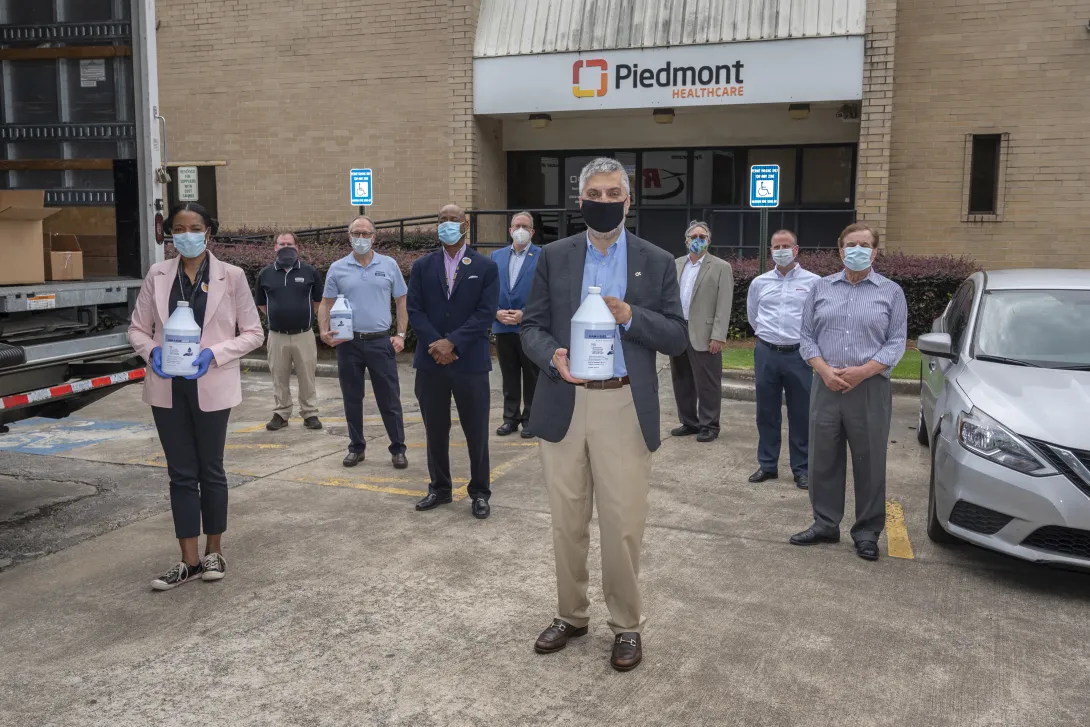
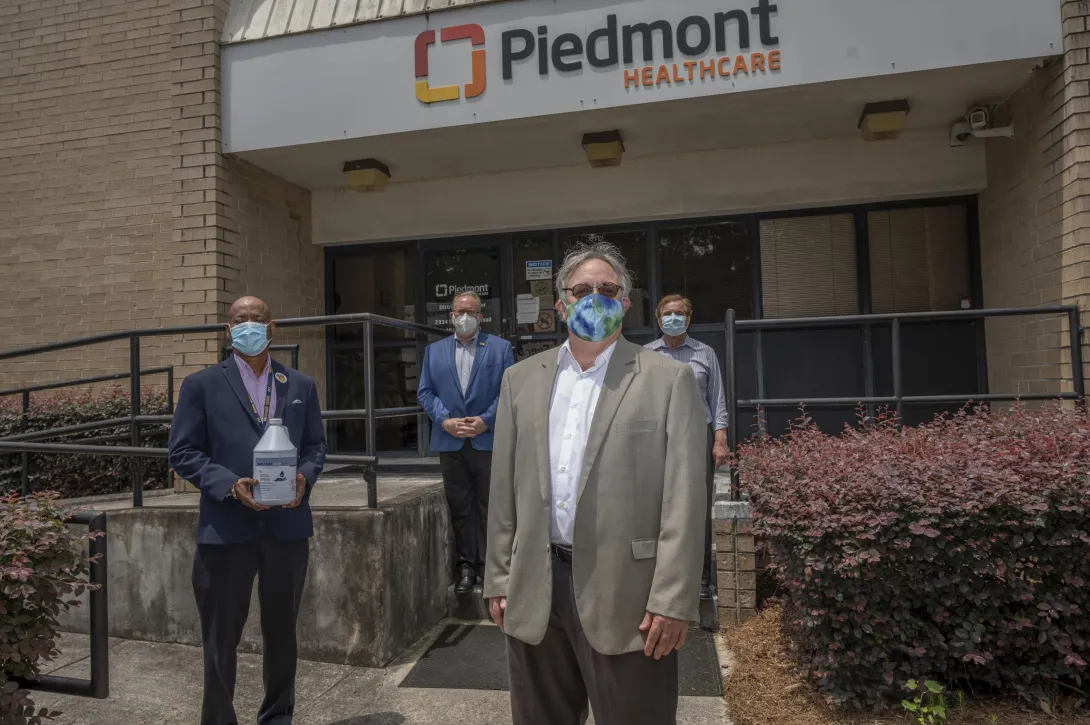
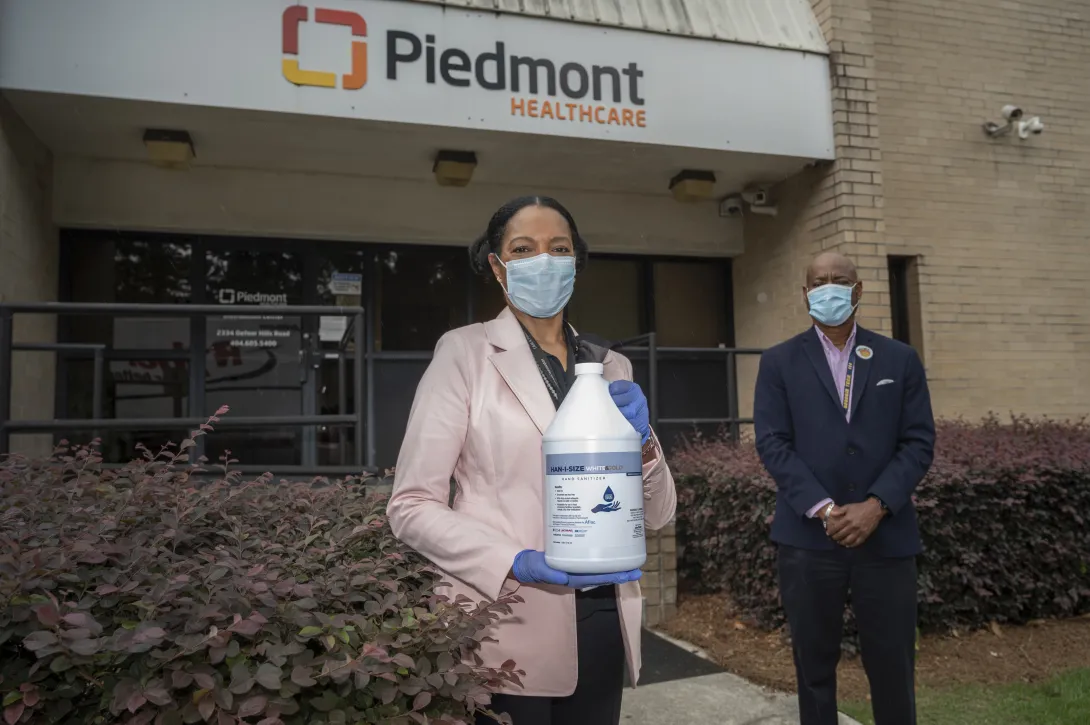
So many people Seth Marder spoke to didn’t see the hand sanitizer crisis brewing. The country was going to run dangerously short if someone did not act urgently.
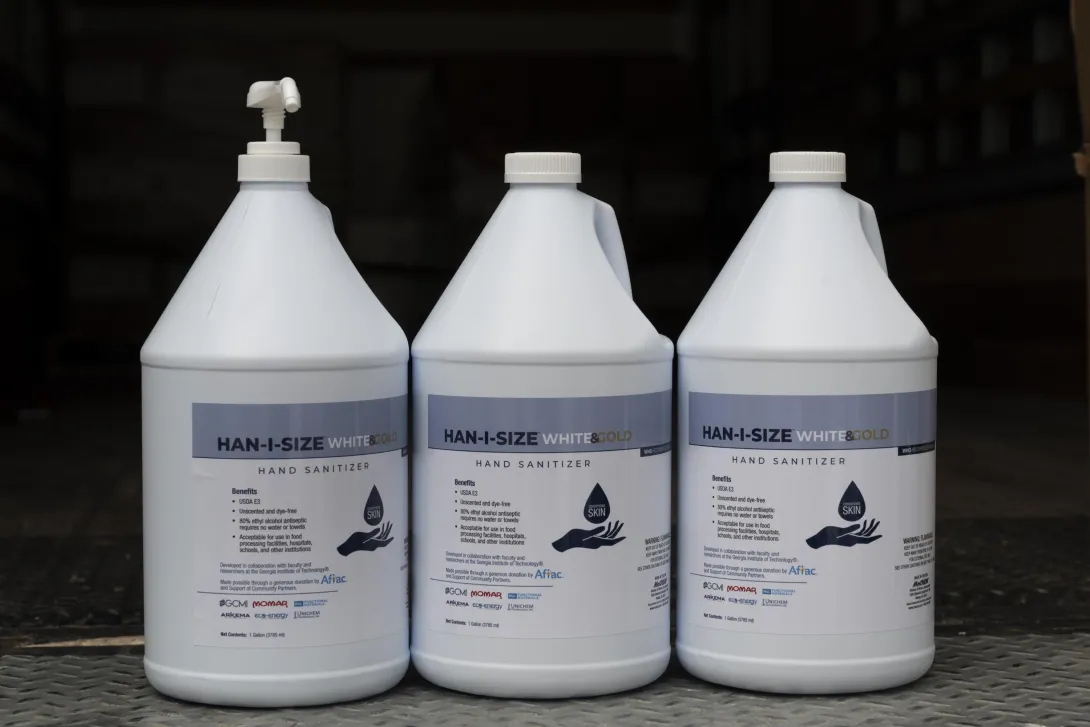
The professor at the Georgia Institute of Technology rallied colleagues and partners around the cause in March, and by early June, they had replaced a key component of hand sanitizer, created a new supply chain, and initiated their own donation of 7,000 gallons of a newly designed sanitizer to medical facilities.
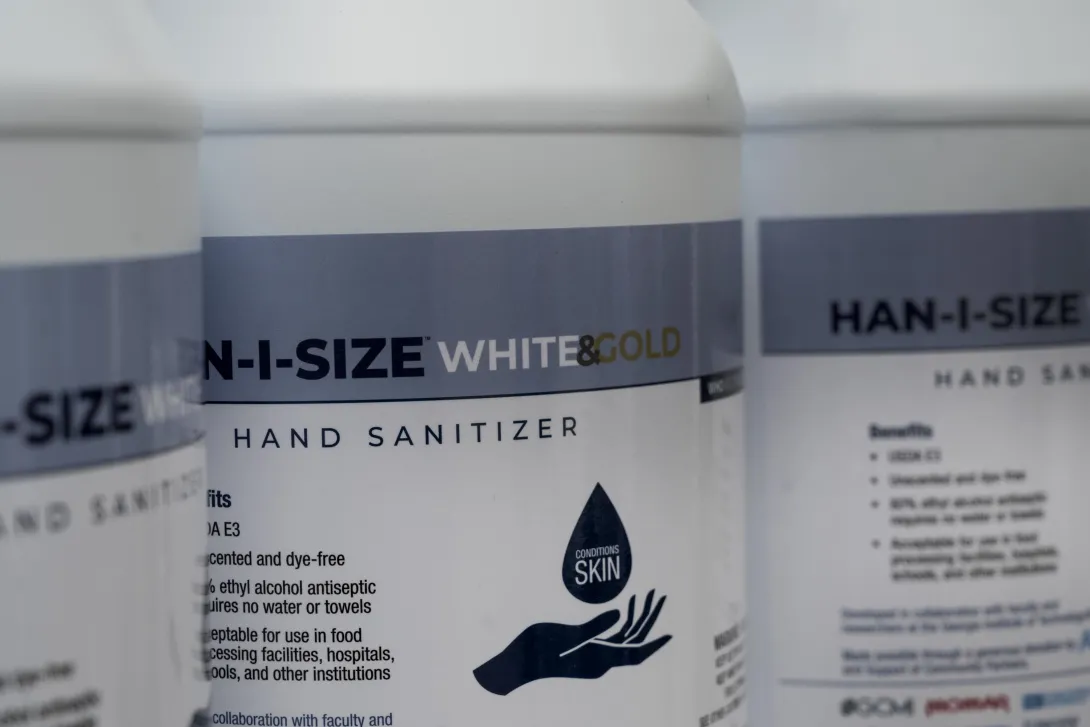
Its name: Han-I-Size White & Gold, named for the colors of Georgia Tech. The new supply chain also may ensure that hand sanitizer producers across the country do not run out of the main active ingredient, alcohol, but the team’s path to success was a stony labyrinth.
“This project was on life support so many times because people did not understand how severe this shortage was going to be,” said Marder, a Regents Professor in Georgia Tech’s School of Chemistry and Biochemistry. “I called hospitals and institutions to assess the need and heard the same thing over and over: ‘No, we just got a delivery. We have no need. You’re wasting your time.’”
Marder was not. Contacts at major chemical suppliers of hand sanitizer ingredients said that a critical shortage of alcohol, particularly the one usually in hand sanitizer, isopropanol, was coming.
“Isopropanol plants in the U.S. were running at full capacity and still didn’t have enough. People were using pharmaceutical-grade ethanol now, too, but it was also in short supply. We weren’t going to have enough of either; I mean the whole United States was running low,” Marder said.
Clean hands cabal
Marder hastily drafted Chris Luettgen, a professor of practice in Georgia Tech’s School of Chemical and Biomolecular Engineering, George White, interim vice president of Georgia Tech’s Office of Industry Collaboration, and Atif Dabdoub, a Georgia Tech alumnus and owner of a local chemical company, Unichem Technologies, Inc.
To the three chemists and the business professional, it seemed simple: Mix alcohol with water, peroxide, and the moisturizer glycerin then bottle and ship it. That bubble burst quickly.
Luettgen, who had worked in the consumer products industry for 25 years at Kimberly-Clark Corporation and knew how to take products to market, had to plow through constant unexpected supply chain barriers and bureaucracy while White forged connections between companies. Neither the supply chain nor the business relationships had existed before, and the teams’ phones stayed glued to their ears night and day as they created them from scratch.
“When I worked for Kimberly-Clark, getting a new product out would take the company nine to 18 months, and the three of us had to get this done in weeks. The demand was there, and people were getting sick in some cases from lack of sanitizing. We felt speed was necessary to meet the growing demand. Seth told me to push this across the goal line, and I put everything into it,” Luettgen said.
“Georgia Tech is about the power to convene. Companies and stakeholders are eager to come to the table here to make things happen,” White said about forging new business ties. “Not everyone has that incredible recognition as a problem solver with the brainpower amassed here.”
Stinking of gin
Purchasing truckloads of alcohol was priority one.
Boutique liquor distilleries in Georgia were already converting to sanitizer ethyl alcohol production, but output was nowhere near enough to meet demand. ExxonMobil connected the team with Eco-Energy, a company that handles fuel-grade ethanol as a gasoline additive.
“The amount of ethanol that’s made for fuel in the U.S. is 1,500 times the amount of the isopropanol made. They could drain off about 1 percent of what is used for fuel and double or triple the amount of alcohol available for hand sanitizer in this country. And the fuel companies wouldn’t even notice it was gone, especially since hardly anyone was driving anymore,” Marder said.
But then prospective hand sanitizer distributors crimped their noses at that ethanol, saying it smelled odd.
“I thought, ‘This has the makings of a screenplay.’ I asked the distributor if we could come over to smell a sample for ourselves,” White said. “It needed a little love.”
Eco-Fuels produced the highly refined ethanol and then processed it through carbon filtration to increase purity and reduce odor. Atlanta-based chemical manufacturer, Momar, Inc., oversaw production, packaging, and distribution of Han-I-Size White & Gold.
The Georgia Tech team garnered funding through a donation from insurer Aflac Incorporated allocated through the Global Center for Medical Innovation (GCMI), a Georgia Tech affiliated non-profit organization that guides new experimental medical solutions to market. Aflac’s gift of $2 million through GCMI has also expedited the development, production, and purchase of other PPE to donate to health care workers.
In addition, GCMI helped guide the hand sanitizer through regulatory processes and to market. In a another development, the U.S. Food and Drug Administration was also aware of the dire shortage of alcohol for sanitizer and issued waivers for the pandemic to allow for use of ethanol in sanitizers without having to meet usual specifications.
Water, water everywhere
Arkema, Inc. donated hydrogen peroxide, which was delivered to PSG Functional Materials, which mixed and packaged the product then shipped with no delivery fee to Atlanta. Though water is ubiquitous, hand sanitizer requires purified water, and the Coca-Cola Company donated a tanker truck of it just when White was pondering desperate measures.
“If I have to get a truck to go pick up water and drive it, I’ll do it myself,” he said.
Finally, the first few hundred gallons of donated Han-I-Size White & Gold rolled into Piedmont Healthcare in Atlanta and Brightmoor Nursing Center in Griffin, Georgia, in the second week of June 2020.
GCMI is facilitating donations of the 7,000 gallons nationwide. Separate from the Aflac-financed donations, Momar will continue to manufacture the new hand sanitizing formula commercially to include in its regular product lineup, and Georgia Tech will be able to purchase it at a reduced rate to help protect researchers now returning to their labs.
The new supply chain, the first of its kind, of “waiver-grade” ethanol has given hand sanitizer producers across the country a new opportunity to re-supply America.
“Hopefully, we helped solved a national need,” Luettgen said.
Read about what else we are doing to help in the Covid-19 crisis.
Here's how to subscribe to our free science and technology email newsletter
Writer & media inquiries: Ben Brumfield, ben.brumfield@comm.gatech.edu or John Toon (404-894-6986), jtoon@gatech.edu.
Georgia Institute of Technology
Georgia Tech Arts is still seeking projects for the 2021 ACCelerate: ACC Smithsonian
Creativity and Innovation Festival in Washington, DC. All Georgia Tech students, faculty, and staff are invited to apply by May 1, 2020.
Even if you do not have a finished project exploring the intersection of science,
engineering, art, design, and technology, we encourage you to speak with Es
Famojure at esther.famojure@arts.gatech.edu about your concepts.
Learn about Georgia Tech's 2019 participants for some inspiration.
The festival brings together all institutions included in the Atlantic Coast Conference to
celebrate creativity and innovation with a specific focus on science, engineering, arts, and
design. It will be held April 9 -11, 2021 at the Smithsonian National Museum of American
History.
Submit your project for consideration by May 1, 2020 to be considered.
News Contact
Es Famojure
esther.famojure@arts.gatech.edu


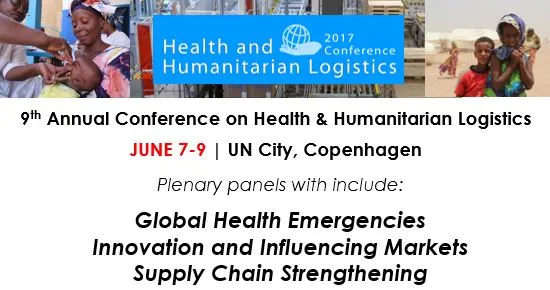
WHEN: June 7-9, 2017
WHERE: UN City, Copenhagen
WHAT: Panels and interactive sessions focusing on topics such as:
- Global Health Emergencies
- Innovation and Influencing Markets
- Strengthening Health Supply Chains
TO REGISTER ONLINE please visit chhs.gatech.edu/conference/2017/registration.
*As the 2017 conference will be hosted at the United Nations City, it will be free of charge. All attendees must be registered online prior to the event and must present an official form of government-issued photo ID to enter the UN City conference venue.
OVERVIEW:
The HHL Conference is pleased to announce the opening Keynote address from Dr. Richard Brennan, Director of Emergency Operations, Emergencies Programme, World Health Organization (WHO) in geneva, who led the Ebola Response from October 2014 to January 2016 as the Director at the WHO HQ. Dr. Brennan now oversees WHO’s response to health emergencies globally as part of the new Emergencies Programme which brings together several departments to streamline WHO’s role in emergencies globally, from prevention and preparedness to response, and from humanitarian emergencies to disease outbreaks. See full bio here.
Each year the Conference on Health & Humanitarian Logistics (HHL) provides an open forum for the discussion of challenges and new solutions in disaster preparedness and response, long-term development and humanitarian aid, and global health delivery. This neutral platform encourages learning and collaboration within and across institutions; promotes system-wide improvements in organizations and the sector as a whole; identifies important research issues; and establishes priorities in terms of strategies, policies and investments.
Speakers and participants in the event come from across global health and humanitarian sectors, from governments, NGOs, foundations, private industry, and academia, and share diverse perspectives in health and humanitarian challenges. The agenda features keynote addresses, panel discussions, focused interactive workshops, oral presentations, lunchtime group discussions, and interactive poster sessions covering a broad set of research topics and applications.
Submissions were accepted for 3 categories this year: interactive workshops, oral presentations, and posters, which explore challenges and solutions for building efficient and effective supply chains for health and humanitarian challenges. Particular topics of interest include public private partnerships, innovative uses of data or technology, and creating sustainable supply chain systems.More information about these sessions is available here. The final list of presentation, workshop sessions, and posters will be online at the links here as they are confirmed.
2017 Conference Co-organizers:
- Özlem Ergun, Northeastern University
- Jarrod Goentzel, Humanitarian Response Lab, MIT
- Etleva Kadilli, UNICEF Supply Division, Copenhagen
- Pinar Keskinocak, CHHS, Georgia Tech
- Julie Swann, CHHS, Georgia Tech
- Luk Van Wassenhove, Humanitarian Research Group, INSEAD
2017 Speakers and presenters include representatives from:
Bill & Melinda Gates Foundation, Centers for Disease Control & Prevention, (CDC), Central Medical Stores Trust of Malawi, Chemonics International, DHL, Earthquake Reconstruction & Rehabilitation Authority (ERRA) Pakistan, GS1 Nigeria, Global Scientific Solutions for health, Imperial Health Sciences, John Snow Inc., Laerdal Global Health, Logistimo India, Medecins Sans Frontieres, National Medical Stores Uganda, National Primary Health Care Development Agency of Nigeria, Nexleaf Analytics, North Star Alliance, Partnership for Supply Chain Management, UCLA, Vienna University of Economics and Business, UNICEF Supply Division, UN World Food Programme, UPS, World Health Organization, USAID, and more.
News Contact
Meghan Smithgall
Center for Health & Humanitarian Systems (CHHS)