
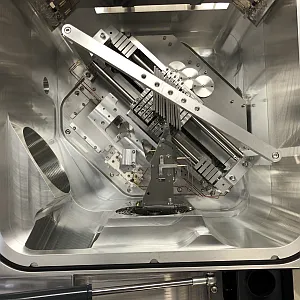
The Materials Characterization Facility (MCF) at Georgia Tech has installed a new inorganic m spectrometry facility. The facility includes two new inductively couple plasma mass spectrometry (ICP-MS) systems: a Thermo iCAP RQ quadrupole ICP-MS for streamlined and high-throughput determinations of elemental concentrations and a Thermo Neoma multicollector ICP-MS with collision cell technology for the precise determinations of isotope ratios within a given sample.
Each instrument can measure elemental variability in both dissolved aqueous samples as well as solids/minerals via laser ablation microsampling from a Teledyne Iridia laser ablation system. Together the system can measure isotopes at precision in elemental systems from Li and U.
Planned applications include: (1) high-resolution measurements of Ca, Sr, Ba, Mg, and B elemental and isotopic variability in seawater and marine and terrestrial carbonates for paleoclimate reconstructions, (2) (U-Th)/Pb dating and Hf isotope measurements to study the origin of critical mineral deposits, with a potential engineering application and the development of novel methods for increasing precision/accuracy and minimizing sample consumption during routine analyses of water quality and environmental contamination.
The MCF welcomes users interested in these and other potential applications of this new facility to their scientific and engineering research to contact David Tavakoli (atavakoli6@gatech.edu).
News Contact
David Tavakoli (atavakoli6@gatech.edu).
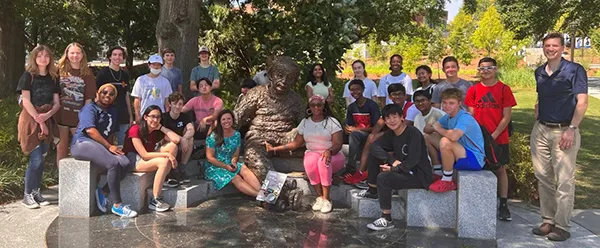
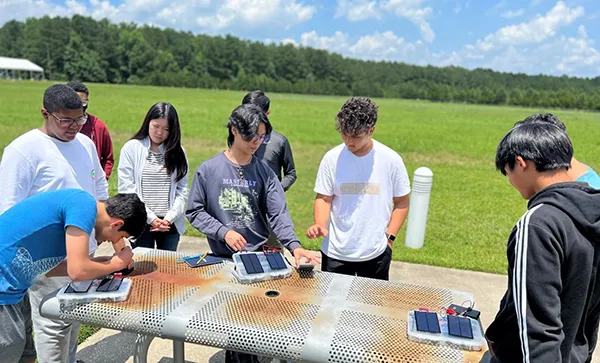
The Summer of 2022 is off to an energetic start! The Energy, Policy, and Innovation Center (EPICenter) hosted two week-long cohorts of "Energy Unplugged," an energy-themed STEAM camp for 35 high school students. Dr. Rich Simmons and Strategic Energy Institute fellow Azell Francis engaged with collaborators from around the state, and led the campers in hands-on interactive demonstrations and experiments involving solar panels, batteries, catapults, water rockets, and remote-control cars. The first camp was held on the Georgia Tech Savannah campus, and the second on the Georgia Tech main campus in Atlanta. Both camps covered both renewable and non-renewable energy sources, energy production and delivery, environmental impacts, and global electricity access. Campers gained insights into how a STEAM-oriented education can be a path that leads to an exciting and successful career in energy.
During the week of June 13 - 17, 2022, GT Savannah was host to a very engaged group of campers. Launching right into activities, the students built and tested catapults, integrating important physics and math concepts into hands-on fun. Next up was the water rocket design challenge, where they showcased their creativity to achieve maximum height and distance. The City of Savannah’s Office of Sustainability displayed their electric vehicle, and shared perspectives on local sustainability initiatives. A highlight of both summer camps was field trip day! The campers visited Georgia Power’s Plant McIntosh, which is a combined cycle gas turbine plant, and the Gulfstream Aerospace Corporation, where the G6 and G7 aircraft are assembled. The week ended too soon, but not before the camp students raced to the finish line driving a re-engineered remote-control electric car, and in true Georgia Tech fashion, hearing the steam engine whistle blow.
Simmons and Francis brought the Energy Unplugged fun to GT Atlanta during the week of June 21 – 24, 2022. The Kendeda Building for Innovative Sustainable Design served as an ideal instructional backdrop for the camp. The Living Building, as it is often called, is certified to generate more energy than it consumes, collect, capture, and process more water than it consumes, and, to the greatest extent possible, be regenerative, rather than consumptive. Hands-on learning remained a key pillar of the camp, conducting experiments with micro-grids and solar panels. The group also had the opportunity to visit Georgia Power’s Morgan Falls Hydroelectric Plant which began commercial operations in 1904, and GE Power’s Monitoring and Diagnostics Center, where more than 500 GW of gas turbine power plants are monitored. The week wrapped up with “shark-tank” style team presentations where campers took an entrepreneurial approach to delivering basic energy services to off-grid communities in the developing world.
Energy Unplugged is administered by Georgia Tech Summer P.E.A.K.S. (Program for Enrichment and Accelerated Knowledge in STEAM) at CEISMC (the Center for Education Integrating Science, Mathematics, and Computing). CEISMC serves as the primary connection point between Georgia Tech faculty and students and the preK-12 STEAM education community, reducing the barriers between kids and higher education. Annually, CEISMC programs impact more than 39,000 students, 1,700 teachers, 200 schools in over 75 school districts throughout the state of Georgia.
News Contact
Brent Verrill, Research Communications Program Manager, SEI

“Thirty years ago not many folks were interested or thinking about sustainability. BBISS was. At Georgia Tech, we do cover many areas in sustainability, and right now after 30 years, BBISS has the history and the ability that can provide expertise to those that are seeking solutions.”
Chaouki Abdallah, Executive Vice President for Research
The Brook Byers Institute for Sustainable Systems (BBISS) is one of Georgia Tech’s 10 interdisciplinary research institutes.
News Contact
Brent Verrill, Research Communications Program Manager
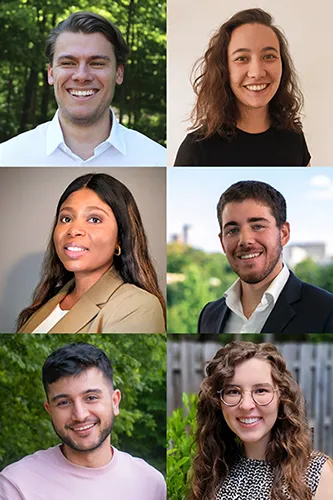
The second class of Brook Byers Institute for Sustainable Systems (BBISS) Graduate Fellows has been selected. The BBISS Graduate Fellows Program provides graduate students with enhanced training in sustainability, team science, and leadership in addition to their usual programs of study. Each two-year fellowship is funded by a generous gift from Brook and Shawn Byers and is additionally guided by a Faculty Advisory Board. The students apply their skills and talents, working directly with their peers, faculty, and external partners on long-term, large team, sustainability relevant projects. They are also afforded opportunities to organize and host seminar series, develop their professional networks, publish papers and draft proposals, and develop additional skills critical to their professional success and future careers leading research teams.
The 2022 class of Brook Byers Institute for Sustainable Systems Graduate Fellows are:
- Oliver Chapman - Ph.D. student, School of Public Policy, Ivan Allen College of Liberal Arts
- Megan Conville - Ph.D. student, School of City and Regional Planning, College of Design
- Carlos Fernandez - Ph.D. student, George W. Woodruff School of Mechanical Engineering, College of Engineering
- Sarah Roney - Ph.D. student, School of Biological Sciences
- Olianike Olaomo - Ph.D. student, School of History and Sociology, Ivan Allen College of Liberal Arts
- Vishal Sharma - Ph.D. student, School of Interactive Computing, College of Computing
The Faculty Advisory Board for the BBISS Graduate Fellows is composed of the faculty who submitted the students' nominations. Nominations for Class III of the BBISS Graduate Fellows program will open in the Spring 2023. It is expected that 6 to 8 scholars will be selected for next year’s group.
The Faculty Advisory Board for the inaugural class are:
Updates and outcomes will be posted to the BBISS website as the project progresses. Additional information is available at https://research.gatech.edu/sustainability/grad-fellows-program.
News Contact
Brent Verrill, Research Communications Program Manager
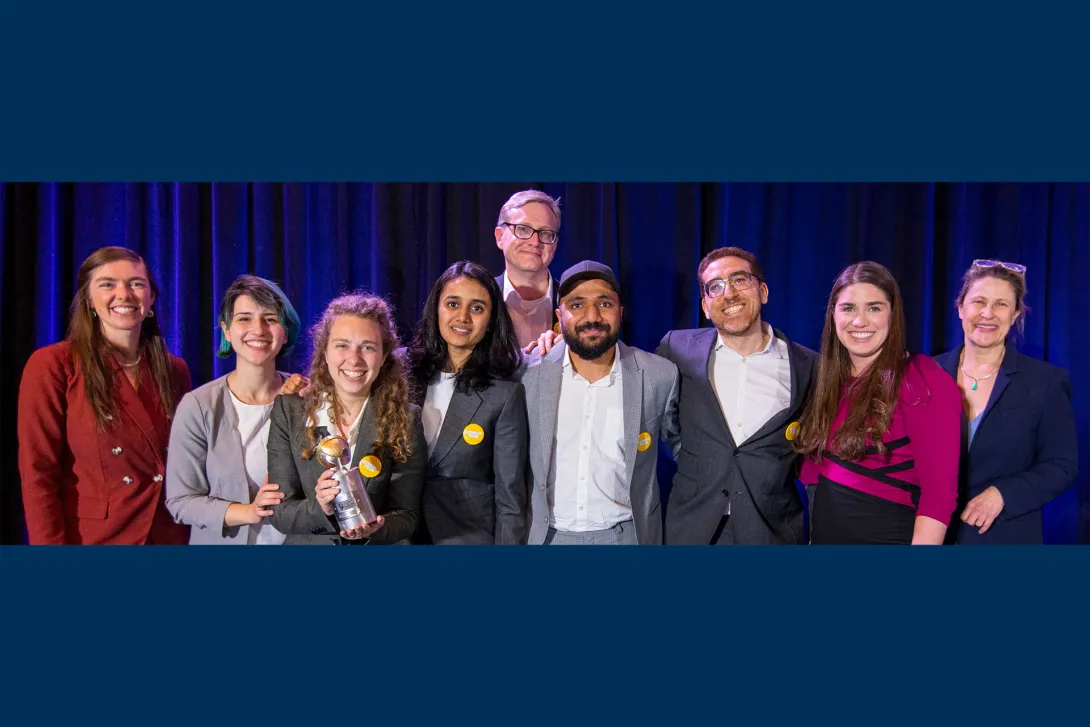
The Georgia Tech student team, "English Avenue Yellow Jackets", is the 2022 Design Challenge Residential Division Grand Winner for the Department of Energy's Solar Decathlon. They also took home first place in the contest's new Retrofit Housing division. Their winning entry retrofitted a 102-year-old house in Atlanta's English Avenue neighborhood.
"The target was to retrofit an existing house to net zero," Aayushi Mody, the team lead said. "And, well, we exceeded the target by making it net positive. The house basically generates more energy than it utilizes." But, Mody explained, that's just the beginning.
In addition to a net positive retrofit, the English Avenue Yellow Jackets provided solutions for rainwater harvesting and graywater reuse, a financial model that included land trust subsidies, and an additional 60 years' worth of projected weather data that proved the house would stay net positive even in cases of extreme weather.
Full Story...
News Contact
Ann Hoevel, Director of Communications, College of Design
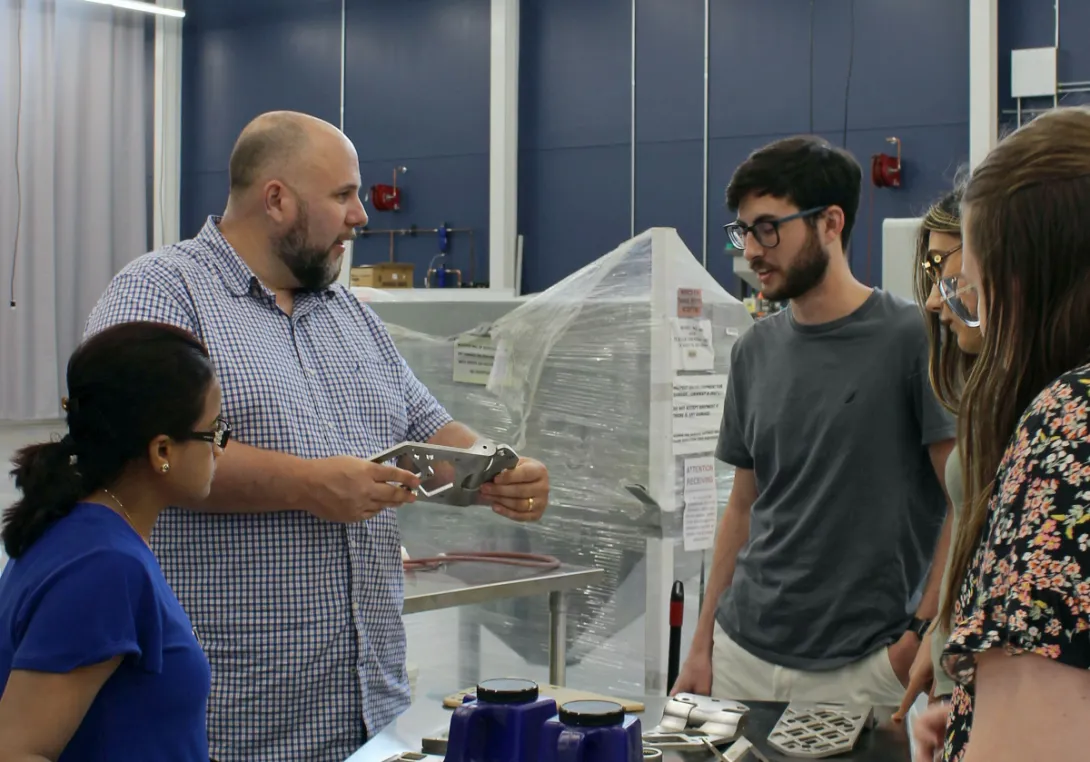
1. What is your field of expertise and at what point in your life did you first become interested in this area?
I work at the intersection of mechanics, metallurgy, machine learning, and manufacturing. I became interested in engineering as a small child – my grandfather was an engineer, and when I would spend time with my grandparents in the summer, I would go to work with him, and I was fascinated with drawing boards, alligator clips, circuits, and more. In high school, I started interning at the business he had built that primarily developed automation and test equipment for circuit breaker manufacturing (he had passed and my uncle then ran it). I started in the stock room, worked through the machine shop, assembly, and into quality control in my first years there. Then I became an engineering assistant as I went into my undergraduate studies. I had thought that I wanted to be electrical engineer (like my grandfather), but after 6 – 8 months of assisting EE, I realized that my true passion was in mechanical engineering, and I moved over to ME – so that foundation instilled in me that I had a passion for ME, manufacturing, and automation. The metallurgy came years later, when I won a graduate fellowship to work at NASA Glenn while earning my Master’s degree. I worked with metallurgists there who were developing new shape memory alloys, which fascinated me. I resisted materials science and metallurgy for many years, insisting that should be someone else’s job, and I should stick to manufacturing and ME. However, it became evident that you can’t engineer with shape memory alloys or develop their manufacturing unless you deeply understood their metallurgy – that resonated with me when I attended a conference in 2008 while working for a startup company that was commercializing some of the new shape memory alloys the group I’d worked with at NASA had developed. When I returned from that conference, I signed up for my PhD program the next week and dove deep into the intersection of metallurgy, manufacturing, and mechanics. The machine learning came years later, several years into my faculty career. We were working with several companies and the state Office of Economic Development in Colorado (I started my faculty career at Colorado School of Mines) to develop an R&D center and technology incubator to support the growing metals 3D printing industry. When I asked the industry people why they needed a center/consortium at Mines in this area – what were they not getting at other additive manufacturing centers at that time (this was 2014/2015), they said “no one is helping us with our data problems.” So, that became our mission – data informatics innovations in metals additive manufacturing. Here at GT, I’m thrilled by the opportunities, colleagues, and infrastructure available to bring it all together – our big vision for this IMat initiative is to develop R&D test beds and technology incubators for AI materials manufacturing.
2. Why is your theme area important to the development of Georgia Tech’s Materials research strategy?
Largely, our materials research laboratories (nation-wide and globally, not just at Georgia Tech) have been designed and built to support human operators. However, AI cannot independently function in the same way and in the same environments – or, at least, we will never realize its full potential if we make it play by our rules. Re-thinking and designing new materials laboratories that can operate autonomously and semi-autonomously is critical to be at the forefront of future innovations.
3. What are the broader global and social benefits of the research you and your team conduct?
Lowering barriers and times for the discovery and development of new materials and manufacturing – lower costs, faster times to deployment, increased sustainability, and finding better solutions. Also, with AI engines, the ability to distribute manufacturing to local/underserved parts of the globe and our nation – we saw this at the onset of COVID – when our corporate supply chain was unprepared to meet the demand, people were able to contribute respirators, masks, and more using the 3D printers in their garages, libraries, schools, universities, and hospitals and serve their community. However, people in their garages are rarely equipped to qualify/certify/ensure safety of critical parts and widgets on their own – the data infrastructure + AI enables qualification/certification to happen through statistics, and then rapid dissemination of the manufacturing “how to”. One could even imagine a future where the burden of qualification and certification could be shared across everyone participating in the supply chain – that will take a lot of policy and economic reform and rethinking as well, but as we gain confidence in our understanding of statistical models and data management infrastructure and software, it becomes more and more feasible.
4. What are your plans on engaging a wider GT faculty pool with IMat research?
I think the group of involved faculty now spans 7 or 8 schools and 3 colleges, at least – I’ve stopped counting, to be honest – the interest and support of colleagues here at GT is tremendous. On our larger proposals, there are anywhere from 20 – 30 faculty involved – I think this next one we may exceed 40. I welcome anyone who has ideas for how they can contribute or wants to learn more about the vision for AI materials + manufacturing test beds to email me anytime, and we’ll setup a time to meet and discuss. I also intend to hold some workshops and conferences – we received funding to start a consortium that will hold quarterly meetings for any interested business or faculty, and newsletters will also be sent, starting in 2022.
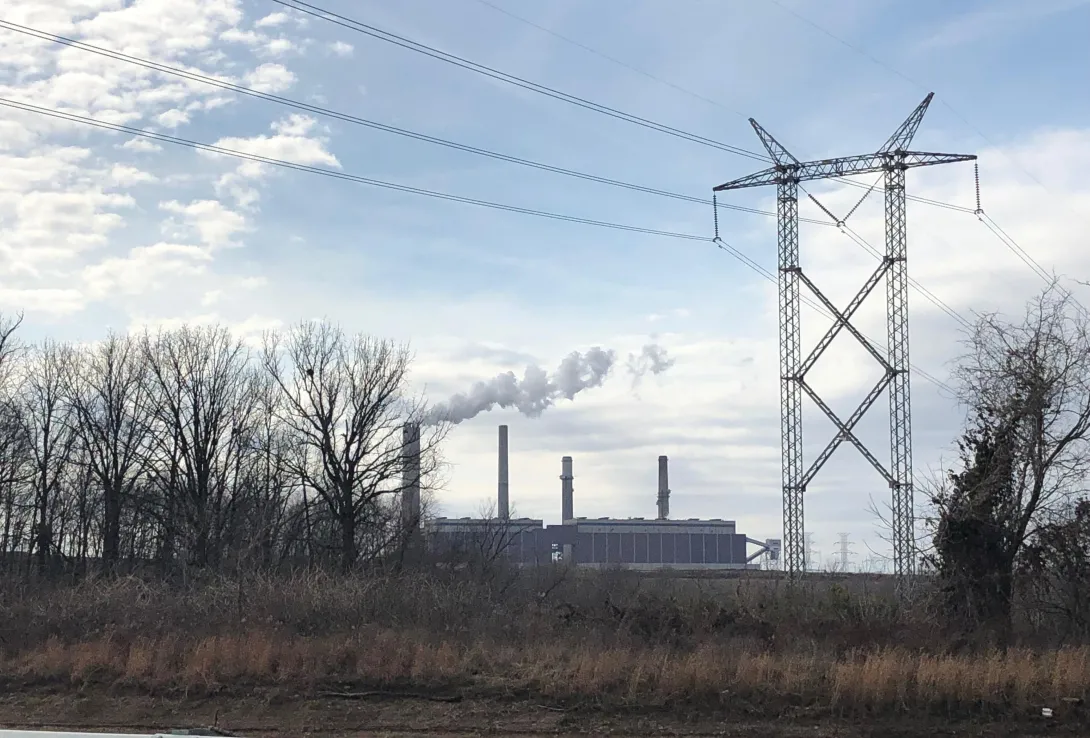
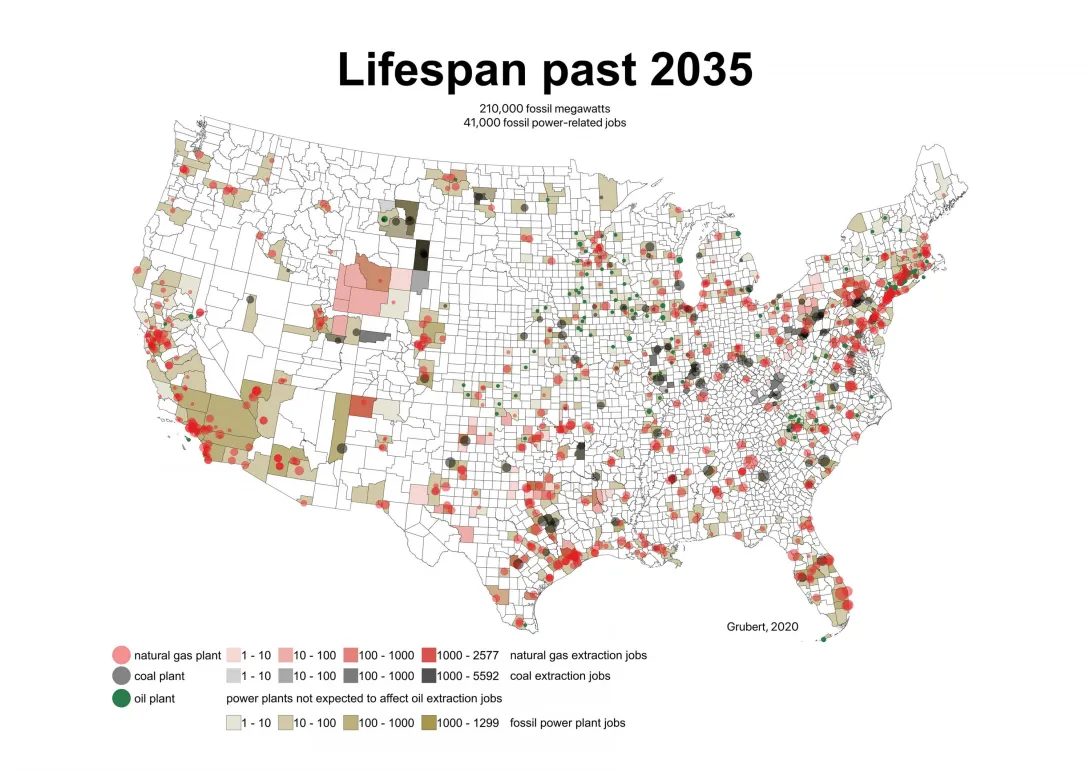
Decarbonizing U.S. electricity production will require both construction of renewable energy sources and retirement of power plants now operated by fossil fuels. A generator-level model described in the Dec. 4 issue of the journal Science suggests that most fossil fuel power plants could complete normal lifespans and still close by 2035 because so many facilities are nearing the end of their operational lives.
Meeting a 2035 deadline for decarbonizing U.S. electricity production, as proposed by the incoming U.S. presidential administration, would eliminate just 15% of the capacity-years left in plants powered by fossil fuels, says the article by Emily Grubert, a Georgia Institute of Technology researcher. Plant retirements are already underway, with 126 gigawatts of fossil generator capacity taken out of production between 2009 and 2018, including 33 gigawatts in 2017 and 2018 alone.
“Creating an electricity system that does not contribute to climate change is actually two processes — building carbon-free infrastructure like solar plants, and closing carbon-based infrastructure like coal plants,” said Grubert, an assistant professor in Georgia Tech’s School of Civil and Environmental Engineering. “My work shows that because a lot of U.S. fossil fuel plants are already pretty old, the target of decarbonization by 2035 would not require us to shut most of these plants down earlier than their typical lifespans.”
Of U.S. fossil fuel-fired generation capacity, 73% (630 out of 840 gigawatts) will reach the end of its typical lifespan by 2035; that percentage would reach 96% by 2050, she says in the Policy Forum article published in Science. About 13% of U.S. fossil fuel-fired generation capacity (110 gigawatts) operating in 2018 had already exceeded its typical lifespan.
Because typical lifespans are averages, some generators operate for longer than expected. Allowing facilities to run until they retire is thus likely insufficient for a 2035 decarbonization deadline, the article notes. Closure deadlines that strand assets relative to reasonable lifespan expectations, however, could create financial liability for debts and other costs. The research found that a 2035 deadline for completely retiring fossil fuel-based electricity generators would only strand about 15% (1,700 gigawatt-years) of capacity life, along with about 20% (380,000 job-years) of direct power plant and fuel extraction jobs that existed in 2018.
In 2018, fossil fuel facilities operated in 1,248 of 3,141 counties, directly employing about 157,000 people at generators and fuel extraction facilities. Plant closure deadlines can improve outcomes for workers and host communities — providing additional certainty, for example, by enabling specific advance planning for things like remediation, retraining for displaced workers, and revenue replacements.
“Closing large industrial facilities like power plants can be really disruptive for the people who work there and live in the surrounding communities,” Grubert said. “We don't want to repeat the damage we saw with the collapse of the steel industry in the 1970s and ’80s, where people lost jobs, pensions, and stability without warning. We already know where the plants are, and who might be affected. Using the 2035 decarbonization deadline to guide explicit, community grounded planning for what to do next can help, even without a lot of financial support.”
Planning ahead will also help avoid creating new capital investment that may not be needed long-term. “We shouldn't build new fossil fuel power plants that would still be young in 2035, and we need to have explicit plans for closures both to ensure the system keeps working and to limit disruption for host communities,” she said.
Underlying policies governing the retirement of fossil fuel-powered facilities is the concept of a “just transition” that ensures material well-being and distributional justice for individuals and communities affected by a transition from fossil to non-fossil electricity systems. Determining which assets are “stranded,” or required to close earlier than expected, is vital for managing compensation for remaining debt or lost revenue, Grubert said in the article.
CITATION: Emily Grubert, “Fossil electricity retirement deadlines for a just transition” (Science, 2020). https://science.sciencemag.org/content/370/6521/1171
Research News
Georgia Institute of Technology
177 North Avenue
Atlanta, Georgia 30332-0181 USA
Media Relations Contact: John Toon (404-894-6986) (jtoon@gatech.edu)
Writer: John Toon
News Contact
John Toon
Research News
(404) 894-6986
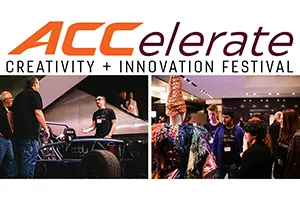
Georgia Tech Arts is still seeking projects for the 2021 ACCelerate: ACC Smithsonian
Creativity and Innovation Festival in Washington, DC. All Georgia Tech students, faculty, and staff are invited to apply by May 1, 2020.
Even if you do not have a finished project exploring the intersection of science,
engineering, art, design, and technology, we encourage you to speak with Es
Famojure at esther.famojure@arts.gatech.edu about your concepts.
Learn about Georgia Tech's 2019 participants for some inspiration.
The festival brings together all institutions included in the Atlantic Coast Conference to
celebrate creativity and innovation with a specific focus on science, engineering, arts, and
design. It will be held April 9 -11, 2021 at the Smithsonian National Museum of American
History.
Submit your project for consideration by May 1, 2020 to be considered.
News Contact
Es Famojure
esther.famojure@arts.gatech.edu