

By Frida Carrera
Several months after the completion of the 2021 InVenture Prize Competition, we caught up with John Wooten to see what he’s been up to! In 2021’s competition, John’s innovation Block Transfer, a decentralized stock transfer agent protocol for global financial markets, placed as a finalist.
Today, John Wooten has been actively working to grow Block Transfer by securing final SEC approval, acquiring funding by US Bank, and submitting utility patents. He believes that by combining blockchain tech with traditional financial markets, we can fundamentally change the world. John describes his experience as a finalist in the competition as being invaluable and advises, “We didn't know we could partake given prior admission to CX. Biggest advice is to just TRY!”
You can learn more about Block Transfer here: https://www.blocktransfer.io/consult
To learn more about the upcoming InVenture Prize Competition visit https://inventureprize.gatech.edu/ . Registration closes on Jan. 19.

By Frida Carrera
After almost a year since the completion of the 2021 InVenture Prize Competition, we caught up with finalist Sammie Hasen to see what she’s been up to over the past couple of months! For 2021’s competition, Sammie’s invention, BCase, placed as a finalist for its accessible, discreet, and secure birth control storage that attaches directly to the back of your phone.
Today, Sammie successfully launched BCase in New York City on World Contraception Day as one of five brands featured by Medsur Inc, the consumer goods company founded by Sammie. On September 26th, Medsur was even invited by The Pill Club, a leading contraceptive company, to participate in the launch of their uterus-shaped vending machines in New York. Medsur now continues to garner the attention from many leading health companies in the birth control space and this is just the beginning for Sammie.
“I plan to keep growing Medsur and follow our vision of creating a suite of innovative products for uterus owners. I am slowly growing the team, and I have now added the incredible Alexa Graham as COO. She is a rockstar, and she will help me grow Medsur to be all that we envision it to be!”, she explained.
Sammie adds that Medsur is always looking for new ambassadors to join the team and encourages anyone passionate about the femtech space and building innovative products to consider signing up!
You can learn more about Medsur and BCase on their website here: https://www.medsurinc.com/
To learn more about the upcoming InVenture Prize Competition visit https://inventureprize.gatech.edu/ . Registration closes on Jan. 19.

Industrial Internet of Things in 2020 was presented by Alain Louchez at the IoT for Manufacturing Symposium organized by the Factory Information Systems Center at the Georgia Tech Manufacturing Institute on November 11, 2020.
For a full activity report please see: https://cdait.gatech.edu/Activities/Industrial_Internet_of_Things
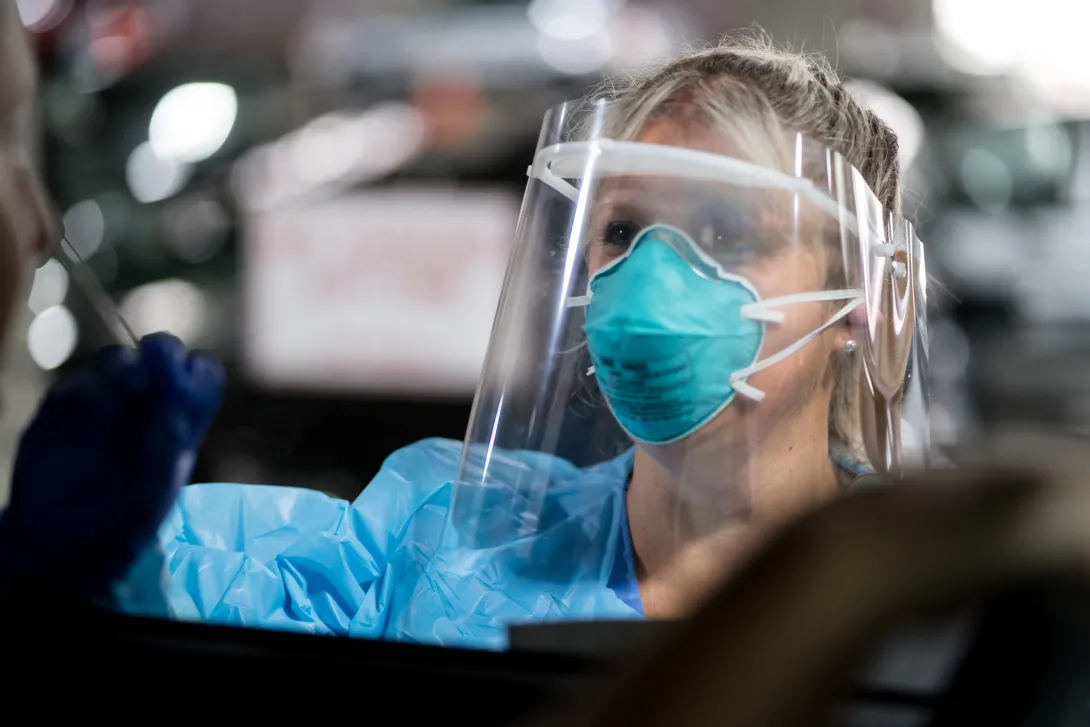
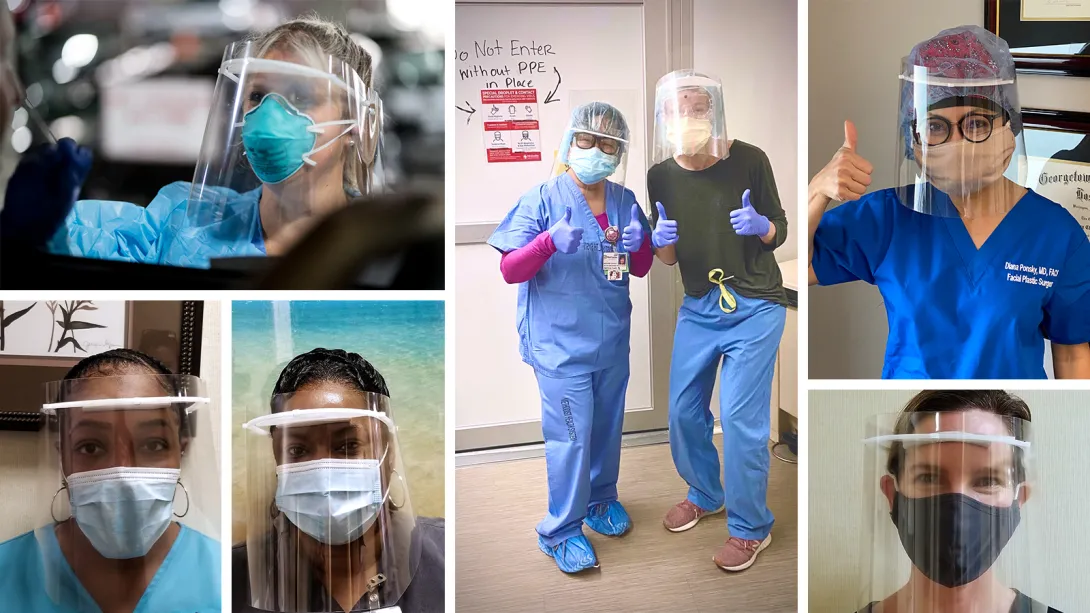
Personal initiatives by a pediatrician and by researchers to make face shields for medical workers have transformed into an industry collaboration that by June had delivered 1.8 million shields to hospitals and other organizations around the country with plans to produce 2.5 million all total. A $2 million donation from Aflac Incorporated for personal protective equipment (PPE) financed the bulk of the shields.
To make it happen, a team of researchers and industry partners convened at the Global Center for Medical Innovation (GCMI), a Georgia Tech-affiliated nonprofit that guides new experimental medical solutions to market. The group combined the physician’s vision with the researchers’ original designs, adjusted them to pass FDA emergency guidelines, and then coordinated mass production and distribution.
A physician’s wisdom
The project grew wings in mid-March, after Dr. Joanna Newton became concerned that the nationwide shortage of PPE was leaving healthcare workers across the country vulnerable. Newton is a physician specializing in improving healthcare safety through technology at Children’s Healthcare of Atlanta, and she was already collaborating with Georgia Tech on other projects.
She grabbed the phone to leverage the connection.
“I called Sherry Farrugia to tell her about my idea to 3D-print PPE. We needed to quickly find a solution for the PPE shortage around the country, and I knew we had the right team here in Atlanta to help,” said Newton, a pediatric hematologist/oncologist at the Aflac Cancer and Blood Disorders Center of Children’s.
“The situation was urgent, and I knew who would have the right expertise to get this done,” said Farrugia, chief operating officer and strategy officer of Children’s Healthcare of Atlanta Pediatric Technology Center, which is part of Georgia Tech.
Farrugia had Newton present her idea at GCMI to researchers, advisors, and industry partners who immediately put together a team to address the need for face shields to protect healthcare workers from droplets containing the coronavirus. She also discussed the need with Devesh Ranjan, associate chair of the George W. Woodruff School of Mechanical Engineering, who suggested connecting the effort to a parallel initiative in that school.
Bringing in engineers
At the same time, along with Ranjan, Sam Graham, chair of the George W. Woodruff School of Mechanical Engineering, and Susan Margulies, chair of the Wallace H. Coulter Department of Biomedical Engineering, were coordinating efforts across campus to develop various medical devices in response to the pandemic. Graham, Margulies, and Ranjan quickly connected GCMI with Christopher Saldana and Saad Bhamla, faculty members in Georgia Tech’s College of Engineering, who were leading an simultaneous effort to address the face shield problem with their students using rapid fabrication techniques like 3-D printing, laser cutting, and waterjet cutting.
“The Georgia Tech mechanical engineering team used rapid fabrication equipment and quickly produced multiple face shield designs that could be manufactured in high volumes for the rapid response environment that Covid-19 required,” Saldana said.
Making a few thousand shields in a lab had likely already saved lives, but the Georgia Tech researchers and GCMI put their designs on the internet, where they have been downloaded thousands of times by organizations manufacturing them around the world. And the manufacturing partners they engaged have been turning out hundreds of thousands of shields to save many more lives.
“You may need 45 minutes for a headband with a 3D printer, but manufacturers turn out six of them every 19 seconds. Then making a million face shields becomes a real possibility,” said Mike Fisher, who leads product development at GCMI.
GCMI opened a GoFundMe page, which brought in $20,000, and then engaged their first manufacturing partner, Delta Air Lines.
A manufacturing explosion
“Delta converted one of their groups from manufacturing airplane interiors to doing the face shields. They started off by manufacturing 6,000 shields, and that got the momentum going,” Leiter said. “Two thousand shields went to Mount Sinai Hospital in New York; 2,000 went to Piedmont Healthcare in Atlanta; and 2,000 went to Children’s Healthcare of Atlanta.”
Things began to snowball.
Graham engaged Siemens Industries to fulfill a face shield order from the Georgia Emergency Management Agency (GEMA) for distribution in Georgia. Partners from ExxonMobil began looking for more potential manufacturers. And Aflac contacted Children’s looking for worthy Covid-19 related efforts to support.
“We asked for a donation of $500,000 for manufacturers to retool their operations. Aflac made a gift of $2 million to GCMI to promote the production of PPE,” Farrugia said. “We were able to buy tooling for an automotive plastics manufacturer called Quality Model in South Carolina, and they have made over 750,000 face shields so far.”
GCMI won a bid from the Federal Emergency Management Agency (FEMA) for 1,141,600 face shields, which are being made by Quality Model, where ExxonMobil helped rearrange production lines for shields.
Siemens made an additional 100,000 shields from Aflac’s gift, which is also being used to purchase existing PPE to donate to healthcare workers. Kia Motors quickly produced an initial 15,000 shields, which the company financed itself.
“Kia got the open source design from the Georgia Tech website and ran with it on their own,” Saldana said.
These partners are delivering the following number of shields: Quality Model, 1,251,600; Kia Motors, 300,000; Siemens Industries, 205,000; Delta Air Lines, 106,100; Georgia Tech, 20,000; and EIS, 15,000. And more are still to come.
The shields went across the country, from hospitals in New York City to Prisma Health in South Carolina, to nursing homes in the Pensacola area, and to rural Louisiana and Mississippi, Leiter said.
Thanks in large part to Aflac’s gift, GCMI and Farrugia are coordinating with partners, including Georgia Tech engineers, to produce N95 masks, hospital gowns, and hand sanitizer, all redesigned for the Covid-19 age.
Research News
Georgia Institute of Technology
177 North Avenue
Atlanta, Georgia 30332-0181 USA
Media Relations Assistance: John Toon (404-894-6986) (jtoon@gatech.edu).
Writer: Ben Brumfield
News Contact
John Toon
Research News
(404) 894-6986

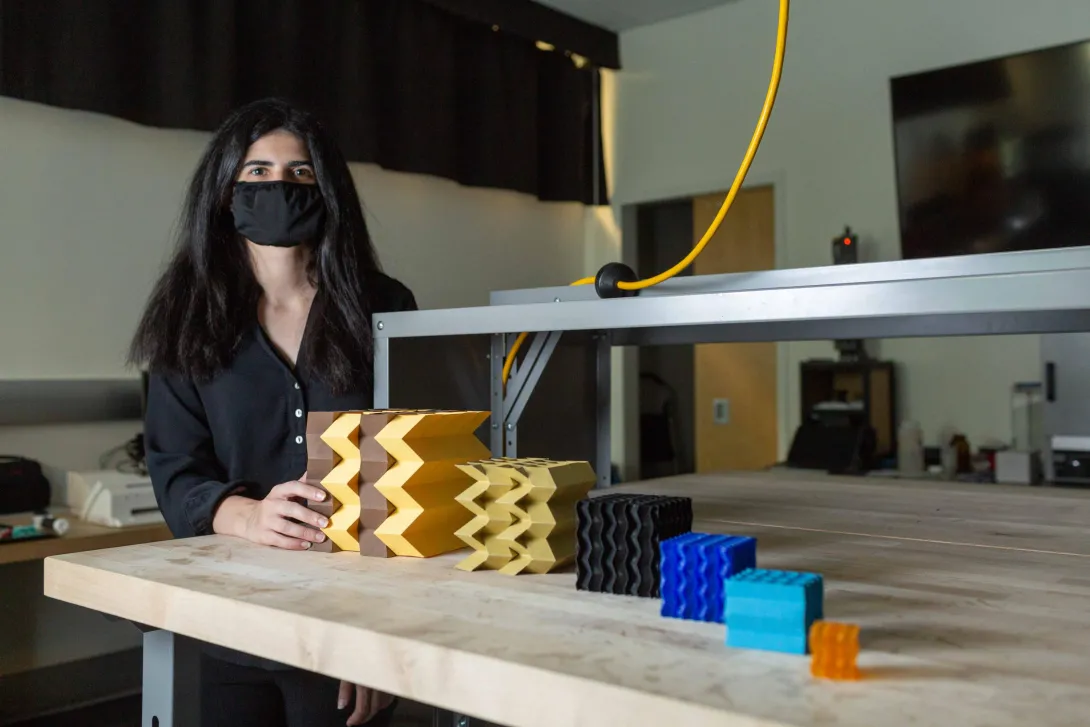

The simplicity and elegance of origami, an ancient Japanese art form, has motivated researchers to explore its application in the world of materials.
New research from an interdisciplinary team, including Northwestern University’s Horacio Espinosa and Sridhar Krishnaswamy and the Georgia Institute of Technology’s Glaucio Paulino, aims to advance the creation and understanding of such folded structures for applications ranging from soft robotics to medical devices to energy harvesters.
Inspired by origami, mechanical metamaterials — artificial structures with mechanical properties defined by their structure rather than their composition — have gained considerable attention because of their potential to yield deployable and highly tunable structures and materials.
What wasn’t known was which structures integrate shape recoverability, pronounced directional mechanical properties, and reversible auxeticity — meaning their lateral dimensions can increase and then decrease when progressively squeezed. Though some 3D origami structures have been produced through additive manufacturing, achieving the folding properties displayed in ideal paper origami remained a challenge.
Using nanoscale effects for an origami design, the team of researchers from Northwestern’s McCormick School of Engineering and Georgia Tech's School of Civil and Environmental Engineering sought to answer that question. They produced small, 3D, origami-built metamaterials, successfully retaining the best properties without resorting to artifacts to enable folding.
“The created structures constitute the smallest fabricated origami architected metamaterials exhibiting an unprecedented combination of mechanical properties,” said Espinosa, the James and Nancy J. Farley Professor of Manufacturing and Entrepreneurship and professor of mechanical engineering and (by courtesy) biomedical engineering and civil and environmental engineering.
“Our work demonstrated that rational design of metamaterials, with a large degree of shape recoverability and direction-dependent stiffness and deformation, is possible using origami designs, and that origami foldability enables a state where the material initially expands and subsequently contracts laterally (reversible auxeticity),” added Espinosa, who serves as director of Northwestern’s theoretical and applied mechanics graduate program. “Such properties promise to influence a number of applications across a wide range of fields encompassing the nano-, micro-, and macro-scales, leveraging the intrinsic scalability of origami assemblies.”
“Guided by geometry, the scaling and miniaturization of the origami metamaterial are exciting in itself and by the unprecedented multifunctionality that it naturally enables,” said Paulino, the Raymond Allen Jones Chair in Georgia Tech’s School of Civil and Environmental Engineering.
“Only an interdisciplinary effort combining origami design, 3D laser printing with nanoscale resolution, and in situ electron microscopy mechanical testing could reveal the unprecedented combination of properties our work demonstrated and their potential impact on future applications,” added Paulino, who contributed to establishing the National Science Foundation Emerging Frontiers in Research and Innovation program named ODISSEI (Origami Design for Integration of Self-assembling Systems for Engineering Innovation).
“Just like nature has architected a wide range of structures using just a few material systems, origami allows us to engineer resilient structural components with distinct physical properties along different directions,” said Krishnaswamy, professor of mechanical engineering.
“We can envision origami-based soft microrobots that are stiff along some directions to carry payloads while maintaining other degrees of flexibility for motion. Origami-metamaterials that exploit reversible auxeticity and large deformation can lead to multifunctional applications ranging from deployable microsurgical instruments and medical devices to energy steering and harvesting,” added Krishnaswamy, the director of Northwestern’s Center for Smart Structures and Materials.
The study presents new avenues to be explored long term, Espinosa said.
“There are a number of possibilities,” he said. “One is the fabrication of origami structures with ceramic and metallic materials, while preserving nanoscale dimensions, to exploit size effects in the mechanical response of the structures leading to superior energy dissipation per unit volume and mass. Another is the use of piezoelectric polymers, which can result in energy harvesters that can drive sensing modalities or power microsurgical tools.”
The research, “Folding at the Microscale: Enabling Multifunctional 3D Origami-Architected Metamaterials” was published in the journal Small on July 27. Along with Espinosa, Krishnaswamy, and Paulino, coauthors include Northwestern’s Nicolas A. Alderete, Zhaowen Lin, and Heming Wei, and Larissa S. Novelino from Georgia Tech.
The research was supported by the Army Research Office (award W911NF1220022), a Multi-University Research Initiative through the Air Force Office of Scientific Research (AFOSR-FA9550-15-1-0009), the Office of Naval Research (grants N00014-15-1-2935 and N00014-16-1-3021), and the National Science Foundation (grant No. 1538830). Nicolas Alderete received a fellowship from the Argentinian Roberto Rocca Education Program and Larisa Novelino from the Brazilian National Council for Scientific and Technological Development (project 235104/2014-0).
Writer: Brian Sandalow, Northwestern University
News Contact
John Toon
Research News
(404) 894-6986

Georgia Tech Arts is still seeking projects for the 2021 ACCelerate: ACC Smithsonian
Creativity and Innovation Festival in Washington, DC. All Georgia Tech students, faculty, and staff are invited to apply by May 1, 2020.
Even if you do not have a finished project exploring the intersection of science,
engineering, art, design, and technology, we encourage you to speak with Es
Famojure at esther.famojure@arts.gatech.edu about your concepts.
Learn about Georgia Tech's 2019 participants for some inspiration.
The festival brings together all institutions included in the Atlantic Coast Conference to
celebrate creativity and innovation with a specific focus on science, engineering, arts, and
design. It will be held April 9 -11, 2021 at the Smithsonian National Museum of American
History.
Submit your project for consideration by May 1, 2020 to be considered.
News Contact
Es Famojure
esther.famojure@arts.gatech.edu