

Gaurav Doshi, Assistant Professor in Applied Economics, Georgia Tech School of Economics
Gaurav Doshi, assistant professor in applied economics and a faculty affiliate of the Georgia Tech Energy Policy and Innovation Center researches, among other topics, ways to make the benefits of large electrification projects more transparent.
It’s a chicken and egg situation: Should renewable energy projects launch first hoping that transmission lines to pipe generated power to distant places will follow on their heels? Or should the transmission lines be stood up first as a way to attract investments in renewable energy projects? Which comes before the other? It’s a question that has intrigued Gaurav Doshi, assistant professor at the School of Economics at Georgia Tech, for a while now. His award-winning paper about this research explores the downstream effects of building power lines.
After a bachelor’s and master’s degree in applied economics from the Indian Institute of Technology at Kanpur, Doshi earned his doctorate in the same field from the University of Wisconsin at Madison in 2023. He explored questions about environmental economics as part of his doctoral work.
“Once I started researching energy markets in the U.S., I kept getting deeper and coming up with new questions,” Doshi says. Among the many his work explores: What are the effects of infrastructure policies and how can they help decarbonization efforts? What are some of the unintended consequences policy makers need to think about?
One of his current research projects has roots in his doctoral work. It explores how to quantify the benefits of difficult-to-quantify environmental infrastructure projects. Case in point: Decarbonization will likely lead to more electrification from renewable energy resources and will need power lines to transport this energy to places of demand. The costs for such infrastructure are pretty transparent as part of government project funding. But the benefits are less so, Doshi points out. To develop effective policy, both the costs and benefits need clear visibility. “Otherwise the question arises ‘why should we spend billions of dollars of taxpayer money if we don’t know the benefits?’”
News Contact
Written by: Poornima Apte
Contact: Priya Devarajan || SEI Communications Program Manager

Top (Left to Right): John Kim, Maghfira “Afi” Ramadhani, Mehmet “Akif” Aglar
Bottom (Left to Right): La’Darius Thomas, Yifan Liu, Niraj Palsule
The Energy Policy and Innovation Center (EPIcenter) at Georgia Tech has announced the selection of six students for its inaugural Summer Research Program. The doctoral candidates, pursuing degrees in electrical and computer engineering, economics, computer science, and public policy, will be on campus working full-time on their dissertation research throughout the summer semester and present their findings in a final showcase.
EPIcenter will provide a full stipend and tuition for the 2025 summer semester to support the students.
“I look forward to hosting a fantastic cohort of early-career energy scholars this summer,” said Laura Taylor, EPIcenter’s director. “The summer research program will not only help the students advance their research while engaging in interdisciplinary dialogue but also offers professional development opportunities to position them for a strong start to their careers.”
The students will work with EPIcenter staff and be provided with on-campus workshops on written and oral communications. Biweekly meetings over the summer will offer the students an opportunity to share their work, progress, and ideas with each other and the EPIcenter faculty affiliates. In addition, the students will have the opportunity to engage with programs and distinguished guests of the center.
For students interested in presenting their research at a conference, EPIcenter also will provide travel grants of up to $600 pursuant to having their paper/presentation posted on the EPIcenter website.
"I applied to the Summer Research Program because its structure and community aligned perfectly with my summer plan on dissertation work in energy policy,” said Yifan Liu. “I aim to finalize key dissertation chapters and engage closely with peers and mentors to prepare me for the job market."
The program offers students an opportunity to promote their work through the EPIcenter communication channels including the website, news feeds, blogs, and the SEI newsletter.
“I am very excited to spend my summer at EPIcenter exploring how battery storage entry affects competition in the electricity market,” said Maghfira “Afi” Ramadhani, one of the student affiliates selected for the summer research program. “Specifically, I look at how the rollout of battery storage in the Texas electricity market impacts renewable curtailment, fossil-fuel generator markup, and generator entry and exit.”
With a variety of backgrounds and perspectives on energy, each of the students in the summer program brings something unique to EPIcenter.
La’Darius Thomas: “My project explores the potential of peer-to-peer energy trading systems in promoting decentralized, sustainable energy solutions. I aim to contribute to the development of energy models that empower individuals and communities to directly participate in electricity markets.”
Niraj Palsule: “I intend to gain interdisciplinary insights interfacing energy transition technology and policy developments by participating in the EPIcenter Summer Research Program.”
John Kim: “I believe the EPIcenter Summer Research Program will deepen my investigation of how environmental hazards disproportionately affect vulnerable communities through research on power outage impacts and lead contamination. This summer, I hope to refine my analysis and complete research on the socioeconomic dimensions of power reliability and environmental resilience.”
Mehmet “Akif” Aglar: "I applied to the EPIcenter Summer Research Program because it offers the chance to work alongside and learn from a community of highly qualified researchers across various fields. I believe the opportunity to present my work, receive feedback, and benefit from the structure the program provides will be invaluable for advancing my research."
About EPICenter
The mission of the Energy Policy and Innovation Center is to conduct rigorous studies and deliver high impact insights that address critical regional, national, and global energy issues from a Southeastern U.S. perspective. EPICenter is pioneering a holistic approach that calls upon multidisciplinary expertise to engage the public on the issues that emerge as the energy transformation unfolds. The center operates within Georgia Tech’s Strategic Energy Institute.
News Contact
Priya Devarajan || SEI Communications Program Manager

Daniel Molzahn will readily admit he’s a Cheesehead.
Born and brought up in Wisconsin, the associate professor at the School of Electrical and Computer Engineering attended the University of Wisconsin, Madison, for undergraduate and graduate studies. It was also at Madison that he decided to go into the family business: power engineering.
Molzahn’s grandfather was a Navy electrician in World War II and later completed a bachelor’s in electrical engineering. He eventually was plant director at a big coal plant in Green Bay. Molzahn’s dad was also a power engineer and worked at a utility company, focusing on nuclear power.
It was not uncommon for family vacations to include a visit to a coal mine or a nuclear power plant. Being steeped in everything power engineering eventually seeped into Molzahn’s bones. “I remember seeing all the infrastructure that goes into producing energy and it was endlessly fascinating for me,” he says.
That endless fascination has worked its way into Molzahn’s research today—at the intersection of computation and power systems.
News Contact
Written by: Poornima Apte
News Contact: Priya Devarajan || SEI Communications Program Manager

Matthew Oliver, Associate Professor, School of Economics, Georgia Tech, EPIcenter Faculty Affiliate
Students in Matthew Oliver’s economics of environment and international energy markets classes likely don’t have a clue about his unusual journey to the lectern: “I was bent on being a rock and roll musician from the time I was 16, and so I ended up dropping out of the University of Memphis after just three semesters,” says Oliver, an associate professor in the School of Economics at the Georgia Institute of Technology. “I was on tour for eight years — and I was starting to feel burned out.”
At a crossroads, Oliver decided to end his musical career — a choice he credits with launching him into academia. “I was 28 and wondering what to do with my life, so I reenrolled in college and discovered economics.” With a longtime love of the environment and growing concern for the climate, says Oliver, “I grew fascinated with solar power and other renewables and the new markets emerging around them.”
Today, his work in energy and environmental economics has implications for policies shaping the energy transition, from subsidies for rooftop solar to the expansion of battery storage.
“The current frontier of energy economics is electricity and renewables, and these are areas I am passionate about,” he says.
PVs and amped up electric use
One of Oliver’s core research thrusts is the solar rebound effect (SRE). This phenomenon involves a quirk of human behavior: When people install solar photovoltaic (PV) panels on the roofs of their homes, they often consume more electricity. “The introduction of solar energy does not perfectly displace grid-supplied energy, but instead reduces demand for grid-supplied energy on a less than one-for-one basis, because the household increases its total electricity consumption,” says Oliver. The bottom line: Solar PV systems may not lead to as much carbon emission reduction as anticipated.
News Contact
Written by: Leda Zimmerman
News Contact: Priya Devarajan, SEI Communications Program Manager
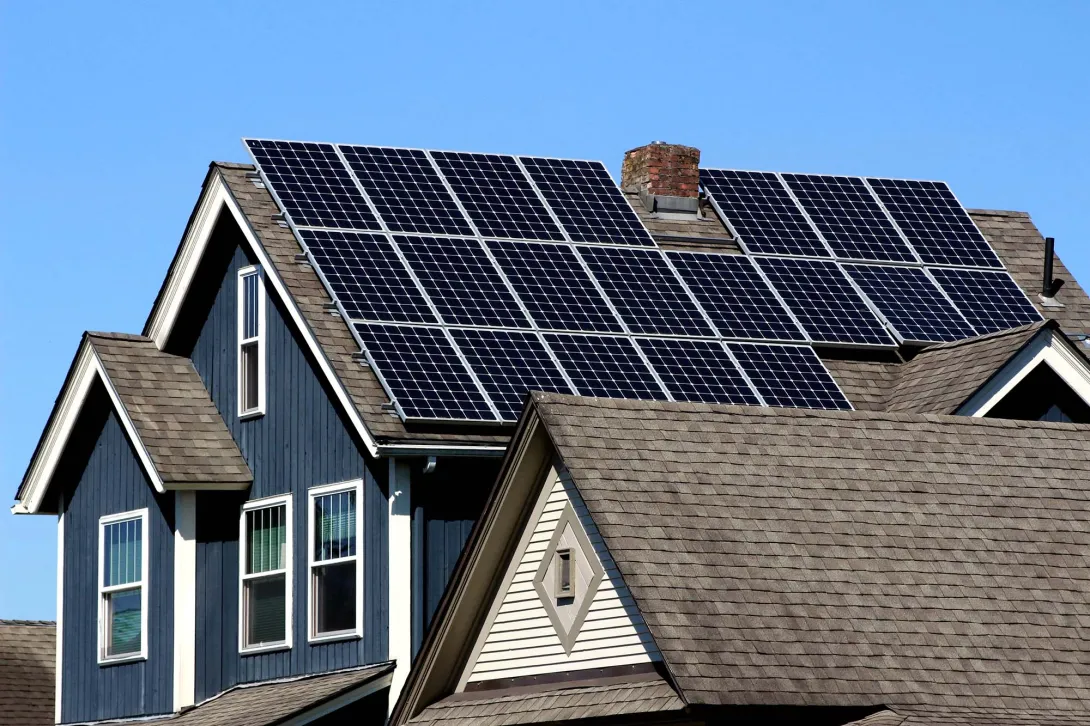
A recent study by Matthew E. Oliver from the Georgia Institute of Technology and his co-authors, Juan Moreno-Cruz from the University of Waterloo and Kenneth Gillingham from Yale University, delves into the solar rebound effect.
The "solar rebound effect" is a phenomenon where households with residential solar photovoltaic (PV) systems end up consuming more electricity in response to greater solar energy generation. This outcome arises because the cost savings from generating their own electricity lead to increased usage. A recent study by Matthew E. Oliver from the Georgia Institute of Technology and his co-authors, Juan Moreno-Cruz from the University of Waterloo and Kenneth Gillingham from Yale University, delves into this effect, providing crucial insights for policymakers and researchers.
The study, titled "Microeconomics of the Solar Rebound under Net Metering," explores how different net metering policies influence the solar rebound effect. Net metering allows households to sell excess electricity generated by their solar panels back to the grid, often at the retail rate. This policy makes solar PV systems more financially attractive but also impacts household behavior.
The authors developed a theoretical framework to understand the solar rebound. They found that under classic net metering, the rebound is primarily an income effect. Households feel wealthier due to the savings on their electricity bills and thus consume more electricity. However, under net billing, where excess electricity is compensated at a lower rate, a substitution effect also comes into play. This means households might change their consumption patterns based on the relative costs of electricity from the grid versus their solar panels.
The study also incorporates behavioral economics concepts like moral licensing and warm glow effects. Moral licensing occurs when people justify increased consumption because they feel they are already doing something good, like generating green energy. Warm glow refers to the positive feelings from contributing to environmental sustainability, which can either increase or decrease consumption depending on the household's values.
One of the key takeaways from the study is the importance of the regulatory environment. Policymakers need to carefully design net metering policies to balance promoting solar adoption while accounting for the possibility that rebound effects may offset the desired outcomes of grid resilience and reduced greenhouse gas emissions. For instance, switching from net metering to net billing might reduce the rebound effect, leading to better environmental outcomes.
The welfare analysis conducted by the authors shows that the solar rebound's impact on social welfare depends on various factors, including the cleanliness of the electricity grid and the external costs of electricity production. In cleaner grids, the rebound might be less detrimental, while in grids reliant on fossil fuels, it could negate some of the environmental benefits of solar adoption.
This research underscores the complexity of energy policy and the need for nuanced approaches that consider both economic and behavioral factors. By understanding the solar rebound effect, stakeholders can make more informed decisions to promote sustainable energy use.
For more detailed insights, you can explore the full study by Matthew E. Oliver and his co-authors. Their work provides a robust foundation for future empirical research and policy development in the field of renewable energy.
This article was written with the assistance of Microsoft Copilot (Jan. 27, 2025) and edited by Georgia Tech EPIcenter's Gilbert X. Gonzalez and Matthew E. Oliver.
News Contact
News Contact: Priya Devarajan || SEI Communications Program Manager
Written by: Gilbert X. Gonzalez, EPIcenter, Matthew Oliver, EPIcenter Faculty Affiliate
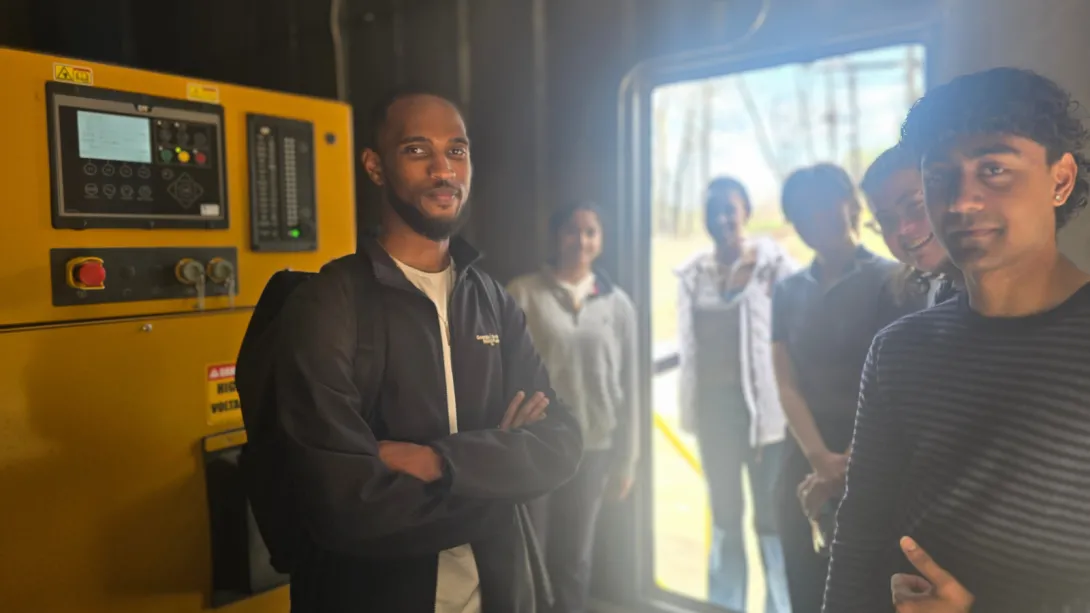
Students in the GROWER VIP on a site visit to Cobb EMC, a non-profit electric utility company, this spring.
Georgia Tech's new GROWER VIP is creating the country's most comprehensive real-time power outage tracker for research use. The database will help researchers explore questions about the causes and effects of power outages and how policy interventions can help strengthen grid resilience.
Why now?
This understanding is urgent in the wake of increasingly extreme climate change-driven weather events and natural disasters, as well as the federal government’s investment of more than $15 billion in grid modernization under the Inflation Reduction Act and Bipartisan Infrastructure Law.
The database will help researchers learn more about the causes of outages and their societal impacts, such as on housing prices, business activity, public health, and crime. It will also help them obtain greater insight into which communities experience the most frequent and longest outages and what can be done to help.
How does it work?
- Utility companies report real-time power outages, but the data is fractured across different service territories and states.
- Users can’t download data directly, making the information difficult to use for research and evaluation.
- Because of this, it's hard for researchers and agencies to understand the extent and scope of problems with the energy grid.
To address these challenges, the GROWER team developed algorithms and web scrapers. They use Amazon Web Services to crawl the utility websites every 15 minutes and collect the power outage data for many states in one place.
Who’s Involved?
The Grid Resilience, Outage, Weather, and Emergency Response (GROWER) Lab is a Vertically Integrated Project launched in 2024 by faculty and students in the Ivan Allen College of Liberal Arts and the College of Engineering.
Brian Y. An, an assistant professor in the School of Public Policy, and Constance Crozier, an assistant professor in the School of Industrial and Systems Engineering, lead the project alongside John Kim, the lab manager and a public policy Ph.D. student. The group includes 15 students in computer science, city and regional planning, business, public policy, and industrial systems and engineering programs.
What’s Next?
The GROWER team has already begun applying findings from the dataset to research questions.
They are writing a paper based on data showing that racial and ethnic minorities experience more frequent and longer power outages than other groups and have also begun examining the effects of power outages on crime and medical emergencies.
This summer, they will partner with the Oak Ridge National Laboratory to provide technical assistance to the Department of Energy Grid Deployment Office, which is the lead federal agency administering grid modernization grants.
“It is incredibly rewarding to connect with research groups in and out of Georgia Tech who share this vision with us,” An said. “We’re excited to conduct robust research that will inform real-word policy making across the country."
News Contact
Di Minardi
Ivan Allen College of Liberal Arts
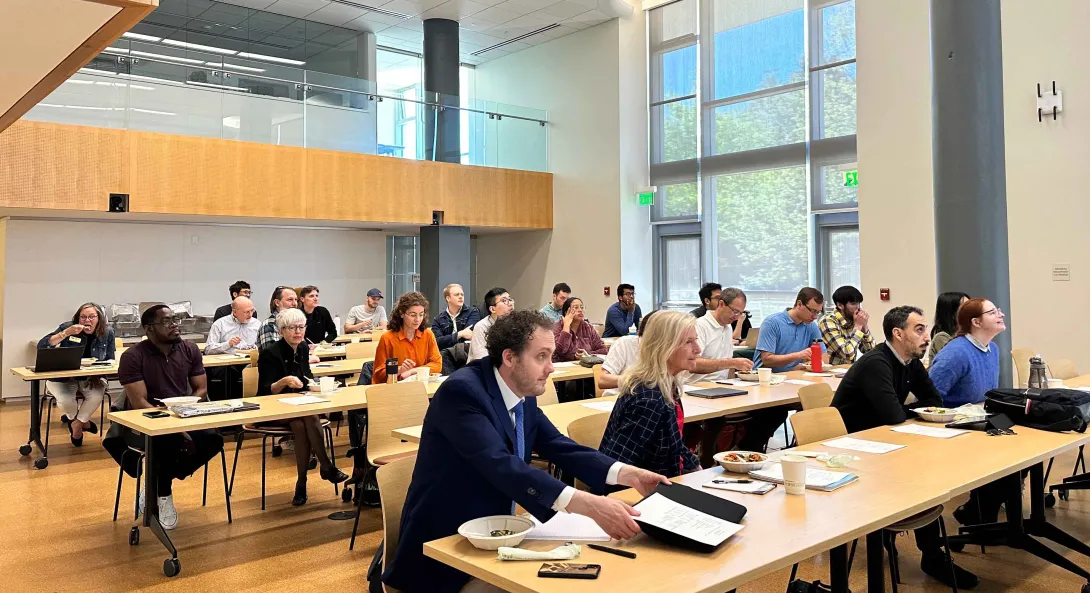
Audience at the EPICenter Lightning Talks (Round 2) held at the Georgia Tech Library
On April 12, the Energy, Policy, and Innovation Center (EPICenter) hosted its second round of the “Friday Lightning Talk Series” at the Scholars Event Network space in the Price Gilbert Library.
Eight multidisciplinary participants from Georgia Tech, including postdoctoral students, graduate students, research faculty, and research associates from public policy, economics, electrical and computer engineering, industrial and systems engineering, and EPICenter, presented an overview of an energy-related research project during the session.
Laura Taylor, chair of the School of Economics and interim director of EPICenter, introduced the organization’s new faculty affiliate program through which affiliates, their students, and postdocs present and share research ideas and receive feedback from the audience.
Topics covered during the session included understanding the social costs of natural gas deregulation, managing EV charging during emergencies, exploring whether daylight saving time saves energy, the green energy workforce, the effects of community solar on household energy use, the Atlanta Energyshed project, clean hydrogen production in Georgia, and household responses to grid emergencies.
The interactive session was well attended with over 25 attendees asking thought-provoking questions and providing suggestions on future areas to explore.
The first round was held on March 1 and was such a success that this second round had a full slate of presenters and a full house of audience members. The agendas for both lightning round talks are available below, along with links to presentation slides.
A unit of the Strategic Energy Institute of Georgia Tech, EPICenter’s mission is to conduct rigorous research and deliver high-impact insights that address the energy needs of the southeastern U.S., while keeping a national and global perspective. EPICenter calls upon broad, multidisciplinary expertise to engage the public and create solutions for critical emerging issues as our nation’s energy transformation unfolds.
News Contact
Priya Devarajan || SEI Communications Program Manager

Omar Asensio, GT Energy Research Faculty and HBS visiting fellow, Institute for the Study of Business in Global Society
A new study by Associate Professor Omar Isaac Asensio and a team of students in Georgia Tech’s School of Public Policy finds that federal housing policies accelerate energy efficiency participation among low- and moderate-income households — even when those policies don’t directly address energy efficiency.
The research, published in Nature Sustainability, shows how community development block grants from the U.S. Department of Housing and Urban Development (HUD) generated an average of 5% to 11% energy savings in economically burdened households in Albany. The savings equate to the cost of roughly two months of groceries per household per year.
"These housing participants who didn't come in thinking about energy efficiency saved anywhere from $75 to $482 per year in energy bills," Asensio said. "Those are meaningful savings that really impact people. So, we ended up finding very significant hidden social benefits from these policies that were previously unknown."
https://youtu.be/eWqOFj9qRxw
The findings are surprising because HUD grants do not specifically target energy efficiency or sustainability measures in exchange for governmental assistance. Instead, they are given at the discretion of the local government to residents facing housing emergencies such as deteriorating roofs or broken HVAC systems in the hot summer. Because of the high amount of deferred maintenance in these homes, the fixes have a spillover effect of significantly reducing energy use — for example, by adopting more efficient technologies and bringing structures up to building codes — and saving money for people who receive them.
The multidisciplinary research team in Asensio’s Data Science & Policy Lab, including current and former Public Policy students Olga Churkina and Becky D. Rafter and industrial engineering alumna Kira E. O'Hare, also found that the cost-effectiveness of housing-based interventions rivals standalone energy efficiency policies, offering a promising alternative for reaching marginalized communities.
"For decades, we’ve struggled to get meaningful participation with conventional policies in these lower and moderate-income communities, including among renters and people in multi-family homes,” Asensio said. "Using housing block grants as an entry strategy to drive efficiency is an important policy innovation.”
With support from the National Science Foundation, ESRI, Inc., and the Georgia Smart Communities Challenge, Asensio and his co-authors spent nearly four years collecting, cleaning, and combining Albany's previously siloed city data into one community analytics repository. They linked records for 5.9 million utility bills per month from 2004 to 2019, allowing them to see long-run impacts of policy intervention, energy consumption, and payments by household — an uncommonly granular level of data.
"Overall, HUD-funded block grants in Albany reduced electricity use by 4.72 million kilowatt hours over the study period versus the control group," the researchers wrote. "The reduction in non-baseload emissions is equivalent to 3.70 million pounds of coal not being burned or the carbon sequestered by 3,695 acres of forest."
Asensio's research is timely because the Southeast has some of the country's highest energy-burdened households. In the U.S., spending over 6% of net income on energy is considered a burden. In Albany, renters' and homeowners' energy costs can surpass ten or even 20% of household budgets, Asensio said, and many housing applicants are elderly and on fixed incomes.
Unlike conventional energy initiatives that are reliant on self-selection, housing programs can provide a more equitable and localized strategy. That's because "most of the standalone policies for energy efficiency have two main outcomes," Asensio said. "First, the programs generally attract more affluent and informed homeowners, in which case, questions arise as to whether this might be a good use of public funds. Second, when these policies are restricted to certain income eligibility limits, we don't get enough participation from lower-income residents for a long list of reasons. So, reaching low- and moderate-income households has become a fundamental challenge."
In contrast, housing block grants naturally target a broader range of residents with high energy burdens and help circumvent the problem of low participation. Rather than trying to market an energy-saving offer to people who aren't interested or are distrustful of the government, HUD grants have long waiting lists.
"There are thousands and thousands of communities that look very much like Albany within and outside of major metro areas,” Asensio said. "This is a relatively untapped opportunity for driving energy efficiency within households who may not necessarily have an awareness of or interest in energy efficiency measures.”
The paper, “Housing Policies and Energy Efficiency Spillovers in Low and Moderate Income Communities,” was published online in Nature Sustainability on March 18. It is available at https://doi.org/10.1038/s41893-024-01314-w. This work was partially supported by awards from the National Science Foundation (Award No. 1945332), ESRI, Inc., the Georgia Smart Communities Challenge, and the Institute for the Study of Business in Global Society at Harvard Business School.
News Contact
Di Minardi
Ivan Allen College of Liberal Arts
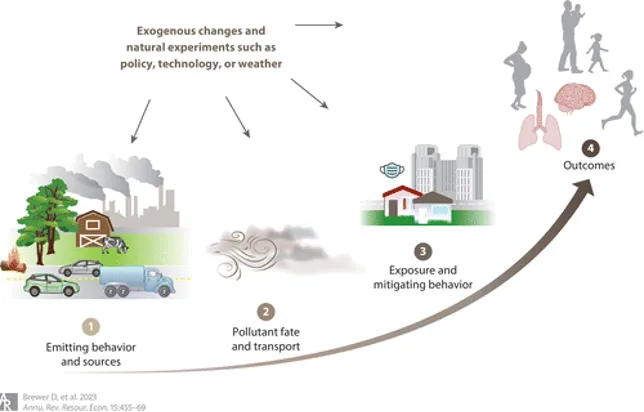
Simple schematic documenting the path of air pollution from emissions to outcomes. This review discusses the challenges of measuring how emissions of pollutants (step 1) disperse through the air (step 2) to become eventual exposures (step 3) and health outcomes (step 4).
Faculty
Dylan Brewer, Daniel Dench, and Laura Taylor
Written by Sharon Murphy
About This Project
The Energy, Policy, and Innovation Center faculty affiliates Dylan Brewer, Daniel Dench, and Interim Director Laura Taylor published an article titled "Advances in Causal Inference at the Intersection of Air Pollution and Health Outcomes." The authors compare the methods used in the epidemiology literature with the causal inference framework used in economics in analyzing the effect of air pollution on health outcomes.
Determining the quality and accuracy of the evidence linking air pollution to human health has been a challenge for research in this area.
Each academic discipline has a unique lens through which they view and solve a problem, which may result in different conclusions being drawn from the same data. While studies that involve randomization across populations can provide evidence and are widely used in medical research, exposures to everyday air pollution cannot be randomized by a researcher.
Many existing studies exploring the health impacts of air pollution rely on establishing correlations between pollutants and health outcomes. However, correlations do not imply causation and can lead to bad policy. In this study, the EPICenter affiliates reviewed methodological contributions made by economists to determine if using statistical methods to the study of the health effects of air pollution can contribute to more robust and reliable findings.
To understand the difficulty researchers face, consider a typical air pollution study that collects health data of residents living near a pollution source, such as a coal-fired power plant. The data would be used to see if there is an increased incidence of adverse health outcomes such as asthma, chronic obstructive pulmonary disease, or cardiopulmonary disease. However, many factors can create a confounding effect on the final results if the researcher doesn’t take them into consideration. For instance, the power plant may have been built in a low-income location, or lower-income households may have moved near the power plant to take advantage of lower rent or property prices. This may conflate the effect of income and air pollution on health.
Simple schematic documenting the path of air pollution from emissions to outcomes. This review discusses the challenges of measuring how emissions of pollutants (step 1) disperse through the air (step 2) to become eventual exposures (step 3) and health outcomes (step 4).
Economists promote the use of natural experiments to overcome confounding factors. Natural experiments mimic familiar laboratory experiments. For instance, in the power plant example, random variation in wind direction would result in some households being randomly more exposed to air pollution, regardless of income. By taking advantage of this randomization, researchers can compare differences in a particular health outcome between those more exposed and less exposed, while overcoming confounding effects such as income, and move one step closer toward improving our understanding of the relationship between air pollution and adverse health outcomes.
The authors conclude by emphasizing the need for creating multidisciplinary teams, including economists, air-quality modelers, and public health and medical researchers. “While one may not think of economists as a natural contributor to this line of research, the analytical framework honed by economists over decades can contribute important expertise to the design of these types of studies,” Taylor concluded, “and result in better evidence for policymakers.”
Read more: https://doi.org/10.1146/annurev-resource-101722-081026
News Contact
Priya Devarajan | SEI Communications Program Manager
Authored by: Sharon Murphy, Strategic Energy Institute
The study of energy is multidimensional and can be approached through disciplines such as economics and public policy, engineering, science, and even architecture and urban planning. The Energy, Policy, and Innovation Center at Georgia Tech (EPICenter) seeks to create bridges between faculty and students whose work may be enhanced through complementary research or knowledge in disciplines across campus and has named the first class of faculty affiliates in the EPICenter program.
Thirteen Georgia Tech faculty have been appointed as EPICenter Affiliates, representing the study of energy through the lenses of economics, public policy, electrical engineering, civil and environmental engineering, and industrial and systems engineering. The affiliates will act as an informal advisory committee to help guide EPICenter and connect Georgia Tech energy researchers to each other and to policy and decision-makers throughout the Southeast.
EPICenter Interim Director Laura Taylor envisions the Faculty Affiliate program to lead to more enrichment opportunities for students, and more awareness of the research intersections of energy technology, economics, and public policy.
About Energy at Georgia Tech
The Georgia Institute of Technology is renowned for its world-class academic programs such as engineering, business, computer science, and city and regional planning. There is a depth of excellence at Georgia Tech that few universities can match thanks in large part to the faculty, many of whom are the foremost experts in their fields. U.S. News & World Report recently ranked Georgia Tech third in the nation for energy and fuels research.
News Contact
Priya Devarajan || Communications Program Manager | SEI