

From left, Georgia Tech's Nakia Melecio, Keith McGreggor, and Raghupathy "Siva" Sivakumar, are the NSF I-Corps Southeast Hub director, faculty lead, and principal investigator, respectively.
The National Science Foundation (NSF) awarded a syndicate of eight Southeast universities — with Georgia Tech as the lead — a $15 million grant to support the development of a regional innovation ecosystem that addresses underrepresentation and increases entrepreneurship and technology-oriented workforce development.
The NSF Innovation Corps (I-Corps) Southeast Hub is a five-year project based on the I-Corps model, which assists academics in moving their research from the lab to the market.
Led by Georgia Tech’s Office of Commercialization and Enterprise Innovation Institute, the NSF I-Corps Southeast Hub encompasses four states — Georgia, Florida, South Carolina, and Alabama.
Its member schools include:
- Clemson University
- Morehouse College
- University of Alabama
- University of Central Florida
- University of Florida
- University of Miami
- University of South Florida
In January 2025, when the NSF I-Corps Southeast Hub officially launches, the consortium of schools will expand to include the University of Puerto Rico. Additionally, through Morehouse College’s activation, Spelman College and the Morehouse School of Medicine will also participate in supporting the project.
With a combined economic output of more than $3.2 trillion, the NSF I-Corps Southeast Hub region represents more than 11% of the entire U.S. economy. As a region, those states and Puerto Rico have a larger economic output than France, Italy, or Canada.
“This is a great opportunity for us to engage in regional collaboration to drive innovation across the Southeast to strengthen our regional economy and that of Puerto Rico,” said the Enterprise Innovation Institute’s Nakia Melecio, director of the NSF I-Corps Southeast Hub. As director, Melecio will oversee strategic management, data collection, and overall operations.
Additionally, Melecio serves as a national faculty instructor for the NSF I-Corps program.
“This also allows us to collectively tackle some of the common challenges all four of our states face, especially when it comes to being intentionally inclusive in reaching out to communities that historically haven’t always been invited to participate,” he said.
That means bringing solutions to market that not only solve problems but are intentional about including researchers from Black and Hispanic-serving institutions, Melecio said.
Keith McGreggor, director of Georgia Tech’s VentureLab, is the faculty lead charged with designing the curriculum and instruction for the NSF I-Corps Southeast Hub’s partners.
McGreggor has extensive I-Corps experience. In 2012, Georgia Tech was among the first institutions in the country selected to teach the I-Corps curriculum, which aims to further research commercialization. McGreggor served as the lead instructor for I-Corps-related efforts and led training efforts across the Southeast, as well as for teams in Puerto Rico, Mexico, and the Republic of Ireland.
Raghupathy “Siva” Sivakumar, Georgia Tech’s vice president of Commercialization and chief commercialization officer, is the project’s principal investigator.
The NSF I-Corps Southeast Hub is one of three announced by the NSF. The others are in the Northwest and New England regions, led by the University of California, Berkeley, and the Massachusetts Institute of Technology, respectively. The three I-Corps Hubs are part of the NSF’s planned expansion of its National Innovation Network, which now includes 128 colleges and universities across 48 states.
As designed, the NSF I-Corps Southeast Hub will leverage its partner institutions’ strengths to break down barriers to researchers’ pace of lab-to-market commercialization.
"Our Hub member institutions have successfully commercialized transformative technologies across critical sectors, including advanced manufacturing, renewable energy, cybersecurity, and biomedical fields,” said Sivakumar. “We aim to achieve two key objectives: first, to establish and expand a scalable model that effectively translates research into viable commercial ventures; and second, to address pressing societal needs.
"This includes not only delivering innovative solutions but also cultivating a diverse pipeline of researchers and innovators, thereby enhancing interest in STEM fields — science, technology, engineering, and mathematics.”
U.S. Rep. Nikema Williams, D-Atlanta, is a proponent of the Hub’s STEM component.
“As a biology major-turned-congresswoman, I know firsthand that STEM education and research open doors far beyond the lab or classroom.,” Williams said. “This National Science Foundation grant means Georgia Tech will be leading the way in equipping researchers and grad students to turn their discoveries into real-world impact — as innovators, entrepreneurs, and business leaders.
“I’m especially excited about the partnership with Morehouse College and other minority-serving institutions through this Hub, expanding pathways to innovation and entrepreneurship for historically marginalized communities and creating one more tool to close the racial wealth gap.”
That STEM aspect, coupled with supporting the growth of a regional ecosystem, will speed commercialization, increase higher education-industry collaborations, and boost the network of diverse entrepreneurs and startup founders, said David Bridges, vice president of the Enterprise Innovation Institute.
“This multi-university, regional approach is a successful model because it has been proven that bringing a diversity of stakeholders together leads to unique solutions to very difficult problems,” he said. “And while the Southeast faces different challenges that vary from state to state and Puerto Rico has its own needs, they call for a more comprehensive approach to solving them. Adopting a region-oriented focus allows us to understand what these needs are, customize tailored solutions, and keep not just our hub but our nation economically competitive.”
News Contact
Péralte C. Paul
peralte@gatech.edu
404.316.1210
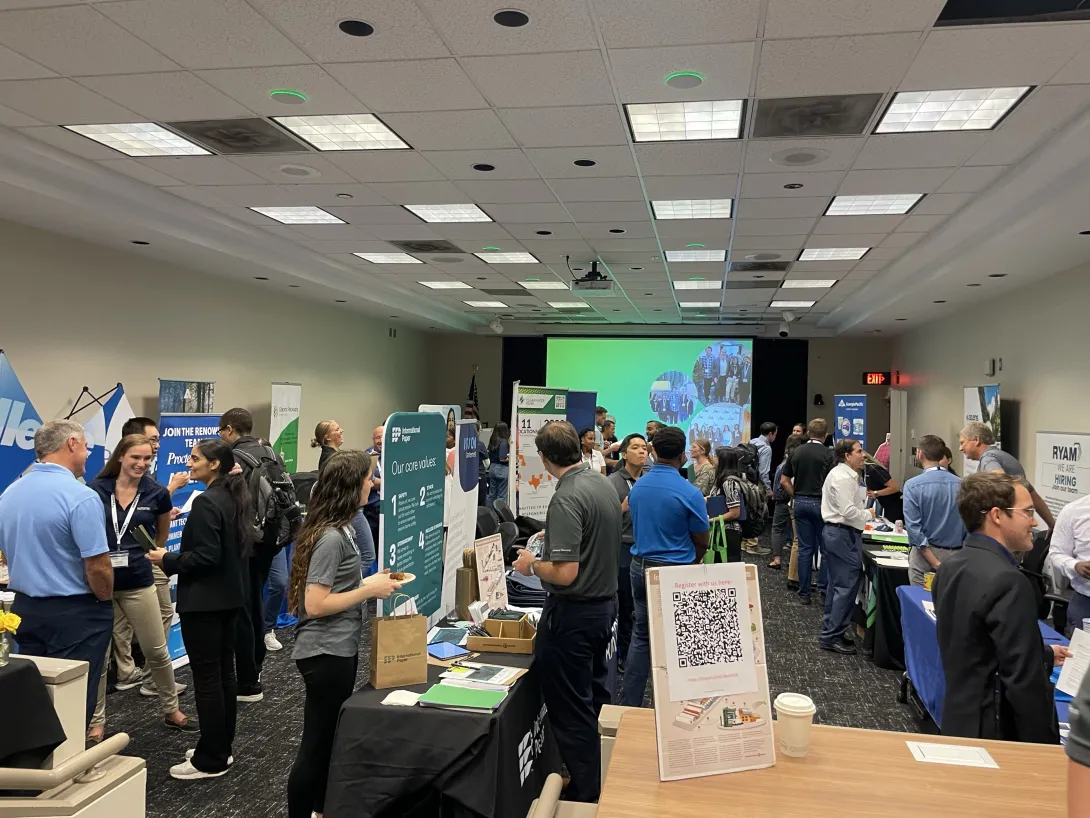
TAPPI Career Fair 2024 at the Renewable Bioproducts Institute
The TAPPI Student Chapter hosted a career fair on Thursday, September 12 at the Georgia Tech Renewable Bioproducts Institute. With nearly 100 students in attendance, the event provided an excellent opportunity for students as well as professionals in the pulp and paper industry, to connect, network, and explore career opportunities. The fair attracted 45 representatives from 15 leading companies in the industry who offered internships, full-time and co-ops for both graduates and undergraduates.
“The TAPPI Student Chapter Career Fair was an incredible opportunity for students to engage directly with industry leaders, explore diverse career paths, and secure valuable internships and job offers. The enthusiasm and participation from both students and companies truly highlighted the strength and potential of our future workforce,” said Chris Luettgen, faculty advisor of the TAPPI Student Chapter and the initiative lead for process efficiency & intensification of pulp, paper packaging, and tissue manufacturing at the Renewable Bioproducts Institute.
News Contact
Priya Devarajan || RBI Communications Program Manager
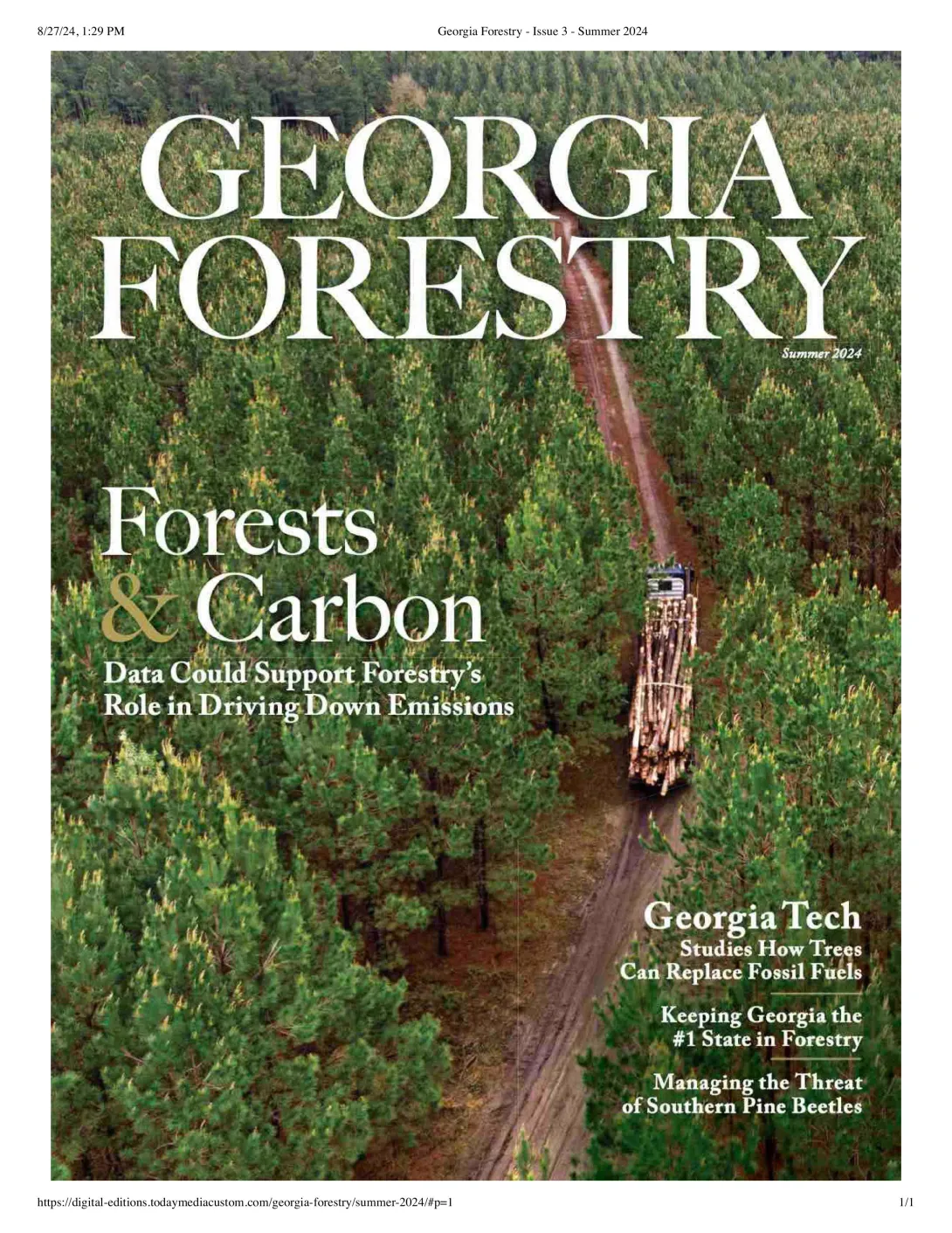
Cover of Summer 2024 Georgia Forestry Magazine
Georgia Forestry Association members receive Georgia Forestry Magazine four times per year. The magazine brings together writers and leaders from the Georgia Forestry Association, Georgia Forestry Commission, and Georgia Sustainable Forestry Initiative. The magazine’s dynamic content is focused on keeping its audience connected to resources and empowered to make good decisions about their forestland asset.
In the Summer 2024 issue, the magazine has featured the Georgia Tech Renewable Bioproducts Institute and its faculty researchers Anthony J. “Bo” Arduengo, professor of practice in the School of Chemistry and Biochemistry, Matt McDowell, Carter N. Paden, Jr. Distinguished Chair and associate professor in the School of Materials Science and Engineering, and Meisha Shofner, professor in the School of Materials Science and Engineering. The feature titled ‘The Green Gusher: How Wood-Based Innovations Are Revolutionizing Sustainability and Technology,’ was written by John Casey and discussed how wood-based innovations are revolutionizing sustainability and technology in the forestry industry and included Georgia Tech’s forestry in focus video that included interviews with the three researchers.
News Contact
Priya Devarajan || RBI Communications Program Manager

The U.S. Department of Energy (DOE) has awarded Georgia Tech researchers a $4.6 million grant to develop improved cybersecurity protection for renewable energy technologies.
Associate Professor Saman Zonouz will lead the project and leverage the latest artificial technology (AI) to create Phorensics. The new tool will anticipate cyberattacks on critical infrastructure and provide analysts with an accurate reading of what vulnerabilities were exploited.
“This grant enables us to tackle one of the crucial challenges facing national security today: our critical infrastructure resilience and post-incident diagnostics to restore normal operations in a timely manner,” said Zonouz.
“Together with our amazing team, we will focus on cyber-physical data recovery and post-mortem forensics analysis after cybersecurity incidents in emerging renewable energy systems.”
As the integration of renewable energy technology into national power grids increases, so does their vulnerability to cyberattacks. These threats put energy infrastructure at risk and pose a significant danger to public safety and economic stability. The AI behind Phorensics will allow analysts and technicians to scale security efforts to keep up with a growing power grid that is becoming more complex.
This effort is part of the Security of Engineering Systems (SES) initiative at Georgia Tech’s School of Cybersecurity and Privacy (SCP). SES has three pillars: research, education, and testbeds, with multiple ongoing large, sponsored efforts.
“We had a successful hiring season for SES last year and will continue filling several open tenure-track faculty positions this upcoming cycle,” said Zonouz.
“With top-notch cybersecurity and engineering schools at Georgia Tech, we have begun the SES journey with a dedicated passion to pursue building real-world solutions to protect our critical infrastructures, national security, and public safety.”
Zonouz is the director of the Cyber-Physical Systems Security Laboratory (CPSec) and is jointly appointed by Georgia Tech’s School of Cybersecurity and Privacy (SCP) and the School of Electrical and Computer Engineering (ECE).
The three Georgia Tech researchers joining him on this project are Brendan Saltaformaggio, associate professor in SCP and ECE; Taesoo Kim, jointly appointed professor in SCP and the School of Computer Science; and Animesh Chhotaray, research scientist in SCP.
Katherine Davis, associate professor at the Texas A&M University Department of Electrical and Computer Engineering, has partnered with the team to develop Phorensics. The team will also collaborate with the NREL National Lab, and industry partners for technology transfer and commercialization initiatives.
The Energy Department defines renewable energy as energy from unlimited, naturally replenished resources, such as the sun, tides, and wind. Renewable energy can be used for electricity generation, space and water heating and cooling, and transportation.
News Contact
John Popham
Communications Officer II
College of Computing | School of Cybersecurity and Privacy

Eight Georgia Tech researchers were honored with the ACM Distinguished Paper Award for their groundbreaking contributions to cybersecurity at the recent ACM Conference on Computer and Communications Security (CCS).
Three papers were recognized for addressing critical challenges in the field, spanning areas such as automotive cybersecurity, password security, and cryptographic testing.
“These three projects underscore Georgia Tech's leadership in advancing cybersecurity solutions that have real-world impact, from protecting critical infrastructure to ensuring the security of future computing systems and improving everyday digital practices,” said School of Cybersecurity and Privacy (SCP) Chair Michael Bailey.
One of the papers, ERACAN: Defending Against an Emerging CAN Threat Model, was co-authored by Ph.D. student Zhaozhou Tang, Associate Professor Saman Zonouz, and College of Engineering Dean and Professor Raheem Beyah. This research focuses on securing the controller area network (CAN), a vital system used in modern vehicles that is increasingly targeted by cyber threats.
"This project is led by our Ph.D. student Zhaozhou Tang with the Cyber-Physical Systems Security (CPSec) Lab," said Zonouz. "Impressively, this was Zhaozhou's first paper in his Ph.D., and he deserves special recognition for this groundbreaking work on automotive cybersecurity."
The work introduces a comprehensive defense system to counter advanced threats to vehicular CAN networks, and the team is collaborating with the Hyundai America Technical Center to implement the research. The CPSec Lab is a collaborative effort between SCP and the School of Electrical and Computer Engineering (ECE).
In another paper, Testing Side-Channel Security of Cryptographic Implementations Against Future Microarchitectures, Assistant Professor Daniel Genkin collaborated with international researchers to define security threats in new computing technology.
"We appreciate ACM for recognizing our work," said Genkin. “Tools for early-stage testing of CPUs for emerging side-channel threats are crucial to ensuring the security of the next generation of computing devices.”
The third paper, Unmasking the Security and Usability of Password Masking, was authored by graduate students Yuqi Hu, Suood Al Roomi, Sena Sahin, and Frank Li, SCP and ECE assistant professor. This study investigated the effectiveness and provided recommendations for implementing password masking and the practice of hiding characters as they are typed and offered.
"Password masking is a widely deployed security mechanism that hasn't been extensively investigated in prior works," said Li.
The assistant professor credited the collaborative efforts of his students, particularly Yuqi Hu, for leading the project.
The ACM Conference on Computer and Communications Security (CCS) is the flagship annual conference of the Special Interest Group on Security, Audit and Control (SIGSAC) of the Association for Computing Machinery (ACM). The conference was held from Oct. 14-18 in Salt Lake City.
News Contact
John Popham
Communications Officer II
College of Computing | School of Cybersecurity and Privacy
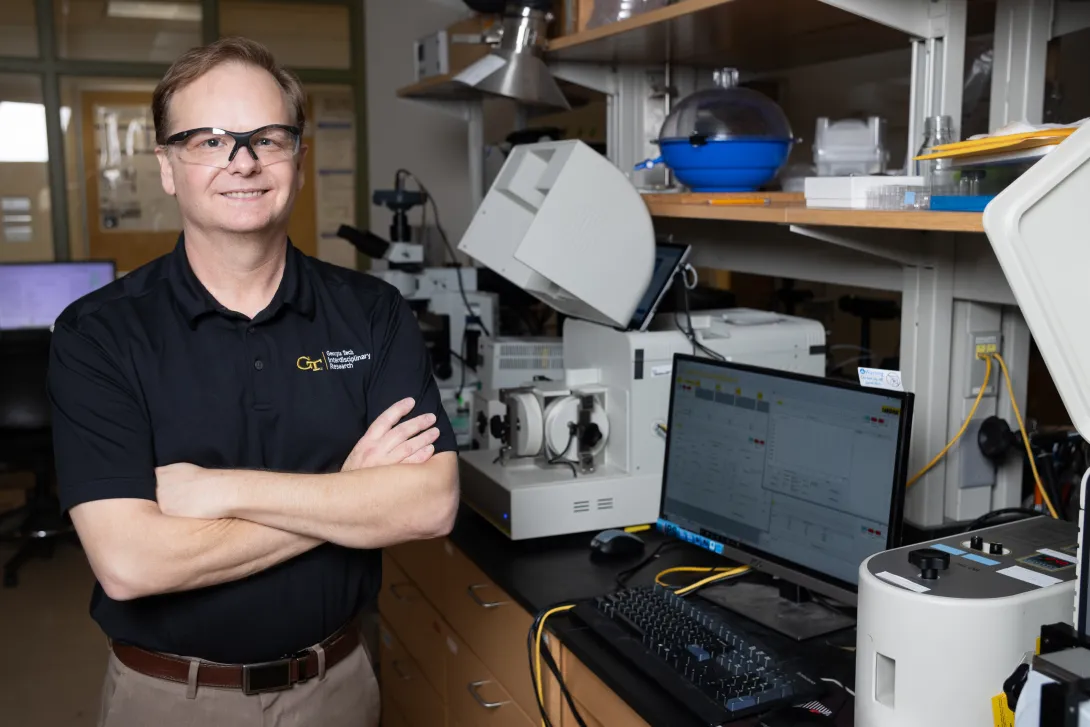
J. Carson Meredith, Executive Director of the Renewable Bioproducts Institute and Professor in Georgia Tech's School of Chemical and Biomolecular Engineering.
J. Carson Meredith, a professor in Georgia Tech’s School of Chemical and Biomolecular Engineering, is the 2024 recipient of the Andrew Chase Award from the American Institute of Chemical Engineers (AIChE) Forest and Plant Bioproducts Division.
Meredith will receive the award at the Annual AIChE Meeting in San Diego California, later this month.
The award recognizes Meredith’s research in nanocellulose chemical modification, composites, and cellulose-based renewable barrier coatings, which has resulted in seven patent applications, one commercial license, and ongoing research projects with six companies, reflecting the impact these advancements are making. His group recently reported the first successful recycling and reuse of nanocellulose gas barrier films and achieved one of the lowest water vapor barrier coatings derived from cellulose to date.
Meredith, ChBE’s James Preston Harris Faculty Fellow, is executive director of Georgia Tech’s Renewable Bioproducts Institute, which aims for future where plant biomass will enable a carbon neutral society and manufacturing infrastructure through traditional and emerging products.
News Contact
Brad Dixon || braddixon@gatech.edu
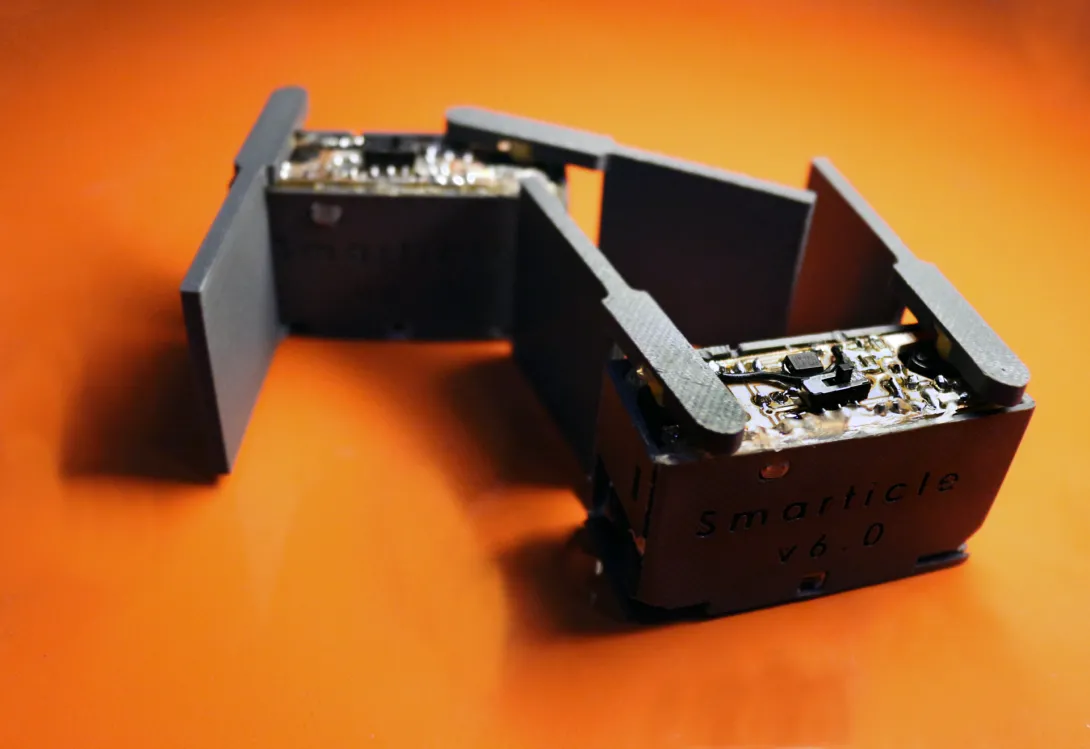
A pair of Smarticle robots from the lab of Prof. Dan Goldman. Earlier research from his group observed the arise of order in active matter from the physics of low rattling. (Photo Credit: Christa M. Ernst)
If you’ve ever watched a large flock of birds on the wing, moving across the sky like a cloud with various shapes and directional changes appearing from seeming chaos, or the maneuvers of an ant colony forming bridges and rafts to escape floods, you’ve been observing what scientists call self-organization. What may not be as obvious is that self-organization occurs throughout the natural world, including bacterial colonies, protein complexes, and hybrid materials. Understanding and predicting self-organization, especially in systems that are out of equilibrium, like living things, is an enduring goal of statistical physics.
This goal is the motivation behind a recently introduced principle of physics called rattling, which posits that systems with sufficiently “messy” dynamics organize into what researchers refer to as low rattling states. Although the principle has proved accurate for systems of robot swarms, it has been too vague to be more broadly tested, and it has been unclear exactly why it works and to what other systems it should apply.
Dana Randall, a professor in the School of Computer Science, and Jacob Calvert, a postdoctoral fellow at the Institute for Data Engineering and Science, have formulated a theory of rattling that answers these fundamental questions. Their paper, “A Local-Global Principle for Nonequilibrium Steady States,” published last week in Proceedings of the National Academy of Sciences, characterizes how rattling is related to the amount of time that a system spends in a state. Their theory further identifies the classes of systems for which rattling explains self-organization.
When we first heard about rattling from physicists, it was very hard to believe it could be true. Our work grew out of a desire to understand it ourselves. We found that the idea at its core is surprisingly simple and holds even more broadly than the physicists guessed.
Dana Randall Professor, School of Computer Science & Adjunct Professor, School of Mathematics
Georgia Institute of Technology
Beyond its basic scientific importance, the work can be put to immediate use to analyze models of phenomena across scientific domains. Additionally, experimentalists seeking organization within a nonequilibrium system may be able to induce low rattling states to achieve their desired goal. The duo thinks the work will be valuable in designing microparticles, robotic swarms, and new materials. It may also provide new ways to analyze and predict collective behaviors in biological systems at the micro and nanoscale.
The preceding material is based on work supported by the Army Research Office under award ARO MURI Award W911NF-19-1-0233 and by the National Science Foundation under grant CCF-2106687. Any opinions, findings, and conclusions or recommendations expressed in this material are those of the authors and do not necessarily reflect the views of the sponsoring agencies.
Jacob Calvert and Dana Randall. A local-global principle for nonequilibrium steady states. Proceedings of the National Academy of Sciences, 121(42):e2411731121, 2024.
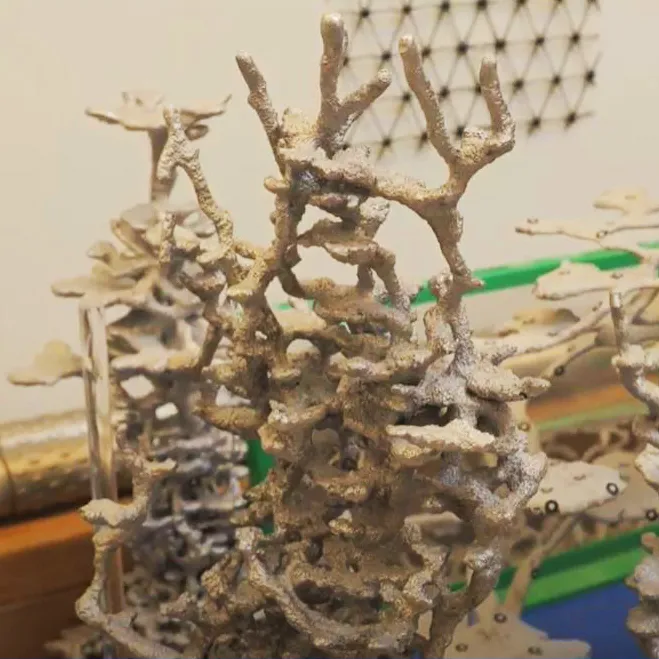
Ant hill cast in molten aluminum to show intricate underground structure of tunnels and chambers, much like the branches of coral.
- Written by Benjamin Wright -
Nature doesn’t waste energy, and nature finds ways to adapt to a changing world. Understanding those two principles led David Frost to his interest in bio-inspired design. Frost, the Elizabeth and Bill Higginbotham Professor in Georgia Tech’s School of Civil and Environmental Engineering, has spent the last dozen years searching for ways to use nature’s efficiency and ingenuity to improve the civil engineering field. His efforts are paying off. In the last year alone, research from his lab has resulted in multiple patent filings, licensing agreements, and product launches — all of which take their inspiration from the biological world.
Many of those research projects have been the subjects of doctoral research by Frost’s students, with support and advisement from Michael Helms, co-director of Georgia Tech’s Center for Biologically Inspired Design (CBID) and the Brook Byers Institute for Sustainable Systems lead for biologically inspired design. The CBID mandate is to encourage researchers to find inspiration in the biological world, where design solutions have been in development for three-and-a-half billion years as life has on Earth has evolved. Building on the concept that nature isn’t wasteful, one of the goals of bio-inspired design is to develop products that are both energy and materially efficient, and therefore more sustainable.
As the subsurface exploration and excavation thrust leader for the National Science Foundation (NSF) Center for Bio-mediated and Bio-inspired Geotechnics (CBBG), Frost focuses on what’s going on below the planet’s surface. His inspiration comes from things like tree roots, earthworms, spider webs, and ant colonies. In fact, ants are what first got him interested in bio-inspired design.
“There are many organism systems that have not been thought of as necessarily the most intelligent systems. But in fact, they are following a set of rules, approaches, or guidelines and are producing things that, in the end, are both energy- and resource-efficient and adaptive,” said Frost. “One of these is ant colonies. We see the hills above ground, but what’s going on below the ground, with the tunnels and chambers, is fascinating.”
Early in his time with CBBG, Frost came across a Florida artist who made metal castings of ant colony structures. Frost acquired some, made more castings of his own, and then built digital models of ant colonies to understand how the structures maintain their strength. He also studied exactly how ants build such complex structures so efficiently.
“They take advantage of capillarity, arching effects, and the strength of spirals,” explained Frost.
Ants dig by carefully and quickly probing each grain of sand or dirt, in the same way a human might test a Jenga piece, before deciding whether it can be safely removed without damaging the tunnel. As a result, ants are extremely energy efficient as they dig, continually removing the least encumbered pieces of material. Based on this information, Frost and his team are exploring ways to improve the effectiveness and energy usage of tunnel-boring machines.
Other bio-inspired projects from Frost’s research that are further along in the development process include building anchors inspired by tree roots, a ground heat-exchange system based on spirals and plant xylem, a geogrid (or stabilization mesh) design based on spiderwebs, a worm-inspired soil probe, and another probe design influenced by a vortex and centipedes that would displace a minimum amount of soil.
“I'm convinced that just about any system in nature we look at will help us think about analogs for things that, as human engineers, we’d like to do — and do better,” said Frost. “The opportunities for inspiration and improvement are endless.”
Take the Root-Inspired Ground Anchor (RIGA), for example. Anchors are an essential element in construction, stabilizing retaining walls and other foundation structures. Traditionally, anchors are straight poles inserted into the ground. Looking at tree roots, Frost wondered if there was a better way. That thought led him to inventing an anchor that can be driven into the ground and then expanded under the surface, similar to the structure of tree roots. The expandable anchor improves load capacity by up to 75% and is about two-thirds as long as a conventional anchor. After years of refinement, the device has been patented, licensed, and is the basis of a startup founded by Ph.D. student John Huntoon.
Frost takes the most pride in the real-world impact of his bio-inspired designs. Since 2023, Georgia Tech has filed, or is in the process of filing, utility patents for five of them. Like the RIGA system, those patents will be available for licensing for commercial use. Companies have already contacted Frost about his heat-exchange and geogrid concepts.
“Civil engineering doesn’t traditionally have a culture of patent-producing research,” noted Frost. “It’s exciting to see these filings and how they can generate energy and enthusiasm for studying natural systems and using what we learn to improve the world. Practical application has always been very important to me.”
Frost is finding that practical application also appeals to the next generation of civil engineers — specifically K-12 students interested in the profession who tour the CBID affiliated labs on campus. The students study nature’s designs and figure out how to apply them, rather than learn traditional construction methods.
“Ants, spiders, and worms are immediately relatable for middle- and high-school students,” Frost said. “They think engineering is all math and science, and that doesn’t sound fun to them. Instead, we show them they can be inspired by anything and then use that to make it about conservation and adaptation and energy minimization. Those are things they are interested in.”
Frost is hopeful that the students of today and tomorrow will continue to take inspiration from nature, enabling humans to adapt to a changing world as effectively as nature has.
News Contact
Brent Verrill, Research Communications Program Manager, BBISS
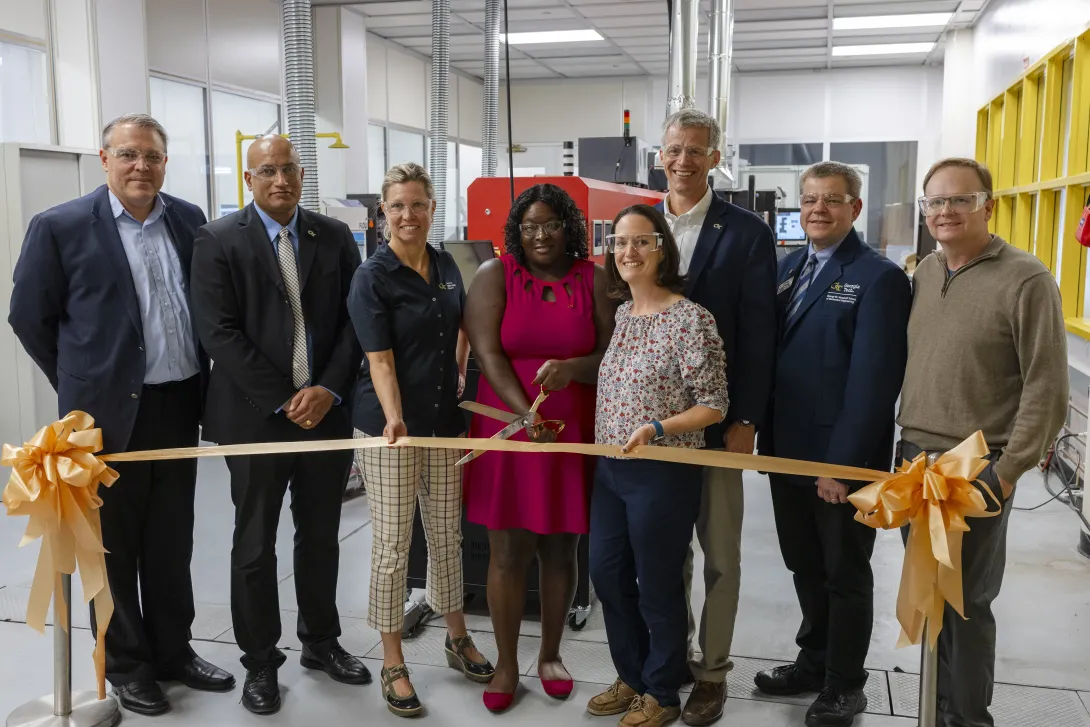
Partners of the facility gathered for an official ribbon cutting ceremony. From left to right: Eric Vogel, Hightower Professor in MSE, and executive director for the Institute for Matter and Systems; Devesh Ranjan, Eugene C. Gwaltney, Jr. school chair and professor in the George W. Woodruff School of Mechanical Engineering; Julia Kubanek, Vice President of Interdisciplinary Research; Tequila Harris, professor in the Woodruff School and facility leader; Christine Conwell, interim executive director for the Strategic Energy Institute; Tim Liewen, interim executive vice president for Research; Thomas Kurfess, Regent's Professor in the Woodruff School and executive director of the Georgia Tech Manufacturing Institute; J. Carson Meredith, professor and James Preston Harris Faculty Fellow in the School of Chemical and Biomolecular Engineering, executive director of the Renewable Bioproducts Institute. Photo: Christopher McKenney.
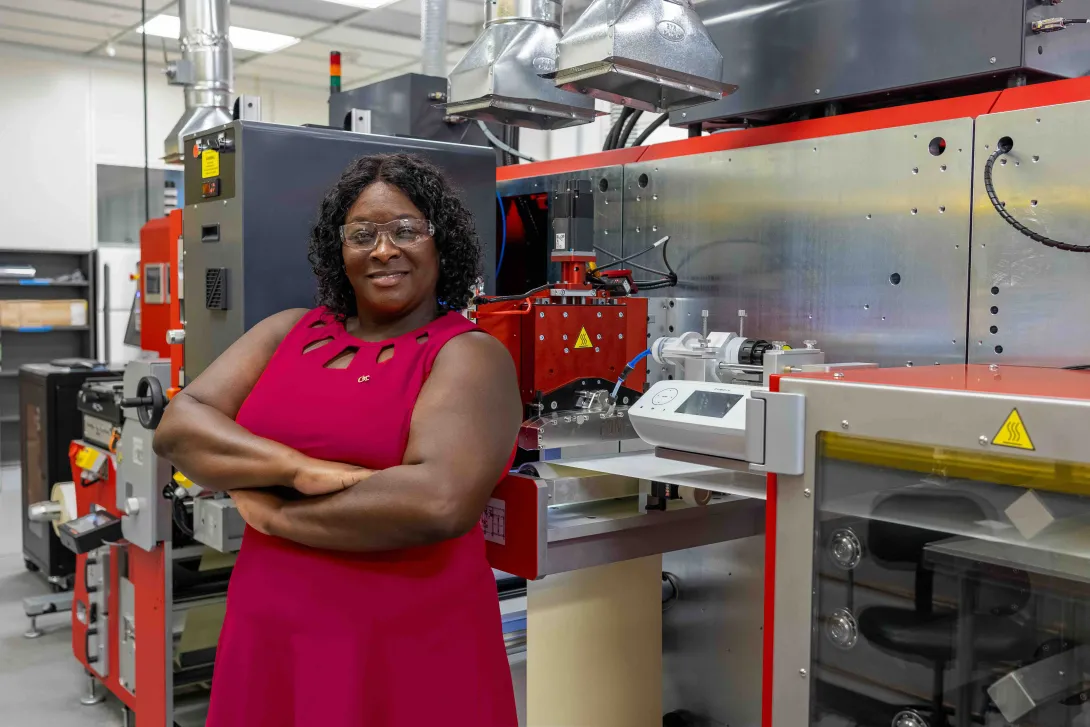
Tequila Harris, professor in the George W. Woodruff School of Mechanical Engineering, next to the modular R2R equipment. Photo: Christopher McKenney.
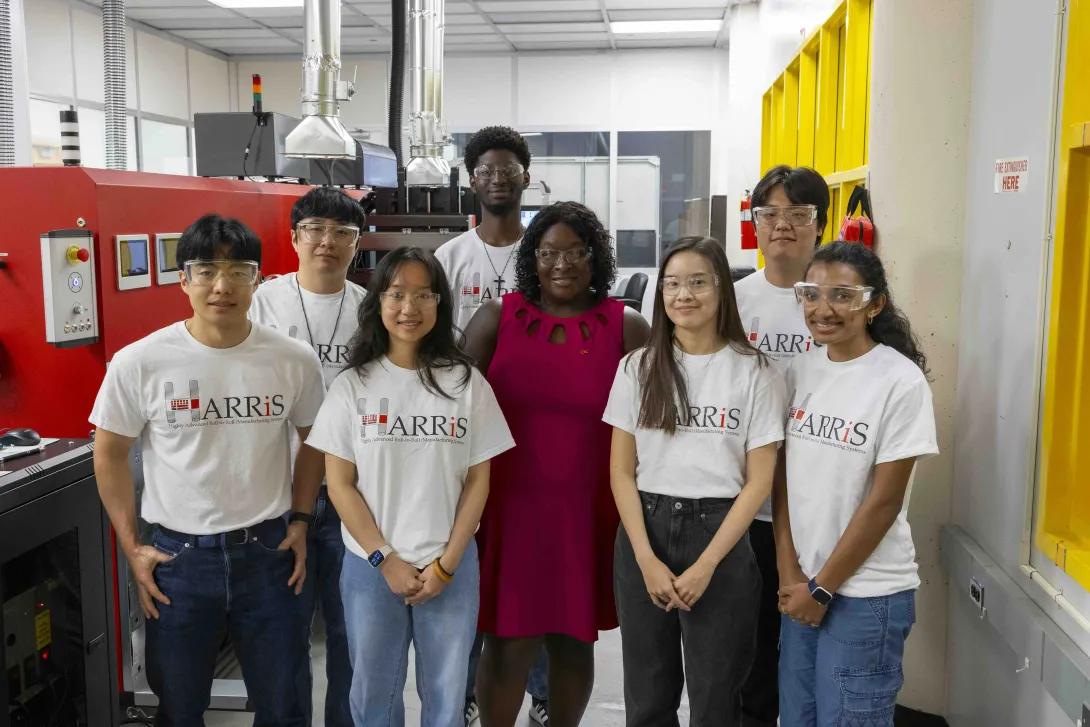
The Highly Advanced Roll-to-Roll iManufacturing Systems (HARRiS) research group in the new R2R facility. Photo: Christopher McKenney.
Whether it’s developing new products, reducing costs, or increasing accessibility, innovations in manufacturing stand to improve the lives of companies and consumers alike. Georgia Tech recently took another step toward ensuring those innovations make it from lab to market with the launch of a Modular Pilot Scale Roll-to-Roll Manufacturing Facility.
“As researchers develop new materials, one of the key aspects we’re missing is how to make them at scale. This is a major oversight because if we can’t make them at scale, we can’t transition from basic research to commercialization,” said Tequila Harris, a professor in the George W. Woodruff School of Mechanical Engineering. “With this new facility, we can prove our discoveries beyond lab-scale studies — and can go from materials innovation to product development at scale.”
Led by Harris, the new facility is the result of a partnership between the Georgia Tech Manufacturing Institute(GTMI), the Strategic Energy Institute, and the Woodruff School. As a pilot facility, it will serve as a testbed for scaling up manufacturing research open for Georgia Tech researchers as well as academic, government, and industry partners around the world.
“The larger vision I see at Georgia Tech involves innovation in manufacturing for large-scale industries,” said Georgia Tech’s Interim Executive Vice President for Research Tim Lieuwen at the facility’s unveiling event on Sept. 19. “It’s crucial that we’re innovating in basic science and technology, but we also need to be innovating in large-scale manufacturing.”
Roll-to-roll (R2R) manufacturing transforms flexible rolls of substrate materials, such as paper, metal foils, and plastics, into more complex, transportable rolls upon coating the surface with one or more fluids, such as inks, suspensions, and solutions, which are subsequently dried or cured on the base substrate. Its high yield and efficiency make R2R an ideal method for the sustainable, large-scale production of components for solar cells, batteries, flexible electronics, and separations — all industries that have expanded in Georgia in recent years.
“As a state institution, we’re ultimately here to serve our state,” said Lieuwen, who is also Regents’ Professor and David S. Lewis Jr. Chair in the Daniel Guggenheim School of Aerospace Engineering. “We’re seeing Georgia emerge as the national leader in terms of recruiting corporate investments in this space and in industries that will be served by this facility.”
Roll-to-Roll Innovations
The R2R process is similar to the production of newspapers, where a large roll of blank paper goes through a series of rollers printing text and photos. “The roll-to-roll aspect is the process of using a specialized tool to force fluid onto a moving surface,” says Harris. It’s one of the fastest-growing methods for producing thin film materials — photovoltaics used in solar cells, transistors in flexible electronics, and micro-batteries, for example — at a large scale.
Harris’s group works to develop novel manufacturing tools, with a particular focus on understanding and improving the dynamics of thin film manufacturing to increase efficiency and minimize waste. Her group is particularly interested in slot die coating, an R2R technique where a liquid material is precisely deposited onto a substrate through a narrow slot. With the new pilot facility, researchers like Harris will be able to take their work to the next level.
“Slot die coating on a roll-to-roll can handle the broadest viscosity range of most coating methods. Therefore, you can process a lot of different materials very quickly and easily,” says Harris. “It’s one of the fastest-growing technologies in the U.S. — and currently, this is the most advanced modular pilot scale facility at an academic university in the United States.”
“Georgia Tech is way ahead of the curve in terms of our facilities,” says GTMI Executive Director and Regents’ Professor Thomas Kurfess. “This will grow our capability in the battery area, membranes, flexible electronics, and more to allow us to support the development of new technologies.”
“As technologies around cleantech continue to advance at an unprecedented pace, pilot manufacturing facilities provide a critical bridge between innovative benchtop research and commercial-scale production and manufacturing,” says Christine Conwell, interim executive director of the Strategic Energy Institute. “We are excited about the opportunities this R2R facility will provide to the Georgia Tech energy community and our industry partners.”
News Contact
Audra Davidson
Research Communications Program Manager
Georgia Tech Manufacturing Institute
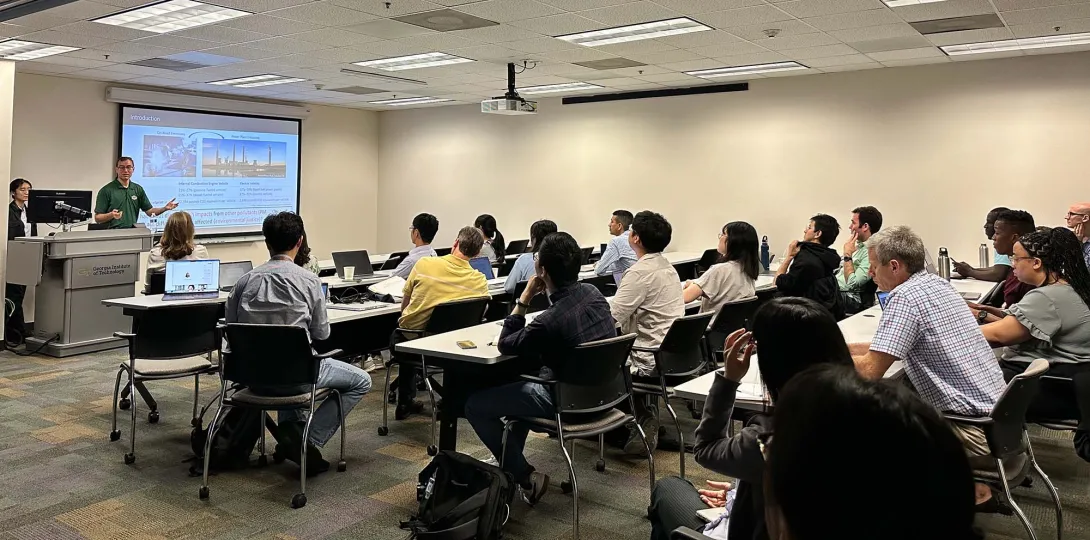
Dan Molzahn and his fellow researcher presenting at EPIcenter's Energy and Public Health Symposium
On Friday, May 10th, four Georgia Tech research teams, supported through the Energy, Policy, and Innovation Center ’s seed grant program presented their research findings to an engaged audience of fellow researchers and students.
The research teams included Georgia Tech faculty from across three colleges who presented their interdisciplinary research findings at the intersection of human health and energy systems.
The event began with a welcome address by Laura Taylor, the interim director of EPIcenter followed by EPIcenter’s director of Research Studies, Rich Simmons, who provided an overview of the vision behind the seed grant program. The seed grants were a culmination of a June 2020 workshop that invited researchers to proactively identify and mitigate new energy-health intersections and challenges by developing the knowledge to respond effectively to the interrelated challenges of public health and our current, and future energy infrastructure. The symposium included presentations from:
- Pengfei Liu, professor in the School of Earth and Atmospheric Sciences, on climate-induced air quality deterioration and its health risks in the Southeastern United States.
- Dan Molzahn, assistant professor in Electrical and Computer Engineering, and Xin Xie, professor in Civil Engineering on assessing the impacts of electric vehicle adoption and charging on air pollution and health
- Shuichi Takayama, professor in Biomedical Engineering on improving toxicology models that measure the impact of particulate matter on lung functioning to enhance energy and environmental policy-making
- Laura Taylor, on linking transit-related air pollution to health outcomes using the causal inference framework.
News Contact
Priya Devarajan || SEI Communications Program Manager