
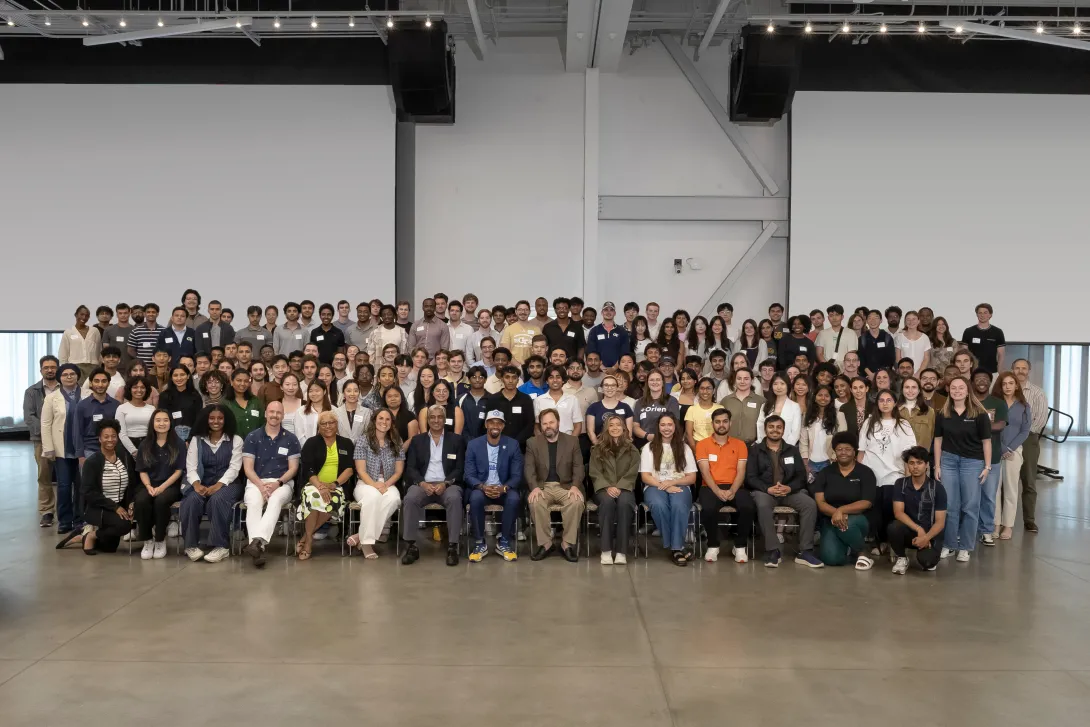
CREATE-X’s 12th cohort of Startup Launch with CREATE-X staff members and Atlanta leadership.
CREATE-X, Georgia Tech’s premier entrepreneurship program, kicked off its 12th Startup Launch cohort this month with a record-breaking 137 student teams and 25 faculty and research teams — totaling 318 founders. The summer-long accelerator, known for turning ideas into real-world ventures, is once again positioning Georgia Tech as a national leader in invention and startup creation.
This year’s cohort spans a wide range of industries, including artificial intelligence, defense, healthcare, gaming, sustainability, media management, agriculture tech, fashion tech, education, and more.
“These founders are in the messy middle and that's a beautiful place to be. There’s a lot of freedom in that,” said Margaret Weniger, director of Startup Launch. “We’re all going to be in this together. It's a safe space to try new things. It’s OK if it doesn't work out because what we want founders to learn is an entrepreneurial mindset and entrepreneurial spirit — something you take with you no matter what you do after this.”
Over the next 12 weeks, teams will validate ideas, build products, and acquire customers with the help of dedicated coaches, a robust founder community, and a network of mentors and alumni.
Raghupathy "Siva" Sivakumar, Georgia Tech’s inaugural vice president of Commercialization and the faculty founder of CREATE-X, spoke about the core of CREATE-X and what it would take for founders to succeed.
“Startup Launch is not about Georgia Tech gaining from your success. We are here just for one reason, which is to make you successful,” he said. “You need to hold yourself accountable. You need to be ambitious in terms of how big a problem you solve. You need to be emphatic that the customer matters. The successful teams are 100% behind what's going to make the lives of customers easier and better.”
In 2014, CREATE-X was co-founded by Sivakumar, Steve McLaughlin(who is now the president of The Cooper Union for the Advancement of Science and Art), and other Georgia Tech faculty, including Ray Vito, Craig Forest, and Ravi Bellamkonda (who is now the executive vice president and provost of The Ohio State University). The program received its initial major philanthropic support from Chris Klaus, a Georgia Tech alumnus and tech entrepreneur, whose gift helped launch the initiative, and , played a key role in building out the program's maker courses. Over the years, CREATE-X has continued to grow, thanks largely to the philanthropic support of alumni and foundations who believe in its mission.
In the last decade, the program has produced over 650 startups, $2.4 billion in portfolio valuation, and had eight founders named to Forbes’ 30 Under 30. Wagner shared stories of past teams who pivoted dramatically — from a glucose-monitoring pillow to a sobriety app now valued at over $350 million, and from a camping gear delivery service to a billion-dollar logistics platform.
“We don’t know which ideas will become the next unicorns,” Weniger said. “But we’re betting on you.”
At the kickoff event, McLaughlin and Klaus were honored for their contributions to Georgia Tech’s entrepreneurial ecosystem. McLaughlin encouraged the founders through the story of CREATE-X.
“From the very beginning, we challenged CREATE-X to be a startup as well. To this day, CREATE-X has raised its own money to do this. It's a reminder of what it takes to make this happen,” he said. “This is the most difficult challenge you have ever taken. I think at the time, we were probably skeptical about whether students could do it. Now we know that you can.”
Georgia Tech President Ángel Cabrera reflected on the impact of McLaughlin, Klaus, and others who saw the vision of Georgia Tech being an entrepreneurial campus.
“Ten years ago, this was a crazy, absurd idea,” he said. “Now, 150 teams are working on their own crazy ideas. Even though sometimes there's this idea of the entrepreneur as a loner, what you learn very quickly is entrepreneurship is a team sport.”
Klaus spoke about people collaborating and helping solve problems together.
“I'm especially inspired by Georgia with its complex history,” he said. “It continues to be a place where peace can be envisioned and pursued. I think this recognition strengthens my commitment to building bridges, resolving conflict, and lifting up voices that seek unity. As you build your businesses, you'll be building collaborations and partnerships, and hopefully make the world a better place.”
As the summer progresses, founders will be guided by CREATE-X’s core values: experiential education, entrepreneurial confidence, and real-world impact. Weniger encouraged teams to “show up uncomfortable” and “leverage every single resource” available.
The journey will culminate at Demo Day, where teams will showcase their startups to investors, industry leaders, and the broader community. The event is free, open to the public, and promises a front-row seat to the next wave of Georgia Tech-born innovation.
Demo Day 2025 will take place on Thursday, Aug. 28, at 5 p.m., in the Exhibition Hall. For more information and to RSVP, visit the CREATE-X Demo Day Eventbrite.
News Contact
Breanna Durham
Marketing Strategist
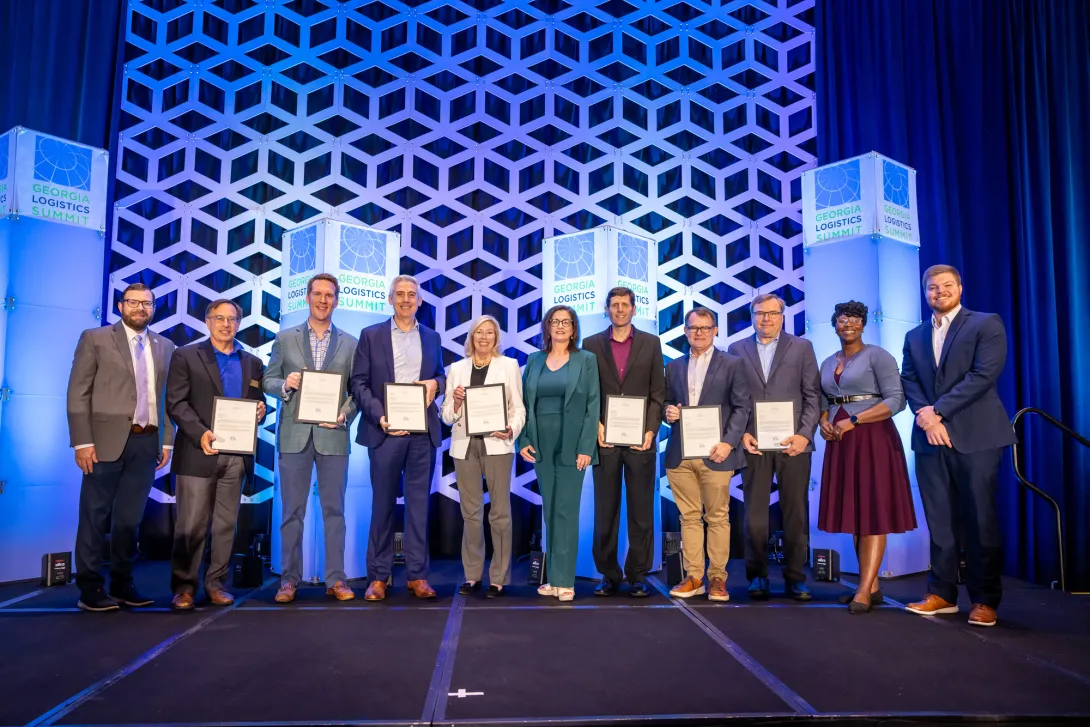
Members of the Georgia Center of Innovation – Logistics Advisory Board gathered at the 2025 Georgia Logistics Summit, where each received a personal note of recognition from Governor Brian Kemp for three years of dedicated service. Their collective efforts have advanced freight and logistics across Georgia—strengthening collaboration between industry, government, and academia to drive the state’s economic growth.
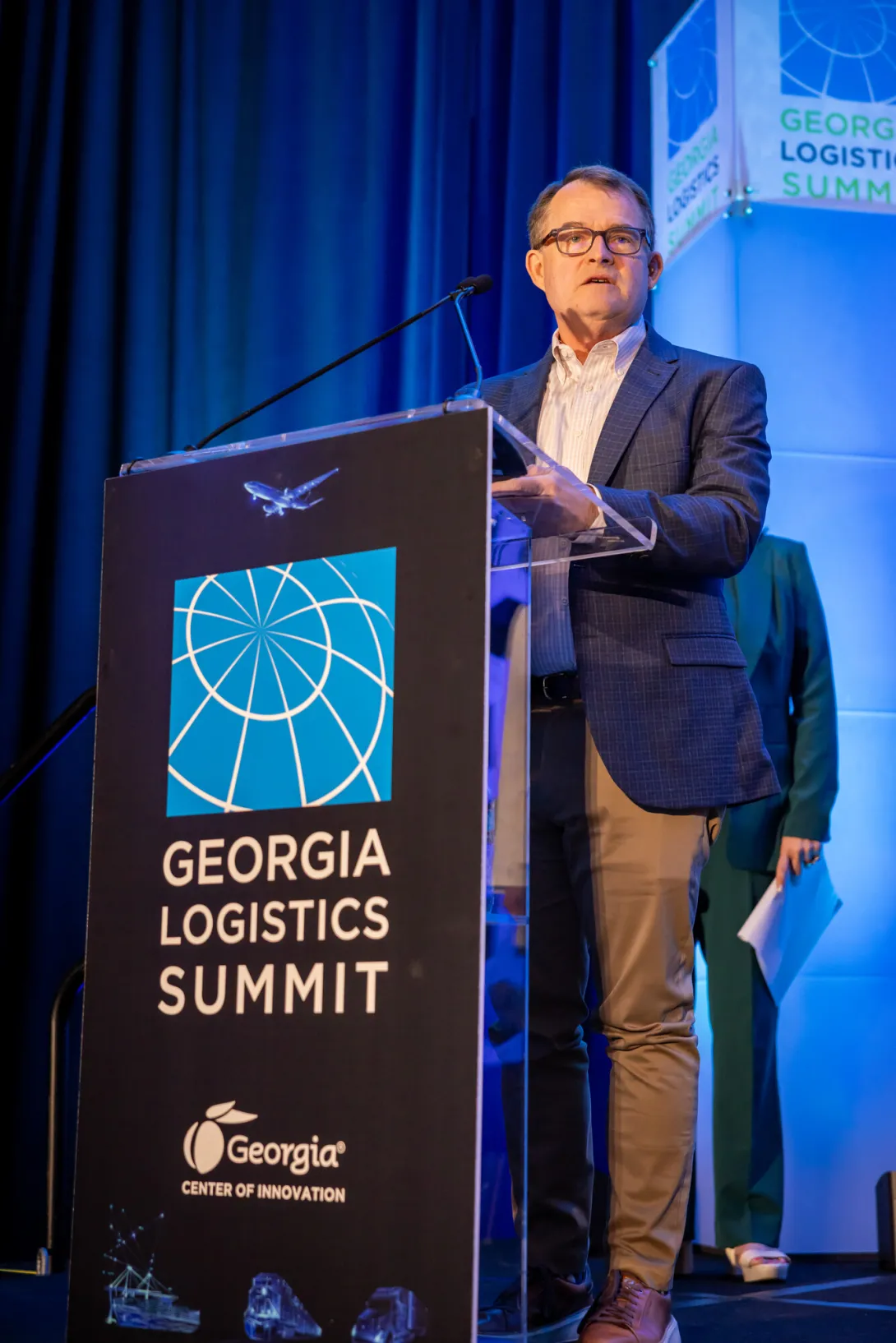
Chris Gaffney of Georgia Tech’s Supply Chain and Logistics Institute addresses the Georgia Logistics Summit, reflecting on the power of public-private collaboration. “It’s that bridge between dialogue and execution that makes this group so valuable. Together, we’re building the capabilities that help Georgia’s communities and businesses grow, thrive, and lead.”

Pascal Van Hentenryck participated in a panel discussion of how AI and digital technologies are reshaping supply chains, including future predictions and real-world examples of their impact on logistics.
The Georgia Center of Innovation, a strategic arm of the Georgia Department of Economic Development (GDEcD), hosted hundreds of attendees at the 2025 Georgia Logistics Summit, where experts offered insights on the intersection of technology and logistics, updates on infrastructure investments, and how the state is preparing the future workforce to support growth. Established in 2009 as the first state-led event of its kind, the Georgia Logistics Summit is one of the Southeast’s key logistics and supply chain events, connecting industry professionals for networking and knowledge-sharing.
The economic impact of Georgia’s transportation and logistics industry was $107 billion in 2023, according to an economic impact study by the University of Georgia’s Selig Center for Economic Growth. These industries supported more than 578,000 Georgia jobs, or one in nine jobs in the state. From 2010 to 2023, transportation and logistics jobs in Georgia grew by 68%, outpacing the national growth rate of 52%. Additionally, in 2023 and 2024 alone, new logistics and distribution sector investments, including cold storage and ecommerce fulfillment centers, totaled $3.8 billion and created over 9,000 new jobs.
“Georgia’s unmatched global connectivity is one of the driving forces behind our economic success. Decades of strategic investment in our logistics and supply chain infrastructure – from our ports and rail lines to our highways and air cargo capabilities – have led to record-breaking economic investments and trade,” said Georgia Department of Economic Development Commissioner Pat Wilson. “The Logistics Summit brings together private sector, government, and education leaders to learn from experts, exchange best practices, and explore opportunities in the rapidly evolving logistics landscape to maximize opportunities. Events like this strengthen collaboration and spark new ideas that keep Georgia businesses competitive on a global scale.”
Georgia Department of Transportation Commissioner Russell R. McMurry highlighted Georgia’s strategic investments and how the Georgia Department of Transportation (GDOT) is leveraging technology to improve freight flow. He cited the leadership of Governor Brian P. Kemp and support from the General Assembly to allocate $1 billion to the newly created Georgia Freight Program over the past two years. Additional investments in transportation infrastructure are advancing the timing for key planned transportation projects that will maintain and improve Georgia’s interstate highway system, roads, and bridges. Georgia’s multimodal transportation network carried nearly half a billion tons of freight in 2019, valued at $673 trillion. Projections show that freight volume is expected to nearly double to 900 million in tonnage and freight value to more than double today’s value by 2050. Working with partners that include the Center of Innovation and the Georgia Institute of Technology, GDOT is focusing on enhancing safety and efficiency, including projects to add 50% more truck parking and installing fiber internet on Georgia interstates.
Georgia Ports Authority Vice President of Operations Susan Gardner provided updates on strategic investments to expand capacity at the ports, and how Georgia Ports Authority (GPA) is leveraging live data to improve safety, track vessel productivity and containers, and eliminate congestion. Gardner emphasized building a technological culture and prioritizing hiring creative employees, as well as harnessing data insights to boost efficiency. GPA is investing in $4.5 billion in improvements over the next decade as part of its port master plan to expand cargo handling capabilities and support future supply chain requirements.
This year’s feature panel, “AI and Beyond: Embracing Digital Transformation in Logistics,” included leadership from The Home Depot, Havertys Furniture, and TOTO USA, as well as research perspectives from the Georgia Institute of Technology. Panelists highlighted the ways digital technologies are reshaping supply chains, including a three- to five-year outlook for the industry, and provided insights attendees can use to shape their strategies to move more efficiently as AI and automation transform the industry.
“Digital technologies are reshaping supply chains in various ways, and Georgia is working to stay ahead of the curve,” said Center of Innovation Executive Director David Nuckolls. “The Center of Innovation and our specialized logistics team work alongside this dynamic industry, helping to position businesses for growth. The annual Georgia Logistics Summit is a powerful opportunity to build connections and equip businesses with crucial knowledge and resources.”
Educating the needed talent was the focus of the event’s final panel, with University System of Georgia Chancellor Sonny Perdue and Technical College System of Georgia Commissioner Greg Dozier providing updates on how the state’s post-secondary institutions are developing a globally competitive workforce. Discussion focused on how these institutions are ensuring the skills they are teaching match the jobs logistics companies are looking for, including creative problem-solving and effective use of new AI and automation tools. The breadth of Georgia’s technical college programs was also discussed, including the High Demand Career Initiatives program and a pilot program called “Dual Achievement” that enrolls students who withdrew from high school in a technical college program, enabling them to earn a high school diploma alongside a technical college certificate, diploma, or degree. Panelists focused on the importance of helping students get where they want to go faster, upskilling the existing workforce, and how connections between industry leaders and educators can help foster greater outcomes.
The Center of Innovation’s Logistics Industry Advisory Board also recognized the winners of the inaugural Future Innovators in Supply Chain competition. The competition invited college students to create videos about supply chain careers, reflecting the Center’s commitment to developing future logistics leaders. Led by professor Parisa Pooyan, student team “The Masters of Logistinomics” from Kennesaw State University won first prize and a $3,000 grant for the university. Eli Hampton, Angeline Harris, Joe Johnson, and Dana Pazhouhesh created the winning video, which can be viewed here.
For additional information on the 2025 Georgia Logistics Summit and to stay up-to-date on next year’s plans, visit galogisticssummit.com.
Participants in the 2025 Georgia Logistics Summit also included leaders from S&P Global Market Intelligence, Boost Phase Ventures, and M.D. Livingstone Consulting.
About the Georgia Center of Innovation
Exclusive to Georgia, the Center of Innovation helps Georgia businesses of all types and sizes find inspired solutions to challenges and opportunities. The Center connects new and expanding businesses with a team of experts, external partners, and independent mentors to tap into the technical expertise and guidance they need. By encouraging collaboration across six key industries: Aerospace, AgTech, Energy Technology, Information Technology, Logistics, and Manufacturing, the Center helps Georgia prepare for growth in strategic industry ecosystems.
About GDEcD
The Georgia Department of Economic Development (GDEcD) is the state’s sales and marketing arm. It is Georgia’s lead agency for attracting new business investment, encouraging the expansion of existing industry and small businesses, and locating new markets for Georgia products. As the state’s official destination marketing organization, it drives traveler visitation and promotes the state as a location for film and digital entertainment projects. GDEcD is responsible for planning and mobilizing state resources for economic development, fostering innovation and the arts to drive opportunity from the mountains to the coast.
News Contact
Allie Dean, Communications Manager, Georgia Department of Economic Development | adean@georgia.org
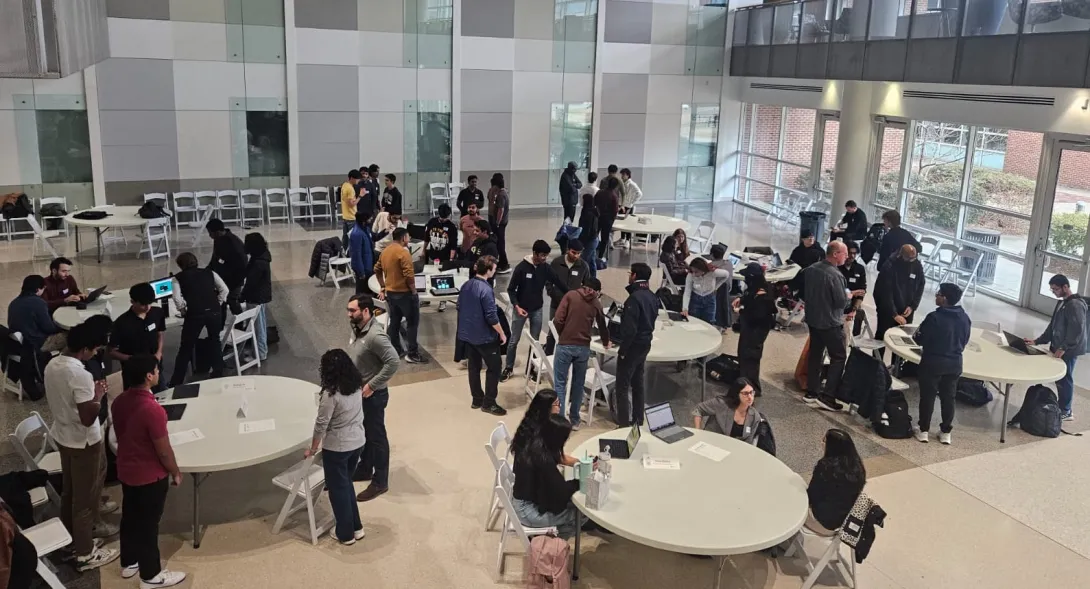
EnergyHack@GT, an inaugural student-run energy and sustainability hackathon
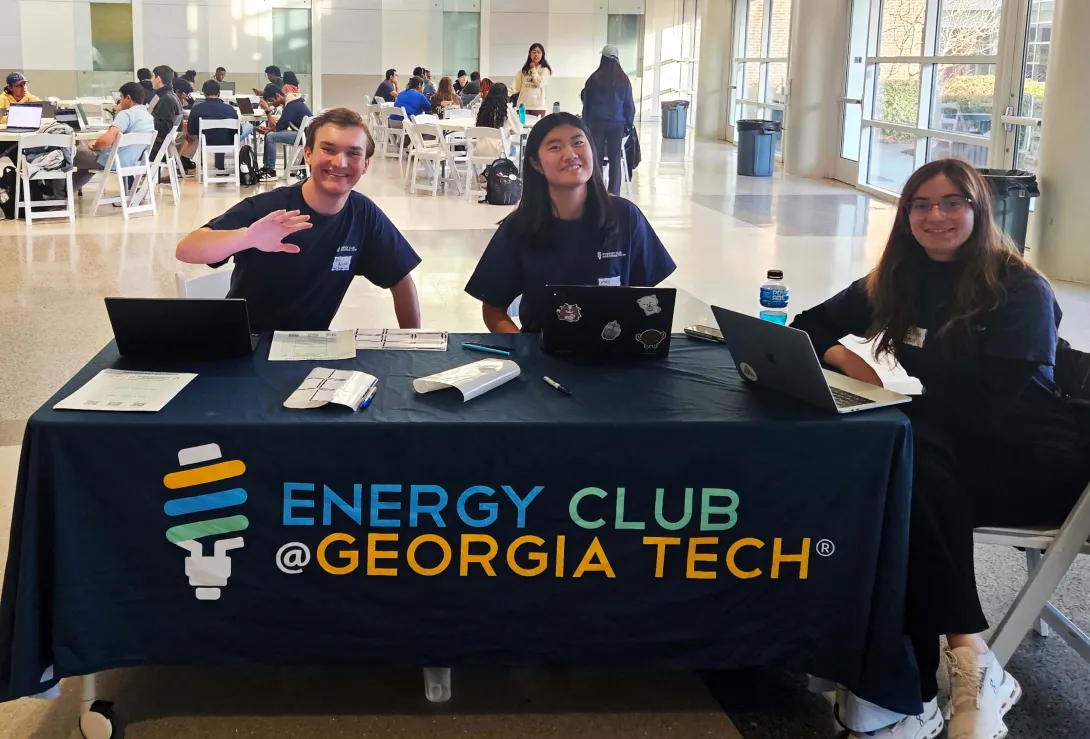
Energy Club Team Members during EnergyHack@GT
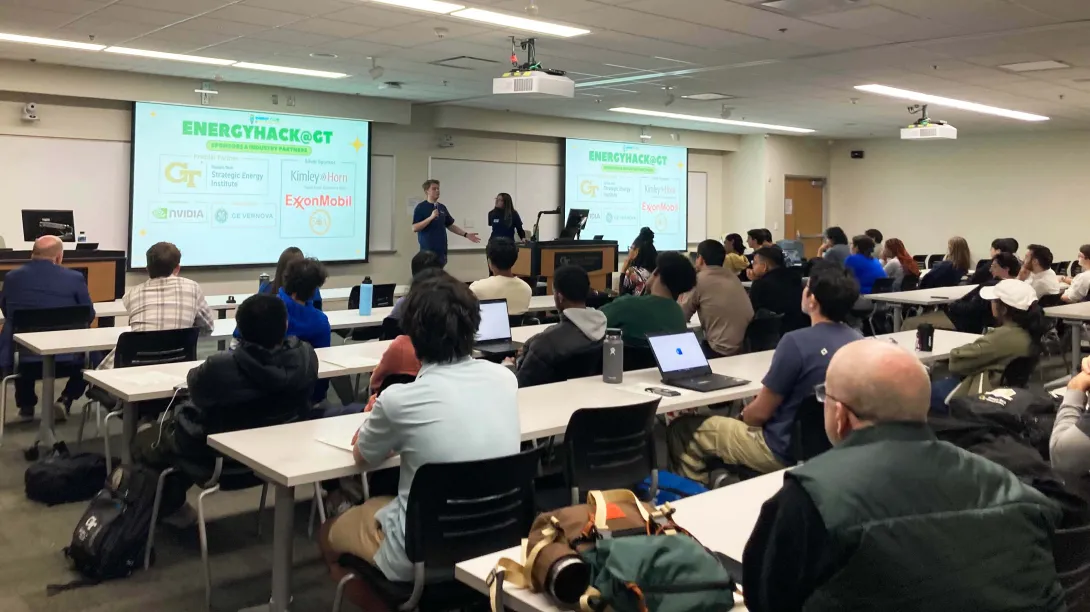
Presentations during EnergyHack@GT
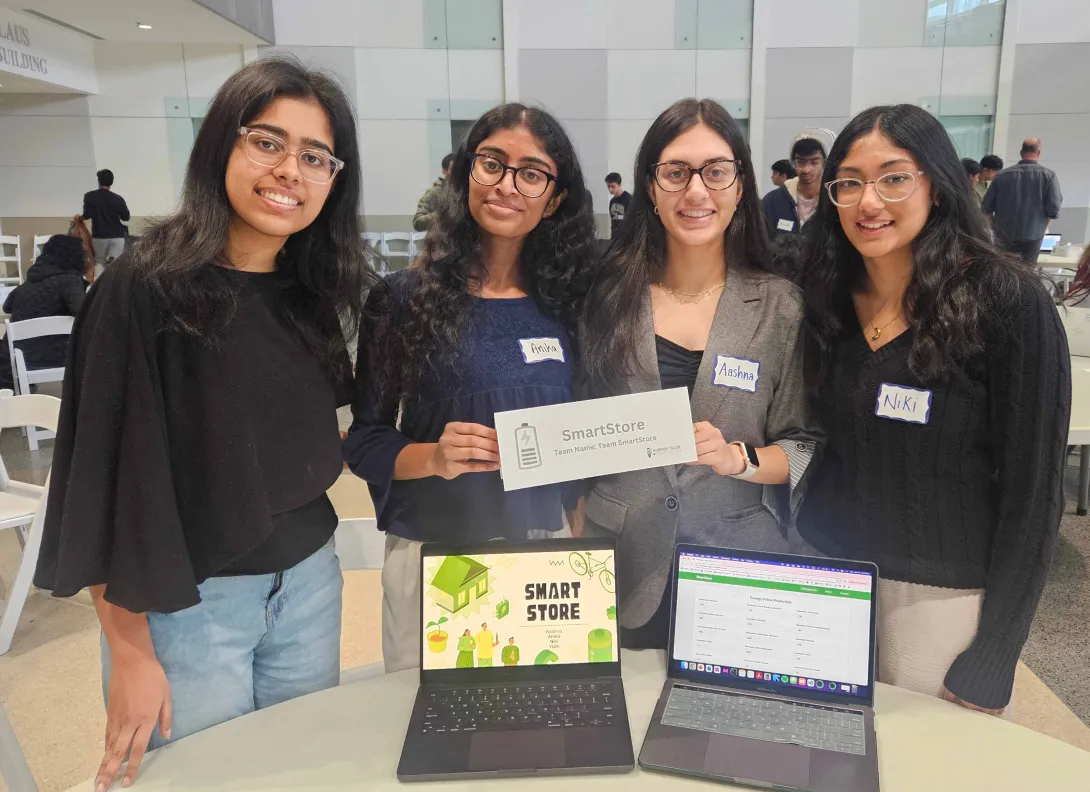
SmartStore, one of the Project Teams at EnergyHack@GT
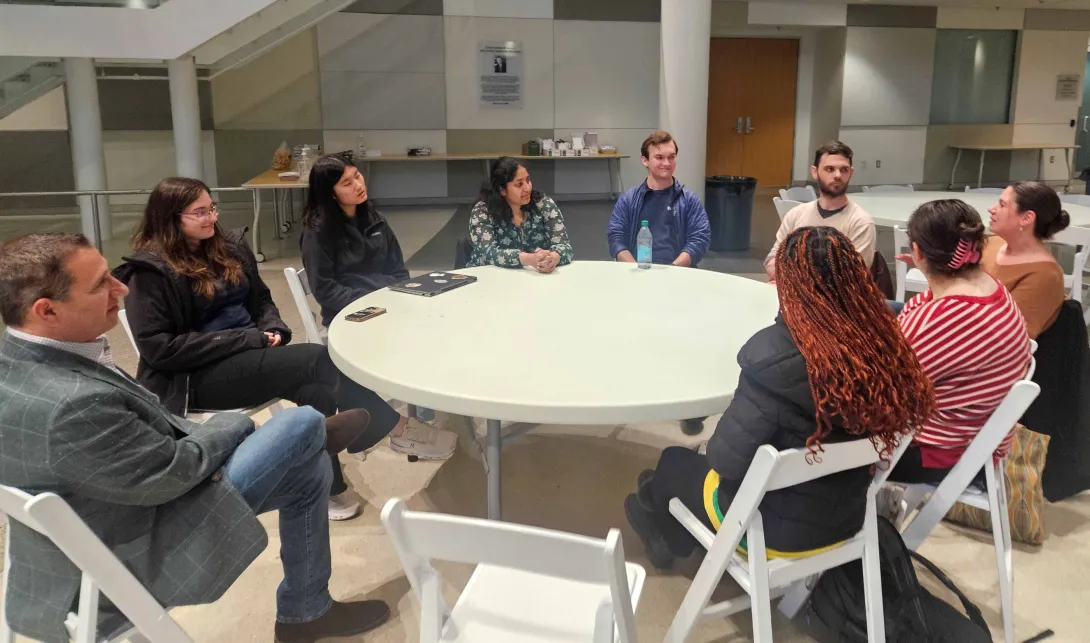
Roundtable Discussion during EnergyHack@GT
EnergyHack @GT, Georgia Tech’s inaugural student-run energy and sustainability hackathon, kicked off Jan. 17-19, 2025. Organized by the Energy Club at Georgia Tech, the mission of the hackathon was to unite passionate students to tackle critical challenges in the energy industry while fostering innovation and collaboration.
Over the course of 36 hours, participants collaborated in teams to brainstorm, design, and prototype projects that promote sustainable practices based on diverse problem statements, addressing this year’s tracks: energy storage, energy security, and decarbonization. These themes targeted urgent issues, from balancing renewable energy supply and demand to safeguarding infrastructure against cyber threats and reducing greenhouse gas emissions. The projects were evaluated by a panel of judges.
Along with showcasing keynote speeches and educational workshops, the event culminated with the top three teams winning cash prizes. With more than 100 registered participants, 17 project submissions, and leaders from some of the biggest energy and tech companies, EnergyHack @GT successfully fostered collaboration and showcased the potential of student-driven solutions for advancements in energy and sustainability.
“The inaugural student-led EnergyHack was a tremendous success, and I am incredibly proud of the committee members for turning this brilliant idea into an outstanding event,” Dan Molzahn, assistant professor in the School of Electrical and Computer Engineering and faculty advisor for the Energy Club, said. “Their dedication and hard work truly brought this vision to life, fostering innovation and collaboration within the vibrant Georgia Tech student community.”
The event kicked off with an engaging opening ceremony featuring inspiring keynote speeches that set the tone for the hackathon’s ambitious objectives. Jessica Roberts, assistant professor in the School of Interactive Computing, shared insights into models used to track coal pollution sources and their dispersion across the United States. Steve Hummel, senior vice president at Chart Industries, discussed how artificial intelligence (AI) is reshaping demand projections and driving diversification in generation portfolios. Following the presentations, participants joined a dynamic team mixer to form diverse, multidisciplinary teams and networked with professionals from Kimley-Horn in a dedicated session.
Throughout the hackathon, participants had access to expert-led workshops and mentorship. A session on "Machine Learning (ML) and AI for Materials Screening and Discovery" by Victor Fung, assistant professor in the School of Computational Science and Engineering, explored the role of AI in advancing sustainable materials. A meet and greet with keynote speakers allowed participants to engage in thought-provoking discussions on energy and sustainability issues.
The energy and creativity peaked during the Project Expo, where 17 innovative solutions were showcased. Representatives from NVIDIA, GE Vernova, and other industry leaders reviewed projects, offering insights and feedback.
The closing ceremony celebrated the participants’ achievements and the event highlights, featuring a keynote by Priya Donti, assistant professor at the Massachusetts Institute of Technology's Department of Electrical Engineering and Computer Science and Laboratory for Information and Decision Systems, and founder of Climate Change AI, on using AI to combat climate change and to build sustainability solutions.
EnergyHack @GT served as a platform for innovation and learning, showcasing the potential of student-led initiatives in shaping the future of energy and sustainability. Awards were presented to the top three projects that stood out for their creativity and impact:
- Best Overall Hack: Watts The Power, a project that predicts the energy and environmental impact of training ML models, earned the team a $250 cash prize.
- Second Place: EcoTokens, a Chrome extension designed to reduce token usage in AI tools to save energy, won a $150 prize.
- Third Place: Eco Charge, an electric vehicle charging optimizer designed to minimize CO₂ emissions, secured a $100 prize.
News Contact
News Contact: Priya Devarajan || SEI Communications Program Manager
Written By: Braden Queen, Tejaswi Manoj, May Ming
Acknowledgments/Contributions by: Victoria Pozzi, Max Zhang, Eli Acree, Radhika Sharma
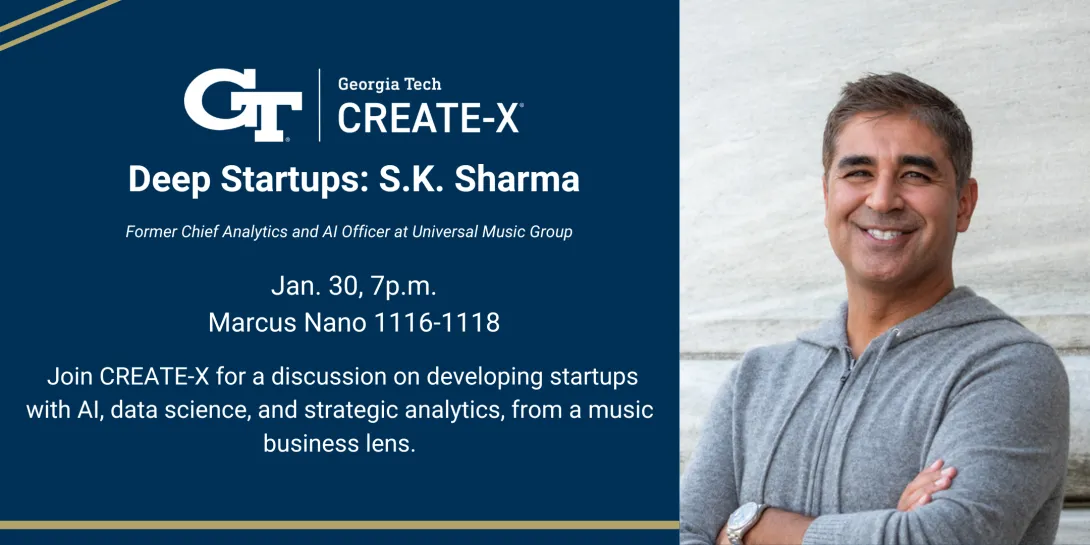
Pictured S.K. Sharma Deep Startups Poster, with headshot and the following: S.K. Sharma, Former Chief Analytics and AI Officer at Universal Music Group, Deep Startups, Jan. 30, 7p.m. Marcus Nano 1116-1118, Join CREATE-X for a discussion on developing startups with AI, data science, and strategic analytics, from a music business lens.
CREATE-X is set to host its next Deep Startups panel event on Thursday, Jan. 30, at 7 p.m. in the Marcus Nanotechnology Building Rooms 1116– 1118. The event will feature S.K. Sharma — former chief analytics and AI officer at Universal Music Group — and an expert in AI, data science, and strategic analytics. During Deep Startups, Sharma will dive into startup development within the context of the music business industry. Seating is limited. Students can register for Deep Startups on Engage. Faculty, staff, and the general public can register for Deep Startups on Eventbrite.
Deep Startups is a series that brings together knowledgeable entrepreneurs and Startup Launch alumni from various business sectors to discuss their experiences forming companies that address significant, contemporary challenges. Attendees spend an informative evening discovering the intersection of technology and entrepreneurship.
From 2016 until recently, S.K. Sharma led a global team of Ph.D. data scientists, engineers, and strategists at Universal Music Group (UMG) to develop innovative and scalable solutions that drive real-time market insights and audience engagement. His leadership has been instrumental in creating differentiated intellectual property and market-leading capabilities in AI, machine learning, and prescriptive analytics, earning him multiple patents in marketing analytics.
Sharma's academic background includes a Ph.D. in chemical physics and physical chemistry from Caltech. His research has been published in numerous peer-reviewed journals, and he has held concurrent roles in academia and industry, including senior research scientist at Caltech's Beckman Institute. His corporate career includes significant positions such as vice president at Lehman Brothers, executive director at UBS, and vice president and partner at Mitchell Madison Group, where he advised global private equity funds and venture capital managers.
In addition to his role at UMG, Sharma is an entrepreneur in residence at UC San Diego's Office of Innovation and Commercialization, where he supports pioneering advancements in science and engineering. He is also an investor at Provisio Medical, a company revolutionizing endovascular procedures with its Sonic Lumen Tomography technology.
Sharma's contributions to the field of AI and analytics have been widely recognized. He was awarded Billboard magazine's 40 Under 40 and has been a commencement speaker at UC San Diego's Jacobs School of Engineering. His work in developing AI-driven marketing technologies has set new standards in the industry, ensuring compliance with global privacy regulations while driving significant improvements in marketing efficiency.
Attendees of Deep Startups will hear practical knowledge and actionable advice on entrepreneurship from Sharma. Each CREATE-X event is an opportunity to network, build ideas, and prepare for the Startup Launch program, which provides $5,000 in optional seed funding, $150,000 in in-kind services, mentorship, entrepreneurial workshops, networking events, and resources to help build and scale startups. Students, faculty, researchers, and alumni interested in developing their own startups are encouraged to apply. The deadline to apply for Startup Launch is March 17, 2025. Spots are limited. Apply now for a higher chance of acceptance and early feedback. If you have any questions about getting started, email us at create-x@groups.gatech.edu.
News Contact
Breanna Durham
Marketing Strategist
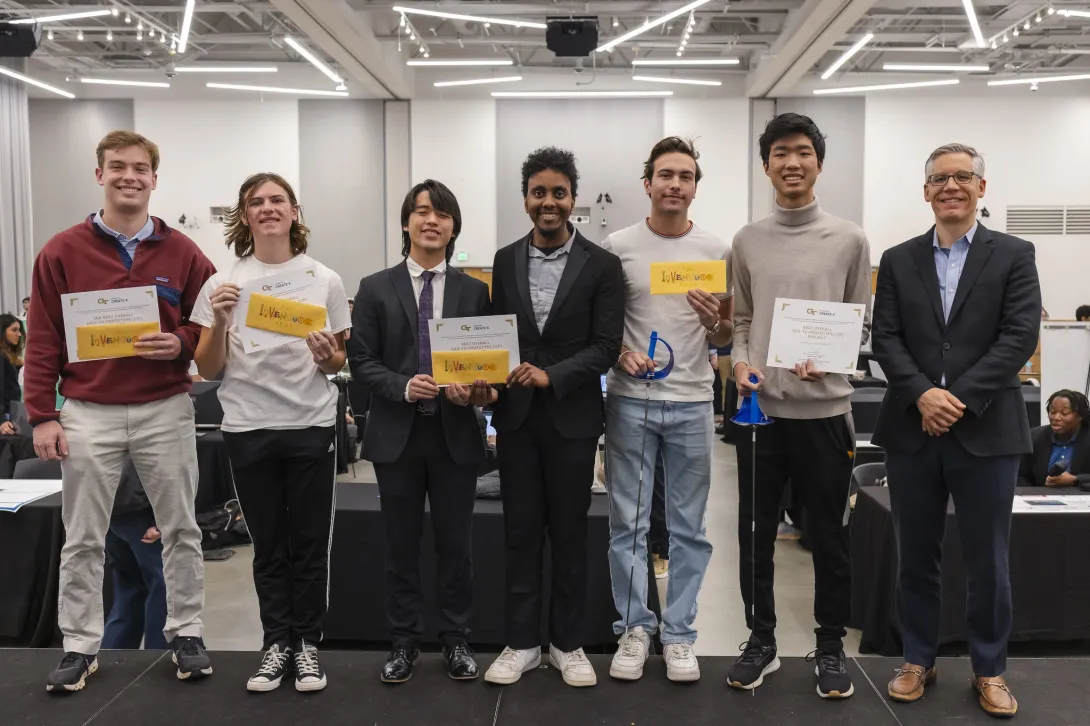
The winners of the Fall 2024 I2P Showcase stand together in Exhibition Hall.
- SuperStream: John-Wright Stanly
- Convexity Electronics: Calla Scotch, Levi Bloch, Phi Cai
- Soul: Ashraf Mansour, Benjamin Wilson, Michal Gregus
- Allez Go: Adam Kulikowski, Jason Mo
- Craig Forest, Associate Director of Make
Two teams tied for Best Overall projects of the Fall 2024 I2P Showcase. Over two hours, 49 teams displayed prototypes that they developed over the semester to hundreds of attendees, while judges circulated the room. The showcase is the last event of their Idea-to-Prototype (I2P) course, where Georgia Tech students earn research credit (for undergraduate students only), receive up to $500 in reimbursement for physical material expenses, and build a working product with faculty mentorship. The course is held in the spring, summer, and fall. Graduate students can also take the course, and student can take it up two times.
As a part of the showcase, the winning team, or teams in this case, also receive a golden ticket into the CREATE-X summer startup accelerator, Startup Launch. This program provides founders with $5,000 in optional seed funding, $150,000 in in-kind services like accounting and legal services, mentorship, and entrepreneurial education, among other benefits. At the end of that experience, startup teams can present their products to investors and industry partners at Demo Day, which attracts over a thousand attendees each year.
Additionally, winners of the showcase advance directly to the semifinal round of the InVenture Prize, a faculty-led innovation competition for undergraduate students and recent BS graduates of Georgia Tech.
This semester, the first place teams were Allez Go and Soul. Team Allez Go’s founders, Adam Kulikowski and Jason Mo, created a real-time visualization system for fencing blades using infrared light and reflectors to accurately track positions during a bout. Team Soul, made up of Ashraf Mansour, Benjamin Wilson, and Michal Gregus, developed fitness-tracking soles and shoes, combining the functions of a smart scale, a workout tracker, and a diet tracker into a singular device.
Second place was awarded to Team Convexity Electronics, consisting of Calla Scotch, Levi Bloch, and Phi Cai. Convexity Electronics produces 3D-printed circuit boards that aim to be smaller, faster, and cheaper than lithography-based circuitry.
Team SuperStream, made up of solo-preneur John-Wright Stanly, took home third place. SuperStream adds video previews to URLs to increase engagement.
Read our Q&A with Team Allez Go and Soul below, and stay tuned for our interviews with the other winning teams!
Q&As
Team AllezGo
Adam Kulikowski, Sophomores, Computer Science
Jason Mo, Sophomores, Computer Science
Why did you pursue your startup?
Kulikowski: We're both fencers. I've been fencing for 10 years, and Jason's been fencing close to 10 as well. So, fencing as a sport is really hard to view for non-fencers, and so the idea that we wanted to do is use visualizations, animations, and replays in a similar way that other kinds of sport visualization companies did.
What was the I2P course like for you all?
Mo: So, this prototype actually started over the summer. I was in Startup Lab and just did a study abroad program. During that class, they mentioned that I2P is a great opportunity, and I had this prototype already in the works.
What surprised you about I2P?
Mo: I2P was very generous with funding; we never had any issues with using up our $500. It was just really helpful because our prototype was pretty heavy hardware.
What was your favorite part about I2P?
Mo: Our weekly meetings with Aaron Hillegass, our mentor, were always very, very insightful. I just shot him an email for I2P, hoping that we could work together on this. Sometimes we would talk about prototypes or updates. He had some really good insights, but our mentor also has a lot of industry experience and a lot of experience with his own startups. It was really fun to just ask him general questions and career advice. He was always very responsive, very supportive for us.
Kulikowski: In addition, I really liked seeing the iterations each week. I think the weekly updates kept us accountable to do at least one small thing every week. So, it was cool to see how the ideas slowly started to formulate each week, small steps and small progresses.
What was challenging about building your prototype over the semester?
Mo: There's a lot of technical challenges. One of the things we did this semester is we changed from a 30 frames per second (FPS) camera to a camera that shoots at 120 FPS. And with that, we could detect a lot more processing power. The camera that we're using is only limited to Windows. I've been using a very old laptop, and that's sort of been a bit problematic when we're trying to do very compute intensive tasks.
What would you say to students that are interested in entrepreneurship?
Kulikowski: There are a lot of people that came by our booth, and a lot of them were freshmen students. Every one of them we told, “If you have an idea, if you're really passionate about something, I2P is a fantastic opportunity.” This semester, with the hands-off approach, really felt like you could just work on this idea, and everything was there to support you working on it. That was fantastic because it's we could take full advantage of the time, the resources, and truly flesh out this idea. I really love the support we had and how we had the bonding with the other students.
Team Soul
Ashraf Mansour, Senior, Computer Science
Benjamin Wilson, Junior, Computer Science
Michal Gregus, Junior, Physics and Electrical Engineering
What’s the thought behind the name?
Mansour: We're kind of bringing life through our electronics, back into the shoe, and building a better fitness tracker and a more holistic picture of human health.
What was the showcase like for your team?
Wilson: It was a little nerve wracking. I have full faith in our ideas and concepts, but I feel personally like we still have a long way to go for our project. I’m still satisfied with where we are now, but we never really anticipated that we we're going to win anything.
Mansour: The showcase made me realize how much faster all this moves, even compared to my expectations. We came in with a very basic prototype that we wanted to improve on, but I think the potential was enough to sell the judges in this case. Now we have a big responsibility to deliver on that potential.
What was your favorite thing about I2P Showcase?
Mansour: It really reminds you how much of a tech hub Georgia Tech really is. Seeing how entrepreneurship boosts in real time, especially at the early stages, is something that’s really awe inspiring.
What was challenging about building your prototype over the semester?
Mansour: There are a lot of unique engineering challenges with the product that we’re building, some we anticipated and others we didn’t, but I think that speaks to the true soul of engineering. That adaptability and sense of problem solving is really important.
Wilson: I’m very grateful to have the other people that were involved in this project for brainstorming and making the design better.
What would you say to students that are interested in entrepreneurship?
Wilson: I definitely would encourage anyone that wants to pursue their own startup or has a new idea to just start. It’s far more efficient and far more rewarding to put your ideas out there and try. You’ll learn a lot more through that process of failing than you will contemplating.
A photo gallery from the Fall 2024 I2P Showcase can be viewed on the CREATE-X Flickr page.
CREATE-X is now accepting applications for the summer and fall semesters of the I2P course, and applications for their summer accelerator, Startup Launch. The deadline for I2P applications for Summer 2025 is May 12. The deadline for Startup Launch applications is March 19, 2025. For questions, please email create-x@groups.gatech.edu.
News Contact
Breanna Durham
Marketing Strategist
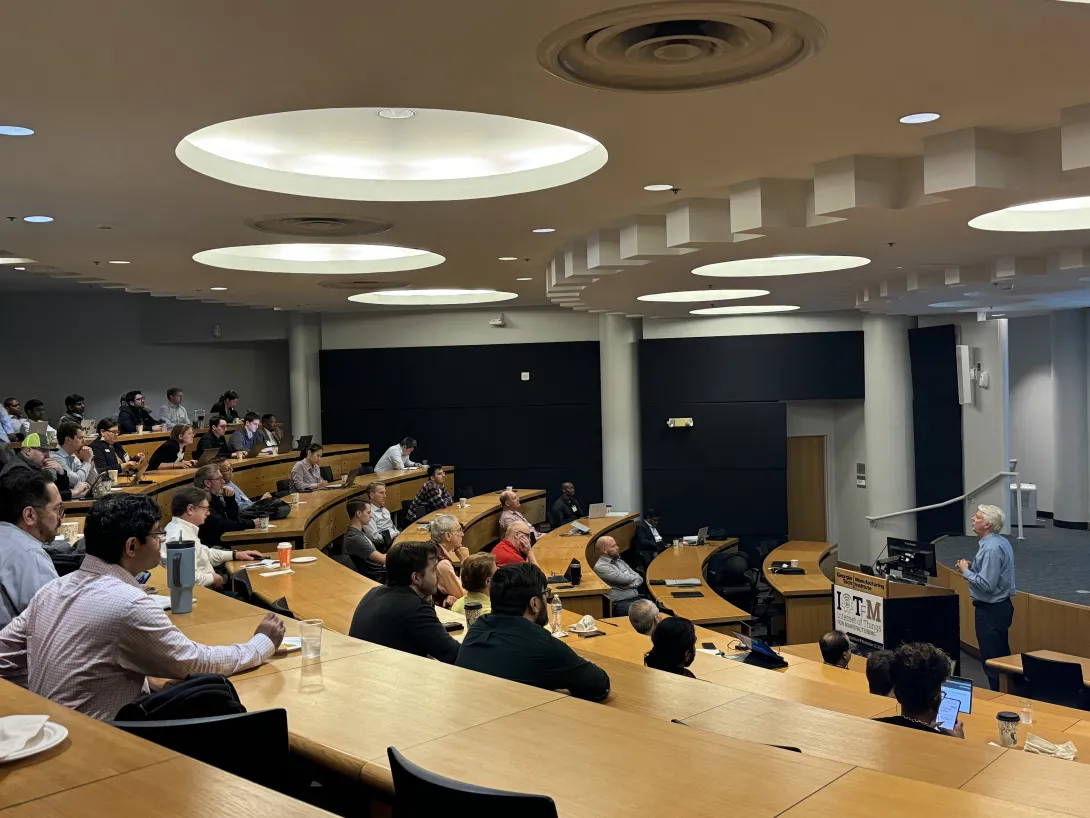
Andrew Dugenske, a principal research engineer at GTMI and symposium organizer, delivering a talk at the symposium's tenth annual gathering.
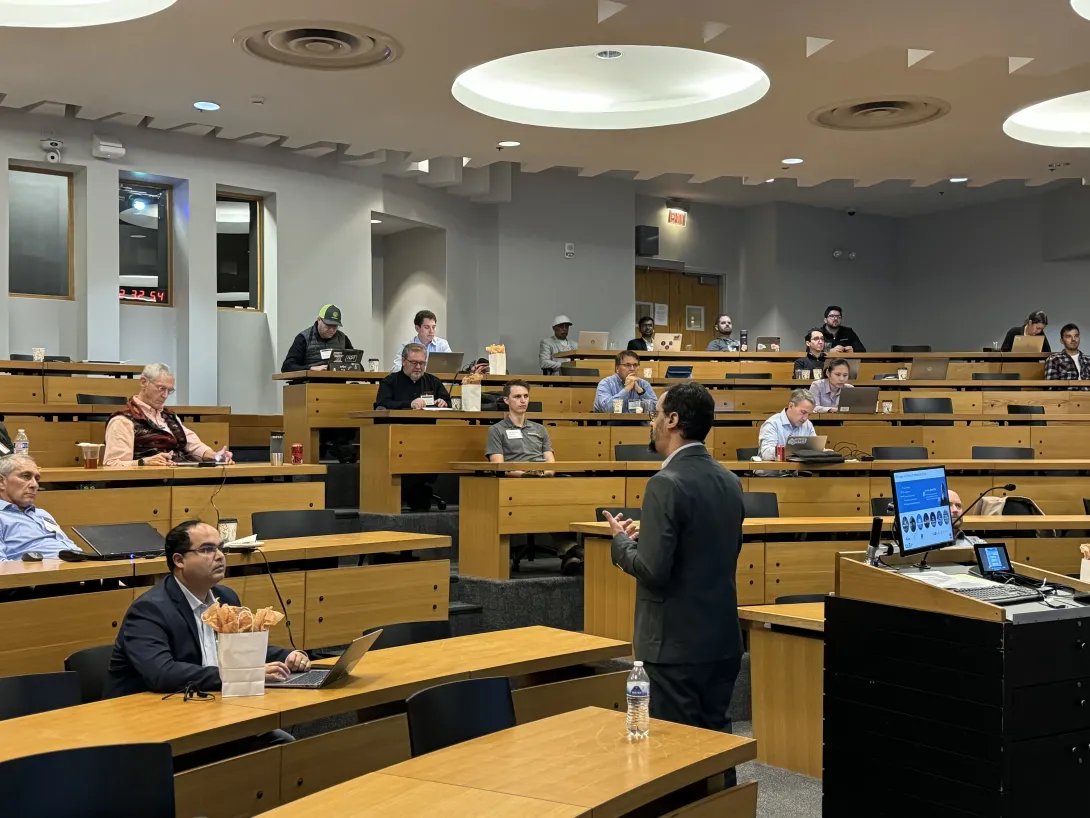
Dago Mata, regional director of business development at Tata Consultancy Services (TCS) and one of the event’s speakers.
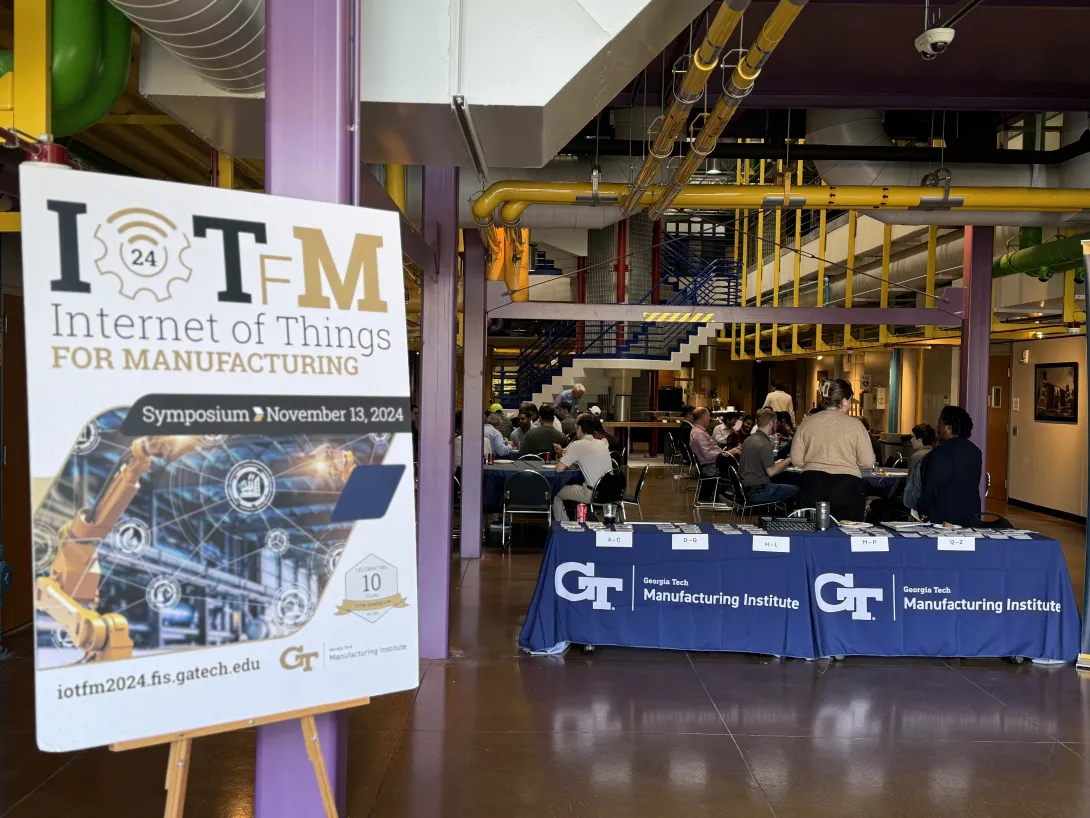
The event was held in the Callaway Research Building on November 13, 2024.
In the rapidly evolving world of manufacturing, embracing digital connectivity and artificial intelligence is crucial for optimizing operations, improving efficiency, and driving innovation. Internet of Things (IoT) is a key pillar of that process, enabling seamless communication and data exchange across the manufacturing process by connecting sensors, equipment, and applications through internet protocols.
The Georgia Tech Manufacturing Institute (GTMI) recently hosted the 10th annual Internet of Things for Manufacturing (IoTfM) Symposium, a flagship event that continues to set the standard for innovation and collaboration in the manufacturing sector. Held on Nov. 13, the symposium brought together industry leaders, researchers, and practitioners to explore the latest advancements and applications of IoT in manufacturing.
"The purpose is to bring the voice of manufacturers directly to the university community," explained Andrew Dugenske, a principal research engineer and director of the Factory Information Systems Center at GTMI. "It's about learning from industry to guide our research, education, and knowledge base, which is inherent to Georgia Tech."
Initiated over a decade ago, the IoTfM Symposium has grown into a premier event that highlights Georgia Tech's commitment to advancing manufacturing technologies.
"This symposium provides a unique platform to share and learn from cutting-edge advancements in IoT and now AI for manufacturing,” said Dago Mata, regional director of business development at Tata Consultancy Services (TCS) and one of the event’s speakers. “The opportunity to engage with industry leaders and showcase practical, real-world implementations was highly motivating."
This year’s symposium welcomed over 100 attendees from across the country. Speakers from TCS, Amazon Web Services, Southwire, and more shared insights on the latest advancements, use cases, current challenges, and future directions for IoT in manufacturing processes.
“My favorite aspect was the case studies presented by major manufacturers, highlighting successful IoT and AI implementations," said Mata, who has attended the symposium since 2018. "These provided actionable takeaways and inspiration for driving similar innovation in my projects — the blend of exclusive learning from real-world applications and the presence of diverse experts made it a truly practical and inspiring event."
A distinctive feature of the IoTfM Symposium is its commitment to providing a platform for industry partners to voice their perspectives on powerful manufacturing research, says Dugenske. "We ask our industry partners to tell us about their experiences, challenges, and future predictions. This way, we can guide our research with the real-world needs of the manufacturing sector to form stronger collaborations and better prepare our students."
This unique format not only enhances the relevance of the symposium but also fosters a collaborative environment where industry leaders can learn from each other and from Georgia Tech's academic community.
As GTMI looks to the future, the symposium will continue to evolve, incorporating new elements and expanding its reach. Dugenske envisions even greater integration with other GTMI initiatives and broader industry engagement.
"Our goal is to create an event that highlights our capabilities and builds deeper connections within the manufacturing community.”
News Contact
Audra Davidson
Research Communications Program Manager
Georgia Tech Manufacturing Institute
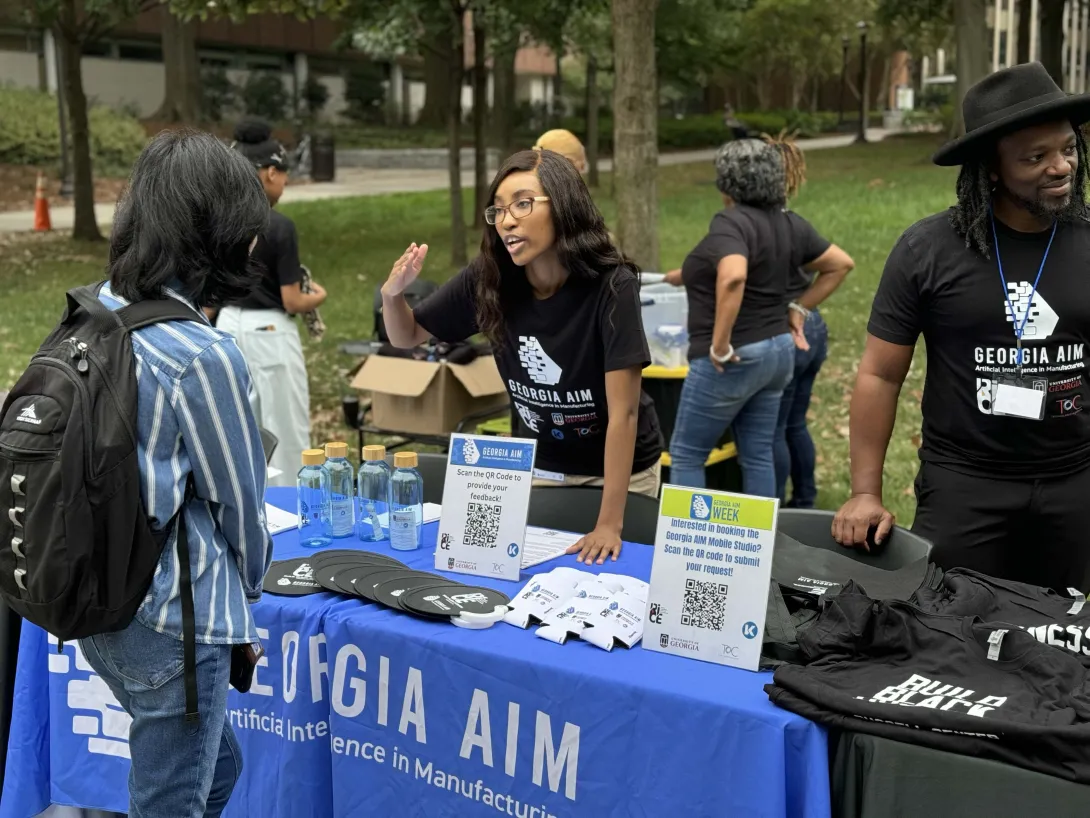
Georgia AIM representatives talk with students on Georgia Tech's campus during the launch event for their new mobile labs.
Gold and white pompoms fluttered while Buzz, the official mascot of the Georgia Institute of Technology, danced to marching band music. But the celebration wasn’t before a football or basketball game — instead, the cheers marked the official launch of Georgia AIM Week, a series of events and a new mobile lab designed to bring technology to all parts of Georgia
Organized by Georgia Artificial Intelligence in Manufacturing (Georgia AIM), Georgia AIM Week kicked off September 30 with a celebration on the Georgia Institute of Technology campus and culminated with another celebration on Friday at the University of Georgia in Athens and aligned with National Manufacturing Day.
In between, the Georgia AIM Mobile Studio made stops at schools and community organizations to showcase a range of technology rooted in AI and smart technology.
“Georgia AIM Week was a statewide opportunity for us to celebrate Manufacturing Day and to launch our Georgia AIM Mobile Studio,” said Donna Ennis, associate vice president, community-based engagement, for Georgia Tech’s Enterprise Innovation Institute and Georgia AIM co-director. “Georgia AIM projects planned events in cities around the state, starting here in Atlanta. Then we headed to Warner Robins, Southwest Georgia, and Athens. We’re excited about the opportunity to bring this technology to our communities and increase access and ideas related to smart technology.”
Georgia AIM is a collaboration across the state to provide the tools and knowledge to empower all communities, particularly those that have been underserved and overlooked in manufacturing. This includes rural communities, women, people of color, and veterans. Georgia AIM projects are located across the state and work within communities to create a diverse AI manufacturing workforce. The federally funded program is a collaborative project administered through Georgia Tech’s Enterprise Innovation Institute and the Georgia Tech Manufacturing Institute.
A cornerstone of Georgia AIM Week was the debut of the Georgia AIM Mobile Studio, a 53-foot custom trailer outfitted with technology that can be used in manufacturing — but also by anyone with an interest in learning about AI and smart technology. Visitors to the mobile studio can experience virtual reality, 3-D printing, drones, robots, sensors, computer vision, and circuits essential to running this new tech.
There’s even a dog — albeit a robotic one — named Nova.
The studio was designed to introduce students to the possibilities of careers in manufacturing and show small businesses some of the cost-effective ways they can incorporate 21st century technology into their manufacturing operations.
“We were awarded about $7.5 million to build this wonderful studio here,” said Kenya Asbill, who works at the Russell Innovation Center for Entrepreneurs (RICE) as the Economic Development Administration project manager for Georgia AIM. “We will be traveling around the state of Georgia to introduce artificial intelligence in manufacturing to our targeted communities, including underserved rural and urban residents.”
Some technology on the Georgia AIM Mobile Studio was designed in consultation with project partners Kitt Labs and Technologists of Color. An additional suite of “technology vignettes” were developed by students at the University of Georgia College of Engineering. RICE and UGA served as project leads for the mobile studio development, and RICE will oversee its deployment across the state in the coming months.
To request a mobile studio visit, please visit the Georgia AIM website.
During Monday’s kickoff, the Georgia Tech cheerleaders and Buzz fired up the crowd before an event that featured remarks by Acting Assistant Secretary of the U.S. EDA Christina Killingsworth; Jay Bailey, president and CEO of RICE; Beshoy Morkos, associate professor of mechanical engineering at the University of Georgia; Aaron Stebner, co-director of Georgia AIM; David Bridges, vice president of Georgia Tech’s Enterprise Innovation Institute; and lightning presentations by Georgia AIM project leads from around the state.
Following the presentations, mobile studio tours were led by Jon Exume, president and executive director, and Mark Lawson, director of technology, for Technologists of Color. The organization works to create a cohesive and thriving community of African Americans in tech.
“I’m particularly excited to witness the launch of the Georgia AIM Mobile Studio. It really will help demystify AI and bring its promise to underserved rural areas across the state,” Killingsworth said. “AI is the defining technology of our generation. It’s transforming the global economy, and it will continue to have tremendous impact on the global workforce. And while AI has the potential to democratize access to information, enhance efficiency, and allow humans to focus on the more complex, creative, and meaningful aspects of work, it also has the power to exacerbate economic disparity. As such, we must work together to embrace the promise of AI while mitigating its risks.”
Other events during Georgia AIM week included the Middle Georgia Innovation Corridor Manufacturing Expo in Warner Robins, West Georgia Manufacturing Day – Student Career Expo in LaGrange, and a visit to Colquitt County High School in Moultrie. The week wrapped on Friday, Oct. 4, at the University of Georgia in Athens with a National Manufacturing Day celebration.
“We’re focused on growing our manufacturing economy,” Ennis said. “We’re also focused on the development and deployment of innovation and talent in the manufacturing industry as it relates to AI and other technologies. Manufacturing is cool. It is a changing industry. We want our students and younger people to understand that this is a career.”
News Contact

U.S. Secretary of the Navy Carlos Del Toro during his remarks at the John Lewis Student Center.
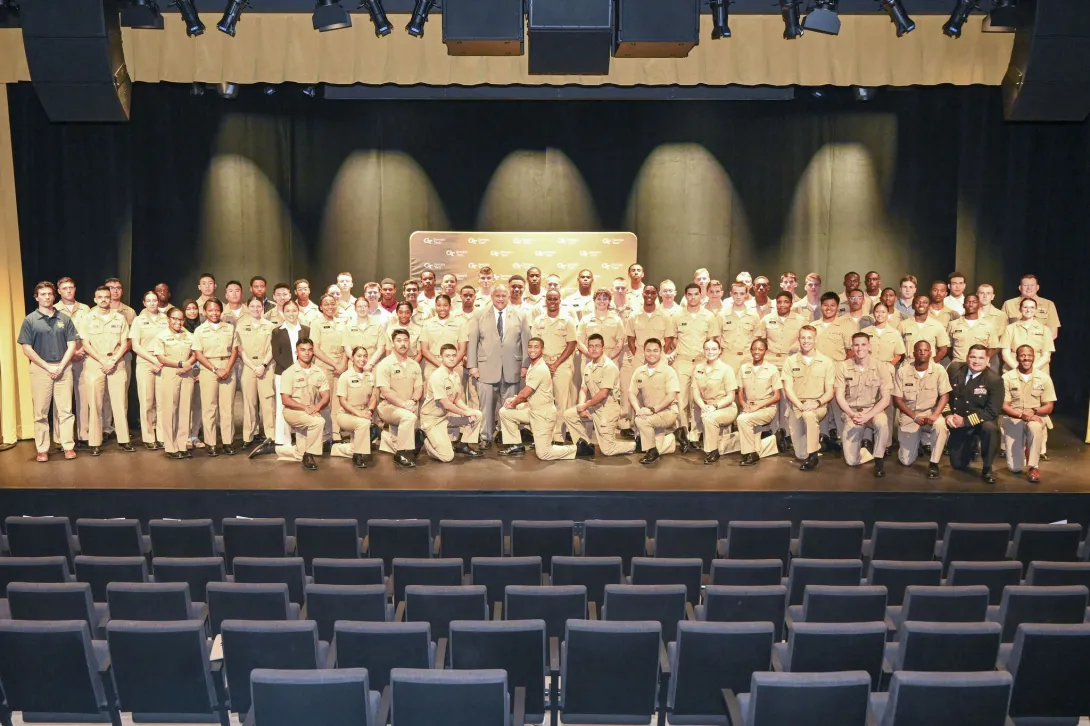
The Secretary provided an update on science and technology research to the Atlanta Region Naval Reserve Officer Training Corps unit, comprised of midshipmen from Georgia Tech, Georgia State University, Kennesaw State University, Morehouse College, Spelman College, and Clark Atlanta University.
The Georgia Tech Research Institute (GTRI) proudly hosted U.S. Secretary of the Navy Carlos Del Toro during his recent campus visit. Del Toro's visit underscored the critical role of innovation and technology in national security and highlighted Georgia Tech's significant contributions to this effort.
“Our Navy-Marine Corps Team remains at the center of global and national security — maintaining freedom of the seas, international security, and global stability,” he explained in his remarks at the John Lewis Student Center. “To win the fight of the future, we must embrace and implement emerging technologies.”
The Secretary provided an update on science and technology research to the Atlanta Region Naval Reserve Officer Training Corps unit, comprised of midshipmen from Georgia Tech, Georgia State University, Kennesaw State University, Morehouse College, Spelman College, and Clark Atlanta University. Del Toro has worked to establish a new Naval Science and Technology Strategy to address current and future challenges faced by the Navy and Marine Corps. The strategy serves as a global call to service and innovation for stakeholders in academia, industry, and government.
“The Georgia Tech Research Institute has answered this call,” he said.
A key pillar of the new strategy, says Del Toro, was the establishment of the Department of the Navy’s Science and Technology Board in 2023, “with the intent that the board provide independent advice and counsel to the department on matters and policies relating to scientific, technical, manufacturing, acquisition, logistics, medicine, and business management functions.”
The board, which includes Georgia Tech Manufacturing Institute (GTMI) Executive Director Thomas Kurfess, has conducted six studies in its inaugural year to identify new technologies for rapid adoption and provide near-term, practical recommendations for quick implementation by the Navy.
“I recently led the team for developing a strategy for integrating additive manufacturing into the Navy’s overall shipbuilding and repair strategy,” says Kurfess. “We just had final approval of our recommendations — we are making a significant impact on the Navy with respect to additive manufacturing.”
Del Toro's visit to Georgia Tech reaffirms the Institute's role as a leader in research and innovation, particularly in areas critical to national security. The collaboration between Georgia Tech and the Department of the Navy continues to drive advancements that ensure the safety and effectiveness of the nation's naval forces.
“Innovation is at the heart of our efforts at Georgia Tech and GTMI,” says Kurfess. “It is an honor to put that effort toward ensuring our country’s safety and national security in partnership with the U.S. Navy.”
“As our department continues to reimagine and refocus our innovation efforts,” said Del Toro, “I encourage all of you — our nation’s scientists, engineers, researchers, and inventors — to join us.”
News Contact
Audra Davidson
Research Communications Program Manager
Georgia Tech Manufacturing Institute
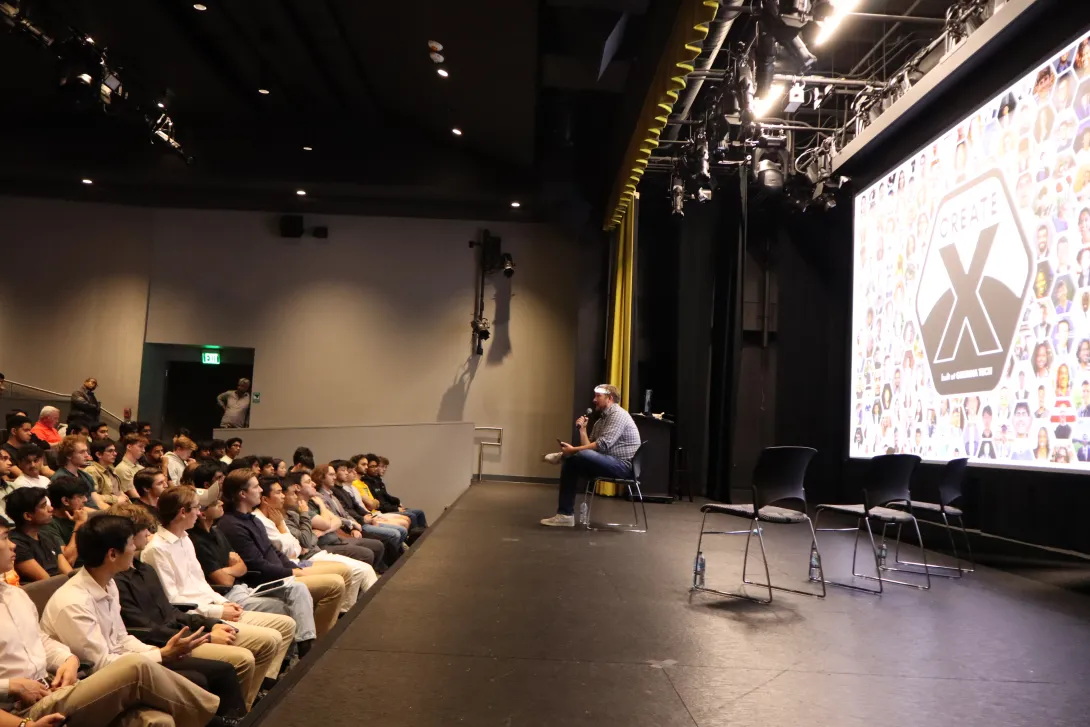
Brad Flora and the founders of Greptile speak about Y Combinator and the startup journey at YC@GT
On Nov. 12, CREATE-X hosted a panel discussion featuring Y Combinator (YC) partner Brad Flora and Georgia Tech and Startup Launch alumni. In addition to sharing experiences, panelists offered practical advice and feedback for aspiring entrepreneurs, and attendees enjoyed the opportunity to network.
Y Combinator, which has produced companies like Twitch, Reddit, AirBnB, and Coinbase, has funded over 143 Georgia Tech alumni, surpassing institutions like the University of Michigan, Duke, and Princeton. YC recruits startups four times a year and provides a $500,000 investment.
Spotlight on Founders
Flora, the event's keynote speaker, shared his journey from a YC founder to a partner, emphasizing the accelerator's commitment to supporting college-age founders. He also spoke about finding ideas, meeting co-founders, knowing when to persist and when to pivot, and more.
“A lot of people think you have to have a great startup idea before you start working on a startup,” Flora said. “The theme you find again and again for the best YC founders is that they were doing something that was interesting to them.”
Flora encouraged students to explore their interests and identify problems they are passionate about solving. He also spoke about "tar pit ideas,” or ideas that seem interesting and novel but don’t translate to a wider audience and wouldn’t be widely used. He advised them to focus on ideas with clear, demonstrable demand.
“The best way to avoid tar pit ideas is to get feedback from your users and find out if they’re actually using them,” Flora said.
Georgia Tech alumni and Greptile founders SooHoon Choi and Vaishant Kameswaran talked about the origins of their company. Choi and Daksh Gupta, their other co-founder, participated in CREATE-X Capstone and then in CREATE-X Startup Launch to develop Tabnam, which initially was an AI shopping assistant that scraped the internet to tell users what people think about their product.
The founders discussed starting Tabnam in a course and moving across the country to work on it in their apartment to getting rejected by YC, pivoting the startup at a hackathon, and developing Greptile. This AI product enables large software teams to review core changes before merging, find issues in their code, understand the source of bugs, and perform other related tasks. That iteration proved successful, gaining millions in funding and hundreds of customers.
Gupta spoke about a framework that kept the co-founders open to pivots. “Startups aren’t small companies. They’re a hypothesis that asks if a company should exist in this space. That means your job is to prove or disprove that hypothesis,” he said.
For more insights, watch the video of the event.
Opportunities for Entrepreneurs
Students, faculty, researchers, and alumni interested in developing their own startups are encouraged to apply to CREATE-X's Startup Launch. The program provides $5,000 in optional seed funding, $150,000 in in-kind services, mentorship, entrepreneurial workshops, networking events, and resources to help build and scale startups. The program culminates in Demo Day, where teams present their startups to potential investors. The deadline to apply for Startup Launch is March 19, 2025. Spots are limited. Apply now for a higher chance of acceptance and early feedback.
News Contact
Breanna Durham
Marketing Strategist
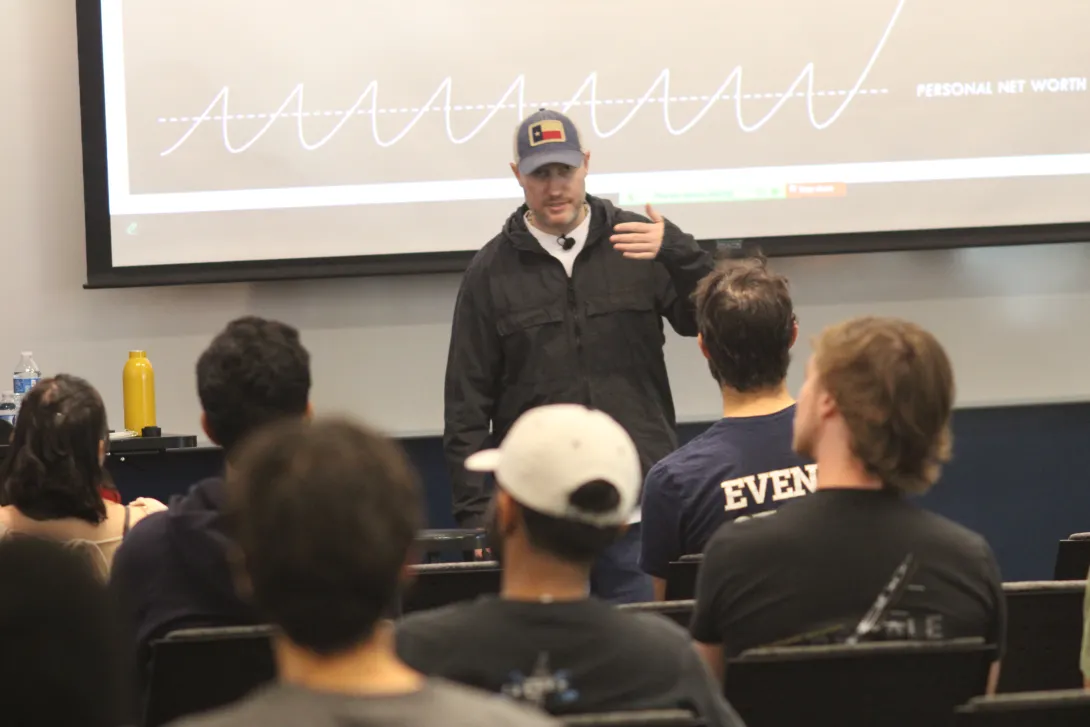
Josh Luber, co-founder of StockX, zerocool, Fanatics Collectibles, and ghostwrite, recently surprised Georgia Tech students with a guest appearance at CREATE-X’s Deep Startups workshop.
Josh Luber, co-founder of StockX, zerocool, Fanatics Collectibles, and ghostwrite, recently surprised Georgia Tech students with a guest appearance at CREATE-X’s Deep Startups workshop. The workshop, part of the Institute’s CREATE-X entrepreneurship program, features accomplished entrepreneurs who share real-world insights on launching and scaling successful ventures. The workshop sessions offer students a rare chance to learn directly from industry leaders.
Luber, best known for transforming his passion for sneakers into the billion-dollar marketplace StockX, has since become a serial entrepreneur. His ventures include collectibles, trading cards, and beyond, showcasing his ability to identify and capitalize on emerging markets.
During the recent workshop, Luber shared his candid experiences, including how he pivoted after a layoff, transitioned between corporate roles and entrepreneurship, raised capital during a market downturn, and created opportunities by "making his own luck." The 46-year-old entrepreneur provided valuable lessons on resilience, adaptability, and innovation in an ever-changing entrepreneurial landscape.
Watch the workshop video to hear insights from Luber.
Start Your Own Venture With CREATE-X Startup Launch
Georgia Tech students, faculty, alumni, and researchers interested in starting or developing their own startups are encouraged to apply for CREATE-X’s Startup Launch program. The program offers $5,000 in optional seed funding, $150,000 in in-kind services such as legal and accounting support, mentorship from seasoned entrepreneurs, and more. The next application deadline is March 19, 2025. Early applicants receive feedback and have a higher chance of acceptance. Apply now.
News Contact
Breanna Durham
Marketing Strategist