
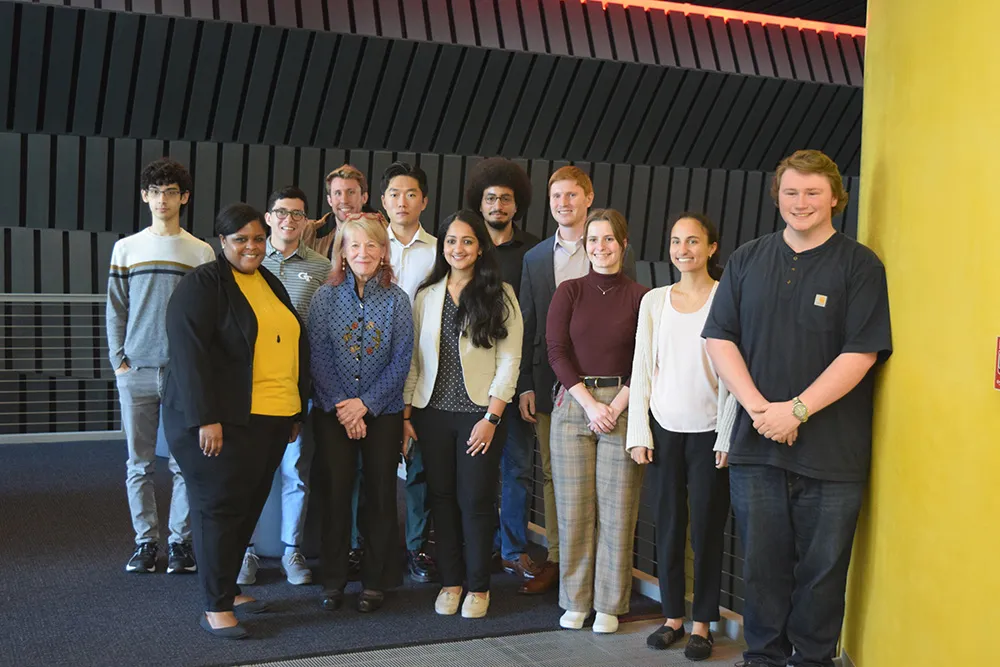
Department of Energy’s (DOE’s) Office of Science Under Secretary Geri Richmond with Georgia Tech Researchers
As head of the Department of Energy’s (DOE’s) Office of Science, the nation’s largest federal sponsor of physical sciences research, Under Secretary Geri Richmond understands the vital role of higher education in advancing U.S. science and innovation. On Monday, Nov. 18, she visited Georgia Tech with Chief of Staff in the Office of the Under Secretary for Science and Innovation Ariel Marshall, Ph.D. Chem 14, to meet with students and faculty and discuss future opportunities for collaboration.
During the visit, Richmond and Marshall toured Dr. Thomas Orlando’s electron and photo induced chemistry on surfaces lab; the Invention Studio; Dr. Akanksha Menon’s water-energy research lab; and the AI Maker Space.
Richmond also joined the Women+ in Chemistry student group for a roundtable discussion. An advocate for underrepresented groups in STEM fields, Richmond is the founding director of the Committee on the Advancement of Women Chemists (COACh). COACh is a grassroots organization dedicated to ensuring equal opportunities for all in science.
Georgia Tech’s longstanding partnership with the DOE is centered on research and technology development aimed at advancing energy systems and promoting sustainability. The Institute plays a key role in the DOE’s national initiatives, contributing to transformative work in energy efficiency, renewable energy, nuclear power, and environmental sustainability. Through joint research programs, grants, and initiatives, Georgia Tech continues to drive innovation and push the boundaries of energy solutions for a sustainable future.
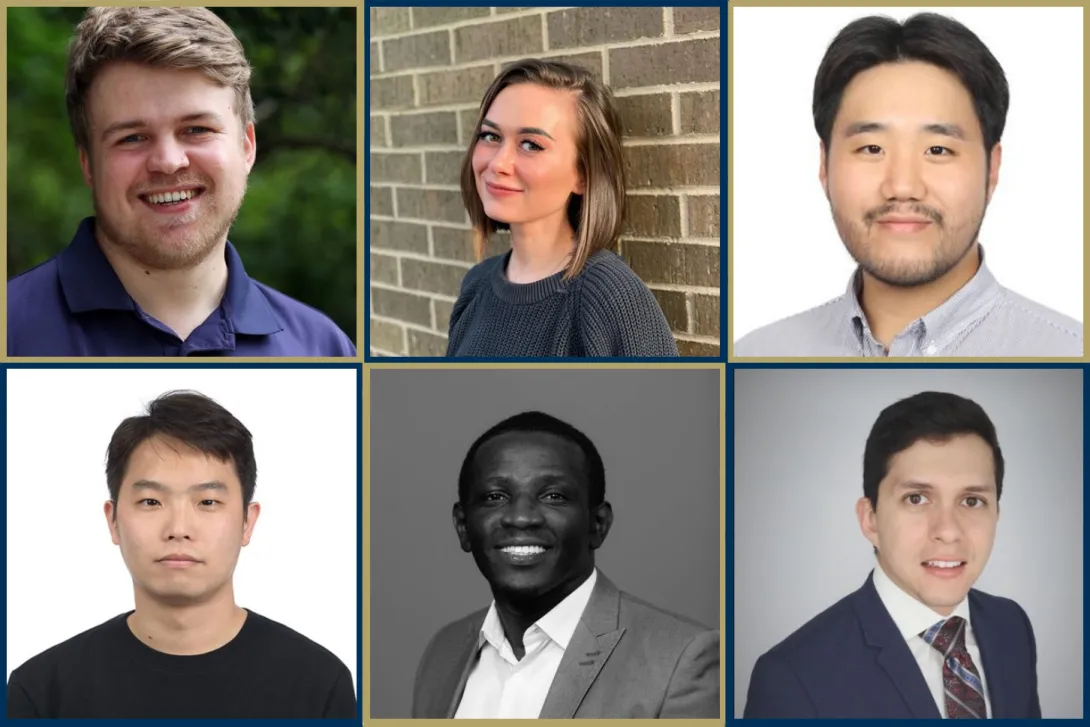
Top Row (Left to Right): Michael Biehler, Winner of 2024 James G. Campbell Fellowship, Erin Phillips & Sanggyun Kim - 2024 Spark Award Winners
Bottom Row (Left to Right): Keun Hee Kim, Richard Asiamah, Erik Barbosa - 2024 Spark Award Winners
The Strategic Energy Institute and the Energy, Policy, and Innovation Center at Georgia Tech are proud to announce the winners of the James G. Campbell Fellowship and Spark Awards for 2024.
Michael Biehler, a fifth-year Ph.D. student in the H. Milton Stewart School of Industrial and Systems Engineering, has been selected as the recipient of the 2024 James G. Campbell Fellowship. The Fellowship is an annual award given to a Georgia Tech graduate student studying renewable energy systems. Candidates are nominated by their advisors in recognition of their exceptional academic achievements in the field of renewable energy.
Biehler’s research leverages multi-modal machine learning to tackle critical challenges in manufacturing, such as enhancing energy efficiency in manufacturing processes. He is advised by Jianjun (Jan) Shi, Carolyn J. Stewart Chair and Professor in the School of Industrial and Systems Engineering.
“I consider this award an incredible honor, and the support means a lot to me, especially with the recent arrival of our second daughter—it will make a significant difference for us,” says Biehler.
The Annual Spark Award recognizes current graduate students who have exhibited outstanding leadership in promoting student engagement with energy research at Georgia Tech, with evidence of broader impacts and service/leadership. The Spark Award recipients for 2024 include Georgia Tech graduate students Richard Asiamah, Erik Barbosa, Keun Hee Kim, Sanggyun Kim, and Erin Phillips.
Richard Asiamah is a third-year Ph.D. student in the School of Electrical and Computer Engineering (ECE). His research focuses on power systems optimization, emphasizing the efficient integration of renewable energy resources into the electricity grid. Asiamah has recently worked as a graduate electrical engineering intern at the National Renewable Energy Laboratory in Golden, Colorado, and is currently serving as the president of the ECE Graduate Students’ Organization.
Erik Barbosa is pursuing a doctorate in mechanical engineering and works under Akanksha Menon, assistant professor in the Woodruff School of Mechanical Engineering. His work in the Water Energy Research Lab focuses on utilizing inorganic salt hydrates to develop thermochemical energy storage, ranging from the material level to system scale, to decarbonize heat for building applications. Barbosa has been actively engaged with mentoring undergraduate students and high schoolers by exposing them to innovative technologies that decarbonize energy.
Keun Hee Kim is a Ph.D. candidate in the Woodruff School. Kim’s research focuses on developing solid polymer electrolytes and artificial interlayers for lithium metal batteries, and synthesizing oxygen evolution reaction and oxygen reduction reaction catalyst materials for proton exchange membrane fuel cells and water electrolyzers.
Sanggyun Kim is a fourth-year Ph.D. student in materials science and engineering, advised by Juan-Pablo Correa-Baena, assistant professor in the School of Materials Science and Engineering. Kim’s research focuses on understanding the complex interfacial interactions between hybrid organic-inorganic halide perovskite films and newly designed charge transport layers in perovskite solar cells (PSCs). His goal is to drive progress in solar energy technology by integrating novel polymer- and molecule-based interlayers, improving the efficiency and stability of PSCs to support more sustainable photovoltaic solutions.
Erin Phillips is a doctoral student in the School of Chemistry and Biochemistry. Her research addresses difficulties associated with lignin valorization, which includes controlling the isolation of lignin from the original irregular lignocellulose structure and depolymerizing lignin into aromatic monomer units via mechanocatalysis. These aromatics can further be valorized as renewable sources for the creation of biofuels and other green chemicals. Phillips is currently serving as the president of the Technical Association of the Pulp and Paper Industry (TAPPI) student chapter at Georgia Tech.
News Contact
News Contact: Priya Devarajan || SEI Communications Program Manager
Southern Company, Georgia Institute of Technology (Georgia Tech), Smart Wires, and other partners have announced that they are collaborating on a new U.S. Department of Energy-funded project. Scheduled for 2025, the project will jointly implement advanced power flow control (APFC) and dynamic line rating (DLR) technologies to support the connection of renewable energy sources and new demand more quickly.
This project, led by the Georgia Tech Center for Distributed Energy with professor Deepak Divan as Principal Investigator, was selected by the U.S. Department of Energy in November 2021 as one of four projects to receive funding for grid enhancing technologies (GETs) that improve grid reliability, optimize existing grid infrastructure, and support the connection of renewable energy. It will use Smart Wires’ APFC solution— SmartValve™—in a mobile deployment combined with its DLR software—SUMO—and also develop control algorithms that improve and fine-tune how these solutions can work in synergy to optimize use of the grid.
“The launch of this innovative project represents an important step toward more efficient and reliable integration of cleaner energy sources,” said Tim Lieuwen, interim executive vice president for Research at Georgia Institute of Technology. “This collaboration allows us to identify, develop and test new ways to manage the power grid in Georgia by co-deploying APFC and DLR technologies.”
While the effectiveness of these solutions is well documented in multiple third-party reports, such as RMI’s GETting Interconnected in PJM, this project will be the first large-scale implementation of both technologies together. It will specifically examine their combined impact and result in the development of design control algorithms to unlock the combined power of these solutions and maximize their efficiency.
SUMO identifies when lines have spare capacity based on real-time weather conditions, while SmartValves can redirect power flows to quickly utilize this spare capacity. This also applies in reverse, with SUMO identifying when the dynamic ratings of lines are less than the static rating. If it’s a hot day, for example, SmartValves can redirect power flows away from these circuits to others with capacity, reducing the risk of system faults while improving operational safety.
The mobile deployment of SmartValves can be installed and in-service within one week. This provides a rapidly deployable solution that avoids extended outages and can be easily moved between sites as system needs evolve over time.
“We’re delighted to provide both SmartValves and SUMO in this project to move the dial in terms of deploying multiple GETs in synergy and optimizing their use,” said Joaquin Peirano, General Manager for the Americas at Smart Wires. “The commitment of utilities like Southern Company to get the most from their existing grid with GETs, combined with the positive regulatory developments such as FERC’s recent Order 1920, positions the U.S. to capture the full value these technologies can provide on transmission grids.”
The project will be delivered in 2025 and will involve a one-year performance period to provide Southern Company with operational experience that can be shared with other utilities and pave the way for greater use of GETs in the U.S.
About Georgia Institute of Technology
The Georgia Institute of Technology is a leading research university, committed to improving the human condition through advanced science and technology. Georgia Tech’s engineering and computing colleges are the largest and among the highest-ranked in the nation. The Institute also offers outstanding programs in business, design, liberal arts, and sciences.
With $1.37 billion annually in research, development, and sponsored activities across all six colleges and the Georgia Tech Research Institute, Georgia Tech is an engine of economic development for the state of Georgia, the Southeast, and the nation. Georgia Tech routinely ranks among the top U.S. universities in volume of research conducted; In 2023, the Institute ranked 17th among U.S. academic institutions in research and development expenditures, according to the National Science Foundation’s Higher Education Research and Development Survey.
About Smart Wires
Smart Wires is the world’s leading grid enhancing technology and services provider. We help electric utilities unlock capacity and solve their critical grid issues, using our solutions to create a more flexible, reliable and affordable grid. This enables a faster, more cost-efficient path to meet growing electricity demand with clean energy generation, at lowest cost to consumers. Headquartered in the Research Triangle of North Carolina, Smart Wires has a global workforce of passionate and visionary industry-leading experts across four continents, who work every day to transform grids globally. In collaboration with our customers and partners, we’ve unlocked over 3.5 Gigawatts capacity—enough to power over 2.5 million homes—supporting the faster integration of clean energy and new demand, enhancing security of supply and delivering cost savings to consumers.
Together, we are reimagining the grid for net zero.
News Contact
Priya Devarajan | SEI Communications Program Manager
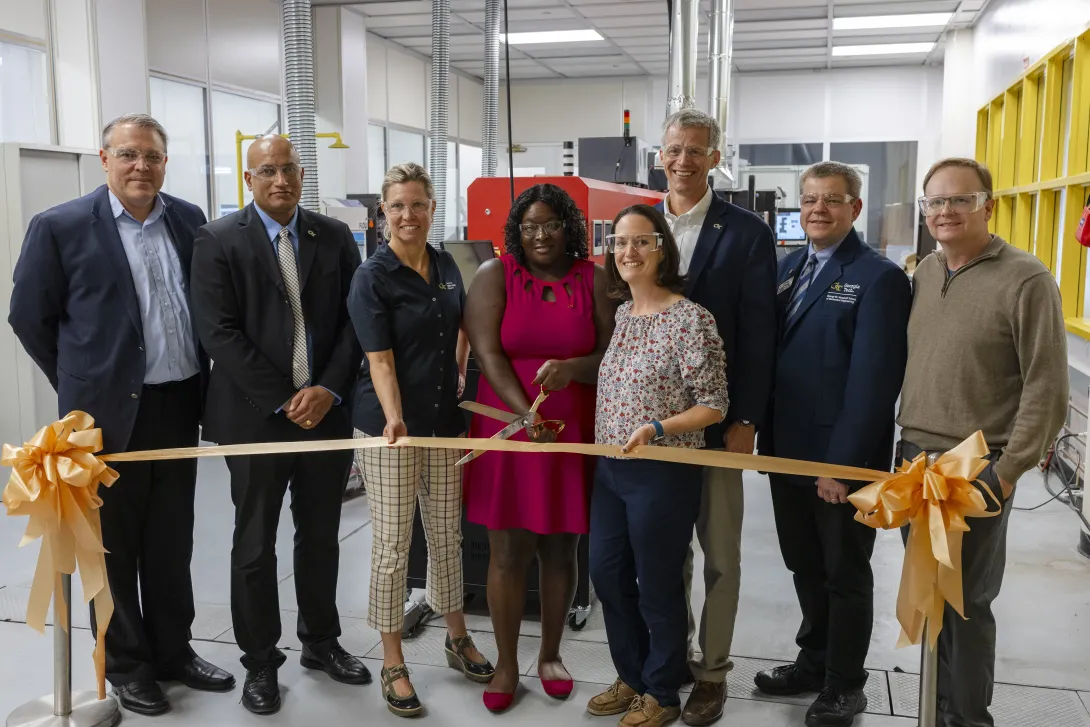
Partners of the facility gathered for an official ribbon cutting ceremony. From left to right: Eric Vogel, Hightower Professor in MSE, and executive director for the Institute for Matter and Systems; Devesh Ranjan, Eugene C. Gwaltney, Jr. school chair and professor in the George W. Woodruff School of Mechanical Engineering; Julia Kubanek, Vice President of Interdisciplinary Research; Tequila Harris, professor in the Woodruff School and facility leader; Christine Conwell, interim executive director for the Strategic Energy Institute; Tim Liewen, interim executive vice president for Research; Thomas Kurfess, Regent's Professor in the Woodruff School and executive director of the Georgia Tech Manufacturing Institute; J. Carson Meredith, professor and James Preston Harris Faculty Fellow in the School of Chemical and Biomolecular Engineering, executive director of the Renewable Bioproducts Institute. Photo: Christopher McKenney.
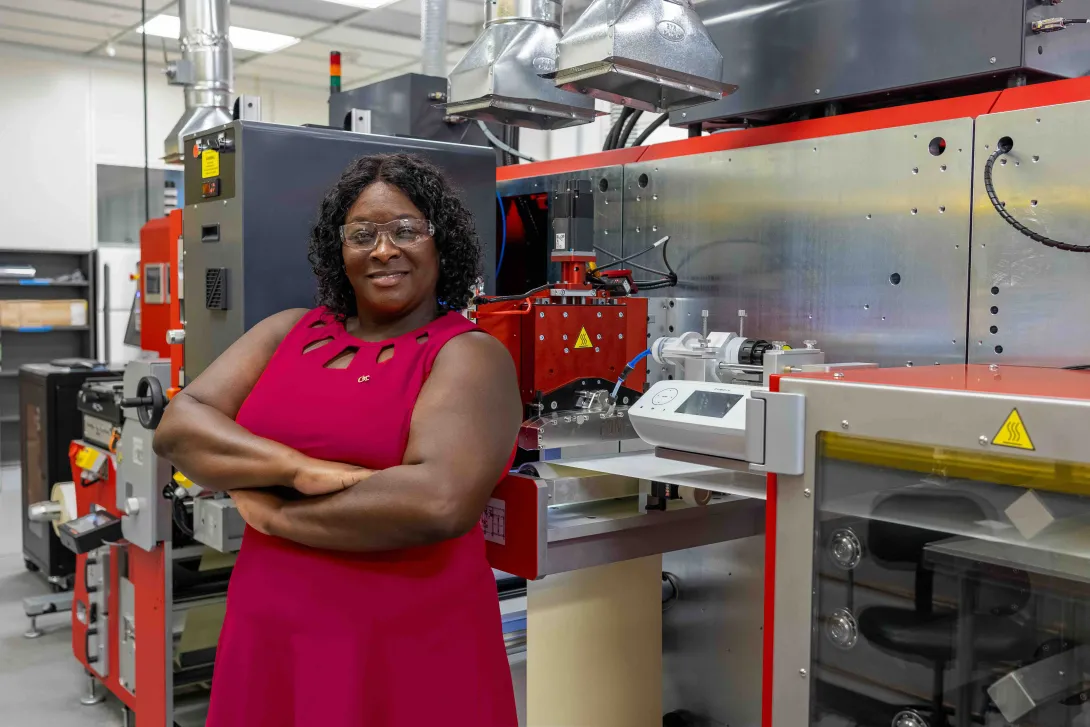
Tequila Harris, professor in the George W. Woodruff School of Mechanical Engineering, next to the modular R2R equipment. Photo: Christopher McKenney.
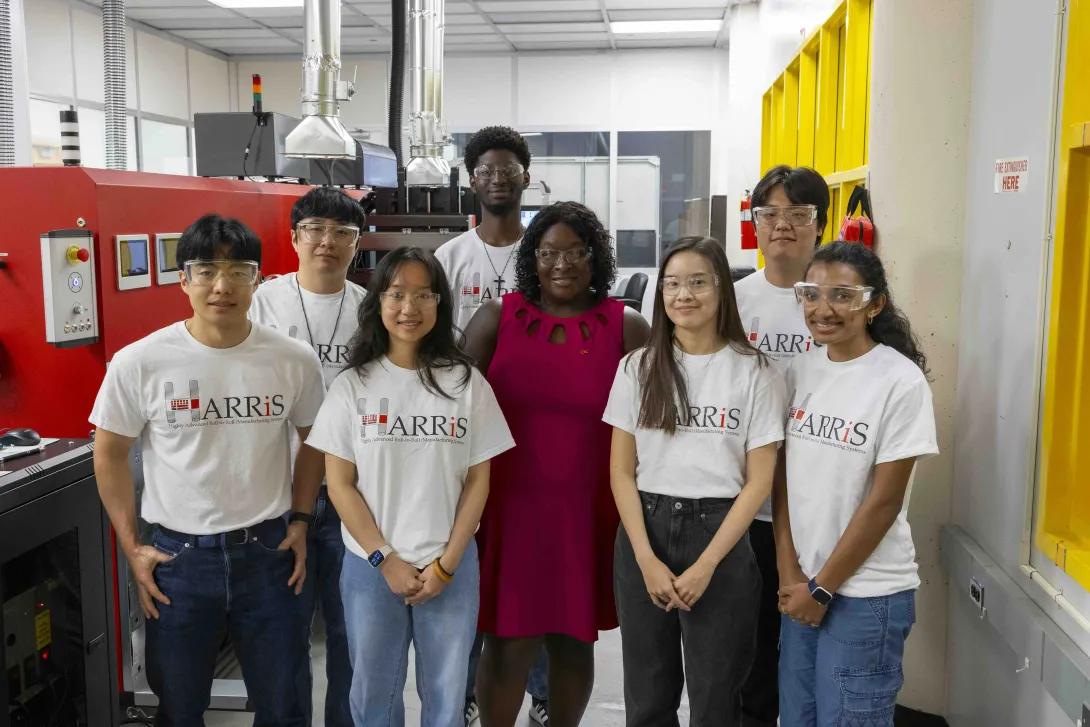
The Highly Advanced Roll-to-Roll iManufacturing Systems (HARRiS) research group in the new R2R facility. Photo: Christopher McKenney.
Whether it’s developing new products, reducing costs, or increasing accessibility, innovations in manufacturing stand to improve the lives of companies and consumers alike. Georgia Tech recently took another step toward ensuring those innovations make it from lab to market with the launch of a Modular Pilot Scale Roll-to-Roll Manufacturing Facility.
“As researchers develop new materials, one of the key aspects we’re missing is how to make them at scale. This is a major oversight because if we can’t make them at scale, we can’t transition from basic research to commercialization,” said Tequila Harris, a professor in the George W. Woodruff School of Mechanical Engineering. “With this new facility, we can prove our discoveries beyond lab-scale studies — and can go from materials innovation to product development at scale.”
Led by Harris, the new facility is the result of a partnership between the Georgia Tech Manufacturing Institute(GTMI), the Strategic Energy Institute, and the Woodruff School. As a pilot facility, it will serve as a testbed for scaling up manufacturing research open for Georgia Tech researchers as well as academic, government, and industry partners around the world.
“The larger vision I see at Georgia Tech involves innovation in manufacturing for large-scale industries,” said Georgia Tech’s Interim Executive Vice President for Research Tim Lieuwen at the facility’s unveiling event on Sept. 19. “It’s crucial that we’re innovating in basic science and technology, but we also need to be innovating in large-scale manufacturing.”
Roll-to-roll (R2R) manufacturing transforms flexible rolls of substrate materials, such as paper, metal foils, and plastics, into more complex, transportable rolls upon coating the surface with one or more fluids, such as inks, suspensions, and solutions, which are subsequently dried or cured on the base substrate. Its high yield and efficiency make R2R an ideal method for the sustainable, large-scale production of components for solar cells, batteries, flexible electronics, and separations — all industries that have expanded in Georgia in recent years.
“As a state institution, we’re ultimately here to serve our state,” said Lieuwen, who is also Regents’ Professor and David S. Lewis Jr. Chair in the Daniel Guggenheim School of Aerospace Engineering. “We’re seeing Georgia emerge as the national leader in terms of recruiting corporate investments in this space and in industries that will be served by this facility.”
Roll-to-Roll Innovations
The R2R process is similar to the production of newspapers, where a large roll of blank paper goes through a series of rollers printing text and photos. “The roll-to-roll aspect is the process of using a specialized tool to force fluid onto a moving surface,” says Harris. It’s one of the fastest-growing methods for producing thin film materials — photovoltaics used in solar cells, transistors in flexible electronics, and micro-batteries, for example — at a large scale.
Harris’s group works to develop novel manufacturing tools, with a particular focus on understanding and improving the dynamics of thin film manufacturing to increase efficiency and minimize waste. Her group is particularly interested in slot die coating, an R2R technique where a liquid material is precisely deposited onto a substrate through a narrow slot. With the new pilot facility, researchers like Harris will be able to take their work to the next level.
“Slot die coating on a roll-to-roll can handle the broadest viscosity range of most coating methods. Therefore, you can process a lot of different materials very quickly and easily,” says Harris. “It’s one of the fastest-growing technologies in the U.S. — and currently, this is the most advanced modular pilot scale facility at an academic university in the United States.”
“Georgia Tech is way ahead of the curve in terms of our facilities,” says GTMI Executive Director and Regents’ Professor Thomas Kurfess. “This will grow our capability in the battery area, membranes, flexible electronics, and more to allow us to support the development of new technologies.”
“As technologies around cleantech continue to advance at an unprecedented pace, pilot manufacturing facilities provide a critical bridge between innovative benchtop research and commercial-scale production and manufacturing,” says Christine Conwell, interim executive director of the Strategic Energy Institute. “We are excited about the opportunities this R2R facility will provide to the Georgia Tech energy community and our industry partners.”
News Contact
Audra Davidson
Research Communications Program Manager
Georgia Tech Manufacturing Institute

Please visit this page for up-to-date information about the progress of this search.
The Georgia Institute of Technology (Georgia Tech) invites applications and nominations for the Executive Director (ED) position in the Brook Byers Institute for Sustainable Systems (BBISS). BBISS, one of Georgia Tech’s Interdisciplinary Research Institutes (IRIs), brings together researchers from across Georgia Tech, including academic and research units, to support world-class sustainability-focused research, student engagement, and industry, government, and nonprofit collaboration toward achieving systemic change.
The BBISS ED will be a dynamic, collaborative, and entrepreneurial leader who will unite a broad range of stakeholders around a vision to elevate and grow sustainability at Georgia Tech. As a systems thinker and inclusive relationship builder, the ED will expand and enhance BBISS collaborations and partnerships within and beyond Georgia Tech to broaden its sustainability footprint in local, regional, national, and international arenas.
The ED will catalyze the formation of interdisciplinary teams to support high-impact programming and grants in areas such as climate science, solutions, and policy; ecosystem and environmental health; sustainable cities and infrastructure; sustainable resource and material use; just and equitable sustainable development; and the economics and business of sustainability.
Applications, Inquiries, and Nominations
To apply for the Executive Director position in the Brook Byers Institute for Sustainable Systems, candidates are requested to submit the following:
- A curriculum vitae
- A letter of interest (not to exceed four pages) that summarizes your qualifications and includes a brief statement of your vision for BBISS
- Contact information for five references (to be contacted with candidate’s permission at a later date)
Candidates are requested to send their application materials (in Word or PDF) to the AGB Search Portal at this link by November 19, 2024, for best consideration.
Nominations and expressions of interest for this opportunity are encouraged. Please direct them to BBISSGATech@agbsearch.com or to the AGB search consultants listed below.
Monica Burton, Principal
monica.burton@agbsearch.com
C: 917.825.2961
Nancy Targett, Ph.D., Executive Search Consultant
nancy.targett@agbsearch.com
C: 302.233.5202
News Contact
Brent Verrill, Research Communications Program Director, BBISS

Industrial Robots sloving a puzzle
The Institute for Robotics and Intelligent Machines (IRIM) launched a new initiatives program, starting with several winning proposals, with corresponding initiative leads that will broaden the scope of IRIM’s research beyond its traditional core strengths. A major goal is to stimulate collaboration across areas not typically considered as technical robotics, such as policy, education, and the humanities, as well as open new inter-university and inter-agency collaboration routes. In addition to guiding their specific initiatives, these leads will serve as an informal internal advisory body for IRIM. Initiative leads will be announced annually, with existing initiative leaders considered for renewal based on their progress in achieving community building and research goals. We hope that initiative leads will act as the “faculty face” of IRIM and communicate IRIM’s vision and activities to audiences both within and outside of Georgia Tech.
Meet 2024 IRIM Initiative Leads
Stephen Balakirsky; Regents' Researcher, Georgia Tech Research Institute & Panagiotis Tsiotras; David & Andrew Lewis Endowed Chair, Daniel Guggenheim School of Aerospace Engineering | Proximity Operations for Autonomous Servicing
Why It Matters: Proximity operations in space refer to the intricate and precise maneuvers and activities that spacecraft or satellites perform when they are in close proximity to each other, such as docking, rendezvous, or station-keeping. These operations are essential for a variety of space missions, including crewed spaceflights, satellite servicing, space exploration, and maintaining satellite constellations. While this is a very broad field, this initiative will concentrate on robotic servicing and associated challenges. In this context, robotic servicing is composed of proximity operations that are used for servicing and repairing satellites in space. In robotic servicing, robotic arms and tools perform maintenance tasks such as refueling, replacing components, or providing operation enhancements to extend a satellite's operational life or increase a satellite’s capabilities.
Our Approach: By forming an initiative in this important area, IRIM will open opportunities within the rapidly evolving space community. This will allow us to create proposals for organizations ranging from NASA and the Defense Advanced Research Projects Agency to the U.S. Air Force and U.S. Space Force. This will also position us to become national leaders in this area. While several universities have a robust robotics program and quite a few have a strong space engineering program, there are only a handful of academic units with the breadth of expertise to tackle this problem. Also, even fewer universities have the benefit of an experienced applied research partner, such as the Georgia Tech Research Institute (GTRI), to undertake large-scale demonstrations. Georgia Tech, having world-renowned programs in aerospace engineering and robotics, is uniquely positioned to be a leader in this field. In addition, creating a workshop in proximity operations for autonomous servicing will allow the GTRI and Georgia Tech space robotics communities to come together and better understand strengths and opportunities for improvement in our abilities.
Matthew Gombolay; Assistant Professor, Interactive Computing | Human-Robot Society in 2125: IRIM Leading the Way
Why It Matters: The coming robot “apocalypse” and foundation models captured the zeitgeist in 2023 with “ChatGPT” becoming a topic at the dinner table and the probability occurrence of various scenarios of AI driven technological doom being a hotly debated topic on social media. Futuristic visions of ubiquitous embodied Artificial Intelligence (AI) and robotics have become tangible. The proliferation and effectiveness of first-person view drones in the Russo-Ukrainian War, autonomous taxi services along with their failures, and inexpensive robots (e.g., Tesla’s Optimus and Unitree’s G1) have made it seem like children alive today may have robots embedded in their everyday lives. Yet, there is a lack of trust in the public leadership bringing us into this future to ensure that robots are developed and deployed with beneficence.
Our Approach: This proposal seeks to assemble a team of bright, savvy operators across academia, government, media, nonprofits, industry, and community stakeholders to develop a roadmap for how we can be the most trusted voice to guide the public in the next 100 years of innovation in robotics here at the IRIM. We propose to carry out specific activities that include conducting the activities necessary to develop a roadmap about Robots in 2125: Altruistic and Integrated Human-Robot Society. We also aim to build partnerships to promulgate these outcomes across Georgia Tech’s campus and internationally.
Gregory Sawicki; Joseph Anderer Faculty Fellow, School of Mechanical Engineering & Aaron Young; Associate Professor, Mechanical Engineering | Wearable Robotic Augmentation for Human Resilience
Why It Matters: The field of robotics continues to evolve beyond rigid, precision-controlled machines for amplifying production on manufacturing assembly lines toward soft, wearable systems that can mediate the interface between human users and their natural and built environments. Recent advances in materials science have made it possible to construct flexible garments with embedded sensors and actuators (e.g., exosuits). In parallel, computers continue to get smaller and more powerful, and state-of-the art machine learning algorithms can extract useful information from more extensive volumes of input data in real time. Now is the time to embed lean, powerful, sensorimotor elements alongside high-speed and efficient data processing systems in a continuous wearable device.
Our Approach: The mission of the Wearable Robotic Augmentation for Human Resilience (WeRoAHR) initiative is to merge modern advances in sensing, actuation, and computing technology to imagine and create adaptive, wearable augmentation technology that can improve human resilience and longevity across the physiological spectrum — from behavioral to cellular scales. The near-term effort (~2-3 years) will draw on Georgia Tech’s existing ecosystem of basic scientists and engineers to develop WeRoAHR systems that will focus on key targets of opportunity to increase human resilience (e.g., improved balance, dexterity, and stamina). These initial efforts will establish seeds for growth intended to help launch larger-scale, center-level efforts (>5 years).
Panagiotis Tsiotras; David & Andrew Lewis Endowed Chair, Daniel Guggenheim School of Aerospace Engineering & Sam Coogan; Demetrius T. Paris Junior Professor, School of Electrical and Computer Engineering | Initiative on Reliable, Safe, and Secure Autonomous Robotics
Why It Matters: The design and operation of reliable systems is primarily an integration issue that involves not only each component (software, hardware) being safe and reliable but also the whole system being reliable (including the human operator). The necessity for reliable autonomous systems (including AI agents) is more pronounced for “safety-critical” applications, where the result of a wrong decision can be catastrophic. This is quite a different landscape from many other autonomous decision systems (e.g., recommender systems) where a wrong or imprecise decision is inconsequential.
Our Approach: This new initiative will investigate the development of protocols, techniques, methodologies, theories, and practices for designing, building, and operating safe and reliable AI and autonomous engineering systems and contribute toward promoting a culture of safety and accountability grounded in rigorous objective metrics and methodologies for AI/autonomous and intelligent machines designers and operators, to allow the widespread adoption of such systems in safety-critical areas with confidence. The proposed new initiative aims to establish Tech as the leader in the design of autonomous, reliable engineering robotic systems and investigate the opportunity for a federally funded or industry-funded research center (National Science Foundation (NSF) Science and Technology Centers/Engineering Research Centers) in this area.
Colin Usher; Robotics Systems and Technology Branch Head, GTRI | Opportunities for Agricultural Robotics and New Collaborations
Why It Matters: The concepts for how robotics might be incorporated more broadly in agriculture vary widely, ranging from large-scale systems to teams of small systems operating in farms, enabling new possibilities. In addition, there are several application areas in agriculture, ranging from planting, weeding, crop scouting, and general growing through harvesting. Georgia Tech is not a land-grant university, making our ability to capture some of the opportunities in agricultural research more challenging. By partnering with a land-grant university such as the University of Georgia (UGA), we can leverage this relationship to go after these opportunities that, historically, were not available.
Our Approach: We plan to build collaborations first by leveraging relationships we have already formed within GTRI, Georgia Tech, and UGA. We will achieve this through a significant level of networking, supported by workshops and/or seminars with which to recruit faculty and form a roadmap for research within the respective universities. Our goal is to identify and pursue multiple opportunities for robotics-related research in both row-crop and animal-based agriculture. We believe that we have a strong opportunity, starting with formalizing a program with the partners we have worked with before, with the potential to improve and grow the research area by incorporating new faculty and staff with a unified vision of ubiquitous robotics systems in agriculture. We plan to achieve this through scheduled visits with interested faculty, attendance at relevant conferences, and ultimately hosting a workshop to formalize and define a research roadmap.
Ye Zhao; Assistant Professor, School of Mechanical Engineering | Safe, Social, & Scalable Human-Robot Teaming: Interaction, Synergy, & Augmentation
Why It Matters: Collaborative robots in unstructured environments such as construction and warehouse sites show great promise in working with humans on repetitive and dangerous tasks to improve efficiency and productivity. However, pre-programmed and nonflexible interaction behaviors of existing robots lower the naturalness and flexibility of the collaboration process. Therefore, it is crucial to improve physical interaction behaviors of the collaborative human-robot teaming.
Our Approach: This proposal will advance the understanding of the bi-directional influence and interaction of human-robot teaming for complex physical activities in dynamic environments by developing new methods to predict worker intention via multi-modal wearable sensing, reasoning about complex human-robot-workspace interaction, and adaptively planning the robot’s motion considering both human teaming dynamics and physiological and cognitive states. More importantly, our team plans to prioritize efforts to (i) broaden the scope of IRIM’s autonomy research by incorporating psychology, cognitive, and manufacturing research not typically considered as technical robotics research areas; (ii) initiate new IRIM education, training, and outreach programs through collaboration with team members from various Georgia Tech educational and outreach programs (including Project ENGAGES, VIP, and CEISMC) as well as the AUCC (World’s largest consortia of African American private institutions of higher education) which comprises Clark Atlanta University, Morehouse College, & Spelman College; and (iii) aim for large governmental grants such as DOD MURI, NSF NRT, and NSF Future of Work programs.
-Christa M. Ernst
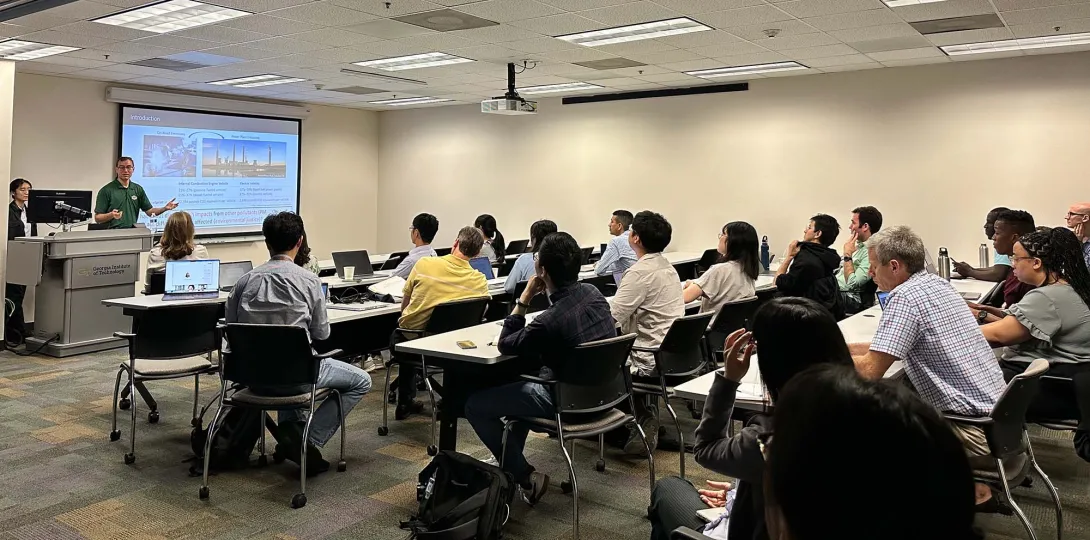
Dan Molzahn and his fellow researcher presenting at EPIcenter's Energy and Public Health Symposium
On Friday, May 10th, four Georgia Tech research teams, supported through the Energy, Policy, and Innovation Center ’s seed grant program presented their research findings to an engaged audience of fellow researchers and students.
The research teams included Georgia Tech faculty from across three colleges who presented their interdisciplinary research findings at the intersection of human health and energy systems.
The event began with a welcome address by Laura Taylor, the interim director of EPIcenter followed by EPIcenter’s director of Research Studies, Rich Simmons, who provided an overview of the vision behind the seed grant program. The seed grants were a culmination of a June 2020 workshop that invited researchers to proactively identify and mitigate new energy-health intersections and challenges by developing the knowledge to respond effectively to the interrelated challenges of public health and our current, and future energy infrastructure. The symposium included presentations from:
- Pengfei Liu, professor in the School of Earth and Atmospheric Sciences, on climate-induced air quality deterioration and its health risks in the Southeastern United States.
- Dan Molzahn, assistant professor in Electrical and Computer Engineering, and Xin Xie, professor in Civil Engineering on assessing the impacts of electric vehicle adoption and charging on air pollution and health
- Shuichi Takayama, professor in Biomedical Engineering on improving toxicology models that measure the impact of particulate matter on lung functioning to enhance energy and environmental policy-making
- Laura Taylor, on linking transit-related air pollution to health outcomes using the causal inference framework.
News Contact
Priya Devarajan || SEI Communications Program Manager
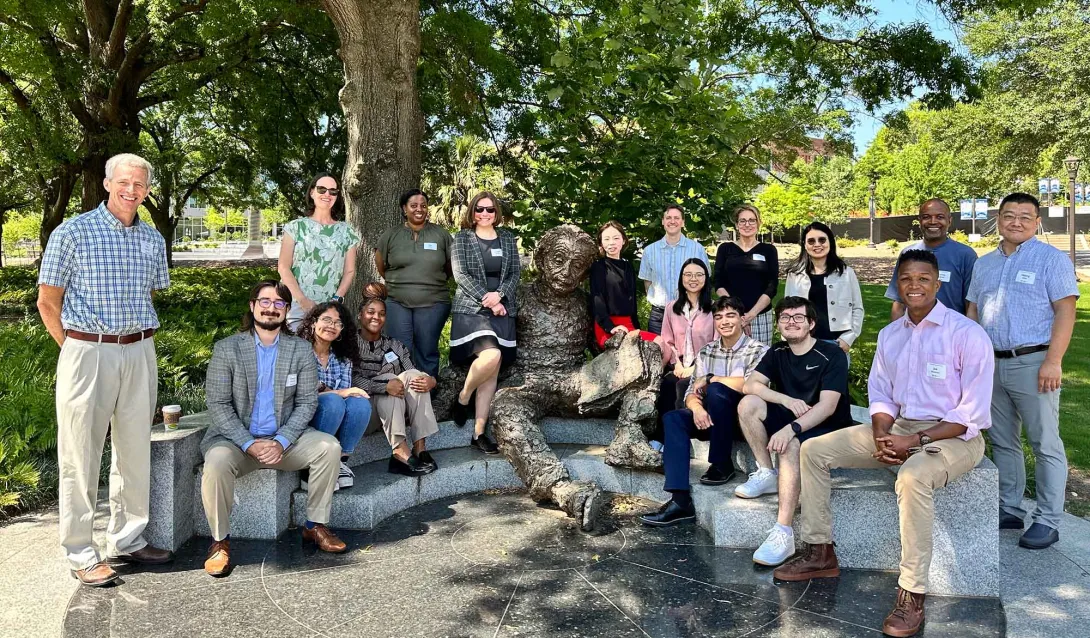
2024 Cohort of the Strategic Energy Institute Summer External Faculty Fellows
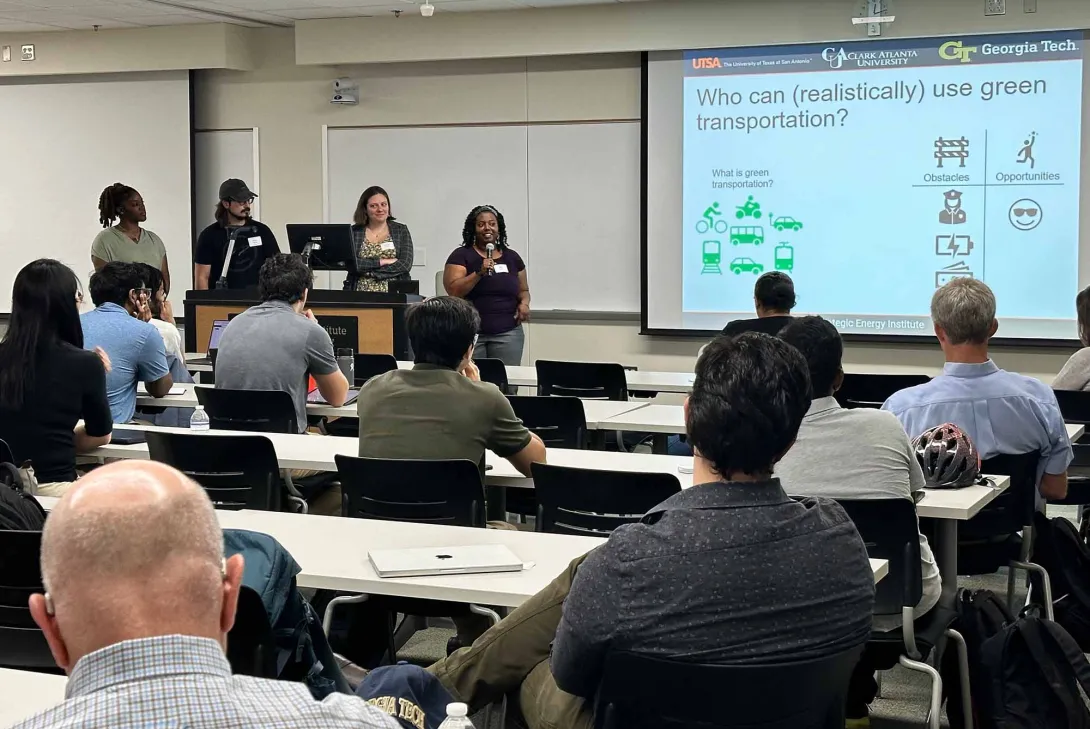
Mila Turner (CAU), and Kristen Brown (UTSA), present their summer research with students Dom Forza and Janiyah White.
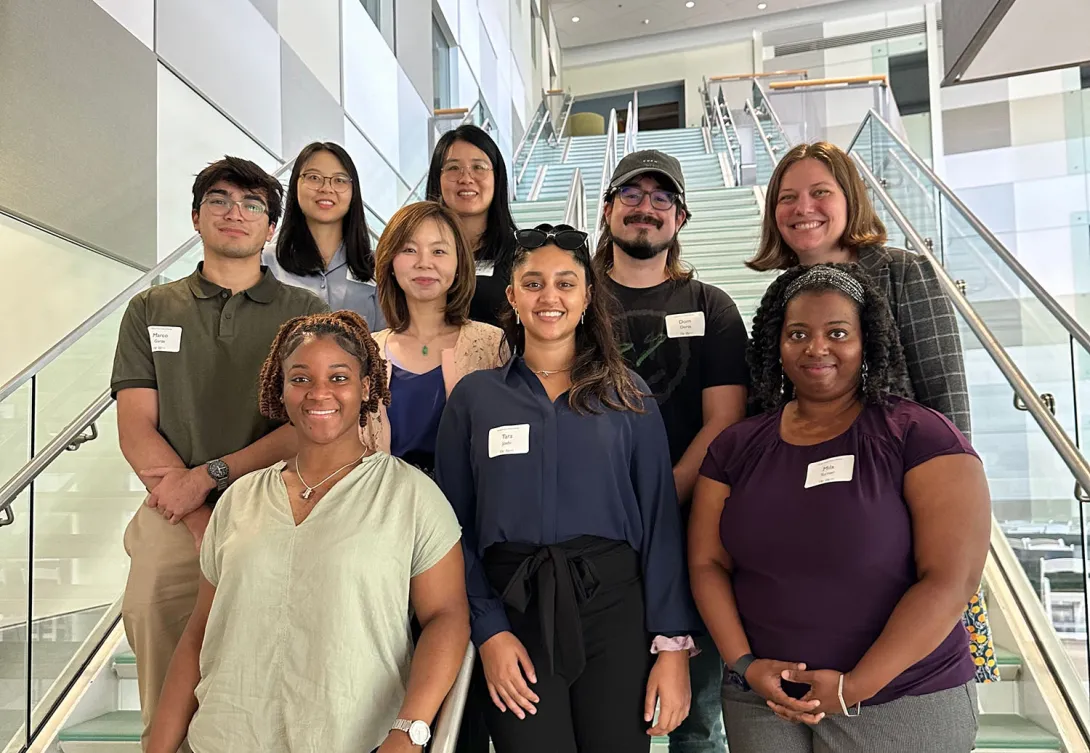
2024 SEI Summer Faculty Fellows along with their students
After completing a 10-week, on-campus fellowship, the members of this year’s Summer Energy Faculty Fellows Program gathered to present their research and discuss their future plans for continuing their research at their home campus.
The fellowship program, sponsored by the Strategic Energy Institute, is designed to connect faculty and students from historically Black colleges and universities and minority-serving institutions with energy research faculty at Georgia Tech and give them an immersive learning experience tailored to their specific interests. The fellows were competitively selected from a nationwide pool of applicants, and this year, the cohort expanded to include 10 participants. Each of the Fellows brought a student and was hosted by a Georgia Tech energy researcher.
The 2024 Faculty Fellows and their students included:
- Kristen Brown and Dom Forza also of the University of Texas at San Antonio (Host: Joe Bozeman III).
- Guenevere Qian Chen with Marco Garza of the University of Texas at San Antonio (Host: Saman Zonouz).
- Beibei Jiang with Tara Joshi of Kennesaw State University (Host: Hailong Chen).
- Milanika S. Turner with Janiyah White of Clark Atlanta University (Host: Joe Bozeman III).
In addition, the cohort also included a collaborator, Zufen Wang from Tennessee State University, with Veronica Kamel (Host: Comas Haynes).
Below is a Q&A about their experiences at Georgia Tech.
Kristen Brown, Assistant Professor, Civil and Environmental Engineering, and Construction Management
How was your overall experience at Georgia Tech?
I had a wonderful time. The team was welcoming, and the facilities were incredibly nice. Atlanta was an enjoyable city to spend time in with tons of great restaurants, and most of the summer wasn't as hot and humid as I had feared.
What would you like to share about your collaborations with Professor Joe Bozeman, Mila Turner, and the team during the past 10 weeks?
It was great to throw around research ideas with the faculty and I enjoyed chatting with the students at Georgia Tech. The students we brought enjoyed Georgia Tech and achieved so much in a short time. The professors who worked together had similar interests and goals for research, which made discussions engaging, and project selection easy.
What are your key takeaways from this program and any work products that you’d like to elaborate on?
The biggest takeaways aren't necessarily surprising — if you focus on something, you can get a lot done in a short amount of time, but you need to start moving quickly and have lots of progress checks.
What would you like to tell your fellow faculty about this program, and will you encourage them to pursue this opportunity?
I would recommend the program to any faculty considering applying. It is an excellent way to make connections and spur new ideas. It also forces you to act on research ideas, rather than having a great discussion and then lacking progress as other projects take priority.
Guenevere (Qian) Chen, Associate Professor, Cloud Technology Endowed Fellow, Electrical and Computer Engineering
How was your overall experience at Georgia Tech?
My experience at Georgia Tech was truly exceptional! The research environment, the amazing people (host and leaders), and the abundant opportunities made it an incredibly rewarding time.
What would you like to share about your collaborations with Professor Saman Zonouz and the student team during the 10 weeks you were in Atlanta?
It was an exceptional experience. Professor Zonouz is one of the most renowned and successful SCADA/PLC researchers both nationally and internationally. I had the privilege of joining their group meetings, and I was thoroughly impressed by the students' motivation, talent, and productivity. The lab consistently produces high-quality publications and fosters a collaborative and welcoming environment. Zonouz’s leadership and mentorship are outstanding, guiding a team of creative, hard-working, and remarkable students. It was an inspiring and enriching experience to work with such an amazing team.
What are your key takeaways from this program and any work products that you’d like to elaborate on?
My key takeaways from this program include the importance of collaboration, innovation, and the impact of strong mentorship. Working alongside such a talented team has reinforced the value of diverse perspectives and the power of collective effort in driving research forward. The hands-on experience with SCADA and 3D printer security has deepened my technical expertise and broadened my understanding of the challenges and opportunities in this field.
In terms of work products, my student Marco Garza, an incoming sophomore, co-authored a paper with Zonouz’s team, which has been submitted to NDSS-25. Furthermore, Zonouz and I are working on proposals for future collaborative projects.
What would you like to tell your fellow faculty at UTSA about this program and will you encourage them to pursue this opportunity?
I highly recommend this program. Midtown Atlanta is a beautiful place with its own unique charm, and the afternoon rains offer a refreshing break — perfect if you're looking to escape the Texas heat. Beyond the pleasant weather, Georgia Tech provides an outstanding research environment where you can engage in cutting-edge work and collaborate with some of the brightest minds in the field. If you're seeking a personally and professionally rewarding experience, this opportunity at Georgia Tech is one you shouldn’t miss!
Beibei Jiang, Assistant Professor of Innovative Materials, Department of Electrical and Computer Engineering
How was your overall experience at Georgia Tech?
Fantastic. I am impressed by the leadership roles of the program team. They have hosted lots of events, including regular faculty meetings, weekly professional training opportunities for undergraduate students, end-of-program presentation opportunities, and more.
What would you like to share about your collaborations with Professor Hailong Chen and the student team during the 10 weeks you were in Atlanta?
The collaboration with Chen’s team was eye-opening and inspiring. We learned a lot of positive lessons through working with his team. One specific lesson is the research team’s management skills, which involve managing research projects and team members, including undergraduate, graduate, and postdoc students. We also learned a lot of practical experimental skills related to battery fabrication and battery testing. We want to establish a long-term collaboration with Chen’s team in the future.
What are your key takeaways from this program and any work products that you’d like to elaborate on?
The key takeaways from the program can be summarized into three aspects:
- We can propose multiple research ideas based on the interdisciplinary techniques between our team and our collaborators’ team at Georgia Tech
- Considering the close geographic distance between KSU and Georgia Tech, many research opportunities at Georgia Tech can be leveraged by KSU students, including research internships at GTRI and graduate programs at Georgia Tech.
- KSU and Georgia Tech can team up on a lot of educational proposals for workforce development by combining the benefits of the two universities.
Is there any other personal information or experience or any feedback that you’d like to share?
As a Georgia Tech alumnus, I am very proud to see the achievements that Georgia Tech has made in the energy field.
What would you like to tell your fellow faculty at KSU about this program and will you encourage them to pursue this opportunity?
Definitely! I am excited to share all the positive feedback about this collaboration experience with my fellow faculty at KSU. I will tell them about the support and professional development opportunities we received from the SEI team and the program. I will also share my experience working with my collaborator at Georgia Tech, including how the project proceeded efficiently through frequent discussions with their team. Finally, I would like to share the wonderful training opportunities and professional development opportunities for our undergraduate students.
Milanika Turner, Associate Professor, Sociology and Criminal Justice
How was your overall experience at Georgia Tech?
I had such a positive experience! This was my first time visiting the campus, and I was impressed. I want to return when it’s buzzing with the energy of the academic year. I regret not visiting the Library this summer. Plus the facilities at CODA were modern, smart, and aesthetically pleasing. Everyone from Georgia Tech that I’ve met has been helpful, professional, and excited about our institutions working together.
What would you like to share about your collaborations with Professor Joe Bozeman, Professor Kristen Brown, and the student team during the past 10 weeks?
This was the smoothest interdisciplinary collaboration I’ve ever engaged in, because we all started from the common point of centering ethics and justice in our work. We all had a lot of fun thinking together and ideated numerous possible projects.
What are your key takeaways from this program and any work products that you’d like to elaborate on?
A key takeaway is that there is still so much work to be done in the pursuit of clean energy, environmental justice, and sustainable climate solutions. We have a lot more good work to do together.
Is there any other personal information or experience or any feedback that you’d like to share?
My program highlight was witnessing the undergraduate students learn and grow into budding researchers. They truly made me proud.
What would you like to tell your fellow faculty at Clark Atlanta about this program and will you encourage them to pursue this opportunity?
I’d tell my fellow faculty that we should get to know our neighbors! Tech is only two miles from CAU so we could easily get together. Plus we’re already working in some of the same local communities. It would be silly for us not to engage more deeply across universities. It’s beneficial for all of us — especially our students — to work together.
Zufen Wang, Assistant Professor, Civil and Architectural Engineering
How was your overall experience at Georgia Tech?
The overall experience was both inspiring and enriching! It was fantastic to connect with numerous outstanding researchers and learn about their remarkable initiatives and intriguing projects.
What would you like to share about your collaborations with Professor Comas Haynes and the student team during the 10 weeks you were in Atlanta?
Professor Haynes has been incredibly supportive throughout our collaboration. He helped connect me with the researchers for current projects and potential collaborations in the future. Additionally, my student conducted research within Comas' team, and I was impressed by the quality of the student's presentation. The most exciting thing is the IAC program that Comas introduced to me. Together with him and my student, we formed a team with a “train the trainer” approach to learn the IAC process!
What are your key takeaways from this program and any work products that you’d like to elaborate on?
Expand research horizons and valuable connections for interdisciplinary collaborations.
Is there any other personal information or experience or any feedback that you’d like to share?
The team at Georgia Tech is exceptionally welcoming and supportive. They generously share their research and project experiences. Their insights have been incredibly valuable to me, especially as I’m in the early stages of my career.
What would you like to tell your fellow faculty at TSU about this program and will you encourage them to pursue this opportunity?
I will highly encourage them to pursue this opportunity. The program goes beyond just the summer experience. It is a crucial foundation for building strong, long-term collaborations.
Dom Dorsa, Undergraduate Student
Working this summer at Georgia Tech greatly informed my decision to attend the institution for graduate school. My work with Bozeman, Turner, and Brown brought me out of my comfort zone and introduced me to areas of my field (namely GIS) that I was otherwise unfamiliar with. Additionally, I was able to make contacts with SEI and with other researchers such as Matthew Realff, with whom I hope to work someday. My biggest takeaway from this program is that research is a team effort. No one researcher uncovers the world. At best, they identify pieces of a larger puzzle. I hope to come back to Georgia Tech, whether for this program or another, and I am eternally grateful to SEI and to the SURE program for having me.
News Contact
Priya Devarajan || SEI Communications Program Manager
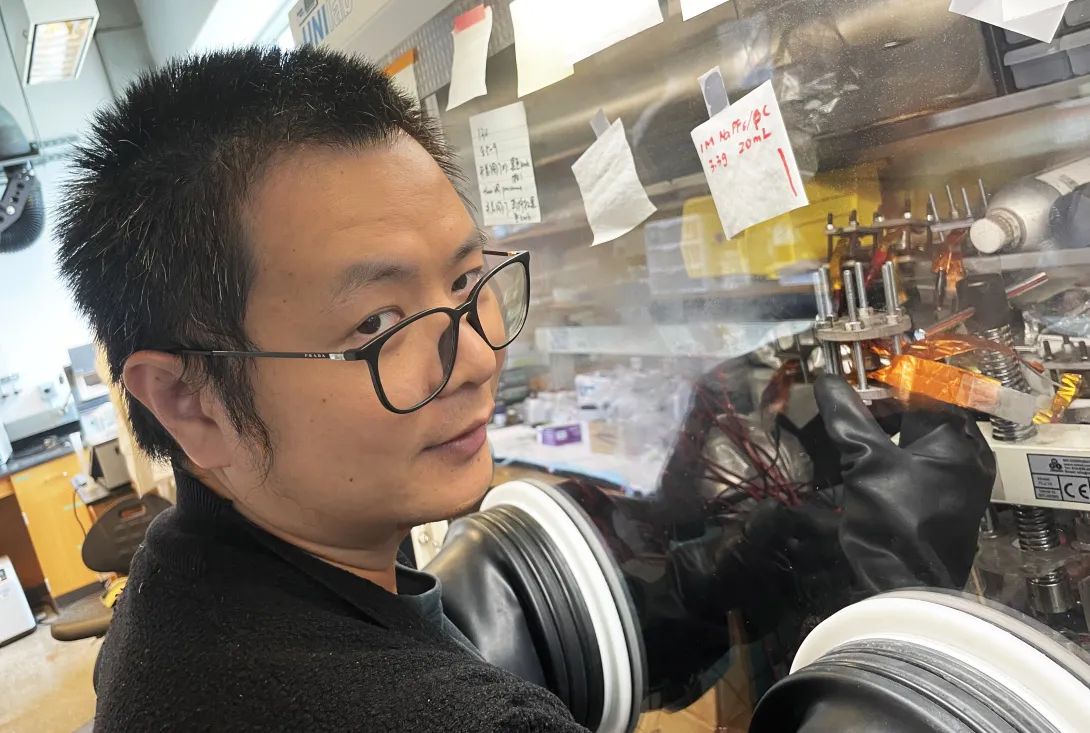
Zhantao Liu with the new low-cost cathode that could revolutionize lithium-ion batteries and the EV industry. Photo by Jerry Grillo
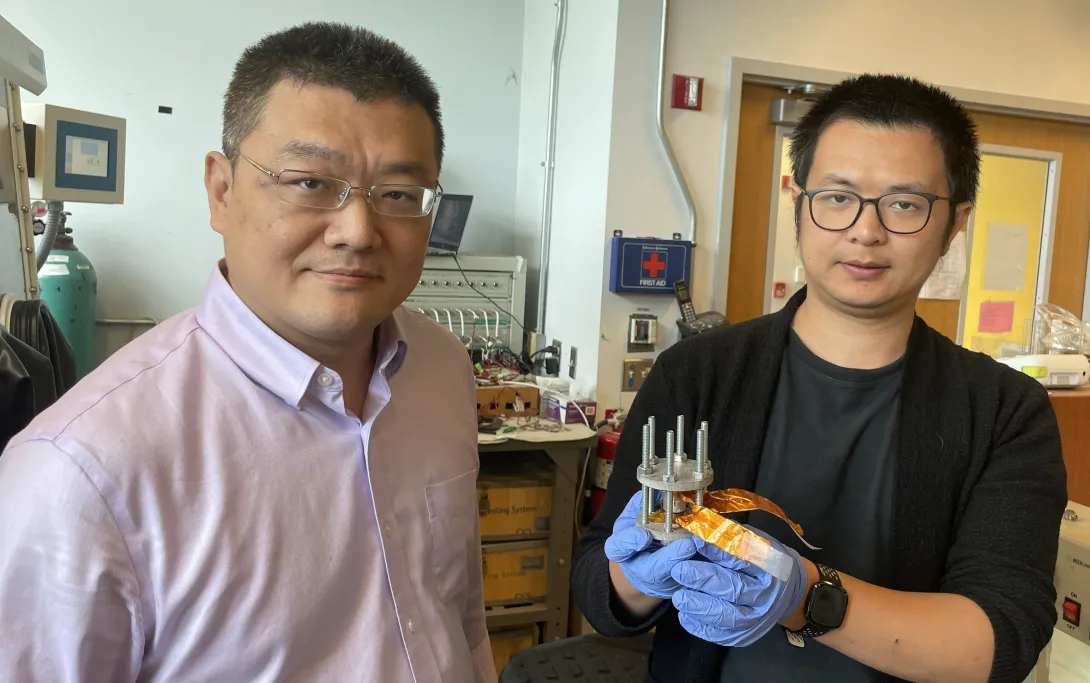
Hailong Chen and Zhantao Liu present a new, low-cost cathode for all-solid-state lithium-ion batteries. Photo by Jerry Grillo
A multi-institutional research team led by Georgia Tech’s Hailong Chen has developed a new, low-cost cathode that could radically improve lithium-ion batteries (LIBs) — potentially transforming the electric vehicle (EV) market and large-scale energy storage systems.
“For a long time, people have been looking for a lower-cost, more sustainable alternative to existing cathode materials. I think we’ve got one,” said Chen, an associate professor with appointments in the George W. Woodruff School of Mechanical Engineering and the School of Materials Science and Engineering.
The revolutionary material, iron chloride (FeCl3), costs a mere 1-2% of typical cathode materials and canstore the same amount of electricity. Cathode materials affect capacity, energy, and efficiency, playing a major role in a battery’s performance, lifespan, and affordability.
“Our cathode can be a game-changer,” said Chen, whose team describes its work in Nature Sustainability. “It would greatly improve the EV market — and the whole lithium-ion battery market.”
First commercialized by Sony in the early 1990s, LIBs sparked an explosion in personal electronics, like smartphones and tablets. The technology eventually advanced to fuel electric vehicles, providing a reliable, rechargeable, high-density energy source. But unlike personal electronics, large-scale energy users like EVs are especially sensitive to the cost of LIBs.
Batteries are currently responsible for about 50% of an EV’s total cost, which makes these clean-energy cars more expensive than their internal combustion, greenhouse-gas-spewing cousins. The Chen team’s invention could change that.
Building a Better Battery
Compared to old-fashioned alkaline and lead-acid batteries, LIBs store more energy in a smaller package and power a device longer between charges. But LIBs contain expensive metals, including semiprecious elements like cobalt and nickel, and they have a high manufacturing cost.
So far, only four types of cathodes have been successfully commercialized for LIBs. Chen’s would be the fifth, and it would represent a big step forward in battery technology: the development of an all-solid-state LIB.
Conventional LIBs use liquid electrolytes to transport lithium ions for storing and releasing energy. They have hard limits on how much energy can be stored, and they can leak and catch fire. But all-solid-state LIBs use solid electrolytes, dramatically boosting a battery’s efficiency and reliability and making it safer and capable of holding more energy. These batteries, still in the development and testing phase, would be a considerable improvement.
As researchers and manufacturers across the planet race to make all-solid-state technology practical, Chen and his collaborators have developed an affordable and sustainable solution. With the FeCl3 cathode, a solid electrolyte, and a lithium metal anode, the cost of their whole battery system is 30-40% of current LIBs.
“This could not only make EVs much cheaper than internal combustion cars, but it provides a new and promising form of large-scale energy storage, enhancing the resilience of the electrical grid,” Chen said. “In addition, our cathode would greatly improve the sustainability and supply chain stability of the EV market.”
Solid Start to New Discovery
Chen’s interest in FeCl3 as a cathode material originated with his lab’s research into solid electrolyte materials. Starting in 2019, his lab tried to make solid-state batteries using chloride-based solid electrolyteswith traditional commercial oxide-based cathodes. It didn’t go well — the cathode and electrolyte materials didn’t get along.
The researchers thought a chloride-based cathode could provide a better pairing with the chloride electrolyte to offer better battery performance.
“We found a candidate (FeCl3) worth trying, as its crystal structure is potentially suitable for storing and transporting Li ions, and fortunately, it functioned as we expected,” said Chen.
Currently, the most popularly used cathodes in EVs are oxides and require a gigantic amount of costly nickel and cobalt, heavy elements that can be toxic and pose an environmental challenge. In contrast, the Chen team’s cathode contains only iron (Fe) and chlorine (Cl)—abundant, affordable, widely used elements found in steel and table salt.
In their initial tests, FeCl3 was found to perform as well as or better than the other, much more expensive cathodes. For example, it has a higher operational voltage than the popularly used cathode LiFePO4 (lithium iron phosphate, or LFP), which is the electrical force a battery provides when connected to a device, similar to water pressure from a garden hose.
This technology may be less than five years from commercial viability in EVs. For now, the team will continue investigating FeCl3 and related materials, according to Chen. The work was led by Chen and postdoc Zhantao Liu (the lead author of the study). Collaborators included researchers from Georgia Tech’s Woodruff School (Ting Zhu) and the School of Earth and Atmospheric Sciences (Yuanzhi Tang), as well as the Oak Ridge National Laboratory (Jue Liu) and the University of Houston (Shuo Chen).
“We want to make the materials as perfect as possible in the lab and understand the underlying functioning mechanisms,” Chen said. “But we are open to opportunities to scale up the technology and push it toward commercial applications.”
CITATION: Zhantao Liu, Jue Liu, Simin Zhao, Sangni Xun, Paul Byaruhanga, Shuo Chen, Yuanzhi Tang, Ting Zhu, Hailong Chen. “Low-cost iron trichloride cathode for all-solid-state lithium-ion batteries.” Nature Sustainability.
FUNDING: National Science Foundation (Grant Nos. 1706723 and 2108688)
News Contact
Energy and National Security Workshop Image
This Summer, the Strategic Energy Institute and GTRI jointly created the Energy and National Security Initiative through an inaugural workshop on July 16.
The initiative included Phase 1 or Category A grants that allowed researchers up to $10,000 in seed funding to understand the viability of their research concepts. The multidisciplinary proposals that won the Category A grants include:
Project Title: Energy Infrastructure Security and Risk Assessment Through Interactive Wargaming
Primary Investigator(s)
Dimitri Mavris (School of Aerospace Engineering)
Scott Duncan (School of Aerospace Engineering)
Michael Balchanos (School of Aerospace Engineering)
Other Investigators
Adam Stulberg (School of International Affairs)
Jenna Jordan (School of International Affairs)
Margaret Kosal (School of International Affairs)
Project Title: International Workshop on Nuclear Cybersecurity: Strengthening Global Leadership and Collaboration
Primary Investigator(s)
Fan Zhang (Nuclear and Radiological Engineering)
Steve Biegalski (Nuclear and Radiological Engineering)
Valerie Thomas (School of Industrial and Systems Engineering)
Alexander Miranda (Electrial and Computer Engineering)
Other Investigators
Guenevere Chen (Electrial and Computer Engineering) (University of Texas San Antonio)
Project Title: Robust Energy Systems Planning by way of Novel Systems Engineering (RESPoNSE)
Primary Investigator(s): Comas Haynes (GTRI)
Other Investigators
Matt McDowell (School of Mechanical Engineering and School of Materials Science and Engineering)
Project Title: Shielding and Microreactor Arrangement Innovation (Samμrai)
Primary Investigator(s)
John Brittingham (GTRI)
Bojan Petrovic (School of Mechanical Engineering)
Other Investigators
Helen Works (GTRI)
Project Title: The Strategic Mineral Economy: Challenges and Opportunities for Critical Resources
Primary Investigator(s)
Bobby Harris (School of Economics)
Matthew Swarts (GTRI)
Other Investigators
Dylan Brewer (School of Economics)
Kevin Caravati (GTRI)
Laura Taylor (School of Economics)
Micah S. Ziegler (School of Chemical and Biomolecular Engineering, School of Public Policy)
Project Title: Trustworthy AI for Critical Power Grid Infrastructure Resilience
Primary Investigator(s):
Glen Chou (School of Cybersecurity and Privacy)
Yatis Dodia (GTRI)
Saman Zonouz (School of Cybersecurity and Privacy, School of Electrical and Computer Engineering)
Phase 2 or Category B of the initiative includes up to $500,000 in seed funding to fund team research proposals, with funds likely to grow to $1.2 million in the coming years. Please note that teams must largely consist of those who participated in or expressed interest via the July workshop.
Georgia Tech researchers and faculty are encouraged to submit the Notice of Intent for Phase 2 (Category B) submissions. While this is not a requirement of the proposal, it will provide the initiative with insights that will help with internal logistics. If you have any questions regarding the Category B Notice of Intent and the grant, please contact the Strategic Energy Institute at connect@energy.gatech.edu.
News Contact
Priya Devarajan || SEI Communications Program Manager