
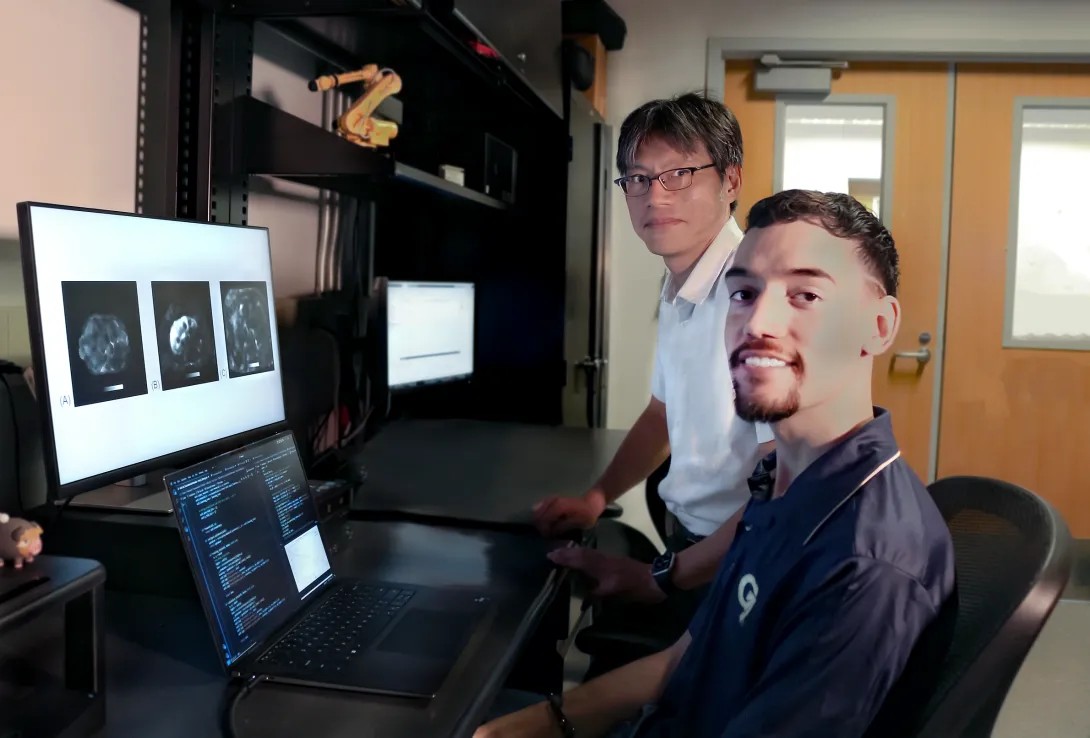
Professor Jun Ueda in the George W. Woodruff School of Mechanical Engineering and robotics Ph.D. student Heriberto Nieves.
Hepatic, or liver, disease affects more than 100 million people in the U.S. About 4.5 million adults (1.8%) have been diagnosed with liver disease, but it is estimated that between 80 and 100 million adults in the U.S. have undiagnosed fatty liver disease in varying stages. Over time, undiagnosed and untreated hepatic diseases can lead to cirrhosis, a severe scarring of the liver that cannot be reversed.
Most hepatic diseases are chronic conditions that will be present over the life of the patient, but early detection improves overall health and the ability to manage specific conditions over time. Additionally, assessing patients over time allows for effective treatments to be adjusted as necessary. The standard protocol for diagnosis, as well as follow-up tissue assessment, is a biopsy after the return of an abnormal blood test, but biopsies are time-consuming and pose risks for the patient. Several non-invasive imaging techniques have been developed to assess the stiffness of liver tissue, an indication of scarring, including magnetic resonance elastography (MRE).
MRE combines elements of ultrasound and MRI imaging to create a visual map showing gradients of stiffness throughout the liver and is increasingly used to diagnose hepatic issues. MRE exams, however, can fail for many reasons, including patient motion, patient physiology, imaging issues, and mechanical issues such as improper wave generation or propagation in the liver. Determining the success of MRE exams depends on visual inspection of technologists and radiologists. With increasing work demands and workforce shortages, providing an accurate, automated way to classify image quality will create a streamlined approach and reduce the need for repeat scans.
Professor Jun Ueda in the George W. Woodruff School of Mechanical Engineering and robotics Ph.D. student Heriberto Nieves, working with a team from the Icahn School of Medicine at Mount Sinai, have successfully applied deep learning techniques for accurate, automated quality control image assessment. The research, “Deep Learning-Enabled Automated Quality Control for Liver MR Elastography: Initial Results,” was published in the Journal of Magnetic Resonance Imaging.
Using five deep learning training models, an accuracy of 92% was achieved by the best-performing ensemble on retrospective MRE images of patients with varied liver stiffnesses. The team also achieved a return of the analyzed data within seconds. The rapidity of image quality return allows the technician to focus on adjusting hardware or patient orientation for re-scan in a single session, rather than requiring patients to return for costly and timely re-scans due to low-quality initial images.
This new research is a step toward streamlining the review pipeline for MRE using deep learning techniques, which have remained unexplored compared to other medical imaging modalities. The research also provides a helpful baseline for future avenues of inquiry, such as assessing the health of the spleen or kidneys. It may also be applied to automation for image quality control for monitoring non-hepatic conditions, such as breast cancer or muscular dystrophy, in which tissue stiffness is an indicator of initial health and disease progression. Ueda, Nieves, and their team hope to test these models on Siemens Healthineers magnetic resonance scanners within the next year.
Publication
Nieves-Vazquez, H.A., Ozkaya, E., Meinhold, W., Geahchan, A., Bane, O., Ueda, J. and Taouli, B. (2024), Deep Learning-Enabled Automated Quality Control for Liver MR Elastography: Initial Results. J Magn Reson Imaging. https://doi.org/10.1002/jmri.29490
Prior Work
Robotically Precise Diagnostics and Therapeutics for Degenerative Disc Disorder
Related Material
Editorial for “Deep Learning-Enabled Automated Quality Control for Liver MR Elastography: Initial Results”
News Contact
Christa M. Ernst |
Research Communications Program Manager |
Topic Expertise: Robotics, Data Sciences, Semiconductor Design & Fab |

Using what she learned from her PIN fellowship, Iesha Baldwin now serves as the inaugural sustainability coordinator for Spelman College.
Whether it’s typing an email or guiding travel from one destination to the next, artificial intelligence (AI) already plays a role in simplifying daily tasks.
But what if it could also help people live more efficiently — that is, more sustainably, with less waste?
It’s a concept that often runs through the mind of Iesha Baldwin, the inaugural Georgia AIM Fellow with the Partnership for Inclusive Innovation (PIN) at the Georgia Institute of Technology’s Enterprise Innovation Institute. Born out of the Georgia Tech Manufacturing Institute, the Georgia AIM (Artificial Intelligence in Manufacturing) project works with PIN fellows to advance the project's mission of equitably developing and deploying talent and innovation in AI for manufacturing throughout the state of Georgia.
When she accepted the PIN Fellowship for 2023, she saw an opportunity to learn more about the nexus of artificial intelligence, manufacturing, waste, and education. With a background in environmental studies and science, Baldwin studied methods for waste reduction, environmental protection, and science education.
“I took an interest in AI technology because I wanted to learn how it can be harnessed to solve the waste problem and create better science education opportunities for K-12 and higher education students,” said Baldwin.
This type of unique problem-solving is what defines the PIN Fellowship programs. Every year, a cohort of recent college graduates is selected, and each is paired with an industry that aligns with their expertise and career goals — specifically, cleantech, AI manufacturing, supply chain and logistics, and cybersecurity/information technology. Fellowships are one year, with fellows spending six months with a private company and then six months with a public organization.
Through the experience, fellows expand their professional network and drive connections between the public and private sectors. They also use the opportunity to work on special projects that involve using new technologies in their area of interest.
With a focus on artificial intelligence in manufacturing, Baldwin led an inventory management project at the Georgia manufacturer Freudenberg-NOK, where the objective was to create an inventory management system that reduced manufacturing downtime and, as a result, increased efficiency, and reduced waste.
She also worked in several capacities at Georgia Tech: supporting K-12 outreach programs at the Advanced Manufacturing Pilot Facility, assisting with energy research at the Marcus Nanotechnology Research Center, and auditing the infamous mechanical engineering course ME2110 to improve her design thinking and engineering skills.
“Learning about artificial intelligence is a process, and the knowledge gained was worth the academic adventure,” she said. “Because of the wonderful support at Georgia Tech, Freudenberg NOK, PIN, and Georgia AIM, I feel confident about connecting environmental sustainability and technology in a way that makes communities more resilient and sustainable.”
Since leaving the PIN Fellowship, Baldwin connected her love for education, science, and environmental sustainability through her new role as the inaugural sustainability coordinator for Spelman College, her alma mater. In this role, she is responsible for supporting campus sustainability initiatives.
News Contact
Kristen Morales
Marketing Strategist
Georgia Artificial Intelligence in Manufacturing
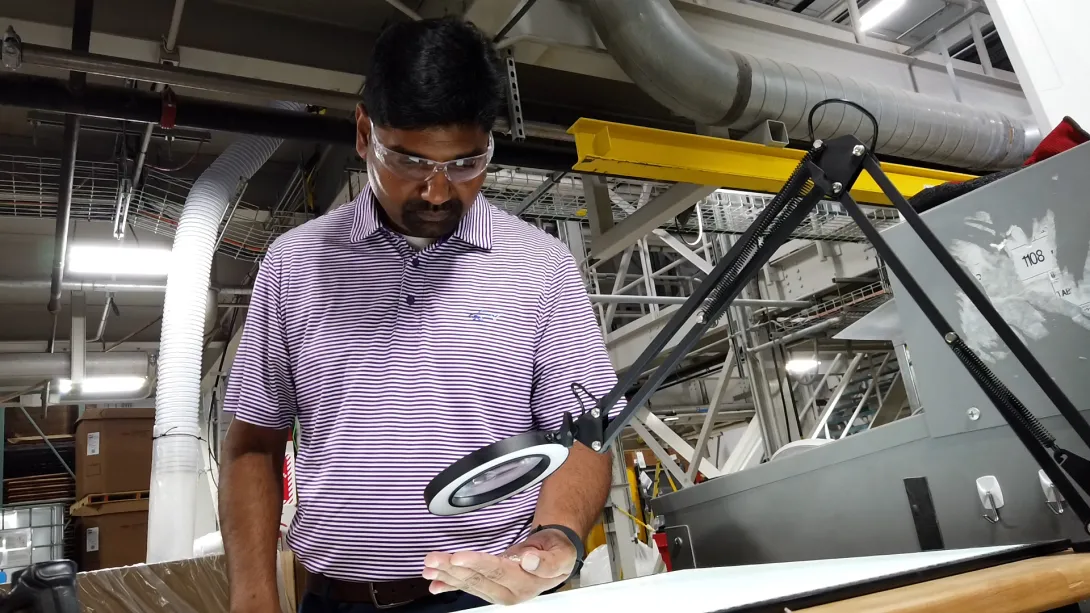
Sean Madhavaraman, a leader at GaMEP, examines work product at Silon in Peachtree City, Georgia
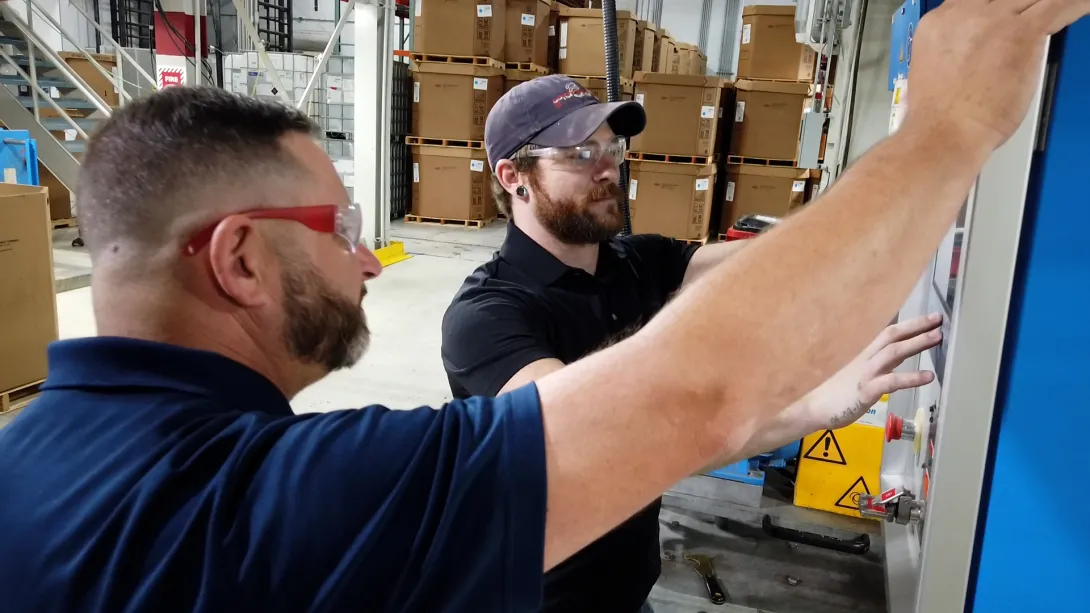
Lead technician, Austin Hicks, taps on a monitoring screen while his co-worker looks on at the manufacturing facility for Silon in Peachtree City, Georgia
“A stitch in time saves nine,” goes the old saying. For a company in Georgia, that adage became very real when damage to a key piece of machinery threatened its operation. The group helping with the stitch in time was the Georgia Manufacturing Extension Partnership (GaMEP), a program of Georgia Tech's Enterprise Innovation Institute that — for more than 60 years — has been helping small- to medium-sized manufacturers in Georgia stay competitive and grow, boosting economic development across the state.
Silon US, a Peachtree City manufacturer that designs and produces engineered compounds used to create a wide range of products — from automotive applications to building materials, such as PEX piping and wire and cable, was experiencing problems with their extrusion line during a time of increasing customer demand. Problems with the drive mechanism on that extrusion line, a piece of equipment critical to the company’s ability to produce, threatened to shut them down. With replacement parts several weeks away, was it safe to continue operating? At what throughput rates? How much collateral damage might be incurred if they continued to operate?
That’s when Silon managers turned to GaMEP for help.
After working through ideas with GaMEP’s manufacturing experts, the team installed wireless condition monitoring sensors that provide continuous, real-time insights on their manufacturing assets’ health. With the sensors, Silon was able to find a sweet spot that not only allowed them to continue operating but also kept them from overexerting the equipment, preventing further damage.
The solution to that problem has now become a routine part of Silon’s process, as company technicians continue to use this sensor technology for early detection of any deviations or anomalies in the machinery’s health, allowing the company’s maintenance team to proactively respond by adjusting scheduled maintenance to avoid costly downtime.
GaMEP’s Sean Madhavaraman says, “Silon is more productive than ever and on track for growth. The strong results in this challenge are a great example of the decades-long focus of GaMEP to educate and train managers and employees in best practices, to develop and implement the latest technology, and to work together with businesses to find solutions.”
Daniel Raubenheimer and Matt Gammon, Silon’s general managers, also lauded GaMEP, saying, “GaMEP’s extensive experience within the manufacturing realm has been a great benefit to our company. The wireless condition monitoring sensors allow us to predict future breakdowns and mitigate a potential catastrophe — allowing us to operate in a safe manner, while saving money, time, and effort.”
News Contact
Blair Meeks
Institute Communications

Advancement in technology brings about plenty of benefits for everyday life, but it also provides cyber criminals and other potential adversaries with new opportunities to cause chaos for their own benefit.
As researchers begin to shape the future of artificial intelligence in manufacturing, Georgia Tech recognizes the potential risks to this technology once it is implemented on an industrial scale. That’s why Associate Professor Saman Zonouz will begin researching ways to protect the nation’s newest investment in manufacturing.
The project is part of the $65 million grant from the U.S. Department of Commerce’s Economic Development Administration to develop the Georgia AI Manufacturing (GA-AIM) Technology Corridor. While main purpose of the grant is to develop ways of integrating artificial intelligence into manufacturing, it will also help advance cybersecurity research, educational outreach, and workforce development in the subject as well.
“When introducing new capabilities, we don’t know about its cybersecurity weaknesses and landscape,” said Zonouz. “In the IT world, the potential cybersecurity vulnerabilities and corresponding mitigation are clear, but when it comes to artificial intelligence in manufacturing, the best practices are uncertain. We don’t know what all could go wrong.”
Zonouz will work alongside other Georgia Tech researchers in the new Advanced Manufacturing Pilot Facility (AMPF) to pinpoint where those inevitable attacks will come from and how they can be repelled. Along with a team of Ph.D. students, Zonouz will create a roadmap for future researchers, educators, and industry professionals to use when detecting and responding to cyberattacks.
“As we increasingly rely on computing and artificial intelligence systems to drive innovation and competitiveness, there is a growing recognition that the security of these systems is of paramount importance if we are to realize the anticipated gains,” said Michael Bailey, Inaugural Chair of the School of Cybersecurity and Privacy (SCP). “Professor Zonouz is an expert in the security of industrial control systems and will be a vital member of the new coalition as it seeks to provide leadership in manufacturing automation.”
Before coming to Georgia Tech, Zonouz worked with the School of Electrical and Computer Engineering (ECE) and the College of Engineering on protecting and studying the cyber-physical systems of manufacturing. He worked with Raheem Beyah, Dean of the College of Engineering and ECE professor, on several research papers including two that were published at the 26th USENIX Security Symposium, and the Network and Distributed System Security Symposium.
“As Georgia Tech continues to position itself as a leader in artificial intelligence manufacturing, interdisciplinarity collaboration is not only an added benefit, it is fundamental,” said Arijit Raychowdhury, Steve W. Chaddick School Chair and Professor of ECE. “Saman’s cybersecurity expertise will play a crucial role in the overall protection and success of GA-AIM and AMPF. ECE is proud to have him representing the school on this important project.”
The research is expected to take five years, which is typical for a project of this scale. Apart from research, there will be a workforce development and educational outreach portion of the GA-AIM program. The cyber testbed developed by Zonouz, and his team will live in the 24,000 square-foot AMPF facility.
News Contact
JP Popham
Communications Officer | School of Cybersecurity and Privacy
Georgia Institute of Technology
jpopham3@gatech.edu | scp.cc.gatech.edu