
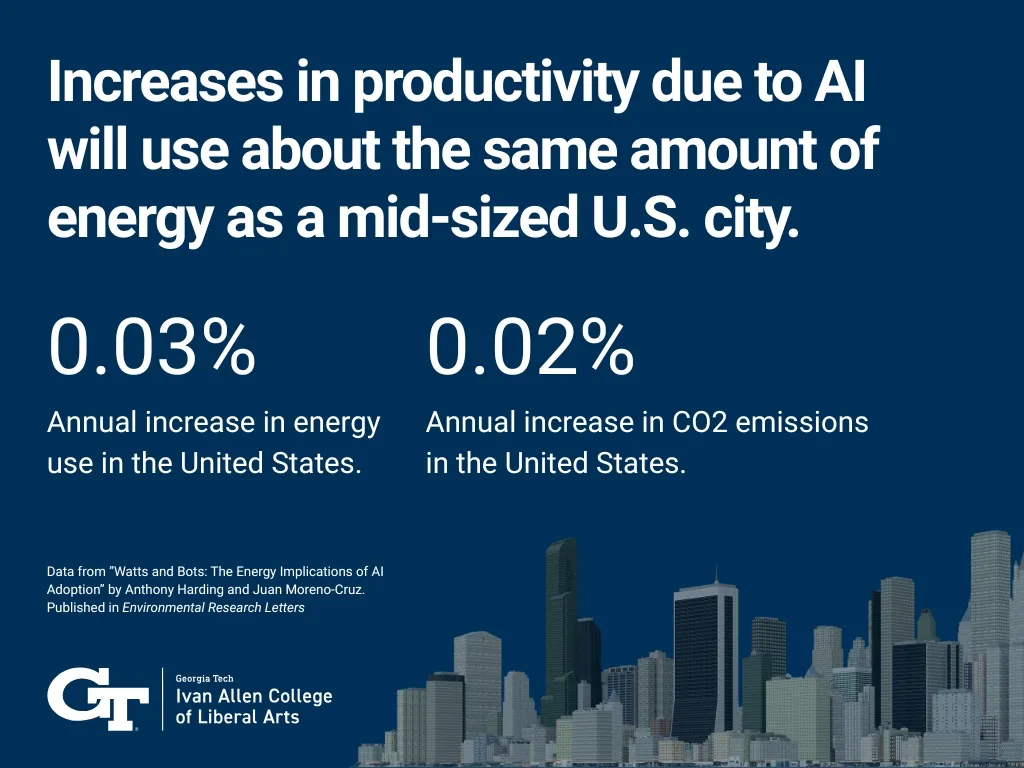
Artificial intelligence doesn’t just consume energy via data centers and hardware. It also increases productivity, which comes with its own energy and emissions costs.
A new study from Georgia Tech’s Jimmy and Rosalynn Carter School of Public Policy is one of the first to estimate how changes in productivity due to AI will affect energy consumption.
The paper, written by Anthony Harding and co-author Juan Moreno-Cruz at the University of Waterloo, suggests that greater productivity due to AI will result in a 0.03% annual increase in energy use in the United States and a 0.02% increase in CO2 emissions. That’s about equal to the yearly electricity use of a mid-sized U.S. city.
“If AI is as transformational as some expect it to be, it makes it even more important to think about the knock-on effects throughout the economy, beyond just the demands of the technology itself,” Harding said. “U.S. energy demand has stabilized since the mid-2000s. There is potential for AI to disrupt this, but there is also large uncertainty.”

Anton Leykin
School of Mathematics Professor Anton Leykin is part of a research team selected to receive support through the AI for Math Fund, a new grant program created to accelerate the development of artificial intelligence (AI) and machine learning tools for mathematics.
“This grant gives me a foothold in a new world where AI can be used in a very concrete way,” says Leykin. “It’s an opportunity to move beyond the hype and develop tools that truly benefit mathematical research.”
With a total of $18 million in inaugural grants to 29 project teams, the AI for Math Fund backs initiatives that create open-source tools, expand high-quality datasets for AI training, and make advanced systems more accessible to mathematicians. The fund received 280 grant applications from researchers and mathematicians worldwide.
Building bridges
Leykin’s global team includes researchers from the University of South Carolina, University of Warwick, and Cornell University. Their project, “Bridging Proof and Computation: For a Verified Lean-Macaulay2 Interface,” aims to connect two powerful systems: Lean, a platform for assisting and formalizing mathematical proofs, and Macaulay2, a computational algebra system widely used in research.
By developing a native interface — a built-in connection that allows the two systems to work together without external tools — and a Lean-based domain-specific language, the project will enable communication between these systems. This will allow Lean users to formulate tactics that involve sophisticated computation done by algorithms implemented in Macaulay2; in return, Macaulay2 users can formalize computer-assisted proofs via Lean with a little help from AI.
“This integration has the potential to transform how mathematicians work,” says Leykin. “It will not only connect Lean and Macaulay2 but also lay the groundwork for a general interface that could benefit other computer algebra systems in the future.”
His goal is to create a robust proof-assistance system where AI can help generate strategies and validate proofs, driving progress in areas that require both computational power and rigorous verification.
About the AI for Math Fund
A joint initiative developed in partnership between Renaissance Philanthropy and founding donor XTX Markets, the AI for Math Fund is one of the largest philanthropic commitments supporting the development of AI and machine learning tools to advance mathematics. Individual grants range up to $1 million for 24 months of work on open-source projects and research.
News Contact
Laura Segraves Smith, writer
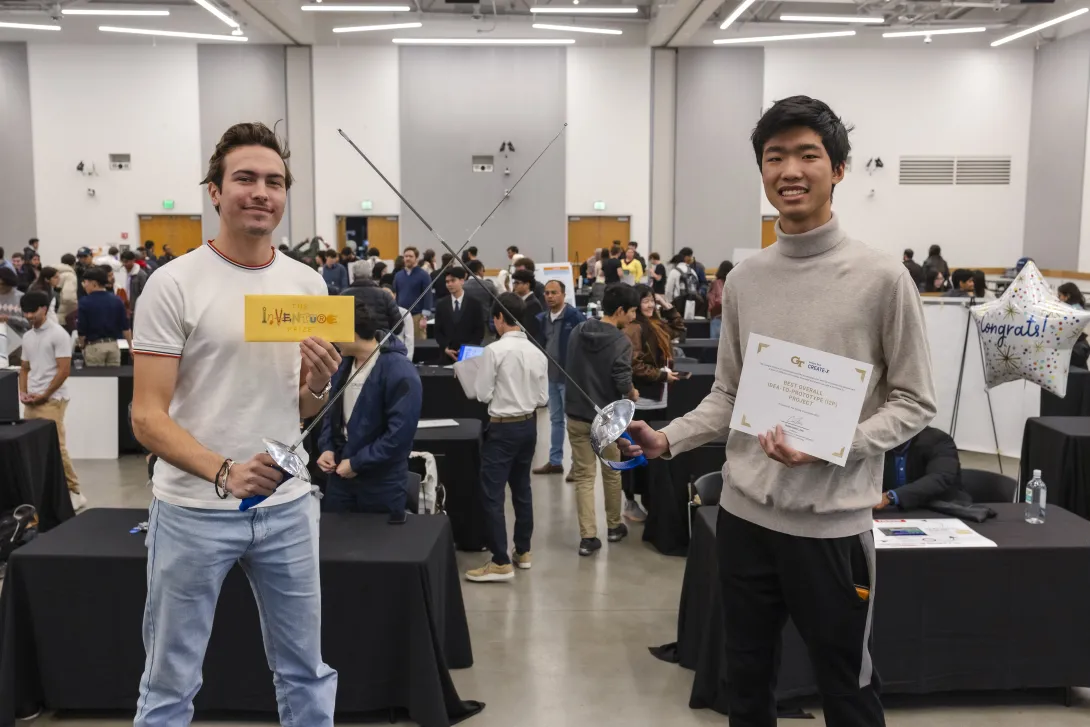
Founders of Allez Go: Adam Kulikowski and Jason Mo
Cricket powder-based protein brownies. A visualization system for fencing blades. A personalized AI application for analyzing blood work. All I2P Showcase prototypes. See what Georgia Tech students have been developing this semester at the Fall 2025 Idea to Prototype (I2P) Showcase on Tuesday, Dec. 2, at 5 p.m. in the Marcus Nanotechnology Building. This year, attendees will have even more original inventions to view, with over 60 teams displaying prototypes.
The event marks the culmination of the semester-long I2P course, where undergraduate students develop functional prototypes aimed at solving real-world problems. Prototypes this semester include a smart military drone, a gentler device for cervical cancer screening, a rotating espresso station, tools to keep AI safe, compact data centers, systems that simulate cyberattacks to help companies strengthen their defenses, and many more.
The showcase is free and open to students, faculty, staff, and members of the local community.
Winning teams will receive prizes and a “golden ticket” into CREATE-X’s Startup Launch, a summer accelerator that provides optional seed funding, accounting and legal service credits, mentorship, and more to help students turn their prototypes into viable startups.
This is a free event, and refreshments will be provided. Register for the Fall 2025 I2P Showcase today!
News Contact
Breanna Durham
Marketing Strategist
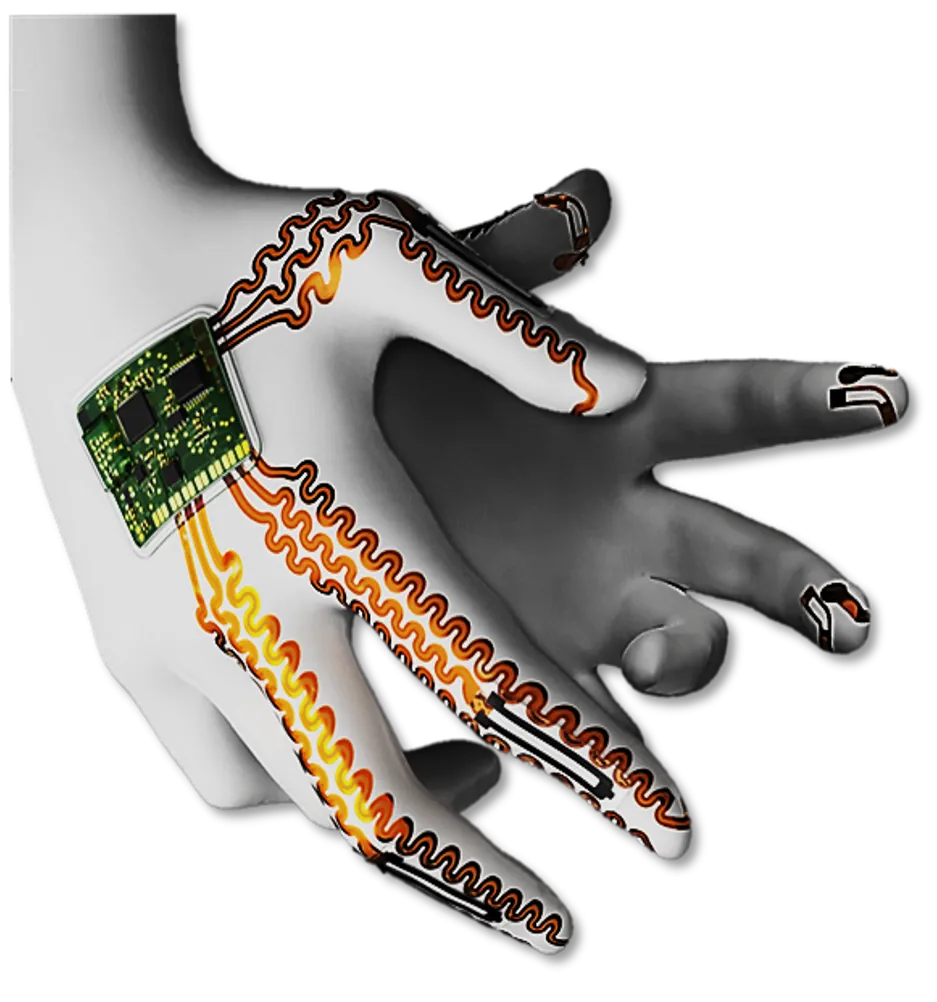
A mock-up of an AI-powered glove with muscles made from lifelike materials paired with intelligent control systems. The technology learns from the body and adapts in real time, creating motion that feels natural, responsive, and safe enough to support recovery.
Pop culture has often depicted robots as cold, metallic, and menacing, built for domination, not compassion. But at Georgia Tech, the future of robotics is softer, smarter, and designed to help.
“When people think of robots, they usually imagine something like The Terminator or RoboCop: big, rigid, and made of metal,” said Hong Yeo, the G.P. “Bud” Peterson and Valerie H. Peterson Professor in the George W. Woodruff School of Mechanical Engineering. “But what we’re developing is the opposite. These artificial muscles are soft, flexible, and responsive — more like human tissue than machine.”
Yeo’s latest study, published in Materials Horizons, explores AI-powered muscles made from lifelike materials paired with intelligent control systems. The technology learns from the body and adapts in real time, creating motion that feels natural, responsive, and safe enough to support recovery.
Muscles That Think, Materials That Feel
Traditional robotics relies on steel, wires, and motors, but rarely captures the nuances of human motion. Yeo’s research takes a different approach. He uses hierarchically structured fibers, which are flexible materials built in layers, much like muscle and tendon. They can sense, adapt, and even “remember” how they’ve moved before.
Yeo trains machine learning algorithms to adjust those pliable materials in real time with the right amount of force or flexibility for each task.
“These muscles don’t only respond to commands,” Yeo said. “They learn from experience. They can adapt and self-correct, which makes motion smoother and more natural.”
The result of that research is deeply human. For someone recovering from a stroke or limb loss, each deliberate movement rebuilds not just strength — it rebuilds confidence, independence, and a sense of self.
A Glove That Gives Freedom Back
One of the first real-world applications is a prosthetic glove powered by artificial muscles (published in ACS Nano, 2025), a device that behaves more like a helping hand than a mechanical tool. Traditional prosthetics rely on rigid motors and preset motions, but Yeo’s design mirrors the natural give-and-take of real muscle.
Inside the glove, thin layers of stretchable fibers and sensors contract, twist, and flex in sync with the wearer’s intent. The glove can fine-tune grip strength, reduce tremors, and respond instantly to the user’s movements, bringing dexterity back to everyday life.
That kind of precision matters most in the smallest tasks: fastening a button, lifting a glass, holding a child’s hand.
“These aren’t just movements,” Yeo said. “They’re freedoms.”
For Yeo, the idea of restoring freedom through movement has driven his research from the very beginning.
A Mission Rooted in Loss
Yeo's work is deeply personal. His path to biomedical engineering began with loss — the sudden death of his father while Yeo was still in college. That moment reshaped his sense of purpose, redirecting his focus from machines that move to technologies that heal.
“Initially, I was thinking about designing cars,” he said. “But after my father’s death, I kind of woke up. Maybe I could do something that helps save someone’s life.”
That purpose continues to guide his lab’s work today, building technologies that help people recover what they’ve lost.
Achieving that vision, however, means tackling some of engineering’s toughest challenges.
Soft Machines, Hard Problems
Creating lifelike muscles isn’t easy. They need to be soft but strong, responsive but safe. And they must avoid triggering the body’s immune system. That means building materials that can survive inside the body — and learn to belong there.
“We always think about not only function, but adaptability,” Yeo said. “If it’s going to be part of someone’s body, it has to work with them, not against them.”
His team calibrates these synthetic fibers like precision instruments — tested, adjusted, and re-tuned until they operate in sync with the body’s natural movements. Over time, they develop a kind of “muscle memory,” adapting fluidly to changing conditions. That dynamic adaptability, Yeo explained, is what separates a machine from a prosthetic that truly feels alive.
From Collaboration to Innovation
Solving problems this complex requires more than one discipline. It takes an entire ecosystem of collaboration. Yeo’s lab brings together experts in mechanical engineering, materials science, medicine, and computer science to design smarter, safer devices.
“You can’t solve this kind of problem in isolation,” he said. “We need all of it — polymers, artificial intelligence, biomechanics — working together.”
That collaborative model is supported by the National Science Foundation (NSF), the National Institutes of Health, and Georgia Tech’s Institute for Matter and Systems. In 2023, Yeo received a $3 million NSF grant to train the next generation of engineers building smart medical technology.
His team now works closely with healthcare providers and industry partners to bring these devices out of the lab and into patients’ lives.
The Future You Can Feel
The future of robotics, according to Yeo, won’t be defined by power or complexity but by feel.
“If it feels foreign, people won’t use it,” he said. “But if it feels like part of you, that’s when it can truly change lives.”
It’s the opposite of The Terminator, where machines replace us. Yeo is designing these machines to help us reclaim ourselves.
News Contact
Michelle Azriel Writer/Editor, Research Communications
Chris Gaffney
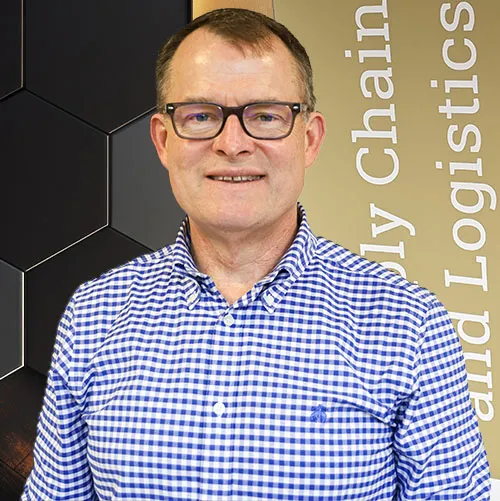
By Chris Gaffney, Managing Director, Georgia Tech Supply Chain and Logistics Institute | Supply Chain Advisor | Former Executive at Frito-Lay, AJC International, and Coca-Cola
The Moment That Changed How I Listen
When I chaired the National Product Supply Group at Coca-Cola, one of our most respected board members was Jeff Edwards. Jeff had decades of experience and commanded respect without ever seeking attention. In a four-hour meeting, Jeff might speak two or three times—never more. But when he did, everyone stopped to listen.
What made Jeff so impactful wasn’t the number of words he used—it was the care behind them. He listened intently, gathered information, built context, and added value only when his perspective would move the conversation forward. His real skill was not speaking—it was listening with purpose.
That experience stayed with me, especially because earlier in my own career, I had a very different experience. While working at AJC International, I attended a leadership program at the Center for Creative Leadership. Early in the program, a cohort of about twenty of us sat in a facilitated discussion. What we didn’t know was that we were being filmed.
Later that day, each of us reviewed our videos one-on-one with an instructor. Watching myself was humbling. I saw a young professional trying too hard to prove himself—talking far too much, jumping in before others, and dominating the conversation. It was uncomfortable to watch, but invaluable. It forced me to face how insecurity can manifest as over-talking and how much more powerful restraint and self-awareness can be. I’ve been on a "less is more" journey ever since.
Why Communication Is a Supply Chain Differentiator
We often talk about supply chain as end-to-end, but that phrase means something deeper than process visibility—it implies constant collaboration. Supply chain professionals must connect with suppliers, customers, and internal stakeholders across every function.
That means communication is the connective tissue of our profession.
- Upstream and downstream, we are translators—interpreting complex data, system logic, and network realities for people who make decisions.
- Inside organizations, we act as bridges between technical teams and commercial leaders.
- Across tiers, we negotiate, influence, and build trust with partners who don’t see what we see every day.
Even as automation expands, supply chains remain messy, human, and physical. Systems can handle the routine, but edge cases, disruptions, and exceptions still rely on judgment—and judgment relies on communication. The ability to see, listen, and convey context in real time is what keeps operations resilient when variability strikes.
In our earlier SCL articles, we wrote that skills that survive AI are the ones that emphasize human discernment—and that critical thinking is about interpreting and questioning rather than accepting data at face value. Communication is where these two intersect. It is how human understanding flows across the supply chain network.
When Communication Breaks Down
I once worked with a technically gifted colleague—let’s call him Forrest—who had deep analytical capability but struggled to speak up in group settings. His insights were sharp, but his inability to communicate them left him isolated. Eventually, he left the organization. It was a tough reminder that technical strength without communication is unrealized potential.
In a global supply chain, it’s not enough to know the answer. You have to make others understand why it’s the answer—and what to do with it. Communication is how insight becomes action.
The Many Dimensions of Communication
We tend to equate communication with speaking, but it’s much broader. Great communicators master four dimensions:
- Speaking – Conveying information clearly, concisely, and confidently.
- Writing – Capturing ideas and decisions in a way that travels across teams and time zones.
- Listening – Absorbing context before contributing, and letting others be heard.
- Observing – Seeing what others miss and using that insight to guide action.
The fourth one—observing—is often overlooked.
Recently, while reading with my granddaughter, she picked out a children’s book titled Bud Finds Her Gift. It’s about discovering one's special ability, and Bud's gift turned out to be observation—simply noticing things others missed. Watching her read that story reminded me how powerful observation really is.
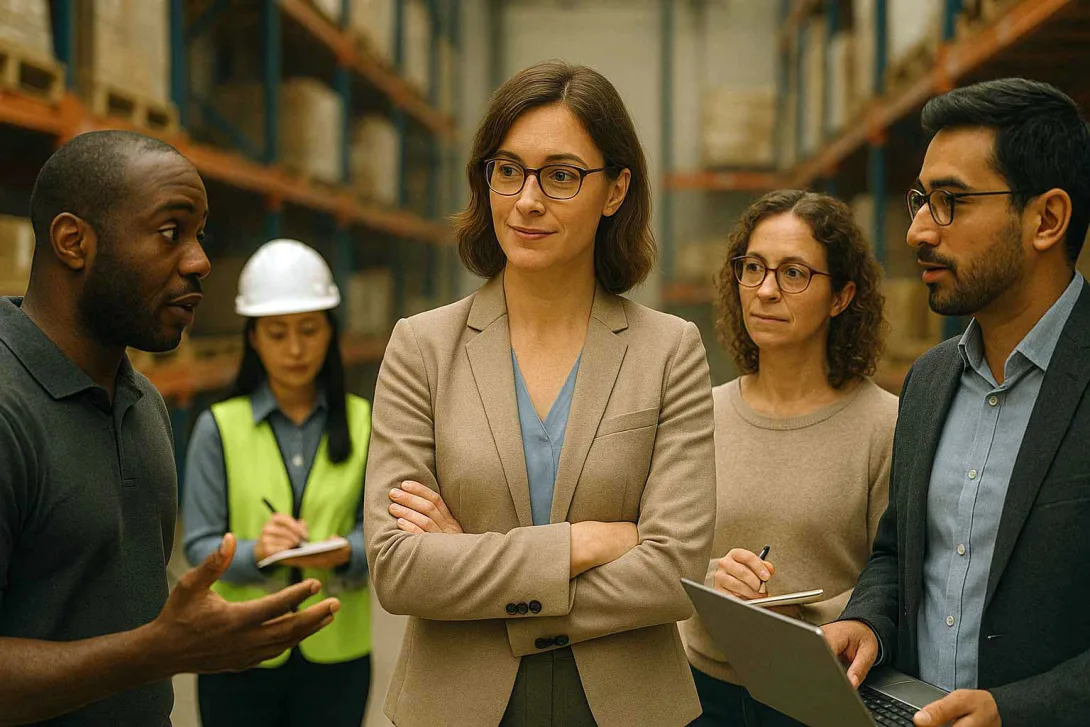
I thought of my former colleague, Tim Harville, with whom I worked at Coregistics. Tim often walked the warehouse with new supervisors, teaching them to "see the operation"—to notice what looks good, what's out of place, and where waste or opportunity hides in plain sight. His goal wasn't to test them—it was to train their eyes. Observation, in that sense, is a key communication skill. You can't describe, explain, or improve what you haven't first seen clearly.
Can Communication Be Taught? Absolutely.
I’ve seen it done.
At Frito-Lay, we invested in communication training for new managers—everything from eliminating filler words to using purposeful body language and structuring messages with intent. At Coca-Cola, Toastmasters chapters gave leaders a safe space to practice public speaking, storytelling, and feedback.
And beyond formal training, there's practice in the everyday moments—taking notes in meetings, volunteering to summarize a discussion, representing a project team, or offering to speak at a class or event. Every repetition builds comfort and clarity.
My own Center for Creative Leadership experience was the beginning of that practice for me. Decades later, I still catch myself needing to slow down, listen, and wait for the right moment. The lesson never stops.
Painting the Picture: When It Works and When It’s Missing
When communication works, credibility follows. Jeff Edwards didn’t have to compete for airtime; his credibility made his words count. When it's missing, even talented people like Forrest can struggle to influence or grow.
Both extremes teach the same lesson: communication isn't about more or less—it's about meaning. It's knowing when to speak, what to say, and how to connect it to the needs of others.
Practical Ways to Build Communication Strength
- Listen to learn. Take notes, paraphrase what you've heard, and confirm understanding
- Translate technical into practical. Explain what data means for the business, not just what it shows.
- Observe before you act. Practice "seeing" your operation or process with fresh eyes.
- Simplify your writing. Clarity beats cleverness every time.
- Seek feedback. Ask trusted peers to tell you how your communication lands.
- Prepare with intent. Know your audience, outcome, and key message before you speak.
Reflection Questions
- Where in my current role does communication make or break outcomes?
- When was the last time I adjusted how I communicate to fit my audience?
- Do I listen more than I speak—and what might I learn if I did?
- How can I model communication that builds understanding rather than winning airtime?
Closing Thought
Technical skills and analytics may earn you a seat at the table, but communication determines whether your ideas move the organization forward.
In a world of AI, automation, and constant change, the ability to listen, observe, and translate context into action remains our most human—and most valuable—differentiator.
Building on more than a year of successful collaboration, Dolby Labs has extended its investment in Georgia Tech’s College of Computing for a second year, donating $600,000 to support cutting-edge research.
Dolby and the College each have laboratories in the Coda building, which promotes collaboration at various levels. The audiovisual technology company supported seven research projects last year, spanning computing systems and AI modeling. The partnership also includes events such as this month’s co-hosted student seminar.
“This partnership has reinforced the importance of taking an interdisciplinary approach to our research,” said Vivek Sarkar, Dean of Computing, who worked in industry for two decades before returning to academia.
“I’d like to see us go even deeper in finding ways to combine faculty from different schools and different research areas to work with one partner.”
[VIDEO: GT Computing Dean Discusses Dolby Deal Details with Senior VP]
Yalong Yang, an assistant professor at Georgia Tech’s School of Interactive Computing, is one of the researchers who received Dolby support last year. He and his lab have been working on creating interactive, immersive versions of stories from the New York Times.
“We’re particularly interested in the engagement side,” Yang said. “That’s what Dolby’s business is about.” Yang and his collaborators have been showing the immersive stories to test subjects while collecting data on heart rate and eye movement.
These collaborations have resulted in several published papers. The code developed is released as open source, enabling anyone to use it. Meanwhile, Dolby scientists can tailor the code for their own needs.
“We deliberately look for ambitious, farther-looking projects," said Shriram Revankar, senior vice president of Dolby’s Advanced Technology Group.
[RELATED: Dean's Session Spotlights Industry Role in Preparing Students for Workforce Success]
"These are the risks that academia can take and do well in, because they have constant access to new students and other faculty."
At its core, the partnership is about developing relationships among faculty, students, and Dolby, according to Humphrey Shi.
"The students get experience in solving real-world problems for an international corporation, and Dolby’s researchers expand their knowledge through connecting with Tech faculty," said Shi, an associate professor in interactive computing whose research has also been supported by Dolby.
News Contact
Ann Claycombe
Communications Director
Georgia Tech College of Computing
claycombe@cc.gatech.edu
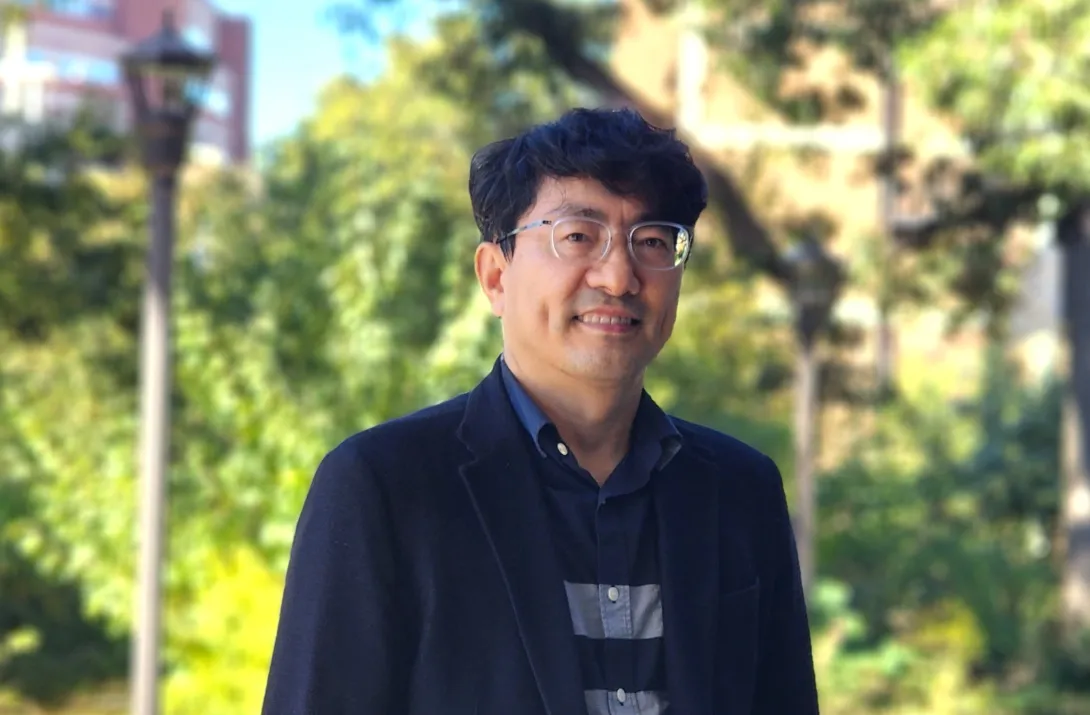
The Center for 21st Century Universities (C21U) is excited to announce that Sanghyun Jang will join Georgia Tech as a C21U visiting research scholar starting on October 20, 2025. He comes from South Korea, where he served as director of the education data center at the Korea Education and Research Information Service (KERIS). For one year, he will be based in Atlanta, Georgia, collaborating with C21U faculty and researchers to develop AI-based learning systems and leverage educational data to improve student outcomes.
“We are pleased to welcome Sanghyun Jang to C21U as our visiting scholar. His leadership and expertise in Korea’s national digital and AI education initiatives offer an invaluable global perspective to our goal of promoting innovation in lifelong learning. His visit will assist us in exploring new models of AI-enabled education that link K–12, higher education, and lifelong learners worldwide,” said C21U Executive Director Stephen Harmon.
Sanghyun has extensive experience leading national education data initiatives in South Korea and collaborating with international organizations like UNESCO and the World Bank. This aligns well with C21U’s mission to promote personalized, data-driven teaching and learning at scale. His expertise highlights our commitment to global collaboration and leadership in AI-powered education.
“I deeply appreciate the opportunity to join C21U and collaborate with Georgia Tech’s outstanding researchers. Their innovative work in AI and lifelong learning provides a strong foundation for meaningful international collaboration and innovation. I am excited that this visiting scholar experience will help build a global network for AI and education research by connecting KERIS, Korean universities, and Georgia Tech,” said Sanghyun Jang.
C21U’s team looks forward to sharing updates on Sanghyun’s work throughout the year. Stay tuned for upcoming events and research highlights.
Sanghyun Jang holds a doctorate in computer engineering from Dongguk University.
News Contact
Yelena M. Rivera-Vale, M.A. (she/her(s)/ella)
Communications Program Manager
C21U, College of Lifetime Learning
Georgia Institute of Technology
Strategic, Learner, Relator, Intellection, Input
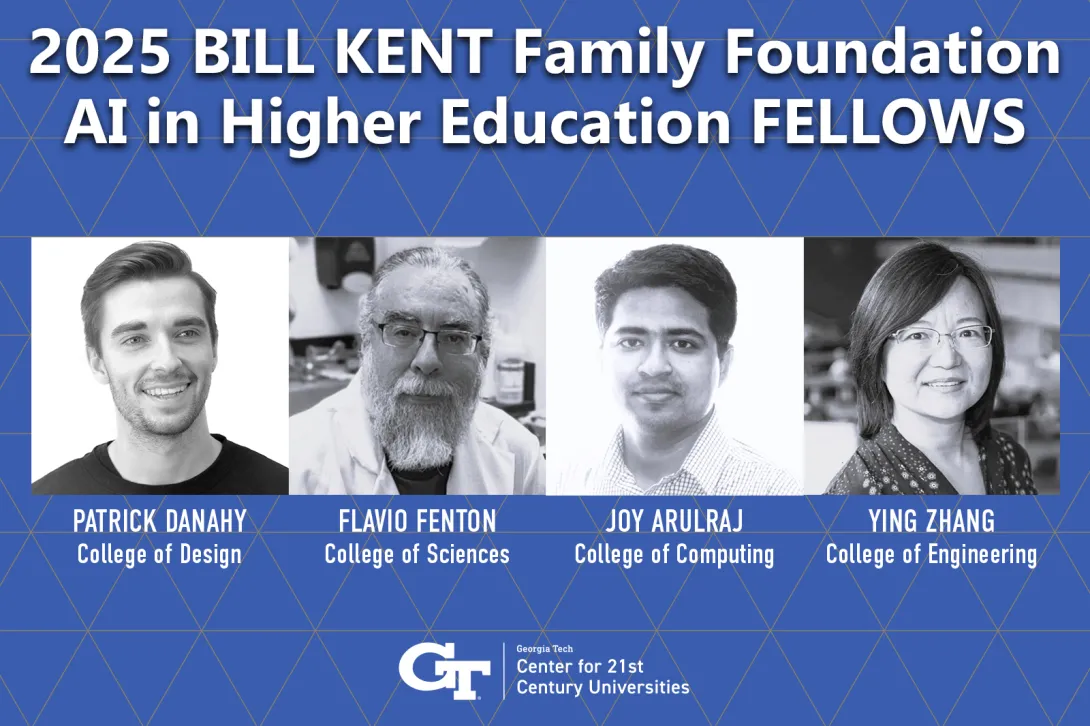
The Center for 21st Century Universities (C21U) has announced the inaugural cohort of Bill Kent Family Foundation AI in Higher Education Faculty Fellows for 2025–26. This C21U-led fellowship program supports faculty projects that explore innovative, ethical, and impactful uses of artificial intelligence in teaching and learning.
The fellows are Professor Flavio Fenton from the College of Sciences, Joy Arulraj from the College of Computing, Patrick Danahy from the College of Design, and Professor and Associate Chair of the School of Electrical and Computer Engineering Ying Zhang, from the College of Engineering. Each fellow will lead a project that advances AI’s role in higher education.
“We deeply appreciate the generosity of the Dr. Bill Kent family in establishing this first philanthropic gift to our new College. Their generous support will allow us to encourage practical applications of AI and foster an appreciation for its ethical use,” said William Gaudelli, inaugural dean of the Georgia Tech College of Lifetime Learning. “This Fellowship will ensure we grow and learn about its use thoughtfully, developing highly innovative and engaging pedagogical experiences for all life’s stages.”
Arulraj’s TokenSmith: Fast, Local, Citable LLM Tutoring introduces a privacy-conscious AI tutoring system for database courses that provides verifiable, course-aligned answers. Fenton’s AI as a Learning Assistant develops AI-enabled instructional modules for physics, neuroscience, and scientific writing to improve conceptual understanding and promote ethical AI use. Danahy’s AI-Enabled Design Ideation and Robotic 3D Printing with Open-Source Platforms integrates AI-driven design and robotic fabrication into architecture education while addressing ethics and sustainability. Zhang’s AI-Enabled Personalized Engineering Education expands personalized learning in large engineering courses through AI tutoring frameworks and integrates AI literacy into the curriculum.
“The Bill Kent Family Fellowship gives our faculty the resources and flexibility to experiment with AI in ways that directly benefit students and inform the future of higher education,” said Stephen Harmon, executive director of C21U.
The fellowship received 21 applications from all seven Georgia Tech colleges, reflecting the educational AI subject-matter experts for their units and the Institute as a whole. Fellows will develop and implement their projects during the 2025–26 academic year and share outcomes through C21U Learning Labs and other campus events.
The Bill Kent Family Foundation partnered with C21U to establish this fellowship and support faculty innovation at Georgia Tech. Through this program, the Foundation invests in projects that explore responsible and impactful uses of artificial intelligence in teaching and learning. By funding this initiative, the Foundation aims to empower educators to develop scalable instructional models, promote ethical AI practices, and prepare students for a future shaped by emerging technologies.
News Contact
Yelena M. Rivera-Vale, M.A. (she/her(s)/ella)
Communications Program Manager
Center for 21st Century Universities
College of Lifetime Learning
Georgia Institute of Technology
Strategic, Learner, Relator, Intellection, Input
Instructors creating online courses have long faced a tradeoff: use text-based materials that are easy to update, or invest in engaging but time-consuming video formats. As a result, learners often get either flexibility or immersion, but rarely both.
“In a field that moves as fast as artificial intelligence, it’s important to be able to update material frequently,” says David Joyner, executive director of online education in the College of Computing. “That’s usually a problem because re-recording means going back into the studio and trying to make the new content fit in with the old.”
Joyner’s latest massive open online course (MOOC), Foundations of Generative AI, uses artificial intelligence to solve that challenge. Images for the course are created using Sora and DALL·E 3, while early drafts of quizzes were generated by GPT-5. The course also uses Grady, an AI autograder that provides feedback on open-ended essays.
The most striking innovation is DAI-vid (pronounced day-eye-vid), a video avatar of Joyner that leads the instruction. To create it, Joyner uploaded a five-minute clip of himself to the generative AI platform HeyGen, along with course scripts and other inputs. The result is a lifelike digital instructor who can let Joyner update his lessons far more easily.
“With AI, we can just modify the text and have the updated video pop right out,” Joyner says. “It takes minutes at my desk instead of an hour in the studio.”
This approach allows Joyner to keep course materials current and produce new videos entirely on his own. “It’s strange, but in a lot of ways this course feels more like it’s mine than the ones where I’m on camera,” he says. “Because AI lets me handle every part of production myself, the finished product feels like my complete work.”
Joyner sees this experiment as an example of AI’s potential to enhance human talent rather than replace it. “Give me AI and I can do five times more than I could alone,” he says. “But give it to our professional video producers, and they will still far outpace me, because expertise matters most. AI just amplifies it.”
Foundations of Generative AI is now available on edX, and the same material is also part of the OMSCS course CS7637: Knowledge-Based AI.
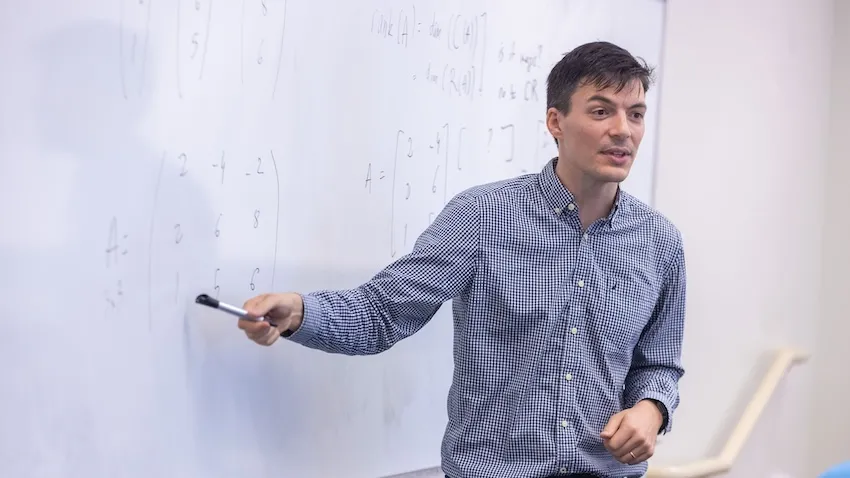
Students in machine learning and linear algebra courses this semester are learning from one of Georgia Tech’s most celebrated instructors.
Raphaël Pestourie has earned back-to-back selections to the Institute’s Course Instructor Opinion Survey (CIOS) honor roll, placing him among the top-ranked teachers for Fall 2024 and Spring 2025.
By returning to the classroom this semester to teach two more courses, Pestourie continues to leverage proven experience to mentor the next generation of researchers in his field.
“Students played a very important part in the survey process, and I thank them for making the classes great,” said Pestourie, an assistant professor in the School of Computational Science and Engineering (CSE).
“I'm incredibly grateful that students shared their feedback so that I could go the extra mile to not only apply my expertise to teach in ways that I think work, but transform my instruction to reach students in the most impactful way I can.”
CIOS honor rolls recognize instructors for outstanding teaching and educational impact, based on student feedback provided through end-of-course surveys.
Student praise of Pestourie’s CSE 8803: Scientific Machine Learning class placed him on the Fall 2024 CIOS honor roll. He earned selection to the Spring 2025 honor roll for his instruction of CX 4230: Computer Simulation.
CSE 8803 is a graduate-level, special topics class that Pestourie created around his field of expertise. Scientific machine learning involves merging two traditionally distinct fields: scientific computing and machine learning.
In scientific computing, researchers build and use models based on established physical laws. Machine learning differs in that it employs data-driven models to find patterns without prior assumptions. Combining the two fields opens new ways to analyze data and solve challenging problems in science and engineering.
Pestourie organized student-focused scientific machine learning symposiums in Fall 2023 and 2024. CSE 8803 students work on projects throughout the course and present their work at these symposiums. Pestourie will use the same approach this semester.
Compared to CSE 8803, CX 4230 is an undergraduate course that teaches students how to create computer models of complex systems. A complex system has many interacting entities that influence each other’s behaviors and patterns. Disease spread in a human network is one example of a complex system.
CX 4230 is a required course for computer science students studying the Modeling & Simulation thread. It is also an elective course in the Scientific and Engineering Computing minor.
“I see 8803 as my educational baby. Being acknowledged for it with a CIOS honor roll felt great,” Pestourie said.
“In a way, I'm prouder of CX 4230 because it was a large, undergraduate regular offering that I was teaching for the first time. The honor roll selection came almost as a surprise.”
To be eligible for the honor roll recognition, instructors must have a minimum CIOS response rate of 70%. Composite scores for three CIOS items are then used to rank instructors. Those items are:
- Instructor’s respect and concern for students
- Instructor’s level of enthusiasm about the course
- Instructor’s ability to stimulate interest in the subject matter
Georgia Tech’s Center for Teaching and Learning (CTL) and the Office of Academic Effectiveness present the CIOS Honor Rolls. CTL recognizes honor roll recipients at its Celebrating Teaching Day events, held annually in March.
CTL offers the Class of 1969 Teaching Fellowship, in which Pestourie participated in the 2024-2025 cohort. The program aims to broaden perspectives with insight into evidence-based best practices and exposure to new and innovative teaching methods.
The fellowship offers one-on-one consultations with a teaching and learning specialist. Cohorts meet weekly in the fall semester and monthly in the spring semester for instruction seminars.
The fellowship facilitates peer observations where instructors visit other classrooms, exchange feedback, and learn effective techniques to try in their own classes.
“I'm very grateful for the Class of 1969 fellowship program and to Karen Franklin, who coordinates it,” Pestourie said. “The honor roll is not just a one-person award. Support from the Institute and other people in the program made it happen.”
Like in Fall 2023 and 2024, Pestourie is teaching CSE 8803: Scientific Machine Learning again this semester. Additionally, he teaches CSE 8801: Linear Algebra, Probability, and Statistics.
Linear algebra and applied probability are among the fundamental subjects in modern data science. Like his scientific machine learning class, Pestourie created CSE 8801. This semester marks the second time Pestourie is teaching the course since Fall 2024.
Pestourie designed CSE 8801 as a refresher course for newer graduate students. This addresses a point of need to help students get off to a good start at Georgia Tech. By offering guidance early in their graduate careers, Pestourie’s work in the classroom also aims to cultivate future collaborators and serve his academic community.
“I see teaching as our one shot at making a good first impression as a research field and a community,” he said.
“I see my work as a teacher as training my future colleagues, and I see it as my duty to our community to do my best in attracting the best talent toward our research field.”
News Contact
Bryant Wine, Communications Officer
bryant.wine@cc.gatech.edu