

Matt Cox, Ph.D. PubPol 2014, played an instrumental role in recent passage of Atlanta legislatiion meant to reduce the energy burden on Atlanta residents.
Matt Cox, a 2014 Ph.D. graduate of the School of Public Policy, played an instrumental role in advancing recent City of Atlanta legislation to help reduce energy burden among low-income residents.
Why tackling energy burden is important: Atlanta is among the nation’s five most energy-burdened cities. If the program performs as advocates expect, it “could be the most impactful climate and energy policy Atlanta has adopted,” says Cox, who as CEO of non-profit Greenlink Analytics uses his Georgia Tech education to find and advocate for equitable climate and energy policies across the Southeast.
“This program will ensure that no resident must choose between food on the table and heating or cooling their homes, making a tangible difference in our community,” City Councilwoman Liliana Bakhtiari said in a statement.
- High energy burden in Atlanta disproportionately affects the city’s Black residents, according to Cox and School of Public Policy from 2018 and 2024.
- Improving energy efficiency is also a smart way to address climate change, School of Public Policy researchers say.
- Cox worked with former Clean Energy Advisory Board Chairwoman Wykeisha Howe to win backing for the energy burden measure. "We discussed the matter with every council member, emphasizing the necessity of creating a fund to finance essential home improvements that would relieve unnecessarily high bills." he said. "We explained the constraints of federal funding, which often resulted in only partial assistance for many households."
- Due in part to Cox’s work, almost every City Council member supported the bill.
Of note: Cox, who helped develop the energy analytics platform used by Greenlink while a Ph.D. student at Georgia Tech, worked on a similar program for Athens, Georgia.
Key context: Helping reduce climate change impacts is a key goal of the School. For instance, Regents’ Professor Marilyn A. Brown recently helped Georgia create its first-ever climate action plan. Professor Daniel Matisoff recently won an award for his work on the benefits of green building pilot programs. And educating a new generation of sustainable energy leaders is the mission of the School’s innovative Master of Sustainable Energy and Environmental Management degree.
News Contact
Michael Pearson
Ivan Allen College of Liberal Arts

Ioanna Maria Spyrou, a Ph.D. candidate in the School of Economics, uses artificial intelligence (AI) and machine learning to predict food insecurity in Africa.
She hopes the tool she’s developing can help policymakers and community organizations implement more timely and targeted interventions to alleviate hunger on the continent.
Why now?
- Nearly 150 million people in Sub-Saharan Africa lack access to the amount and quality of food they need.
- This is primarily due to armed conflicts and more frequent droughts and natural disasters from climate change.
- Understanding which factors impact food shortages the most can help communities plan ahead, adapt to new weather patterns, and be more resilient.
- Spyrou and her advisor, Professor Shatakshee Dhongde in the School of Economics, are working with data from Sudan, South Sudan, the Democratic Republic of the Congo, and Somalia and hope to eventually expand to include more countries.
What’s new?
Other algorithms incorporate machine learning and AI to predict when and where food shortages will occur.
However, Dhongde and Spyrou’s approach is unique because it uses recent data from 2020 to 2023 and includes additional predictors, such as monthly data on conflict, which can be a powerful driver of food insecurity in Africa. (The Africa Center for Strategic Studies says 82% of people experiencing hunger on the continent live in countries in conflict.). Changing weather patterns also means relying on historical data no longer gives accurate information.
“By identifying which factors contribute most to food insecurity in different regions, we can adapt agricultural systems, try new strategies, and build stronger social networks and support systems,” Spyrou said.
What’s next?
Spyrou and Dhongde are working to determine how accurately they can predict food insecurity in Africa with these inputs, and they are optimistic about the results.
They hope the tool can eventually help policymakers, aid organizations, and communities do more with less.
“AI enables us to analyze these large datasets quickly and accurately and create real-time predictions," Dhongde said. "The ultimate goal is to achieve food security and end a crisis that is getting worse and worse.”
News Contact
Di Minardi
Ivan Allen College of Liberal Arts

A new study by School of Public Policy researchers for the Sierra Club looks into the causes of energy burden among Black residents of Georgia.
A new report prepared by Regents’ Professor Marilyn A. Brown and a team of student researchers from Georgia Tech’s School of Public Policy digs into the causes of energy burden among Georgia’s Black residents.
The study aligns with numerous other studies showing that race alone is a contributing factor to experiencing higher energy burdens. However, the Georgia Tech research findings include data showing that homes with children, older people, or those headed by women were even more at risk. Researchers also found that a 13% increase in an area’s Black population equated to an approximately 1% increase in energy burden.
Households are often considered energy-burdened if they spend more than 6% of their monthly budget on energy, according to the report.
“One thing that sets this Sierra Club report aside from other breakdowns of energy burden across the country is the meticulous description of the conditions and causes of high energy burdens among 33 energy-stressed Black households in Georgia, who were identified and interviewed by community organizations,” Brown said.
Historical trends such as mortgage redlining, highway, and power plant placements, and the effect of deforestation and urban heat islands on urban, predominantly Black communities all play a role in contributing to the unusually high energy costs many Black Georgians end up paying, according to the report.
“This isn’t an abstract thing. People are having to choose whether they cool their homes or put food on the table or buy medicine,” said Brown, also Brook Byers Professor of Sustainable Systems.
While the report—parts of which have been published in a peer-reviewed journal and another manuscript under review—makes no policy recommendations, the researchers note that changes to state and federal housing policies are urgently needed.
“Implementing effective policy solutions would not only decrease high energy burdens, bill payment problems, and utility shut-offs, but would also promote the health, safety, and economic vitality of Black families, slash U.S. carbon emissions and build a stronger, more inclusive climate movement,” they wrote.
The report, Energy Burdens of Black Households in Georgia” was published on March 14 by the Sierra Club, which funded the research.
In addition to Brown, Ph.D. students Snehal Kale, Ryan Anthony, and Majid Ahmadi, and alum Ashley Hill, MSEEM 2022, co-authored the report.
News Contact
Michael Pearson
Ivan Allen College of Liberal Arts

Omar Asensio, GT Energy Research Faculty and HBS visiting fellow, Institute for the Study of Business in Global Society
A new study by Associate Professor Omar Isaac Asensio and a team of students in Georgia Tech’s School of Public Policy finds that federal housing policies accelerate energy efficiency participation among low- and moderate-income households — even when those policies don’t directly address energy efficiency.
The research, published in Nature Sustainability, shows how community development block grants from the U.S. Department of Housing and Urban Development (HUD) generated an average of 5% to 11% energy savings in economically burdened households in Albany. The savings equate to the cost of roughly two months of groceries per household per year.
"These housing participants who didn't come in thinking about energy efficiency saved anywhere from $75 to $482 per year in energy bills," Asensio said. "Those are meaningful savings that really impact people. So, we ended up finding very significant hidden social benefits from these policies that were previously unknown."
https://youtu.be/eWqOFj9qRxw
The findings are surprising because HUD grants do not specifically target energy efficiency or sustainability measures in exchange for governmental assistance. Instead, they are given at the discretion of the local government to residents facing housing emergencies such as deteriorating roofs or broken HVAC systems in the hot summer. Because of the high amount of deferred maintenance in these homes, the fixes have a spillover effect of significantly reducing energy use — for example, by adopting more efficient technologies and bringing structures up to building codes — and saving money for people who receive them.
The multidisciplinary research team in Asensio’s Data Science & Policy Lab, including current and former Public Policy students Olga Churkina and Becky D. Rafter and industrial engineering alumna Kira E. O'Hare, also found that the cost-effectiveness of housing-based interventions rivals standalone energy efficiency policies, offering a promising alternative for reaching marginalized communities.
"For decades, we’ve struggled to get meaningful participation with conventional policies in these lower and moderate-income communities, including among renters and people in multi-family homes,” Asensio said. "Using housing block grants as an entry strategy to drive efficiency is an important policy innovation.”
With support from the National Science Foundation, ESRI, Inc., and the Georgia Smart Communities Challenge, Asensio and his co-authors spent nearly four years collecting, cleaning, and combining Albany's previously siloed city data into one community analytics repository. They linked records for 5.9 million utility bills per month from 2004 to 2019, allowing them to see long-run impacts of policy intervention, energy consumption, and payments by household — an uncommonly granular level of data.
"Overall, HUD-funded block grants in Albany reduced electricity use by 4.72 million kilowatt hours over the study period versus the control group," the researchers wrote. "The reduction in non-baseload emissions is equivalent to 3.70 million pounds of coal not being burned or the carbon sequestered by 3,695 acres of forest."
Asensio's research is timely because the Southeast has some of the country's highest energy-burdened households. In the U.S., spending over 6% of net income on energy is considered a burden. In Albany, renters' and homeowners' energy costs can surpass ten or even 20% of household budgets, Asensio said, and many housing applicants are elderly and on fixed incomes.
Unlike conventional energy initiatives that are reliant on self-selection, housing programs can provide a more equitable and localized strategy. That's because "most of the standalone policies for energy efficiency have two main outcomes," Asensio said. "First, the programs generally attract more affluent and informed homeowners, in which case, questions arise as to whether this might be a good use of public funds. Second, when these policies are restricted to certain income eligibility limits, we don't get enough participation from lower-income residents for a long list of reasons. So, reaching low- and moderate-income households has become a fundamental challenge."
In contrast, housing block grants naturally target a broader range of residents with high energy burdens and help circumvent the problem of low participation. Rather than trying to market an energy-saving offer to people who aren't interested or are distrustful of the government, HUD grants have long waiting lists.
"There are thousands and thousands of communities that look very much like Albany within and outside of major metro areas,” Asensio said. "This is a relatively untapped opportunity for driving energy efficiency within households who may not necessarily have an awareness of or interest in energy efficiency measures.”
The paper, “Housing Policies and Energy Efficiency Spillovers in Low and Moderate Income Communities,” was published online in Nature Sustainability on March 18. It is available at https://doi.org/10.1038/s41893-024-01314-w. This work was partially supported by awards from the National Science Foundation (Award No. 1945332), ESRI, Inc., the Georgia Smart Communities Challenge, and the Institute for the Study of Business in Global Society at Harvard Business School.
News Contact
Di Minardi
Ivan Allen College of Liberal Arts
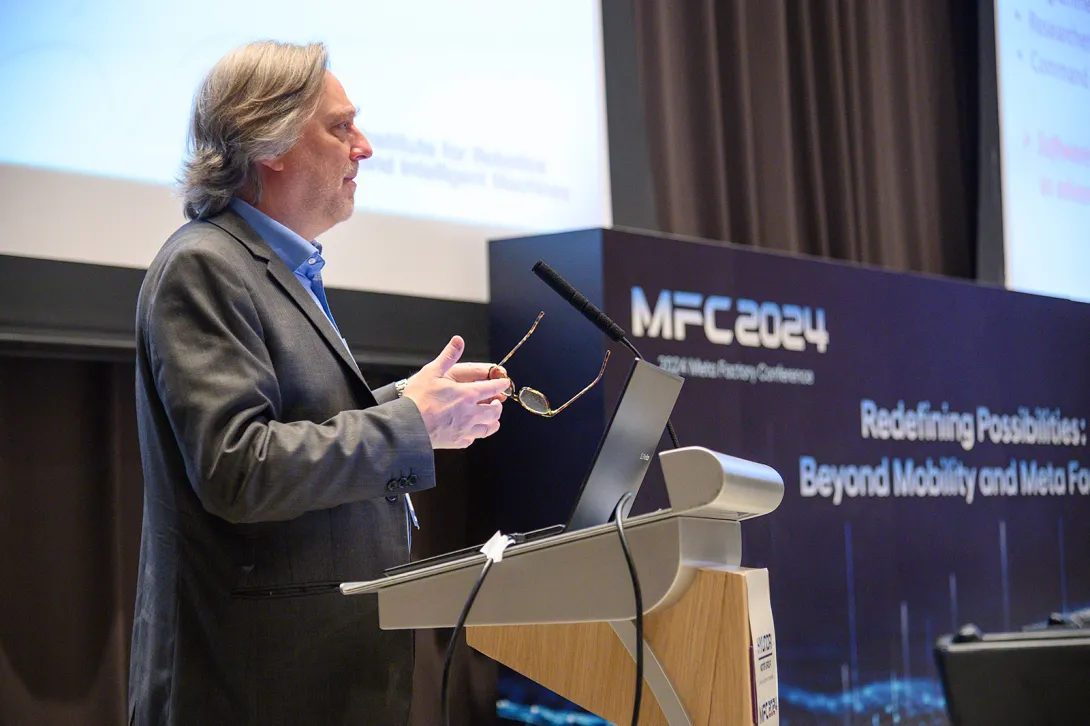
IRIM Director Seth Hutchinson at Hyundai Meta Factory Conference Delivering Keynote
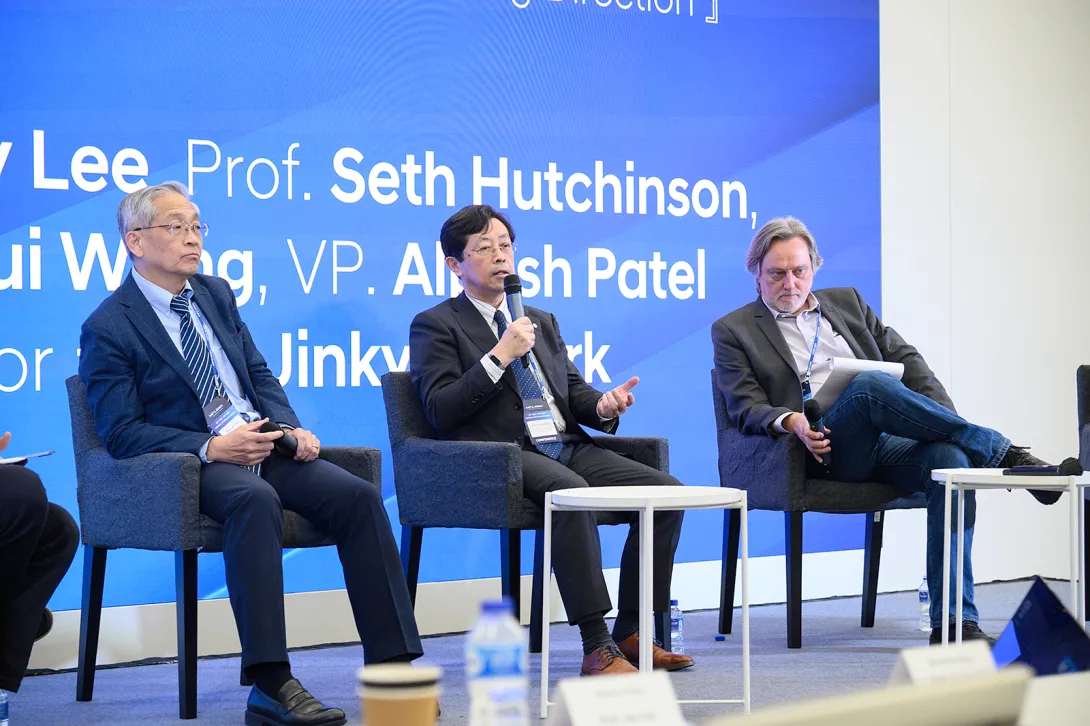
IRIM Director Seth Hutchinson at Hyundai Meta Factory Conference on Panel Discussion
Hyundai Motor Group Innovation Center Singapore hosted the Meta-Factory Conference Jan. 23 – 24. It brought together academic leaders, industry experts, and manufacturing companies to discuss technology and the next generation of integrated manufacturing facilities.
Seth Hutchinson, executive director of the Institute for Robotics and Intelligent Machines at Georgia Tech, delivered a keynote lecture on “The Impacts of Today’s Robotics Innovation on the Relationship Between Robots and Their Human Co-Workers in Manufacturing Applications” — an overview of current state-of-the-art robotic technologies and future research trends for developing robotics aimed at interactions with human workers in manufacturing.
In addition to the keynote, Hutchinson also participated in the Hyundai Motor Group's Smart Factory Executive Technology Advisory Committee (E-TAC) panel on comprehensive future manufacturing directions and toured the new Hyundai Meta-Factory to observe how digital-twin technology is being applied in their human-robot collaborative manufacturing environment.
Hutchinson is a professor in the School of Interactive Computing. He received his Ph.D. from Purdue University in 1988, and in 1990 joined the University of Illinois Urbana-Champaign, where he was professor of electrical and computer engineering until 2017 and is currently professor emeritus. He has served on the Hyundai Motor Group's Smart Factory E-TAC since 2022.
Hyundai Motor Group Innovation Center Singapore is Hyundai Motor Group’s open innovation hub to support research and development of human-centered smart manufacturing processes using advanced technologies such as artificial intelligence, the Internet of Things, and robotics.
- Christa M. Ernst
Related Links
- Hyundai Newsroom Article: Link
- Event Link: https://mfc2024.com/
- Keynote Speakers: https://mfc2024.com/keynotes/
News Contact
Christa M. Ernst - Research Communications Program Manager
christa.ernst@research.gatech.edu
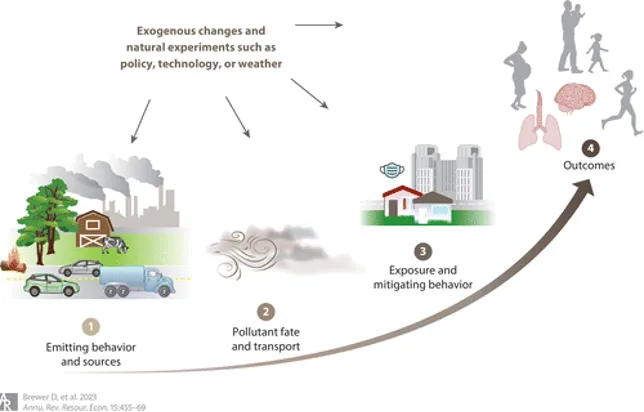
Simple schematic documenting the path of air pollution from emissions to outcomes. This review discusses the challenges of measuring how emissions of pollutants (step 1) disperse through the air (step 2) to become eventual exposures (step 3) and health outcomes (step 4).
Faculty
Dylan Brewer, Daniel Dench, and Laura Taylor
Written by Sharon Murphy
About This Project
The Energy, Policy, and Innovation Center faculty affiliates Dylan Brewer, Daniel Dench, and Interim Director Laura Taylor published an article titled "Advances in Causal Inference at the Intersection of Air Pollution and Health Outcomes." The authors compare the methods used in the epidemiology literature with the causal inference framework used in economics in analyzing the effect of air pollution on health outcomes.
Determining the quality and accuracy of the evidence linking air pollution to human health has been a challenge for research in this area.
Each academic discipline has a unique lens through which they view and solve a problem, which may result in different conclusions being drawn from the same data. While studies that involve randomization across populations can provide evidence and are widely used in medical research, exposures to everyday air pollution cannot be randomized by a researcher.
Many existing studies exploring the health impacts of air pollution rely on establishing correlations between pollutants and health outcomes. However, correlations do not imply causation and can lead to bad policy. In this study, the EPICenter affiliates reviewed methodological contributions made by economists to determine if using statistical methods to the study of the health effects of air pollution can contribute to more robust and reliable findings.
To understand the difficulty researchers face, consider a typical air pollution study that collects health data of residents living near a pollution source, such as a coal-fired power plant. The data would be used to see if there is an increased incidence of adverse health outcomes such as asthma, chronic obstructive pulmonary disease, or cardiopulmonary disease. However, many factors can create a confounding effect on the final results if the researcher doesn’t take them into consideration. For instance, the power plant may have been built in a low-income location, or lower-income households may have moved near the power plant to take advantage of lower rent or property prices. This may conflate the effect of income and air pollution on health.
Simple schematic documenting the path of air pollution from emissions to outcomes. This review discusses the challenges of measuring how emissions of pollutants (step 1) disperse through the air (step 2) to become eventual exposures (step 3) and health outcomes (step 4).
Economists promote the use of natural experiments to overcome confounding factors. Natural experiments mimic familiar laboratory experiments. For instance, in the power plant example, random variation in wind direction would result in some households being randomly more exposed to air pollution, regardless of income. By taking advantage of this randomization, researchers can compare differences in a particular health outcome between those more exposed and less exposed, while overcoming confounding effects such as income, and move one step closer toward improving our understanding of the relationship between air pollution and adverse health outcomes.
The authors conclude by emphasizing the need for creating multidisciplinary teams, including economists, air-quality modelers, and public health and medical researchers. “While one may not think of economists as a natural contributor to this line of research, the analytical framework honed by economists over decades can contribute important expertise to the design of these types of studies,” Taylor concluded, “and result in better evidence for policymakers.”
Read more: https://doi.org/10.1146/annurev-resource-101722-081026
News Contact
Priya Devarajan | SEI Communications Program Manager
Authored by: Sharon Murphy, Strategic Energy Institute

Humans have looked to the stars for guidance for thousands of years — and when it comes to questions of sustainability, the practice is no different.
The best way to deal with climate change is a heated topic of debate here on Earth — laws are created, nonprofits are formed, investments are made, and lobbyists have their say — but the concept also transcends terrestrial boundaries. As we navigate the complexities of shifting to a more sustainable world, it turns out there is a lot we can learn from and apply to our ventures in outer space.
Researchers in the Ivan Allen College think big to explore questions of sustainability on Earth, in outer space, and on a cosmic scale.
The Importance of Megaregions
Brian Woodall, a professor at the Sam Nunn School of International Affairs, uses satellite data to rethink how we understand and address sustainability in our cities. He directs the Sustainable Megaregion Research Project with Mariel Borowitz, an associate professor in the Nunn School, and experts across Georgia Tech.
The group uses data generated by NASA and the National Oceanic and Atmospheric Administration to draw definitive boundaries around Earth's megaregions — large, densely-populated areas such as the Boston-Washington corridor, Greater Tokyo, and the Amsterdam-Brussels-Antwerp triangle. Then, the researchers combine light emissions and other datasets to analyze CO2 emissions, urban buildup, green space, population density, transportation infrastructure, and more.
"In this way, satellite data is critical in our efforts to fashion a comparative, time-sensitive, and data-driven system for delineating megaregion boundaries," Woodall said. "Then, we can assess their effectiveness in addressing sustainable development challenges."
According to the project website, three-quarters of America's population and employment growth will occur in just eight to ten megaregions by 2050. To ensure sustainability in the face of climate threats, we must build resilience and protect critical infrastructure in these areas, the group says.
Political Parallels
However, whether it’s in megaregions or across international borders, it's no secret that humans don't always get along. Lincoln Hines, an assistant professor in the Nunn School, studies the politics of outer space with a focus on the Chinese space program. He says that comparing sustainability challenges on Earth to those in space — such as the 100 million+ pieces of space junk littering Earth's orbit — underscores the political nature of these problems and their international nature.
"The politics of space sustainability largely reflect the politics of sustainability on Earth, as humans continue to confront difficult collective action problems in both domains," Hines explains. "Neither global warming nor space debris care for the human constructs of sovereignty and national borders."
Tony Harding, an economist and assistant professor in the School of Public Policy, echoes this sentiment.
"We have this public good, which is space and near Earth's orbit, where we put satellites. And because no one is in control and has property rights in that area, we end up with an overuse and a lot of space junk," he says. "This parallels the Tragedy of the Commons problem we see on Earth — we have issues with climate change because we're all contributing a small amount to the problem and not facing the full cost of it."
Harding studies the costs and benefits of solar geoengineering, which uses atmospheric particles to reflect the sun's radiation to slow global warming. Whether it's adding sulfate to the skies or cleaning up Earth's orbit, an intergenerational perspective is helpful, he says.
"Should we develop geoengineering technology so the next generation has the choice to use it? Should we leave them with millions of pieces of space debris just because we don't want to clean it ourselves?"
Second Time's a Charm(?)
Despite the growing space debris problem, Borowitz emphasizes that we can proactively address the challenges of space sustainability and learn from our mistakes on Earth.
"It's still early on in space, so we have the opportunity to think about sustainability from the beginning and address these issues before the debris is completely out of control," she says. "We are on an unsustainable path at the moment, but we can adjust before anything goes wrong."
She adds that as interest and activity on the moon ramp up, the same questions apply. Because the moon doesn't have wind or weather like we do on Earth, when something changes its surface it can stay like that for thousands of years.
"So it's really another place where you've got to do it right the first time," Borowitz says. "This is the test, right? The test for humanity — can we do it differently?"
Sustainability on a Cosmic Scale
Chris Michaels, a Marion L. Brittain Postdoctoral Scholar in the School of Literature, Media, and Communication, thinks about space from a symbolic perspective: What would happen if we scale up our consciousness to the level of the cosmos? Michaels teaches a course on modern terraforms and says contemplating the vast reaches of space can challenge us to think about sustainability in new ways.
"The idea of space serves as a new frontier to be explored and colonized. If humans can migrate to other planets and make them home, then sustainability on Earth may look quaint and outdated," he says. "Humans tend to experience time on an atomized scale around their individual lives and have trouble thinking as concretely about the long term. But imagine if humans had a life span of 500 years, or they thought and acted less as individuals and more as members of a human race that extends thousands or even millions of years into the future. Thinking and acting on this larger scale would better align us with the geological timescales of the Earth, where sustaining our lives goes hand in hand with sustaining the Earth."
The sprawling expanse of space is more than just an escape route from our troubled planet, and pondering it helps us shift our perspective from that of the starring role in our little galaxy to a bit character in a much larger play.
Traditional Inspiration, New Solutions
From satellite-driven research to geopolitical challenges and cosmic contemplation, humans continue to look to the stars for inspiration and information on keeping our planet and its orbit healthy.
When it comes to our mandate for more sustainable living, it's not just about protecting our home but how we fit into the wider universe. Becoming better caretakers of our planet connects us to our past and future, here on Earth and out among the stars.
News Contact
Ivan Allen College of Liberal Arts

Professor Daniel Matisoff
For the second time in three years, a Georgia Tech School of Public Policy faculty member has won the prestigious World Citizen Prize in Environmental Performance.
The Association for Public Policy Analysis & Management (APPAM) recently revealed Professor Daniel Matisoff as one of its 2023 honorees, along with his collaborator Douglas Noonan, formerly a professor in the School and now at Indiana University — Purdue University Indianapolis. APPAM also honored Lucy Qiu of the University of Maryland.
The Association for Public Policy Analysis & Management (APPAM) gives the annual award in recognition of research that “assesses pathways to achieve measurable but as-yet-unrealized gains in overall environmental performance.”
“It’s quite an honor to receive this award with Doug for the work that we’ve done to understand what we call the ‘green market transformation,’” Matisoff said. “It’s also gratifying to see continued recognition of the excellent work being done across the School.”
Matisoff and Noonan won for their book Ecolabels, Innovation, and Green Market Transformation.
In announcing the win, APPAM said Ecolabels “provides a new perspective on leveraging markets to transform industry” through its analysis of eco-labeling — the voluntary practice among some companies of acquiring independent certification that their goods or services are more environmentally friendly.
The book focuses on the building industry and certifications such as the Leadership in Energy & Environmental Design, or LEED, program. In the volume, Matisoff and Noonan show that early adopters of such programs help spur adoption across the industry.
“The theory for the work was inspired by the mission of the Kendeda Building at Georgia Tech, which was designed to transform how building and construction are done in the Southeast,” Matisoff said. “We showed that tools that leverage interactions between the public and private sector, such as eco-labeling and pilot and demonstration projects, can help build supply chains, reduce costs, demonstrate the performance of risky technologies, and accelerate uptake of innovative energy and environmental technologies.”
Matisoff will accept the award at the APPAM meeting scheduled to be in Atlanta this November.
Marilyn A. Brown, Regents’ Professor and Brook Byers Professor of Sustainable Systems in the School of Public Policy, received the award in 2021 for her work leading the research team behind the Drawdown Georgia climate initiative. Matisoff is also a member of that team.
In all, three of the seven recipients of the award since its inception in 2019 have been current or former faculty members of Georgia Tech’s School of Public Policy. That track record demonstrates the School’s tradition of leadership and creativity in the energy and environmental policy space, Matisoff said.
“It speaks to the caliber of our faculty and our energy and environmental policy program here at the Georgia Tech School of Public Policy,” said Matisoff, who is also the director of the innovative Master of Sustainable Energy and Environmental Management program.
The School of Public Policy is a unit of the Ivan Allen College of Liberal Arts.
News Contact
Michael Pearson
Ivan Allen College of Liberal Arts

USG Chancellor Sonny Perdue looks on as Georgia Tech President Ángel Cabrera and Executive Vice President for Research Chaouki Abdallah sign the memorandum of understanding with Hyundai officials, signifying the beginning of a transformative partnership.

Georgia Tech President Ángel Cabrera poses for a selfie with Euisun Chung, executive chairman of Hyundai Motor Company.

Georgia Tech and Hyundai leaders pose for a photo following the signing of the memorandum of understanding. From left to right: Executive Vice President for Research Chaouki Abdallah, Georgia Tech President Ángel Cabrera, University System of Georgia Chancellor Sonny Perdue, Executive Chairman of Hyundai Motor Company Euisun Chung, President and CEO Jay Chang, President and Global COO José Muñoz.
In front of a standing-room-only crowd inside the John Lewis Student Center's Atlantic Theater, global leaders from the Hyundai Motor Group and Georgia Tech signed a memorandum of understanding, creating a transformative partnership focused on sustainable mobility, the hydrogen economy, and workforce development.
As the automaker continues to construct its Metaplant America site in Bryan County — the cornerstone of Hyundai's $12 billion investment into electric vehicles and battery production across the state of Georgia — today's signing ceremony symbolizes the vision that Hyundai and Georgia Tech share on the road to advancing technology and improving the human condition.
"As a leading public technological research university, we believe we have the opportunity and the responsibility to serve society, and that technology and the science and policy that support it must change our world for the better. These are responsibilities and challenges that we boldly accept. And we know we can't get there alone. On the contrary, we need travel partners, like-minded innovators, and partners with whom we can go farther, and today's partnership with Hyundai is a perfect example of what that means," Georgia Tech President Ángel Cabrera said.
The state of Georgia and the Institute have positioned themselves as leaders in the electrification of the automotive industry. Hyundai is among the top sellers of electric vehicles in the United States as the company aims to produce up to 500,000 vehicles annually at the $7 billion Savannah plant when production begins in 2025. The plant will create 8,500 jobs, and the company's total investments are projected to inject tens of billions of dollars into the state economy while spurring the creation of up to 40,000 jobs.
"It's clear, we are in the right place with the right partners," Jay Chang, president and CEO of Hyundai Motor Company, said. "When our executive chairman first decided on [the site of] the metaplant, one of the first things he said was, 'Make sure we collaborate with Georgia Tech.’ Hyundai and Georgia Tech have a lot in common. We have proud histories. We celebrate excellence, and we have very high standards. What we love about Georgia Tech is the vision to be a leading research university that addresses global challenges and develops exceptional leaders from all backgrounds."
Spearheading new opportunities for students, the partnership will create technical training and leadership development programming for Hyundai employees and initiate engagement activities to stimulate interest in STEM degrees among students.
José Muñoz, president and global COO of Hyundai Motor Company and president and CEO of Hyundai and Genesis Motor North America, says the company quickly realized the potential impact of the newly forged partnership with Georgia Tech.
"Proximity to institutions like Georgia Tech was one of the many reasons Hyundai selected Georgia for our new EV manufacturing facility. Imagine zero-emissions, hydrogen-powered vehicles here on campus, advanced air mobility shuttling people to Hartsfield-Jackson Atlanta International Airport, or riding hands-free and stress-free in autonomous vehicles during rush hour on I-75 and I-85. Together, Georgia Tech and Hyundai have the resources to fundamentally improve how people and goods move," he said.
In pursuit of sustainability, Hyundai has invested heavily in the potential of hydrogen and plans to lean on the Institute's expertise to explore the potential of the alternative fuel source, primarily for commercial vehicles. Hyundai has deployed its hydrogen-powered XCIENT rigs to transport materials in five countries.
University System of Georgia Chancellor Sonny Perdue was on hand for Tuesday’s ceremony. Reflecting on his visits to the company's global headquarters in South Korea prior to the construction of the West Point, Georgia, Kia plant, he praised the company's values and world-class engineering ability.
"This is a relationship built on mutual trust and respect. It's a company, a family atmosphere, and a culture that I respect and admire for the way they do business and honor progress, innovation, and creativity. That is why I am so excited about this partnership between the Hyundai Motor Group and the Georgia Institute of Technology because that will only enhance that," Perdue said.
Owned by Hyundai, Kia recently invested an additional $200 million into its West Point facility to prepare for the production of the all-electric 2024 EV9 SUV. The plant currently manufactures more than 40% of all Kia models sold in the U.S.
The partnership also includes field-naming recognition at Bobby Dodd Stadium, which is now known as Bobby Dodd Stadium at Hyundai Field, and provides student-athletes and teams with the resources needed to compete at the highest levels, both athletically and academically.
News Contact
Steven Gagliano - Communications Officer
Institute Communications

Georgia emissions fell 5% from 2017 to 2021, according to the Drawdown Georgia research team led by Regents' Professor Marilyn Brown.
Overall greenhouse gas emissions in Georgia fell by 5% between 2017 and 2021, mostly due to the increased use of natural gas and solar for electricity generation, according to the research team behind the Drawdown Georgia climate initiative. Emissions from agriculture and the average individual carbon footprint also shrank.
The decline in emissions comes against a 10% expansion in the state’s economy, showing the potential for reducing emissions while pursuing economic growth, according to the team.
However, the team’s data also show a stark increase in transportation-related emissions, which now exceed pre-pandemic levels and has become the state’s largest source of climate pollution, according to Marilyn Brown, Regents’ Professor and Brook Byers Professor of Sustainable Systems in the School of Public Policy and the principal investigator on the Drawdown Georgia research team.
“While not all of the numbers are trending in the right direction, these data clearly show significant improvements in many sectors of our economy and also highlight where we have the greatest opportunities, namely transportation,” Brown said.
Track Greenhouse Gas Emissions in Your County
The report shows that while emissions from the electricity sector declined more than 15% between 2017 and 2021, transportation sources including cars and trucks put out 4% more climate-warming emissions in 2021 than five years earlier. Emissions from diesel vehicles spiked 16.1%, likely due to increased demand for delivery services driven by online shopping.
Emissions from Georgia’s agricultural and food sector fell by 7.1% during the study period while the average individual carbon footprint of Georgians declined from 22,092 pounds to 20,253 pounds.
“Based on the collaborations we’re a part of, we’re confident this is only the beginning of Georgia’s carbon reduction trend,” John Lanier, executive director of the Ray C. Anderson Foundation, said in a news release on the findings.
The foundation is a primary funder of Drawdown Georgia.
Brown leads the research team, which spans several Georgia colleges and universities. She is an internationally known climate policy researcher who has dedicated most of her career to helping solve the climate crisis.
The analysis is based on data from the first-of-its-kind Drawdown Georgia Emissions Tracker, which aggregates information from federal Energy Department, Transportation Department, and Environmental Protection Agency reports. The tracker was produced by a team of scientists led by William Drummond in the School of City and Regional Planning.
For a more detailed analysis of the findings, visit the Drawdown Georgia blog.
News Contact
Michael Pearson
Ivan Allen College of Liberal Arts