
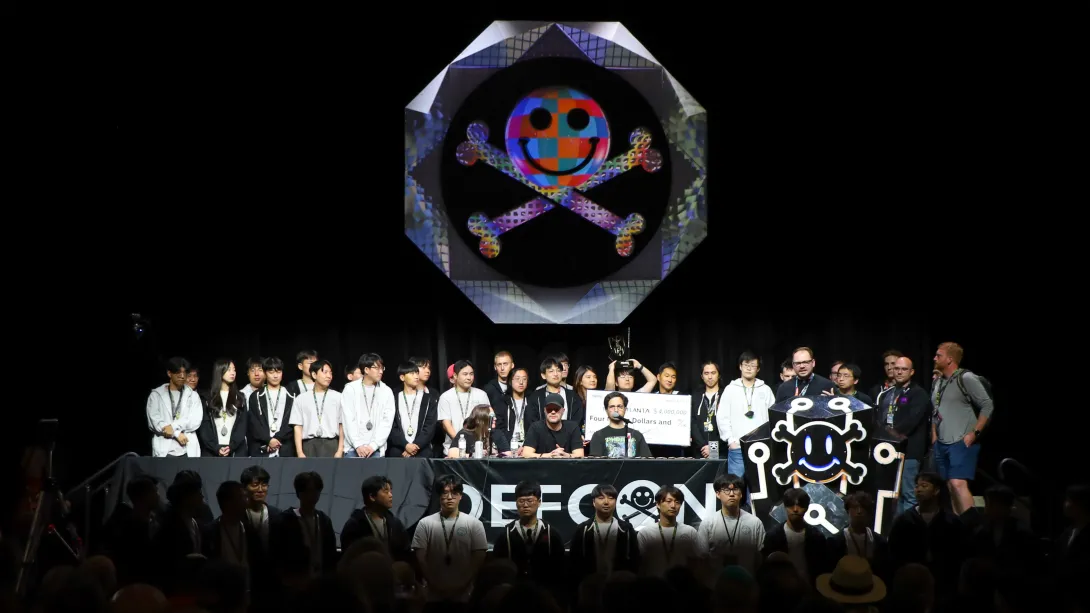
Team Atlanta, a group of Georgia Tech students, faculty, and alumni, achieved international fame on Friday when they won DARPA’s AI Cyber Challenge (AIxCC) and its $4 million grand prize.
AIxCC was a two-year long competition to create an artificial intelligence (AI) enabled cyber reasoning system capable of autonomously finding and patching vulnerabilities.
“This is a once in a generation competition organized by DARPA about how to utilize recent advancements in AI to use in security related tasks,” said Georgia Tech Professor Taesoo Kim.
“As hackers we started this competition as AI skeptics, but now we truly believe in the potential of adopting large language models (LLM) when solving security problems."
The Atlantis system was Team Atlanta’s submission. Atlantis is a fuzzer- or an automated software that finds vulnerabilities or bugs- and enhanced it with several different types of LLMs.
While developing the system, Team Atlanta reported the heat put out by the GPU rack was hot enough to roast marshmallows.
The team was comprised of hackers, engineers, and cybersecurity researchers. The Georgia Tech alumni on the team also represented their employers which include KAIST, POSTECH, and Samsung Research. Kim is also the vice president of Samsung Research.
News Contact
John Popham
Communications Officer II at the School of Cybersecurity and Privacy
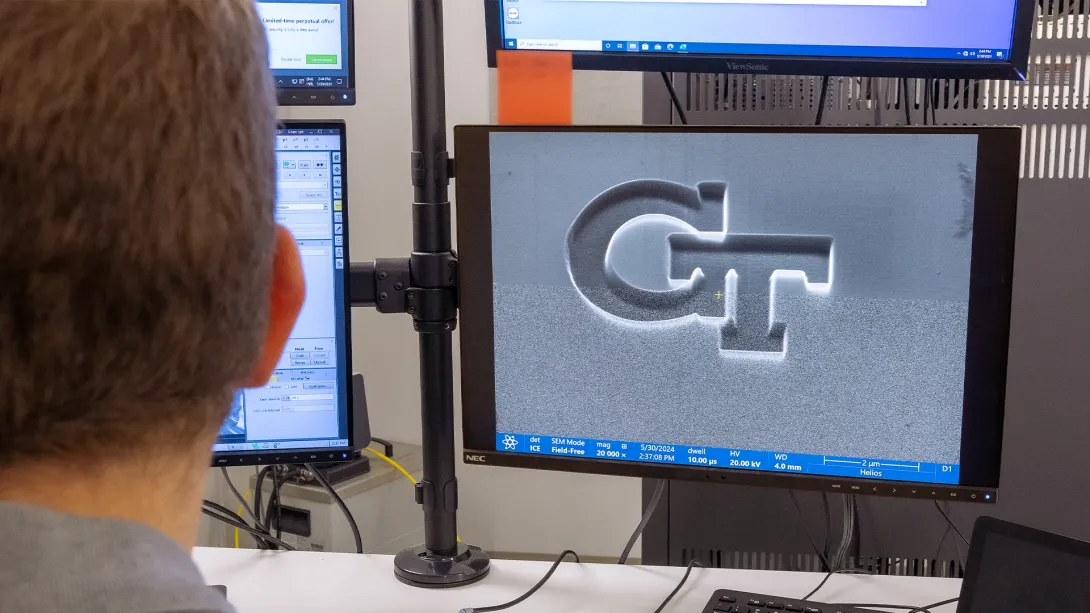
A rare native Atlanta Walter Henderson, Phys 93, associate director for the Materials Characterization Facility and principal research scientist for the Institute for Matter and Systems, jokes that he grew up in “the Stone Age.” But the work that he does managing 12 research leaders who train more than 800 fellow scientists to do over 40,000 hours of work that contributes nearly $400 million in research funding to Georgia Tech each year? That’s positively “Space Age” in nature.
He also notes that they have a surprising amount of fun on the job. For instance, Henderson smiles, consider that time when fast food giant Arby’s asked the team to create the world’s smallest ad by using technology to etch an advertisement onto a sesame seed back in 2018. “We were approached by an ad agency who wanted to earn a Guinness World Record for the smallest sign on the market,” he chuckles. “We used a focused ion beam to do it. It’s a bit like using a laser to inscribe things, except instead of a light beam, it’s this beam of gallium metal ions that you use to etch into samples such as the seed, which also featured the Arby’s logo.”
The ad was then set up at one of their restaurants with an electronic microscope for viewing, given that it was basically about as wide as a human hair, Henderson notes. The agency also made a follow-on internet commercial. “My claim to fame is that I suited up in a bunny suit for them to shoot the video, and some footage in the clean room itself,” he says. “But the actual work was done in our basement-floor Microanalysis lab in the Marcus Nanotechnology Building. In any event, you can still find the ad on YouTube. I just wish I’d had a better agent: I didn’t get any royalties at all, not even, like, a year of free Arby’s.”
It’s not the only time that the facility — a typically serious scientific setting — has been put to equally unique or interesting purposes, though. “For instance, we’ve been asked to analyze pieces of clothing and conduct forensics for crimincal investigations,” notes Henderson. “Given our advanced research equipment, we’ve also been asked to review everything from moon rocks to frogs’ tongues — and practical applications that companies can derive from their scientific properties. On top of it, they’ve also had us test samples and run mechanical property analyses for the Library of Congress and [on] trade secret items for different companies or matters of national security for the government.”
While life inside the lab is fairly routine, Henderson notes, it’s definitely more interesting and varied than some might suspect. “There are certainly moments,” he says. That said, just don’t ask him what happened to the original see, which has since gone AWOL. “I don’t know what happened to it… or if someone at it,” he muses. “But I still have a bottle of sesame seeds in my office, so we could always make a new one.”
by Scott Steinberg, Mgt 99
Read the latest issue of the Georgia Tech Alumni Magazine
News Contact
Amelia Neumeister | Research Communications Program Manager
Institute for Matter and Systems
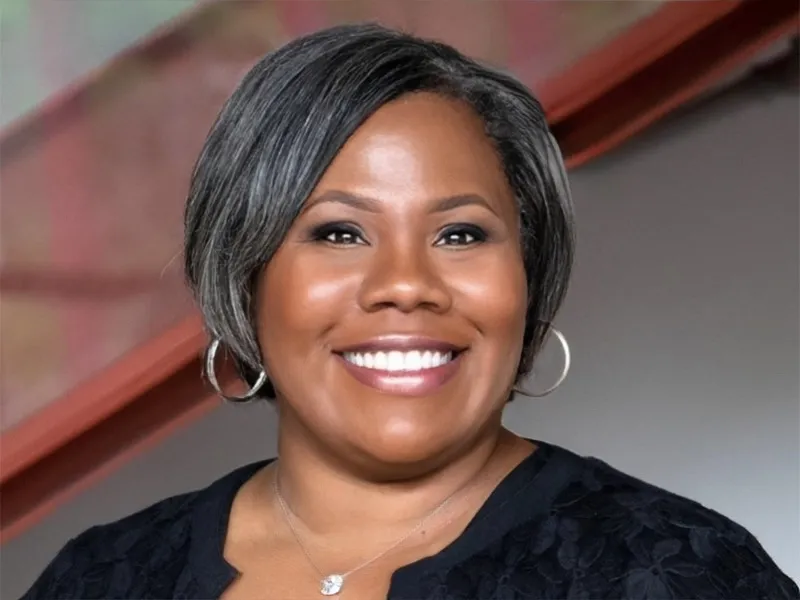
Candace Washington, Jim Pope Fellow

Jim Pope Fellow Candace Washington and mentee Vivianne Akerman
Candace Washington never thought she’d one day run her own business or teach the next generation of project management leaders in construction and engineering. But that’s exactly what she’s doing thanks to Georgia Tech.
In 2012, Washington, a seasoned construction veteran with 25 years of expertise and a master’s degree in building construction from Georgia Tech, noticed a shortage of project managers. She oversaw capital improvements and construction buildouts nationally and was consistently getting asked by clients to oversee the construction buildouts. This would spark the idea to start her business and launch Cancave Management & Engineering.
Over the next decade, Washington built a successful company and yet she continued to see this recurring shortage of project managers. According to Associated Builders and Contractors, the construction sector still grapples with a significant talent shortage that extends beyond the skilled trades to include construction management positions, with a projected need for nearly half a million additional workers in 2025 alone.
“We have fewer people entering the industry. With the pandemic, we had a great exodus where a lot of people decided to get out of the industry and retire early, and then you have the emerging housing market and infrastructure needs, creating demand for construction in general — the perfect storm,” Washington said.
Determined to find more ways to address the problem, she joined Georgia Tech’s School of Building Construction as a part-time instructor and, in 2024, began pursuing her Ph.D. at Tech, where she learned about the Jim Pope Fellowship.
“Being a Pope Fellow has been transformational to my experience as an entrepreneur,” Washington said. “When I started my company, I wish I had something like this. Through this fellowship, I was able to dig deeper into my idea, validate assumptions, and shape it into a solution that addresses the pain points of labor shortages and compliance bottlenecks in the underutilization or over-utilization of resources.”
As a fellow, Washington was also awarded $15,000 in discretionary funds to support her teaching and entrepreneurial efforts. With the resources from Jim Pope, Washington has been able to make meaningful impacts for students and her company.
Over the last year, she has worked on the next evolution of her business by building Extend the Ladder®, a workforce resource and compliance platform built around an industrywide shared resource model for construction professionals. One application of her platform would allow general contractors to share resources by enabling them to find and coordinate talent from a single database.
In addition to helping her pursue a construction job-matching platform, the fellowship has reinforced her love of teaching and mentoring entrepreneurial-minded students. As a part of the fellowship, Washington taught CREATE-X’s Startup Lab, which teaches the fundamentals of evidence-based entrepreneurship.
One student, Vivianne Akerman, a rising junior in industrial engineering, became Washington’s mentee after her spring Startup Lab class. Bitten by the entrepreneurial bug, Akerman decided to continue her entrepreneurial journey in CREATE-X’s Idea-to-Prototype (I2P) course. She turned an idea into action with guidance from Washington, building a solution for a problem she identified during Startup Lab.
“Candace is an amazing mentor who pushes students to be their best selves,” said Akerman, who is developing a makeup platform designed “to make makeup practical and less overwhelming.” The platform will enable consumers to compare and review products and ultimately find what brands work best for them, given their skin type and desired look.
“I love how positive she is,” adds Akerman. “This is new for me — it’s very exciting but also very overwhelming. She helps me stay focused on my priorities and what’s most important.”
Washington emphasizes that there is no guidebook to becoming an entrepreneur; rather, the path must be discovered through conversations, relationship-building, and learning from the experiences of others.
“This experience deepened my appreciation for the spirit of entrepreneurship — it’s been invaluable for me,” she says. “I would tell anybody who's trying to start a business, you need to go through this process.”
Now, as a mentor herself, Washington credits her fellowship in CREATE-X for giving her the confidence and framework to help others. And she credits her path as a mentor and teacher of entrepreneurship to the home she’s found at Georgia Tech.
Drawing from her own experiences, both the challenges and the triumphs, she offers a piece of advice that she believes aspiring entrepreneurs should carry with them.
“Start now — you don’t need all the answers. Focus on the process, stay committed, and be open to real-world feedback.”
Applications are now open for the 2025 Jim Pope Fellowship until Sept. 2. Interested faculty can learn more at https://create-x.gatech.edu/faculty/jim-pope-fellowship.
News Contact
Written by Anne Wainscott-Sargent
Internal Contact
Breanna Durham
Marketing Strategist
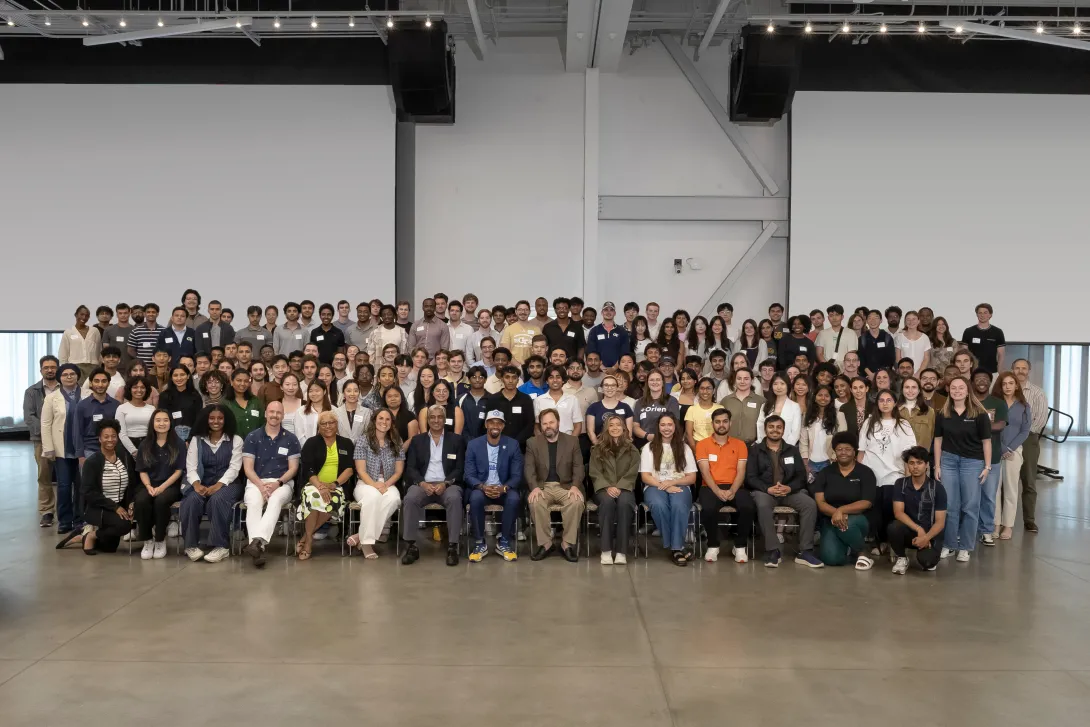
CREATE-X’s 12th cohort of Startup Launch with CREATE-X staff members and Atlanta leadership.
CREATE-X, Georgia Tech’s premier entrepreneurship program, kicked off its 12th Startup Launch cohort this month with a record-breaking 137 student teams and 25 faculty and research teams — totaling 318 founders. The summer-long accelerator, known for turning ideas into real-world ventures, is once again positioning Georgia Tech as a national leader in invention and startup creation.
This year’s cohort spans a wide range of industries, including artificial intelligence, defense, healthcare, gaming, sustainability, media management, agriculture tech, fashion tech, education, and more.
“These founders are in the messy middle and that's a beautiful place to be. There’s a lot of freedom in that,” said Margaret Weniger, director of Startup Launch. “We’re all going to be in this together. It's a safe space to try new things. It’s OK if it doesn't work out because what we want founders to learn is an entrepreneurial mindset and entrepreneurial spirit — something you take with you no matter what you do after this.”
Over the next 12 weeks, teams will validate ideas, build products, and acquire customers with the help of dedicated coaches, a robust founder community, and a network of mentors and alumni.
Raghupathy "Siva" Sivakumar, Georgia Tech’s inaugural vice president of Commercialization and the faculty founder of CREATE-X, spoke about the core of CREATE-X and what it would take for founders to succeed.
“Startup Launch is not about Georgia Tech gaining from your success. We are here just for one reason, which is to make you successful,” he said. “You need to hold yourself accountable. You need to be ambitious in terms of how big a problem you solve. You need to be emphatic that the customer matters. The successful teams are 100% behind what's going to make the lives of customers easier and better.”
In 2014, CREATE-X was co-founded by Sivakumar, Steve McLaughlin(who is now the president of The Cooper Union for the Advancement of Science and Art), and other Georgia Tech faculty, including Ray Vito, Craig Forest, and Ravi Bellamkonda (who is now the executive vice president and provost of The Ohio State University). The program received its initial major philanthropic support from Chris Klaus, a Georgia Tech alumnus and tech entrepreneur, whose gift helped launch the initiative, and , played a key role in building out the program's maker courses. Over the years, CREATE-X has continued to grow, thanks largely to the philanthropic support of alumni and foundations who believe in its mission.
In the last decade, the program has produced over 650 startups, $2.4 billion in portfolio valuation, and had eight founders named to Forbes’ 30 Under 30. Wagner shared stories of past teams who pivoted dramatically — from a glucose-monitoring pillow to a sobriety app now valued at over $350 million, and from a camping gear delivery service to a billion-dollar logistics platform.
“We don’t know which ideas will become the next unicorns,” Weniger said. “But we’re betting on you.”
At the kickoff event, McLaughlin and Klaus were honored for their contributions to Georgia Tech’s entrepreneurial ecosystem. McLaughlin encouraged the founders through the story of CREATE-X.
“From the very beginning, we challenged CREATE-X to be a startup as well. To this day, CREATE-X has raised its own money to do this. It's a reminder of what it takes to make this happen,” he said. “This is the most difficult challenge you have ever taken. I think at the time, we were probably skeptical about whether students could do it. Now we know that you can.”
Georgia Tech President Ángel Cabrera reflected on the impact of McLaughlin, Klaus, and others who saw the vision of Georgia Tech being an entrepreneurial campus.
“Ten years ago, this was a crazy, absurd idea,” he said. “Now, 150 teams are working on their own crazy ideas. Even though sometimes there's this idea of the entrepreneur as a loner, what you learn very quickly is entrepreneurship is a team sport.”
Klaus spoke about people collaborating and helping solve problems together.
“I'm especially inspired by Georgia with its complex history,” he said. “It continues to be a place where peace can be envisioned and pursued. I think this recognition strengthens my commitment to building bridges, resolving conflict, and lifting up voices that seek unity. As you build your businesses, you'll be building collaborations and partnerships, and hopefully make the world a better place.”
As the summer progresses, founders will be guided by CREATE-X’s core values: experiential education, entrepreneurial confidence, and real-world impact. Weniger encouraged teams to “show up uncomfortable” and “leverage every single resource” available.
The journey will culminate at Demo Day, where teams will showcase their startups to investors, industry leaders, and the broader community. The event is free, open to the public, and promises a front-row seat to the next wave of Georgia Tech-born innovation.
Demo Day 2025 will take place on Thursday, Aug. 28, at 5 p.m., in the Exhibition Hall. For more information and to RSVP, visit the CREATE-X Demo Day Eventbrite.
News Contact
Breanna Durham
Marketing Strategist
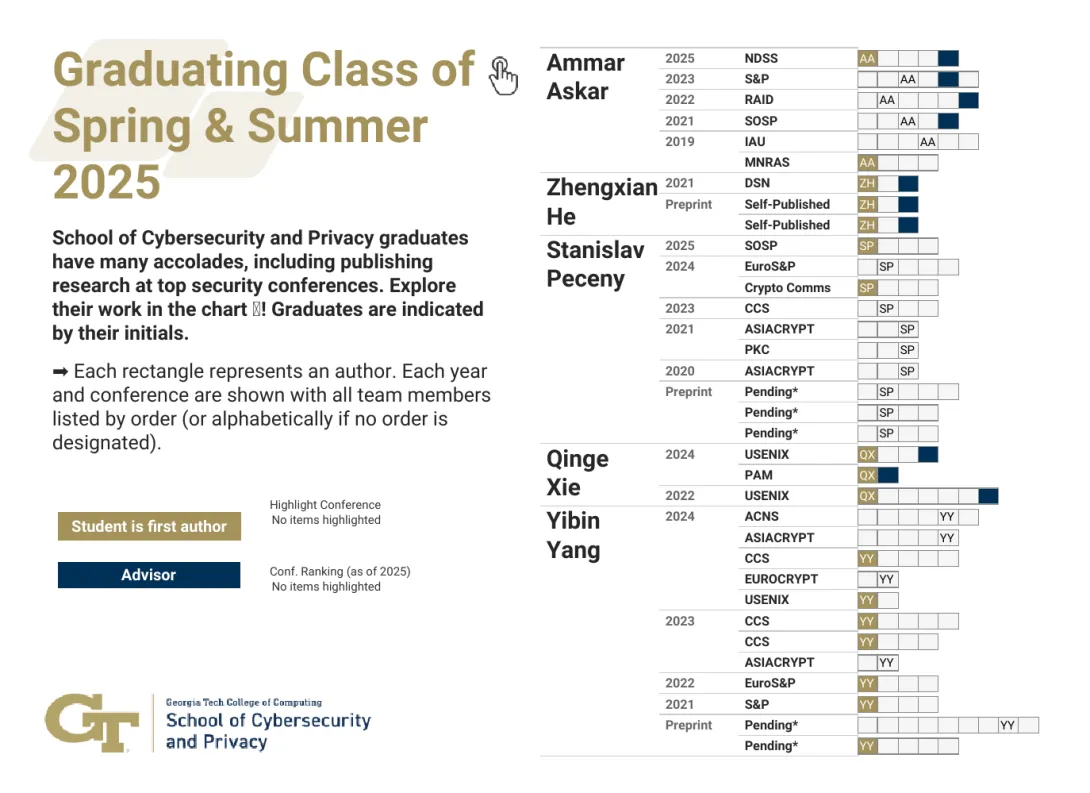
The School of Cybersecurity and Privacy at Georgia Tech is proud to recognize the accomplishments of five doctoral students who finished their doctoral programs in Spring 2025. These scholars have advanced critical research in software security, cryptography, and privacy, collectively publishing 34 papers, most of which appear in top-tier venues.
Ammar Askar developed new tools for software security in multi-language systems, including a concolic execution engine powered by large language models. He highlighted DEFCON 2021, which he attended with the Systems Software and Security Lab (SSLab), as a favorite memory.
Zhengxian He persevered through the pandemic to lead a major project with an industry partner, achieving strong research outcomes. He will be joining Amazon and fondly remembers watching sunsets from the CODA building.
Stanislav Peceny focused on secure multiparty computation (MPC), designing high-performance cryptographic protocols that improve efficiency by up to 1000x. He’s known for his creativity in both research and life, naming avocado trees after famous mathematicians and enjoying research discussions on the CODA rooftop.
Qinge Xie impressed faculty with her adaptability across multiple domains. Her advisor praised her independence and technical range, noting her ability to pivot seamlessly between complex research challenges.
Yibin Yang contributed to the advancement of zero-knowledge proofs and MPC, building toolchains that are faster and more usable than existing systems. His work earned a Distinguished Paper Award at ACM CCS 2023, and he also served as an RSAC Security Scholar. Yang enjoyed teaching and engaging with younger students, especially through events like Math Kangaroo.
Faculty mentors included Regents’ Entrepreneur Mustaque Ahamad, Professors Taesoo Kim and Vladimir Kolesnikov, and Assistant Professor Frank Li, who played vital roles in guiding the graduates’ research journeys.
Learn more about the graduates and their mentors on the 2025 Ph.D. graduate microsite.
News Contact
JP Popham, Communications Officer II
College of Computing | School of Cybersecurity and Privacy
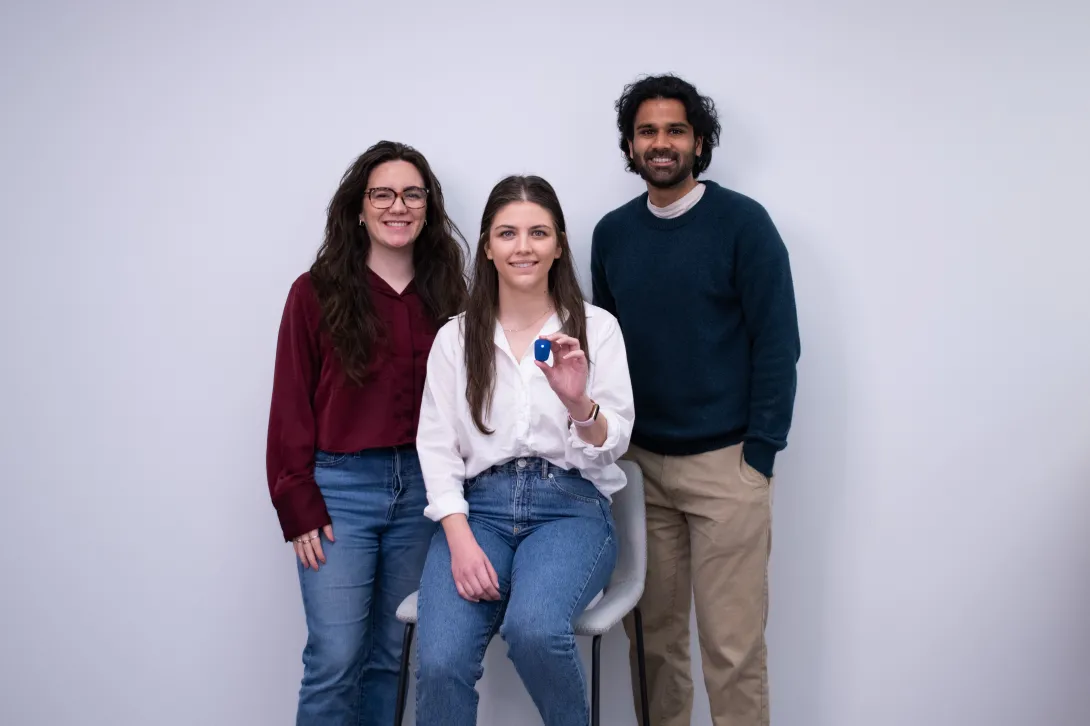
From left to right, Stridelink Founders Cassandra McIltrot , Marzeah “Zea” Khorramabadi, and Neel Narvekar. Khorramabadi is holding one of their sensors, a device like a watch.
According to the National Institutes of Health, nearly one-fourth of the U.S. population over age 45 suffers from foot and ankle issues, which reduce their quality of life, adversely affect walking and other daily functions, and increase the risk of falls.
For orthopedic patients recovering from surgery, walking properly can speed recovery, enabling them to more quickly regain mobility and quality of life. Walking issues or problems with one’s gait can also indicate larger medical problems, from vascular disease to brain, nerve, or spinal cord injuries.
Three alumni from Georgia Tech’s School of Electrical and Computer Engineering and School of Bioengineering hope to help doctors and patients analyze walking patterns through their wearable sensor startup, StrideLink.
“In the same way a cardiologist puts an EKG on you to monitor your heart, we essentially have designed that for walking ability,” says StrideLink founder and CEO Marzeah “Zea” Khorramabadi.
Initially targeting orthopedic practices for their platform, the HIPAA-compliant system wirelessly analyzes patients’ gaits to help doctors remotely monitor their walking ability before and after surgery to better address issues and provide more personalized treatment.
The 26-year-old Georgia Tech graduate of computer engineering founded StrideLink in 2021 with two other Tech students: Cassandra McIltrot, a 2022 biomedical and medical engineering graduate, and Neel Narvekar, who completed his computer engineering studies in 2021.
Since starting StrideLink, the three have raised just under $1 million in pre-seed funding and are now starting their seed funding push.
McIltrot, 24, serves as research director at StrideLink. She says talking to surgeons, physical therapists, and patients was invaluable in building the StrideLink platform, which includes a physical sensor that connects via Bluetooth to a mobile platform. Orthopedic physicians can then access a secure interface to view their patients’ gait data.
“Being able to learn from all those people helped us build something that will bring value,” she says.
Narvekar, the startup’s CTO, calls the technology “a game-changer,” noting, “For the first time, we can widely collect clinically relevant gait data. Starting in orthopedics, this means we can build datasets to predict recovery timelines, identify when patients are off track, and intervene before adverse events occur. Ultimately, this will pave the way for improved care across a range of health conditions."
The enterprising entrepreneurs didn’t do it alone. They leveraged CREATE-X, which supports students in launching successful startups through education, coaching, funding, and other resources.
Below, Khorramabadi and McIltrot share more about their journey as members of the first cohort of CREATE-X’s Female Founders program in Fall 2020. In Summer 2021, the duo completed Startup Launch, a 12-week summer accelerator that helps students launch startups.
Did you two always want to start your own business?
Khorramabadi: It was kind of inevitable for Cassie and me. My dad immigrated from Iran and met my mom here. He started his own business selling cars. So, I grew up with a family that was running a small business. I’ve always had that in me, and it was the expectation that I would go to college. I picked Georgia Tech specifically because they had showcased the CREATE-X program during the tour.
McIltrot: My dad had a construction consulting business, and my mom was a nurse. That’s where the medical influence came from for me. He’s also an engineer. The summer that we decided to pursue this, I was doing research on stroke rehab at Emory.
How did you come up with your big idea?
Khorramabadi: In the middle of the pandemic, there was a lot of emphasis on technology — leaving the clinic and being in a patient's home. How are we going to deliver healthcare effectively when patients aren't directly in front of their doctor?
At the same time, Cassie was doing stroke research, and there was a lot around how heavily walking ability, walking patterns, or your gait is affected. We talked to healthcare professionals, physical therapists, surgeons, everyone. And it was clear that there was a pretty big gap in the market in terms of the technology that would serve these patients who have any symptoms that show up in their walking ability. It wasn’t measured at all. So, we ended up landing on a gait monitor as a solution.
We realized there was a very immediate, straightforward need for our product in orthopedics. If you're getting a knee replacement, ankle, or foot surgery, it's valuable to be able to put this product on a patient preoperatively to better prepare them for surgery. Surgeons can take real measurements of what their patients’ walking ability looks like before surgery and then track them throughout the entirety of their post-op recovery, which can be three months, six months, or even 12 months.
How does the solution work?
Khorramabadi: We designed our platform from the ground up. Our physical sensor connects to a mobile application. That mobile application connects to an entire cloud architecture that has processing servers and database storage. On the physician side, we have an interface for them to view data that fits into their workflow, including receiving insurance reimbursement. The technology component was designed in-house by Neil and me, given our backgrounds in computer engineering.
Are you using AI or advanced analytics in your platform?
Khorramabadi: We have a lot of very advanced data processing methods that are entirely proprietary to our system. We’ve acquired enough data from all of the patients we've seen with Emory, and now we're tracking patients remotely, where we are starting to use real clinical data to train AI to deliver a performance score to these patients. It’s essentially one number that rates how you’re doing related to a healthy or normal gait. We're already using AI right now, and that's something that's going to be released with our product within the next six months.
Where are you in terms of product maturity?
Khorramabadi: We recently started with our first fully remote full-time customer. Before that, we were doing research with another physician at Emory, where they had used it for over a year. At this point, they've tracked over 250 patients, where they put the sensors on at their pre-op appointment and then track them during post-op follow-ups.
They weren’t sent home with the sensors until our sensor was FDA-listed last year, and then we started our first pilot with a private practice in Amelia Island, Florida, last October. That has gone incredibly well, so we just expanded to an orthopedic practice in Alabama, and we should be getting two more practices started in 2025. We've solidified the product fit, and we’re now at the point of scaling it. We also have a research partnership with Children's Hospital Colorado to work on a pediatrics application.
What was most helpful about the CREATE-X programs you participated in at Georgia Tech?
Khorramabadi: Georgia Tech makes exploring doing a startup easy and low-risk for any student. The fact that it was so accessible was monumental early on. In terms of programming, the most valuable part was the emphasis on customer discovery. They did a good job, saying, “You don't know what to build until you talk to enough customers.”
We needed a mentor as part of our first startup class, and we read how James Stubbs, a tenured professor in biomedical engineering, was a previous founder. He’d done a couple of medical device companies that had been acquired. At our first meeting, he told us we need to talk to people. From a business standpoint, it made more sense for us to go to orthopedics rather than physical therapy for a whole host of reasons. But the biggest takeaway of talking to customers was a very consistent experience with both the Startup Launch and the Female Founders program.
McIltrot: The Female Founders program did a fantastic job of that, where we set goals as teams and were encouraged to talk to as many people we think are going to be our customers. We then met as a group and presented what we learned.
So you have to get out of get out of your comfort zone, and not be shy about engaging with people. Cassie, what was the big benefit for you?
McIltrot: We were the first cohort for Female Founders. We checked in every week with our team. Everyone would talk about what they learned that week while talking to people. We were the only medical-focused startup in the program, but being able to share the experience of how we approached people allowed us to learn from each other. We like keeping up with each other on LinkedIn. We learned one of the people in our cohort just closed a funding round.
Is having a community of other women entrepreneurs helpful?
Khorramabadi: Definitely. We’ve gotten a lot out of building a network, especially coming from starting this out of college, where you don't have any industry connections built up yet.
What has been the biggest value from your experience participating in Startup Launch?
Khorramabadi: Networking has been the biggest value for both Startup Launch and Female Founders. Both of those programs emphasized networking and customer discovery. Being involved in both programs at the same time kept us focused on that.
Startup Launch was a good crash course in how you set up your company from a legal aspect, as well as the conversations you need to have with your co-founders, and this is how you pitch and how you raise investment. All these topics are very foreign, and there's not a lot of good information out there on them. So, it was important to have that in the program. It was also nice to connect with Georgia Tech founders who had started companies and seen some success. The program brought them in to talk to us and share what they'd learned. It was nice to have that extra guidance.
What is the biggest benefit of your innovation?
Khorramabadi: The biggest value is knowing how you're doing right now, and also, if you're not doing well, your physician being able to make changes quickly to your plan of care. The platform also lets patients realize what may be contributing to their getting reinjured or having a slower recovery.
What has been the impact of your platform to date?
Khorramabadi: We've already seen the immediate ROI in terms of patients just feeling much better and much more comfortable in their recovery and being able to push themselves a little bit further than they would have otherwise, because they know they have this product that's tracking them, and they know their physician also is tracking them.
On the physician side, there's a lot of incentive for them, because they see this as a tool to stay connected with their patients, which is incredibly valuable for them for delivering the best care or best experience for those patients. Also, this product is now covered by Medicare, CIGNA, and United Healthcare.
McIltrot: One of the things we have heard from patients is they’re using this to instill confidence in their walking ability and their recovery. Because these recovery timelines could be six months to a year to multiple years long, being able to have something that shows how much you've been able to improve is invaluable.
Our future vision is being able to put this on a patient and have a projected recovery laid out. One day, this device could provide recommendations on what went wrong and how to fix it. Being proactive with the care that we deliver to patients is the end goal.
Any advice for Georgia Tech students thinking about taking an innovative idea to market?
Khorramabadi: Go for it. Startups are always a risk, and Georgia Tech provides you with a safety net to take that risk. If you have an idea on how to solve a problem, why wait? Don't hesitate.
If you are looking for a supportive community to help you start your entrepreneurial journey, applications for the Female Founders Program are open until May 19 for Summer 2025. Apply for Female Founders today and over the summer learn entrepreneurship from an all-female coaching team, network with experts and successful entrepreneurs, build your network, and access funding to kick off a startup. Admissions are rolling.
For those interested in seeing the latest startups coming out of CREATE-X, join us for Demo Day 2025! On Aug. 28 at 5 p.m., over 100 startups will fill Exhibition Hall, debuting technologies from clean tech to fashion. Register today for this free event that attracts over 1,500 attendees, from business leaders to enthusiasts, and see how our founders are tackling issues across industries.
News Contact
Written By Anne Wainscott-Sargent
Internal Contact:
Breanna Durham
Marketing Strategist

Forbes 30 Under 30 list featured eight CREATE-X founders. Pictured are Sohan Choudhury of Flint, Garrett Smiley of Sora Schools, Sarah Hamer of RetailReady, and Bruno Geoly of Lumindt.
CREATE-X is celebrating the eight CREATE-X entrepreneurs included on the recent Forbes 30 Under 30 list. They include founders Sohan Choudhury of Flint, Garrett Smiley of Sora Schools, Sarah Hamer of RetailReady, Bruno Geoly and Mia Rath of Lumindt, Rishabh Kewalramani of BackBar, Safir Monroe of UnDelay, and Tamara Zubatiy of Barometer.
Forbes 30 Under 30 is a yearly list of notable young people in art, entertainment, healthcare, science, and more. CREATE-X has had founders on this list 11 times since 2017. Read about how some of the 2025 honorees got their start — and their advice for other aspiring entrepreneurs.
Sohan Choudhury: Flint
The Beginning
“I decided to start Flint because I was passionate about education as a space, and I felt that there's a lot more that could be done with AI in education. When we started the company in May 2023, the perspective of a lot of schools and teachers on AI was very negative because they were looking at how students were using it to cheat. As technologists, my co-founder and I asked, ‘Is there something more we can do to change this narrative and perspective?’ We started building tools for teachers and students and partnering with schools.”
The CREATE-X Experience
“CREATE-X gave me the first avenue to work on my own thing. When I was a first-year or sophomore in college, I didn't know that was possible. I thought once I graduate I'll maybe get an engineering job and just do that. But CREATE-X changed that story for me by giving me another path. As I went down that path with my first company, the advisors we had through CREATE-X were incredibly helpful to us.”
The Outlook
“Day to day, a lot of the work we do is pretty unglamorous. We’re dealing with bugs that our customers are facing, or we’re cold emailing people. It's easy to get lost in the weeds. The Forbes announcement was a great way for us to reflect on what we've done so far. It's such a team effort, so it was validating to get recognition on a broader level for the work we're doing.”
Advice for Success
“If you can code or are interested in coding, pull on that thread. If you can build your own prototypes, which is becoming easy to do nowadays with AI, it will help you get further with your ideas. The second piece of advice is to take your idea and try to convince someone to pay for it. Even if you have a tool that will save your peers time with studying, build something basic for it, but then ask them to pay you five bucks. People speak with their money. There were times at Flint where we had a lot of positive feedback, and then we asked people to pay, and all of the constructive feedback came out.”
Garrett Smiley: Sora Schools
The Beginning
“I was a military brat, so I moved around to a lot of different schools and experienced a bunch of different styles of learning. I went to school in the early 2010s, right when laptops were entering the classroom. We had YouTube, Khan Academy, Coursera, and all these things hit the mainstream. Because of my background, education was a very active question in my life. I saw how these tools completely supercharged my learning and changed the relationship between student and teacher and the dynamics of the classroom.”
The CREATE-X Experience
“CREATE-X asked us to think about large systemic problems we were passionate about. That pushed me to think seriously about how I could help solve a problem in this space. It was helpful to put into practice many of the startup lessons that I'd been studying forever, and it was great to have a community of founders before anyone believed in us.”
The Outlook
“I'm inspired by Forbes’ emphasis on education, so to be recognized in that context was extra special. We’re in 46 states and 16 countries, so it's great to see the breadth that Sora has accomplished. We're bringing this style of education to different communities that, in many cases, have never considered something like this before. Seeing our students accepted into places like Harvard, Georgia Tech, and other elite institutions shows families that you can have a transformative education like Sora and still go to those schools if it makes sense.“
Advice for Success
“Use your free time in school to try the things you're thinking about. Sora was an idea I thought I would circle back to when I was 30 or 40 and had money and credibility. But I was shocked by how open people were to listening to a young person with a few resonating ideas. There's no qualification or age requirement to provide value and improve people's lives.”
Sarah Hamer: RetailReady
The Beginning
“I met my co-founder, Elle, while we were working at a company called Stord, which is also an Atlanta-based startup. Elle and I were put on a project going to a warehouse every week for six months. We saw some gaps in supply chain software and decided to solve them since nothing was on the market. So I applied to Y Combinator and got in, and now we’re here.”
The CREATE-X Experience
“CREATE-X was my first foray into starting a business. It gave me confidence, and I learned a lot of lessons with my first business. I think I would've made a lot of mistakes starting a business now if I hadn't had that experience in college. For example, knowing how important user interviews are, how you’ll probably fail here and there, start small, then scale — the principles you take for granted that CREATE-X taught.”
The Outlook
“I started at Microsoft right out of Georgia Tech and was there for a year and a half. It was a very stable, well-paying job. I followed my gut to leave and join a startup called Stord and then followed it again to leave and start RetailReady. Quitting your stable day-to-day job takes a lot, and I’m proud I took the chance. We’ve grown fast, and it’s a huge honor to be included on the Forbes 30 Under 30 list in the first year of being in business. We’re really happy about it.”
Advice for Success
“When you can, take the chance and do it. Even if you’re not sure, always believe you’ll win. A lot of it is mental fitness, believing what your gut is telling you. There will be times when you’ll say, ‘This probably isn’t the right move to make.’ Listen to that.”
Bruno Geoly: Lumindt
The Beginning
“An inflection point for me was the summer of 2021. I was working at SpaceX, and at the same time, my friends and I had started this Web3 crypto company dealing with NFTs. And I was like, I can mix these two things together to do something cool, something important. The idea of what Lumindt is wasn't even a sparkle in my eye at that time. But I knew I wanted something of my own, doing these two things I enjoy — entrepreneurship and high-level engineering. And that's what I did.”
The CREATE-X Experience
“CREATE X was a way for me and my co-founder to stay accountable for our work. When you have an idea you want to turn into a business, it’s hard to stay on yourself to do that. CREATE-X was a good way for us to always have a thing to go to and ideate what we’re working on. And there was a little bit of competition. You see all of these other people making progress, and it’s good inspiration and a motivator to continue working.”
The Outlook
“My co-founder and I were very appreciative of being included on the Forbes 30 Under 30 list. Looking back on what I wanted to do in college, I just loved building stuff. And to have this small team of people, and we’re able to build what we want, and there's cohesion and camaraderie, I'm very happy with that. It's fun to go to work every day and work with the people I do. And not only that, we now have a business that impacts the world.”
Advice for Success
“If you want to be an entrepreneur, that's a skill set like anything else. If you want to get better at karate, you practice karate. If you want to be a better entrepreneur, you have to practice entrepreneurship. You'll learn a lot about yourself — what problems you like to solve and what problems you need help solving.”
Want to Build Your Own Startup?
Georgia Tech students, faculty, researchers, and alumni interested in developing their own startups are encouraged to apply to CREATE-X's Startup Launch, which provides $5,000 in optional seed funding and $150,000 in in-kind services, mentorship, entrepreneurial workshops, networking events, and resources to help build and scale startups. The program culminates in Demo Day, where teams present their startups to potential investors. The deadline to apply for Startup Launch is Monday, March 17. Spots are limited. Apply now.
News Contact
Article by Alyson Key
CREATE-X Contact:
Breanna Durham
Marketing Strategist

Bradford “Brad” Greer (bottom) and Kevin Ge (top), both 2023 graduates from the George W. Woodruff School of Mechanical Engineering, and founders of CADMUS Health Analytics. Left, Greer loading a stretcher after dropping a patient off.
Bradford “Brad” Greer (bottom) and Kevin Ge (top), both 2023 graduates from the George W. Woodruff School of Mechanical Engineering, have taken their startup, CADMUS Health Analytics, from a classroom project to a promising health tech company. In 2023, CADMUS was accepted into the CREATE-X Startup Launch program. Over the 12-week accelerator, CADMUS made significant strides, and program mentors provided expert guidance, helping the team focus their direction based on real-world needs. Their partnership with Northeast Georgia Health System (NGHS) was a direct result of connections made at Startup Launch’s Demo Day.
How did you first hear about CREATE-X?
We did the CREATE-X Capstone with an initial team of seven people, later transitioning to Startup Launch in the summer. Capstone required a hardware product, but for several reasons, we pivoted to software. By that point, we already had a grasp on the problem that we were working on but didn't have the resources to start working on a large hardware product.
Why did you decide to pursue your startup?
One of our close buddies was an emergency medical technician (EMT), and we also had family connections to EMTs. When we were doing our customer interviews, we found out that Emergency Medical Services (EMS) had multiple problems that we thought we'd like to work on and that were more accessible than the broader medical technology industry.
What was Startup Launch like for you?
Startup Launch seemed to transition pretty seamlessly from the Capstone course. We came to understand our customer base and technical development better, and the program also led us through the process of starting and running a company. I found it very interesting and learned a whole lot.
What was the most difficult challenge in Startup Launch?
Definitely customer interviews. We spent a lot of time on that in the Startup Launch classes. It's a difficult thing to have a good takeaway from a customer interview without getting the conversation confused and being misled. We didn't mention the product, or we tried to wait as long as possible before mentioning the product, so as to not bias or elicit general, positive messaging from interviewees.
We're working in EMS, and the products we are building affect healthcare. EMS is a little informal and a little rough around the edges. Many times, people don't want to admit how bad their practices are, which can easily lead to us collecting bad data.
What affected you the most from Startup Launch?
The resources at our fingertips. When we were running around, it was nice to be able to consult with our mentor. It's great having someone around with the know-how and who's been through it themselves. I revisit concepts a lot.
How did the partnership with NGHS come about?
During Demo Day, we met a Georgia state representative. He put us in touch with NGHS. They were looking for companies to work with through their venture arm, Northeast Georgia Health Ventures(NGHV), so we pitched our product to them. They liked it, and then we spent a long time banging out the details. We worked with John Lanza, who's a friend of CREATE-X. He helped us find a corporate lawyer to read over the stuff we were signing. It took a little back and forth to get everything in place, but in September of last year, we finally kicked it off.
What’s the partnership like?
We provide them a license to our product, have weekly meetings where experts give feedback on the performance of the system, and then we make incremental changes to align the product with customer needs.
While we're in this developmental phase, we're kind of keeping it under wraps until we make sure it’s fully ready. Our focus is primarily on emergent capabilities that NGHS and other EMS agencies are really looking for. Right now, the pilot is set to be a year long, so we're aiming to be ready for a full rollout by the end of the year.
How did you pivot into this other avenue for your product?
EMS does not have many resources. That makes it not a popular space as far as applying emerging technologies. There's only competition in this very one specific vein, which is this central type of software that we plug into, so we're not competing directly with anyone.
EMS agencies, EMTs, and paramedics - the care that they give has to be enabled by a medical doctor. There has to be a doctor linked to the practices that they engage in and the procedures that they do. With the product that we're making now, we want to provide a low-cost, plug-and-play product that'll do everything they need it to do to enable the improvement of patient care.
How are you supporting yourself during this period?
I was paying myself last year, but we're out of money for that, so we're not currently paying for any labor. It's all equity now, but our burn rate outside of that is very low. The revenue we have now easily covers the cost of operating our system. I'm also working part-time as an EMT now. This helps cover my own costs while also deepening my understanding of the problems we are working on.
How are you balancing your work?
It's hard to balance. There's always stuff to do. I just do what I can, and the pace of development is good enough for the pilot. Every week, and then every month, Kevin and I sit down and analyze the rate at which we're working and developing. Then we project out. We're confident that we're developing at a rate that'll have us in a good spot by September when the pilot ends.
What’s a short-term goal for your startup?
Kevin and I are trying to reach back out and see if there's anyone interested in joining and playing a major role. The timing would be such that they start working a little bit after the spring semester ends. I think most Georgia Tech students would meet the role requirements, but generally, JavaScript and Node experience as well as a diverse background would be good.
Where do you want your startup to be in the next five years?
I want to have a very well-designed system. Despite all the vectors I’m talking about for our products, everything should be part of the same system in place at EMS agencies anywhere. I just want it to be a resource that EMS can use broadly.
Another issue in EMS is standards. Even the standards that are in place now aren’t broadly accessible. I think that these new AI tools can do a lot to bridge the lack of understanding of documentation, measures, and standards and make all of that more accessible for the layperson.
What advice would you give students interested in entrepreneurship?
Make sure the idea that you're working on, and the business model, is something you enjoy outside of its immediate viability. I think that's really what's helped me persevere. It's my enjoyment of the project that's allowed me to continue and be motivated. So, start there and then work your way forward.
Are there any books, podcasts, or resources you would recommend to budding entrepreneurs?
I’d recommend Influence to prepare for marketing. I have no background in marketing at all. Influence is a nice science-based primer for marketing.
I reread How to Win Friends and Influence People. I am not sure how well I'm implementing the concepts day-to-day, but I think most of the main points of that book are solid.
I also read The Mom Test. It's a good reference, a short text on customer interviews.
Want to build your own startup?
Georgia Tech students, faculty, researchers, and alumni interested in developing their own startups are encouraged to apply to CREATE-X's Startup Launch, which provides $5,000 in optional seed funding and $150,000 in in-kind services, mentorship, entrepreneurial workshops, networking events, and resources to help build and scale startups. The program culminates in Demo Day, where teams present their startups to potential investors. The deadline to apply for Startup Launch is Monday, March 17. Spots are limited. Apply now.
News Contact
Breanna Durham
Marketing Strategist
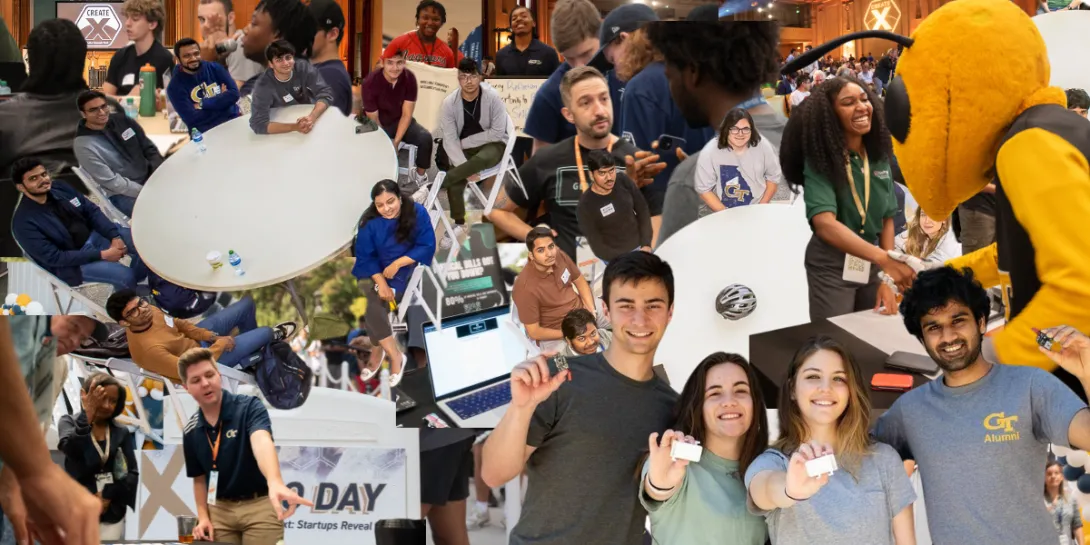
Image of CREATE-X Founders in the Startup Launch program, showing their products, meeting guests of Demo Day, and networking
As CREATE-X enters 2025, the program is more committed than ever to helping students build the future they envision. Through workshops, courses, mentorship, and support, CREATE-X provides a low-risk environment where students can tackle real-world problems and develop solutions.
So far, we have helped launch more than 650 startups by founders from over 38 majors, seen eight founders featured in the Forbes 30 Under 30 Atlanta listing this year, and generated a total portfolio valuation of over $2.4 billion.
Startup Launch, our 12-week summer startup accelerator, continues to be a cornerstone of student entrepreneurship at Georgia Tech, and the program is expanding to accommodate additional teams. Students are encouraged to apply and can even use course projects for their startups. Teams can be in any stage of development and must have at least one Georgia Tech faculty member, alumnus, or current student. Solopreneurs are also accepted. Apply to this summer’s Startup Launch by Monday, March 17.
Benefits of Startup Launch
- Education and Mentorship: Learn from experienced entrepreneurs and business experts.
- Financial Support: Receive $5,000 in optional seed funding and $150,000 of in-kind services like legal counsel and accounting.
- Networking Opportunities: Access a rich entrepreneurial network that will last a lifetime.
- Time in Front of Investors: Participate in Demo Day, Tech’s premier startup showcase, which attracts over 1,500 attendees annually, including investors, business and government leaders, field experts, and potential customers.
- Hands-On Experience: Fully immerse yourself in the startup process and intern for yourself.
- Skill Development: Build skills and confidence that will benefit you in any career path.
Rahul Saxena, director of CREATE-X, encouraged students not to feel like they have to be 100% ready before applying.
“We have seen classroom projects and hackathon teams move on to build very successful startups, even though they weren't originally thinking about it,” he said. “Students should apply for Launch to explore the possibility of it with whatever project they are doing now. You never know what could come of it.”
CREATE-X uses rolling admissions, so apply to Startup Launch today to increase your chances of acceptance. CREATE-X believes in producing quickly, failing fast, and iterating again. The team offers feedback to all applicants and encourages them to submit, even if they’re not entirely sure about their application. A previous info session on Startup Launch and a Startup Launch sample application are available to help students prepare. Attend CREATE-X events to get insights into entrepreneurship, workshop business ideas, find teammates, and prepare your Startup Launch applications. For additional questions, email create-x@groups.gatech.edu.
News Contact
Breanna Durham
Marketing Strategist

Tim Lieuwen, Executive Vice President for Research
Following a nationwide search, Georgia Tech President Ángel Cabrera has named Timothy Lieuwen the Executive Vice President for Research (EVPR). Lieuwen has served as interim EVPR since September 10, 2024.
“Tim’s ability to bridge academia, industry, and government has been instrumental in driving innovation and positioning Georgia Tech as a critical partner in tackling complex global challenges,” said Cabrera. “With his leadership, I am confident Georgia Tech will continue to expand its impact, strengthen its strategic collaborations, and further solidify its reputation as a world leader in research and innovation.”
A proud Georgia Tech alumnus (M.S. ME 1997, Ph.D. ME 1999), Lieuwen has spent more than 25 years at the Institute. He is a Regents’ Professor and holds the David S. Lewis, Jr. Chair in the Daniel Guggenheim School of Aerospace Engineering. Prior to the interim EVPR role, Lieuwen served as executive director of the Strategic Energy Institute for 12 years. His expertise spans energy, propulsion, energy policy, and national security, and he has worked closely with industry and government to develop new knowledge and see its implementation in the field.
Lieuwen has been widely recognized for his contributions to research and innovation. He is a member of the National Academy of Engineering, as well as a fellow of multiple other professional organizations. Recently, he was elected an International Fellow of the U.K.’s Royal Academy of Engineering, one of only three U.S. engineers in 2024 to receive this prestigious commendation. The honor acknowledges Lieuwen’s contributions to engineering and his efforts to advance research, education initiatives, and industry collaborations.
He has authored or edited four books, published over 400 scientific articles, and holds nine patents — several of which are licensed to industry. He also founded TurbineLogic, an analytics firm working in the energy industry. Additionally, Lieuwen serves on governing and advisory boards for three Department of Energy national labs and was appointed by the U.S. Secretary of Energy to the National Petroleum Council.
The EVPR is the Institute’s chief research officer and directs Georgia Tech’s $1.37 billion portfolio of research, development, and sponsored activities. This includes leadership of the Georgia Tech Research Institute, the Enterprise Innovation Institute, nine Interdisciplinary Research Institutes and numerous associated research centers, and related research administrative support units: commercialization, corporate engagement, research development and operations, and research administration.
“I am honored to step into this role at a time when research and innovation have never been more critical,” Lieuwen said. “Georgia Tech’s research enterprise is built on collaboration — across disciplines, across industries, and across communities. Our strength lies not just in the breakthroughs we achieve, but in how we translate them into real-world impact.
“My priority is to put people first — empowering our researchers, students, and partners to push boundaries, scale our efforts, and deepen our engagement across Georgia and beyond. Together, we will expand our reach, accelerate discovery, and ensure that Georgia Tech remains a driving force for progress and service.”
News Contact
Shelley Wunder-Smith | Director of Research Communications
shelley.wunder-smith@research.gatech.edu