
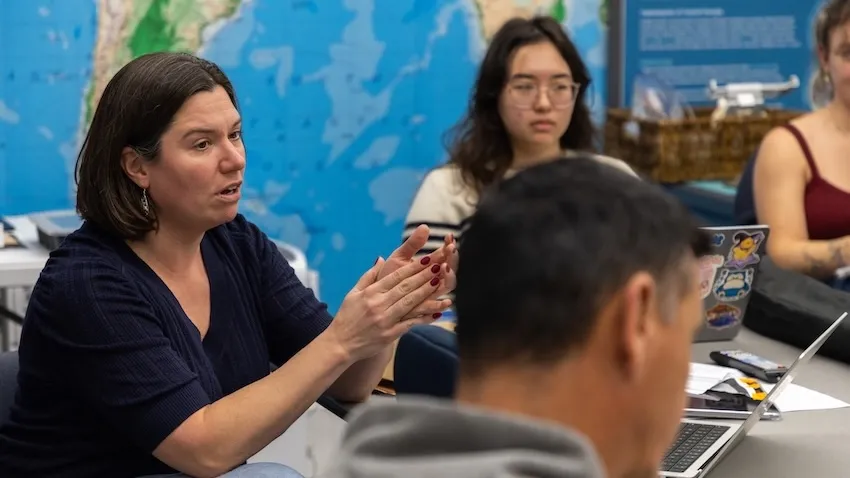
Blind and low vision (BLV) people may soon have access to and more easily understand scientific data in museum exhibits through new “touchable sound” displays.
Associate Professor Jessica Roberts and Ph.D. student Emily Amspoker of Georgia Tech’s School of Interactive Computing are working with the University of Georgia’s Marine Extension and Georgia Sea Grant in Savannah. Together, they’ve developed a prototype display that uses sonification and texture to convey sea floor habitat information from Gray’s Reef National Marine Sanctuary off the coast of Georgia.
Sonification is the process of translating data points into sound.
The display functions as a map that BLV users can follow to learn about each habitat. It is made from a wooden board with laser-cut patterns engraved into the surface. Each pattern represents information about the four types of habitats found in Gray’s Reef. Each pattern has a distinct sound that corresponds to a legend on the board, which provides an audio description of each habitat.
The four habitats are:
- Flat sand — smooth sandy seafloor with little topographic variation that provides habitat for burrowing organisms such as worms, clams, and sand dollars.
- Rippled sand — sandy bottom shaped into small wave-like ridges by currents and wave action; supports microhabitats of small invertebrates and attracts fish feeding on buried prey.
- Sparse live bottom — areas of exposed hard surfaces with scattered attached organisms like sponges, corals, and algae, offering structure and shelter for reef-associated fish and invertebrates.
- Dense live bottom — hard-bottom reef areas with abundant attached marine life, providing high biodiversity and offering food, and breeding sites for numerous species.
By allowing learners to explore these habitats, the team hopes to emphasize the importance of protecting diverse ocean habitats.
“Our job was to figure out how we can use sounds and touch to represent each of the four habitat types so our visitors can explore the ocean without being able to see it,” she said.
Roberts said the project is critical to advance understanding of how science and informal learning can be more inclusive to those who have difficulty processing visual data displays.
“This was particularly exciting to figure out how we could broaden accessibility to data sets because just like so much other scientific data, it’s out there and available, but when it’s presented to the public, it’s usually in visual form,” she said. “There are many open questions about how to do this well within a museum with complex scientific data. We’re moving the needle on that, but there’s a long way to go.”
Right Combination
Amspoker and Roberts created three different versions of the prototype. One was sound-only, one was texture-only, and the other was a combination of sound and texture.
“We expected the multimodal version would work best,” Amspoker said. “We found people used sound and texture in different ways when interacting with it. In cases where people relied on texture, it was still difficult to tell when they crossed the barrier from one texture to another. Sound was very useful in that case.”
Amspoker said computer vision and an app she designed allow the technology to be deployed on any surface, whether a mobile device, a wooden board, or even a classroom floor. A camera set up above the display tracks the user’s hand movements.
“It figures out where you are on the board, and then our code uses the location of your finger to decide what sound should play from the computer,” she said. “What’s nice about our system is it only needs a computer and a webcam, and you can use whatever materials you have on hand for the map.”
Building on a Legacy
Roberts said she is building on the work of a previous NSF-funded collaboration with Dr. Amy Bower, a senior scientist at the Woods Hole Oceanographic Institute in Massachusetts who is blind.
Bower lost her vision in graduate school, but because of her lifelong interest in oceanography, she set out to create ways to learn about ocean data through sound.
In 2021, she launched the Accessible Oceans project through the National Science Foundation’s Advancing Informal STEM Learning program. The interdisciplinary team, including Roberts and collaborators Leslie Smith of Your Ocean Consulting and Jon Bellona of the University of Oregon, created auditory displays of sonified data for museums.
In 2023, the team published an article in Oceanography, the official magazine of the Oeanography Society.
“Informal learning environments are increasingly recognizing the importance of employing multiple modalities to engage all learners and are leveraging sound to enhance visitor experience,” the authors wrote.
“While sonic additions of music, soundscapes, and field recordings add qualitative value, there is a need to explore the potential of sound to facilitate engagement with quantitative information. Data sonification is a promising avenue for increasing accessibility to data within the museum context.”

Artificial intelligence (AI) systems power everything from chatbots to security cameras, yet many of the most advanced models operate as “black boxes.” Companies can use them, but outsiders can’t see how they were built, where they came from, or whether they contain hidden flaws.
This lack of transparency creates real risks. A model could contain security vulnerabilities or hidden backdoors. It could also be a lightly modified version of an open-source system — repackaged in violation of its license — with no easy way to prove it.
Researchers at the Georgia Institute of Technology have developed a new framework, ZEN, to help solve this problem. The tool can recover a model’s unique “fingerprint” directly from its memory, allowing experts to trace its origins and reconstruct how it was assembled.
“Analyzing a proprietary AI model without identifying where it came from and how it is constructed is like trying to fix a car engine with the hood welded shut,” said David Oygenblik, a Ph.D. student at Georgia Tech and the study’s lead author.
“ZEN not only X-rays the engine but also provides the complete wiring diagram.”
ZEN works by taking a snapshot of a running AI system and extracting information about both its mathematical structure and the code that defines it. It compares that fingerprint against a database of known open-source models to determine the system’s origin.
If it finds a match, ZEN identifies the exact changes and generates software patches that allow investigators to recreate a working replica of the proprietary model for testing.
That capability has major implications for both security and intellectual property protection.
“With ZEN, a security analyst can finally test a black-box model for hidden backdoors, and a company can gather concrete evidence to prove its software license was infringed,” Oygenblik said.
To evaluate the system, the research team tested ZEN on 21 state-of-the-art AI models, including Llama 3, YOLOv10, and other well-known systems.
ZEN correctly traced every customized model back to its original open-source foundation — achieving 100% attribution accuracy. Even when models had been heavily modified — differing by more than 83% from their original versions — ZEN successfully identified the changes and enabled full reconstruction for security testing.
The researchers will present their findings at the 2026 Network and Distributed System Security (NDSS) Symposium. The paper, Achieving Zen: Combining Mathematical and Programmatic Deep Learning Model Representations for Attribution and Reuse, was authored by Oygenblik, master’s student Dinko Dermendzhiev, Ph.D. students Filippos Sofias, Mingxuan Yao, Haichuan Xu, and Runze Zhang, post-doctorate scholars Jeman Park, and Amit Kumar Sikder, as well as Associate Professor Brendan Saltaformaggio.
News Contact
John Popham
Communications Officer II School of Cybersecurity and Privacy
Written by: Anne Wainscott-Sargent
As artificial intelligence (AI) drives explosive growth in data centers, communities across the U.S. are facing rising electricity costs, new industrial development, and mounting strain on an aging power grid.
At Georgia Tech, several faculty members are approaching these sustainability challenges from different but complementary angles: examining how data center policy affects local communities, modeling how AI-driven demand reshapes regional energy systems, and building tools that help the public understand the tradeoffs embedded in grid planning. Together, their work highlights how better data, thoughtful policy, and public engagement can guide more resilient and equitable decisions in an AI-powered future.
AI’s Hidden Footprint: How Data Centers Reshape Communities
Ahmed Saeed studies the infrastructure most people never see. An assistant professor in the School of Computer Science and a Brook Byers Institute for Sustainable Systems (BBISS) Faculty Fellow, Saeed focuses on how data centers — the backbone of modern AI — are built, operated, and regulated, and what their growth means for host communities.
“Data centers are the infrastructure for our digital life, so more of them are necessary to keep doing what we’re doing,” he said.
Data center energy consumption could double or triple by 2028, accounting for up to 12% of U.S. electricity use, according to a report by Lawrence Berkeley National Laboratory. U.S. spending on data center construction jumped nearly 70% between May 2023 and May 2024, according to the American Edge Project.
Georgia is an AI data center hub, ranked fourth globally, with $4.6 billion in AI-related venture capital invested across 368 deals, the American Edge Project reported. At a recent town hall in DeKalb County, Georgia, Saeed helped residents connect AI’s promise to its local consequences. Training large AI models can require tens of thousands of graphics processing units (GPUs) running for days or weeks, driving an unprecedented wave of data center construction. AI-focused chips, he noted, can consume 10 to 14 times more power than traditional processors.
That demand often shows up as pressure on local infrastructure. Communities are increasingly concerned about electricity and water use, grid upgrades, and who ultimately pays. In Virginia, Saeed pointed to a legal dispute in which consumer advocates warned that data centers could raise electricity bills by 5% in the short term and up to 50% over time, while utilities argued those investments were inevitable and could benefit customers in the long run.
Environmental concerns add another layer. Saeed cited controversies over water use and backup diesel generators in states, including Georgia and Tennessee, alongside a recent Environmental Protection Agency (EPA) ruling that tightened generator regulations. While diesel generators are clearly harmful, he cautioned that long-term, rigorous evidence linking data centers to regional health impacts remains limited.
Saeed’s research aims to reduce those impacts directly. By optimizing how workloads are scheduled across large server fleets, his team has demonstrated power savings of 4 – 12%, a meaningful gain if U.S. data centers approach projected levels of up to 12% of national electricity use by 2028.
For Saeed, data centers are akin to highways: essential to modern life, disruptive to nearby communities, and shaped by policy choices. The question, he argues, is not whether AI infrastructure should exist, but how transparently and fairly it is built.
Economist Probes the Energy Costs of the AI Boom
While headlines often frame AI as an energy crisis, Georgia Tech environmental and energy economist and BBISS Faculty Fellow Tony Harding is focused on measuring its real — and uneven — impacts. Harding, an assistant professor in the Jimmy and Rosalynn Carter School of Public Policy, uses economic modeling to examine how AI adoption affects energy use, emissions, and local communities.
In recent work published in Environmental Research Letters, Harding and his co-author analyzed how productivity gains from AI could influence national energy demand. Their findings suggest that, at a macro level, AI-related activity may increase annual U.S. energy use by about 0.03% and CO₂ emissions by roughly 0.02%.
“Those numbers are small in the context of the overall economy,” Harding said. “But the impacts are highly uneven.”
That unevenness is evident in where data centers are built. While Northern Virginia remains the country’s top data center hub, with 343 operational data centers, states like Georgia, which currently has 94 operational data centers, are rapidly attracting facilities due to reliable power and favorable tax policies.
Harding’s latest research focuses on local effects, asking why data centers cluster in urban areas, how they influence housing markets, what happens to electricity prices, and whether they exacerbate water stress. Early evidence suggests large facilities can increase local electricity rates, contributing to public backlash and regulatory response. In Georgia, the Public Service Commission has begun requiring new, high power draw customers (like data centers) to cover more of the costs associated with grid expansion.
Harding’s goal is to give policymakers better evidence to design incentives and guardrails. “To manage these technologies responsibly,” he said, “we need a clear picture of their intended and unintended consequences.”
Gamifying a Strained and Aging Power Grid
Daniel Molzahn is tackling another side of the problem: how to modernize an aging power grid under growing demand. Electricity demand is expected to rise about 25% by 2030, driven by data centers, electric vehicles, and broadscale electrification. At the same time, much of the U.S. electricity grid is nearing the end of its lifespan, with many transformers being decades old.
To make these challenges tangible, Molzahn, an associate professor in the School of Electrical and Computer Engineering, developed a browser-based game with a group of students through Georgia Tech’s Vertically Integrated Projects program called Current Crisis. Players take on the role of a utility decision-maker, balancing reliability, wildfire risk, renewable integration, and affordability.
The game grew out of Molzahn’s National Science Foundation CAREER award and reflects his belief that complex systems are best understood experientially. Its initial focus is wildfire resilience, modeling how grid infrastructure can both spark and suffer damage from fires.
But resilience comes at a cost. Burying power lines, for example, reduces wildfire risk but dramatically increases expenses. Players must confront the same tradeoffs utilities face: improve reliability or keep rates low.
Molzahn hopes the game will help students and the public grapple with the realities of planning future power systems. “These choices aren’t abstract,” he said. “They shape affordability, resilience, and our path toward a cleaner grid.”
The project now involves nearly 40 students from across campus, supported by Sustainability NEXT funding and a collaboration with Jessica Roberts, former BBISS Faculty Fellow and director of the Technology-Integrated Learning Environments (TILES) Lab in the School of Interactive Computing.
“As a learning scientist, I look at how to engage people with science and scientific data and get people having conversations they might not otherwise have,” says Roberts, who hopes the seed grant helps the team determine first that they are going in the right direction and, second, how to broaden the impact.
One student, Stella Quinto Lima, a graduate research assistant in Human-Centered Computing, has made the game the focus of her doctoral thesis. Through the game, she wants players to notice their misconceptions about the power grid, energy use, and AI, and to use critical thinking to identify, question, and possibly undo those misconceptions.
“I hope that we can really engage adults and help them see it’s not black and white. The game is not only about power grids, but how AI affects the grid, how it affects our lives, and how it will impact our future.”
The team plans to expand the game’s features, use it in outreach programs, and analyze player decisions as a source of data to study energy-system decision-making.
“We want to change the conversation about power and power grid stability, reliability, and sustainability, Roberts said, “and find a way to get this message to a larger public.”
News Contact
Brent Verrill, Research Communications Program Manager, BBISS

Meta CEO Mark Zuckerberg took the witness stand last week in Los Angeles County Superior Court to defend his company from accusations that social media harms children.
A lawsuit filed by a 20-year-old plaintiff alleges Instagram and other social media apps are designed to make young users addicted to their platforms.
Meanwhile, social media experts believe the algorithms that drive content on these platforms play a role in hooking users and keeping them scrolling for extensive periods of time.
A new study led by Georgia Tech might confirm this suspicion.
Using recently acquired data from more than 10,000 adolescent users, Munmun De Choudhury will audit TikTok’s recommendation algorithm and study its impact on young people’s behavior and mental health.
De Choudhury is leading a multi-institutional research team on a four-year, $1.7 million grant from the Huo Family Foundation.
“We hope to learn the different types of negative exposures that young people experience when using TikTok,” De Choudhury said. “This can help us characterize what they’re watching and build computational methods to understand the consumption behaviors of these participants and how they’re affected by the algorithm.”
De Choudhury, a professor in Georgia Tech’s School of Interactive Computing, is collaborating with Amy Orben, a professor at the University of Cambridge, and Homa Hosseinmardi, an assistant professor at UCLA, on the project.
Social media platforms have become increasingly reluctant to share their data in recent years, posing a challenge for researchers like De Choudhury.
“We can’t do the type of studies we did 10 years ago with X (formerly Twitter) because the API is much more restrictive,” she said. “There are limited ways to programmatically access people’s data now.
“We must go through a tedious, manual process to get around declining access to social media data. This data-gathering process is essential given the sensitive nature of mental health research. You want data that is shared with consent.”
Orben collected TikTok data from more than 10,000 young people in the UK who consented to provide their personal data archives in accordance with the European Union’s General Data Protection Regulation (GDPR).
The collected data includes watch histories, which De Choudhury said distinguishes this research from other social media studies that focus on what users post.
“We don’t understand passive social media consumption very well, so we hope to close that gap and learn what that looks like,” she said. “That could complement or contrast what we know about people’s active engagement on these platforms. Is what they’re consuming directly related to what they’re posting? How does passive consumption affect young people’s mental health?”
A clearer picture of how algorithm-based content affects young people could result in design interventions to minimize negative effects. De Choudhury said studying data from young people is critical because it’s not too late to steer them away from unhealthy behavioral patterns.
“Some of the earliest signs or symptoms of mental health conditions appear in adolescence,” she said. “If appropriate care and support are provided, maybe it’s possible to prevent these symptoms from becoming full-blown in the future.”
Beyond TikTok
What the research team learns about TikTok could also provide broader insight into other social media platforms.
TikTok has been influential in how social media platforms display video content. Competitors like Instagram and X modeled their video presentation after TikTok’s, which can easily lead to doomscrolling.
“Our hope is that our findings can be generalized, with the caveat the data we have is exclusively from TikTok,” De Choudhury said. “Other platforms have similar video-sharing and consumption features where the video automatically plays from one to the next. We hope what we learn from TikTok will be applicable to people’s activities elsewhere, though it will require future work beyond this project to draw concrete conclusions.”
Simulating Feeds with AI
De Choudhury said an additional part of the study will be using artificial intelligence (AI) to simulate video feeds.
In 2024, Hosseinmardi led a study at the University of Pennsylvania on YouTube’s recommendation algorithm and used bots that either followed or ignored the recommendations.
De Choudhury said they will use a similar method for TikTok.
“The feeds will be realistic but generated by AI to see the potential pathways to consumption rabbit holes,” she said. “This should give us some insight into how algorithms influence the negative and positive exposures people might be having on TikTok.”
Foundation Expands Reach
Based in the UK and established in 2009, the Huo Family Foundation supports community education initiatives in the UK, the U.S., and China.
The organization announced in January its launch of the Huo Family Foundation Science Programme. The new program is committing $17.6 million to fund 20 new multi-year research grants that explore the impact of digital technology on the brain development, social behavior, and mental health of young people.
“Digital technology is profoundly shaping childhood and young adulthood, yet there is limited causal evidence of its effects,” said Yan Huo, founder of the Huo Family Foundation, in a press release. “We are proud to support exceptional researchers advancing vital scientific understanding.”
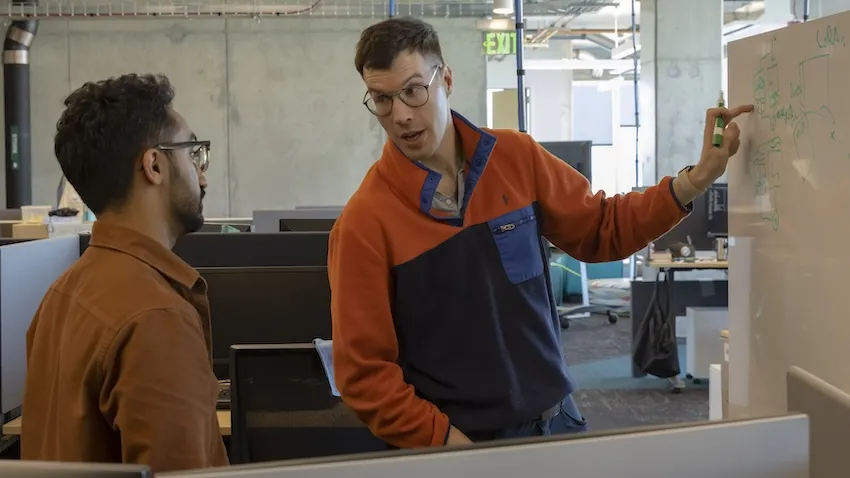
A Georgia Tech Ph.D. candidate is getting a boost to his research into developing more efficient multi-tasking artificial intelligence (AI) models without fine-tuning.
Georgia Stoica is one of 38 Ph.D. students worldwide researching machine learning who were named a 2025 Google Ph.D. Fellow.
Stoica is designing AI training methods that bypass fine-tuning, which is the process of adapting a large pre-trained model to perform new tasks. Fine-tuning is one of the most common ways engineers update large-language models like ChatGPT, Gemini, and Claude to add new capabilities.
If an AI company wants to give a model a new capability, it could create a new model from scratch for that specific purpose. However, if the model already has relevant training and knowledge of the new task, fine-tuning is cheaper.
Stoica argues that fine-tuning still uses large amounts of data, and that other methods can help models learn more effectively and efficiently.
“Full fine-tuning yields strong performance, but it can be costly, and it risks catastrophic forgetting,” Stoica said. “My research asks if we can extend a model’s capabilities by imbuing it with the expertise of others, without fine-tuning?
“Reducing cost and improving efficiency is more important than ever. We have so many publicly available models that have been trained to solve a variety of tasks. It’s redundant to train a new model from scratch. It’s much more efficient to leverage the information that already exists to get a model up to speed.”
Stoica said the solution is a cost-effective method called model merging. This method combines two or more AI models into a single model, improving performance without fine-tuning.
On a basic level, Stoica said an example would be combining a model that is efficient at classifying cats with one that works well at dogs.
“Merging is cheap because you just take the parameters, the weights of your existing models, and combine them,” he said. “You could take the average of the weights to create a new model, but that sometimes doesn’t work. My work has aimed to rearrange the weights so they can communicate easily with each other.”
Through his Google fellowship, Stoica seeks to apply model merging to create a cutting-edge vision encoder. A vision encoder converts image or video data into numerical representations that computers can understand. This enables tasks such as image or facial recognition and generative image captioning.
“I want to be at the frontier of the field, and Google is clearly part of that,” Stoica said. “The vision encoder is very large-scale, and Google has the infrastructure to accommodate it.”
A new robot could solve one of the biggest challenges facing indoor farmers: manual pollination.
Indoor farms, also known as vertical farms, are popular among agricultural researchers and are expanding across the agricultural industry. Some benefits they have over outdoor farms include:
- Year-round production of food crops
- Less water and land requirements
- Not needing pesticides
- Reducing carbon emissions from shipping
- Reducing food waste
Additionally, some studies indicate that indoor farms produce more nutritious food for urban communities.
However, these farms are often inaccessible to birds, bees, and other natural pollinators, leaving the pollination process to humans. The tedious process must be completed by hand for each flower to ensure the indoor crop flourishes.
Ai-Ping Hu, a principal research engineer at the Georgia Tech Research Institute (GTRI), has spent years exploring methods to efficiently pollinate flowering plants and food crops in indoor farms to find a way to efficiently pollinate flower plants and food crops in indoor farms.
Hu, Assistant Professor Shreyas Kousik of the George W. Woodruff School of Mechanical Engineering, and a rotating group of student interns have developed a robot prototype that may be up to the task.
The robot can efficiently pollinate plants that have both male and female reproductive parts. These plants only require pollen to be transferred from one part to the other rather than externally from another flower.
Natural pollinators perform this task outdoors, but Hu said indoor farmers often use a paintbrush or electric tootbrush to ensure these flowers are pollinated.
Knowing the Pose
An early challenge the research team addressed was teaching the robot to identify the “pose” of each flower. Pose refers to a flower’s orientation, shape, and symmetry. Knowing these details ensures precise delivery of the pollen to maximize reproductive success.
“It’s crucial to know exactly which way the flowers are facing,” Hu said.
“You want to approach the flower from the front because that’s where all the biological structures are. Knowing the pose tells you where the stem is. Our device grasps the stem and shakes it to dislodge the pollen.
“Every flower is going to have its own pose, and you need to know what that is within at least 10 degrees.”
Computer Vision Breakthrough
Harsh Muriki is a robotics master’s student at Georgia Tech’s School of Interactive Computing, who used computer vision to solve the pose problem while interning for Hu and GTRI.
Muriki attached a camera to a FarmBot to capture images of strawberry plants from dozens of angles in a small garden in front of Georgia Tech’s Food Processing Technology Building. The FarmBot is an XYZ-axis robot that waters and sprays pesticides on outdoor gardens, though it is not capable of pollination.
“We reconstruct the images of the flower into a 3D model and use a technique that converts the 3D model into multiple 2D images with depth information,” Muriki said. “This enables us to send them to object detectors.”
Muriki said he used a real-time object detection system called YOLO (You Only Look Once) to classify objects. YOLO is known for identifying and classifying objects in a single pass.
Ved Sengupta, a computer engineering major who interned with Muriki, fine-tuned the algorithms that converted 3D images into 2D.
“This was a crucial part of making robot pollination possible,” Sengupta said. “There is a big gap between 3D and 2D image processing.
“There’s not a lot of data on the internet for 3D object detection, but there’s a ton for 2D. We were able to get great results from the converted images, and I think any sector of technology can take advantage of that.”
Sengupta, Muriki, and Hu co-authored a paper about their work that was accepted to the 2025 International Conference on Robotics and Automation (ICRA) in Atlanta.
Measuring Success
The pollination robot, built in Kousik’s Safe Robotics Lab, is now in the prototype phase.
Hu said the robot can do more than pollinate. It can also analyze each flower to determine how well it was pollinated and whether the chances for reproduction are high.
“It has an additional capability of microscopic inspection,” Hu said. “It’s the first device we know of that provides visual feedback on how well a flower was pollinated.”
For more information about the robot, visit the Safe Robotics Lab project page.
News Contact
Nathan Deen
College of Computing
Georgia Tech
The future of clean energy depends on algorithms as much as it does atoms.
Georgia Tech’s Qi Tang is building machine learning (ML) models to accelerate nuclear fusion research, making it more affordable and more accurate. Backed by a grant from the U.S. Department of Energy (DOE), Tang’s work brings clean, sustainable energy closer to reality.
Tang has received an Early Career Research Program (ECRP) award from the DOE Office of Science. The grant supports Tang with $875,000 disbursed over five years to craft ML and data processing tools that help scientists analyze massive datasets from nuclear experiments and simulations.
Tang is the first faculty member from Georgia Tech’s College of Computing and School of Computational Science and Engineering (CSE) to receive the ECRP. He is the seventh Georgia Tech researcher to earn the award and the only GT awardee among this year’s 99 recipients.
More than a milestone, the award reflects a shift in how nuclear research is done. Today, progress depends on computing and data science as much as on physics and engineering.
“I am honored and excited to receive the ECRP award through DOE’s Advanced Scientific Computing Research program, an organization I care about deeply,” said Tang, an assistant professor in the School of CSE.
“I am grateful to my former colleagues at Los Alamos National Laboratory and collaborators at other national laboratories, including Lawrence Livermore, Sandia, and Argonne. I am also thankful for my Ph.D. students at Georgia Tech, whose dedication and creativity make this award possible.”
A problem in nuclear research is that fusion simulations are challenging to understand and use. These simulations generate enormous datasets that are too large to store, move, and analyze efficiently.
In his ECRP proposal to DOE, Tang introduced new ML methods to improve the analysis and storage of particle data.
Tang’s approach balances shrinking data so it is easier to store and transfer while preserving the most important scientific features. His multiscale ML models are informed by physics, so the reduced data still reflects how fusion systems really behave.
With Tang’s research, scientists can run larger, more realistic fusion models and analyze results more quickly. This accelerates progress toward practical fusion energy.
“In contrast to generic black-box-type compression tools, we aim at preserving the intrinsic structures of the particle dataset during the data reduction processes,” Tang said.
“Taking this approach, we can meet our goal of achieving high-fidelity preservation of critical physics with minimum loss of information.”
Computing is essential in modern research because of the amount of data produced and captured from experiments and simulations. In the era of exascale supercomputers, data movement is a greater bottleneck than actual computation.
DOE operates three of the world’s four exascale supercomputers. These machines can calculate one quintillion (a billion billion) operations per second.
The exascale era began in 2022 with the launch of Frontier at Oak Ridge National Laboratory. Aurora followed in 2023 at Argonne National Laboratory. El Capitan arrived in 2024 at Lawrence Livermore National Laboratory.
With Tang’s data reduction approaches, all of DOE’s supercomputers spend more time on science and less time waiting for data transfers.
“Qi’s work in computational plasma physics and nuclear fusion modeling has been groundbreaking,” said Haesun Park, Regents’ Professor and Chair of the School of CSE.
“We are proud of Qi and what this award means for him, Georgia Tech, and the Department of Energy toward leveraging computation to solve challenges in science and engineering, such as sustainable energy."
Previous Georgia Tech recipients of DOE Early Career Research Program awards include:
Itamar Kimchi, assistant professor, School of Physics
Sourabh Saha, assistant professor, George W. Woodruff School of Mechanical Engineering
Wenjing Lao, associate professor, School of Mathematics
Ryan Lively, Thomas C. DeLoach Professor, School of Chemical & Biomolecular Engineering
Josh Kacher, associate professor, School of Materials Science and Engineering
Devesh Ranjan, Eugene C. Gwaltney Jr. School Chair and professor, Woodruff School of Mechanical Engineering
News Contact
Bryant Wine, Communications Officer
bryant.wine@cc.gatech.edu
While not as highlight-reel worthy as the Winter Olympics and the World Cup, experts expect high-performance computing (HPC) to have an even bigger impact on daily life in 2026.
Georgia Tech researchers say HPC and artificial intelligence (AI) advances this year are poised to improve how people power their homes, design safer buildings, and travel through cities.
According to Qi Tang, scientists will take progressive steps toward cleaner, sustainable energy through nuclear fusion in 2026.
“I am very hopeful about the role of advanced computing and AI in making fusion a clean energy source,” said Tang, an assistant professor in the School of Computational Science and Engineering (CSE).
“Fusion systems involve many interconnected processes happening across different scales. Modern simulations, combined with data-driven methods, allow us to bring these pieces together into a unified picture.”
Tang’s research connects HPC and machine learning with fusion energy and plasma physics. This year, Tang is continuing work on large-scale nuclear fusion models.
Only a few experimental fusion reactors exist worldwide compared to more than 400 nuclear fission reactors. Tang’s work supports a broader effort to turn fusion from a promising idea into a practical energy source.
Nuclear fusion occurs in plasma, the fourth state of matter, where gas is heated to millions of degrees. In this extreme state, electrons are stripped from atoms, creating a hot soup of fast-moving ions and free electrons. In plasma, hydrogen atoms overcome their natural electrical repulsion, collide, and fuse together. This releases energy that can power cities and homes.
Computers interpret extreme temperatures, densities, pressures, and plasma particle motion as massive datasets. Tang works to assimilate these data types from computer models and real-world experiments.
To do this, he and other researchers rely on machine learning approaches to analyze data across models and experiments more quickly and to produce more accurate predictions. Over time, this will allow scientists to test and improve fusion reactor designs toward commercial use.
Beyond energy and nuclear engineering, Umar Khayaz sees broader impacts for HPC in 2026.
“HPC is the need of the day in every field of engineering sciences, physics, biology, and economics,” said Khayaz, a CSE Ph.D. student in the School of Civil and Environmental Engineering.
“HPC is important enough to say that we need to employ resources to also solve social problems.”
Khayaz studies dynamic fracture and phase-field modeling. These areas explore how materials break under sudden, rapid loads.
Like nuclear fusion, Khayaz says dynamic fracture problems are complex and data-intensive. In 2026, he expects to see more computing resources and computational capabilities devoted to understanding these problems and other emerging civil engineering challenges.
CSE Ph.D. student Yiqiao (Ahren) Jin sees a similar relationship between infrastructure and self-driving vehicles. He believes AI will innovate this area in 2026.
At Georgia Tech, Jin develops efficient multimodal AI systems. An autonomous vehicle is a multimodal system that uses camera video, laser sensors, language instructions, and other inputs to navigate city streets under changing scenarios like traffic and weather patterns.
Jin says multimodal research will move beyond performance benchmarks this year. This shift will lead to computer systems that can reason despite uncertainty and explain their decisions. In result, engineers will redefine how they evaluate and deploy autonomous systems in safety-critical settings.
“Many foundational problems in perception, multimodal reasoning, and agent coordination are being actively addressed in 2026. These advances enable a transition from isolated autonomous systems to safer, coordinated autonomous vehicle fleets,” Jin said.
“As these systems scale, they have the potential to fundamentally improve transportation safety and efficiency.”
News Contact
Bryant Wine, Communications Officer
bryant.wine@cc.gatech.edu

A newly discovered vulnerability could allow cybercriminals to silently hijack the artificial intelligence (AI) systems in self-driving cars, raising concerns about the security of autonomous systems increasingly used on public roads.
Georgia Tech cybersecurity researchers discovered the vulnerability, dubbed VillainNet, and found it can remain dormant in a self-driving vehicle’s AI system until triggered by specific conditions.
Once triggered, VillainNet is almost certain to succeed, giving attackers control of the targeted vehicle.
The research finds that attackers could program almost any action within a self-driving vehicle’s AI super network to trigger VillainNet. In one possible scenario, it could be triggered when a self-driving taxi’s AI responds to rainfall and changing road conditions.
Once in control, hackers could hold the passengers hostage and threaten to crash the taxi.
The researchers discovered this new backdoor attack threat in the AI super networks that power autonomous driving systems.
“Super networks are designed to be the Swiss Army knife of AI, swapping out tools, or in this case sub networks, as needed for the task at hand," said David Oygenblik, Ph.D. student at Georgia Tech and the lead researcher on the project.
"However, we found that an adversary can exploit this by attacking just one of those tiny tools. The attack remains completely dormant until that specific subnetwork is used, effectively hiding across billions of other benign configurations."
This backdoor attack is nearly guaranteed to work, according to Oygenblik. This blind spot is nearly undetectable with current tools and can impact any autonomous vehicle that runs on AI. It can also be hidden at any stage of development and include billions of scenarios.
“With VillainNet, the attacker forces defenders to find a single needle in a haystack that can be as large as 10 quintillion straws," said Oygenblik.
"Our work is a call to action for the security community. As AI systems become more complex and adaptive, we must develop new defenses capable of addressing these novel, hyper-targeted threats."
The hypothetical fix to the problem was to add security measures to the super networks. These networks contain billions of specialized subnetworks that can be activated on the fly, but Oygenblik wanted to see what would happen if he attacked a single subnetwork tool.
In experiments, the VillainNet attack proved highly effective. It achieved a 99% success rate when activated while remaining invisible throughout the AI system.
The research also shows that detecting a VillainNet backdoor would require 66x more computing power and time to verify the AI system is safe. This challenge dramatically expands the search space for attack detection and is not feasible, according to the researchers.
The project was presented at the ACM Conference on Computer and Communications Security (CCS) in October 2025. The paper, VillainNet: Targeted Poisoning Attacks Against SuperNets Along the Accuracy-Latency Pareto Frontier, was co-authored by Oygenblik, master's students Abhinav Vemulapalli and Animesh Agrawal, Ph.D. student Debopam Sanyal, Associate Professor Alexey Tumanov, and Associate Professor Brendan Saltaformaggio.
News Contact
John Popham
Communications Officer II
School of Cybersecurity and Privacy
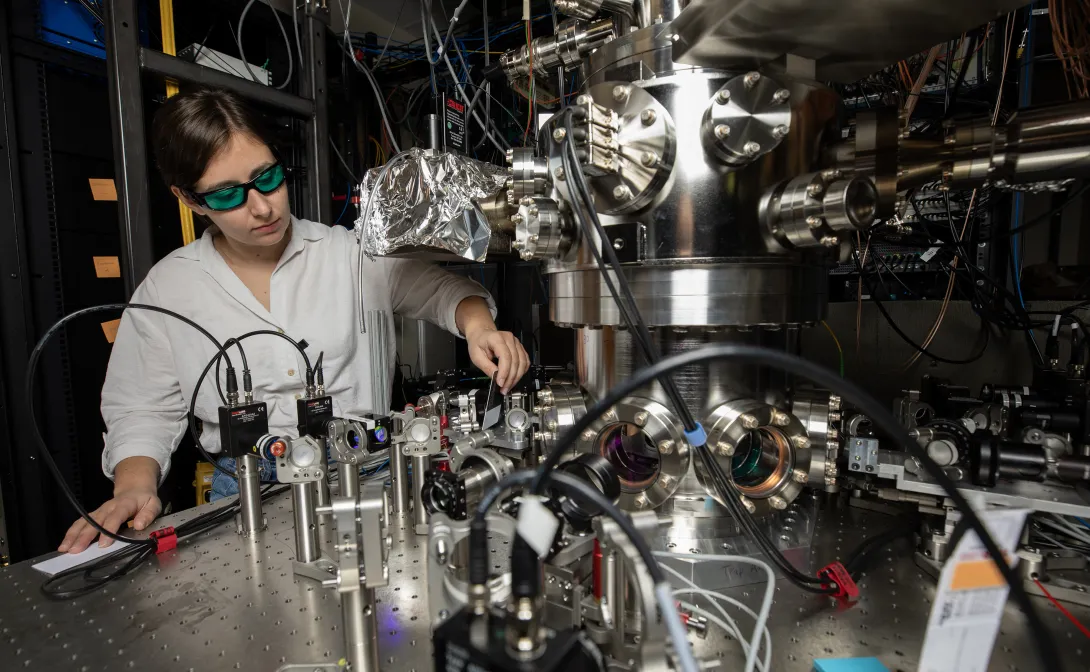
GTRI Research Scientist Darian Hartsell makes adjustments to an improved cryogenic vacuum chamber that helps reduce some common noise sources by isolating ions from vibrations and shielding them from magnetic field fluctuations. (Credit: Sean McNeil, GTRI)
Even very slight environmental noise, such as microscopic vibrations or magnetic field fluctuations a hundred times smaller than the Earth’s magnetic field, can be catastrophic for quantum computing experiments with trapped ions.
To address that challenge, researchers at the Georgia Tech Research Institute (GTRI) have developed an improved cryogenic vacuum chamber that helps reduce some common noise sources by isolating ions from vibrations and shielding them from magnetic field fluctuations. The new chamber also incorporates an improved imaging system and a radio frequency (RF) coil that can be used to drive ion transitions from within the chamber.
“There’s a lot of excitement around quantum computing today, and trapped ions are just one of the research platforms available, each with their own benefits and drawbacks,” explained Darian Hartsell, a GTRI research scientist who leads the project. “We are trying to mitigate multiple sources of noise in this chamber and make other improvements with one robust new design.”
The chamber design is described in a paper published January 20, 2026 in the journal Applied Physics Letters. Some of the technical improvements developed for the project are already being applied at GTRI and collaborating organizations. This work was done in collaboration with Los Alamos National Laboratory.
The goal of the vibration isolation is to reduce the laser amplitude and phase noise when addressing the ions, increasing operation fidelity. The goal of the magnetic field noise reduction is to preserve the coherence of qubits for longer periods of time so researchers can use them for more complex algorithms.
See the complete article on the GTRI news site