
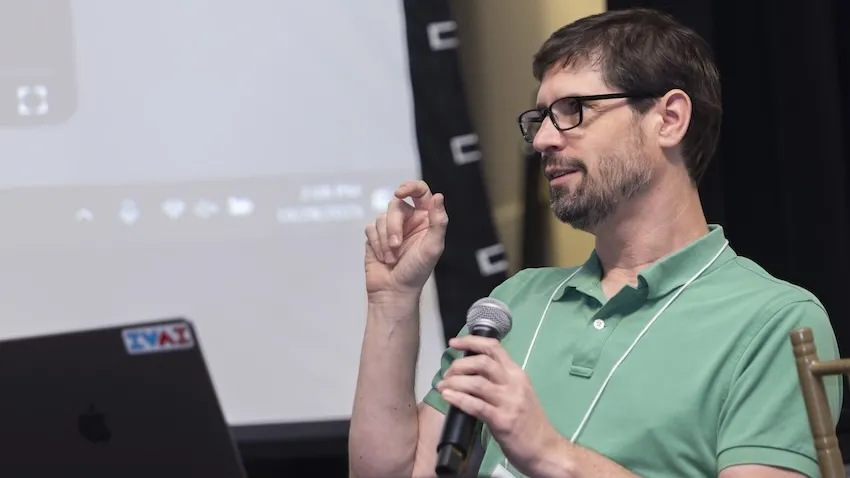
One of the top conferences for AI and computer games is recognizing a School of Interactive Computing professor with its first-ever test-of-time award.
At its event this week in Alberta, Canada, the AAAI Conference on Artificial Intelligence and Interactive Digital Entertainment (AIIDE) is honoring Professor Mark Riedl. The award also honors University of Utah Professor and Division of Games Chair Michael Young, Riedl’s Ph.D. advisor.
Riedl studied under Young at North Carolina State University.
Their 2005 paper, From Linear Story Generation to Branching Story Graphs, highlighted the challenges of using AI to create interactive gaming narratives in which user actions influence the story’s progression.
In 2005, computer game systems that supported linear, non-branching games were widely used. Riedl introduced an innovative mathematical formula for interactive stories ranging from choose-your-own-adventure novels to modern computer games.
“We didn’t use the term ‘generative AI’ back then, but I was working on AI for the generation of creative artifacts,” Riedl said. “This was before we had practical deep learning or large language models.
“One of the reasons this paper is still relevant 20 years later is that it didn’t just present a technology, it attempted to provide a framework for solving a grand challenge in AI.”
That challenge is still ongoing, Riedl said. Game designers continue to struggle with balancing story coherence against the amount of narrative control afforded to users.
“When users exercise a high degree of control within the environment, it is likely that their actions will change the state of the world in ways that may interfere with the causal dependencies between actions as intended within a storyline,” Riedl and Young wrote in the paper.
“Narrative mediation makes linear narratives interactive. The question is: Is the expressive power of narrative mediation at least as powerful as the story graph representation?”
AIIDE is being held this week at the University of Alberta in Edmonton, Alberta. Riedl will receive the award on Wednesday.
A new deep learning architectural framework could boost the development and deployment efficiency of autonomous vehicles and humanoid robots. The framework will lower training costs and reduce the amount of real-world data needed for training.
World foundation models (WFMs) enable physical AI systems to learn and operate within synthetic worlds created by generative artificial intelligence (genAI). For example, these models use predictive capabilities to generate up to 30 seconds of video that accurately reflects the real world.
The new framework, developed by a Georgia Tech researcher, enhances the processing speed of the neural networks that simulate these real-world environments from text, images, or video inputs.
The neural networks that make up the architectures of large language models like ChatGPT and visual models like Sora process contextual information using the “attention mechanism.”
Attention refers to a model’s ability to focus on the most relevant parts of input.
The Neighborhood Attention Extension (NATTEN) allows models that require GPUs or high-performance computing systems to process information and generate outputs more efficiently.
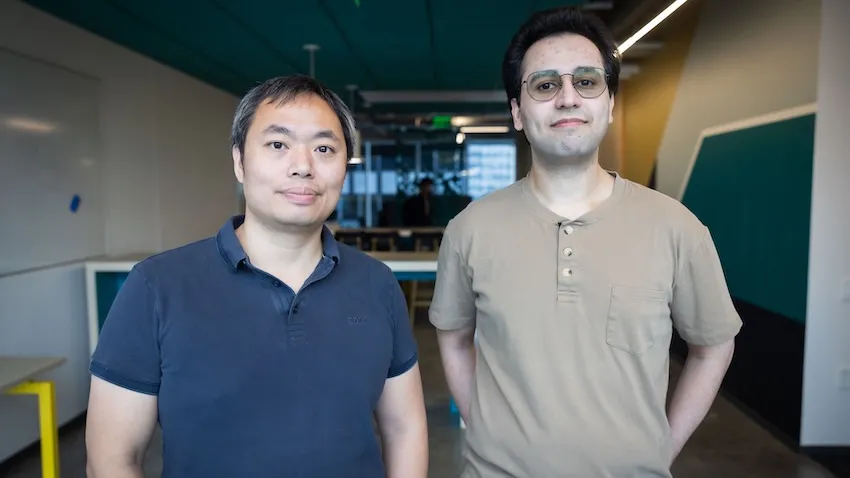
Processing speeds can increase by up to 2.6 times, said Ali Hassani, a Ph.D. student in the School of Interactive Computing and the creator of NATTEN. Hassani is advised by Associate Professor Humphrey Shi.
Hassani is also a research scientist at Nvidia, where he introduced NATTEN to Cosmos — a family of WFMs the company uses to train robots, autonomous vehicles, and other physical AI applications.
“You can map just about anything from a prompt or an image or any combination of frames from an existing video to predict future videos,” Hassani said. “Instead of generating words with an LLM, you’re generating a world.
“Unlike LLMs that generate a single token at a time, these models are compute-heavy. They generate many images — often hundreds of frames at a time — so the models put a lot of work on the GPU. NATTEN lets us decrease some of that work and proportionately accelerate the model.”
Scientists across Georgia Tech rely on powerful software tools to propel breakthroughs in fields ranging from physics to biology. Now, software experts who make that research possible are gaining a new leader.
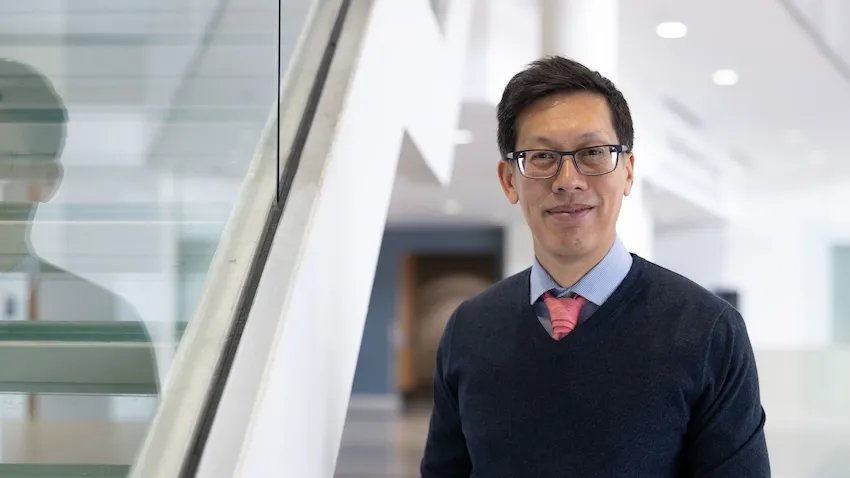
The College of Computing named Professor Rich Vuduc as director of the Center for Scientific Software Engineering (CSSE). The Georgia Tech hub is dedicated to building reliable, high-performance software for scientists.
Under Vuduc’s leadership, CSSE strives to accelerate the pace and increase the quality of scientific discovery by developing custom software tools and best practices tailored to researchers’ needs.
“There is a reproducibility and reliability problem right now with scientific software,” Vuduc said. “The promise of CSSE is to leverage capabilities shared between Georgia Tech, Schmidt Sciences, and industry experts to address this problem.”
Issues arise because scientists often need to develop their own software for experiments or data analysis. However, troubleshooting coding issues and other bugs can slow down research.
To assist these scientists, CSSE receives their input to create custom software tools and best practices. The center employs professional software engineers who build and deliver products tailor-made to the needs of researchers at Georgia Tech and broader scientific communities.
Beyond its research focus, CSSE helps Georgia Tech fulfill its educational mission. The center provides students with direct access and exposure to real-world software engineering.
As the center enters its third year, Vuduc wants to better prepare students for employment by enhancing their hands-on experience while learning from CSSE engineers.
To achieve this goal, Vuduc is working to establish a Ph.D. fellowship program in which CSSE engineers mentor students. This program would connect academic inquiry with industry expertise, creating the next generation of dynamic leaders in computational science.
Vuduc also envisions pairing CSSE with Georgia Tech’s Vertically Integrated Projects (VIP) program. This approach would allow undergraduate students to earn class credit while working with CSSE engineers on large software engineering projects spanning multiple semesters.
“The center gives our students access to something that is very unique to find in a university environment,” Vuduc said.
“The software engineers in CSSE mostly come from industry. They have over 65 years of combined experience doing real-world software engineering that students can learn from.”
Vuduc is a 2010 recipient of the Gordon Bell Prize and a leading expert in high-performance computing (HPC). He was a finalist for the award in 2020 and 2022.
The Gordon Bell Prize, often referred to as the Nobel Prize in supercomputing due to the scope and magnitude of research it recognizes, celebrates achievement in HPC research and application.
Vuduc joined Georgia Tech in 2007 as one of the first faculty hired for the new Division of Computational Science and Engineering (CSE). Not a stranger of leading new units, he saw CSE begin offering M.S. and Ph.D. degrees in 2008 and attain school status in 2010.
Since 2021, Vuduc has served as co-director of the Center for Research into Novel Computing Hierarchies (CRNCH).
CRNCH is an interdisciplinary research center at Georgia Tech that explores technologies and approaches that will usher the next generation of computing. Areas CRNCH studies include quantum computing, brain-inspired computing, and approximate computing.
Vuduc will step down as CRNCH co-director to fulfill his role as CSSE director. The College of Computing will lead a search for CRNCH’s next co-director.
“In a sense, the CRNCH to CSSE transition was partly a natural one because one thing that contributes to software challenges is that hardware platforms are also changing and evolving very rapidly,” said Vuduc.
“People are exploring radically new hardware systems and we will have to write software configured for those too. Centers, like CRNCH and CSSE, strongly position Georgia Tech to lead these endeavors.”
Alessandro (Alex) Orso, the previous CSSE director, departed Georgia Tech earlier this year to become dean of the University of Georgia’s College of Engineering. Orso and Distinguished Professor Irfan Essa wrote the proposal to bring CSSE to Georgia Tech.
Georgia Tech formed CSSE in 2022 after securing an $11 million grant from Schmidt Sciences. Former Google CEO Eric Schmidt and his spouse, Wendy Schmidt, founded the philanthropic venture that funds science and technology research and talent networking programs.
Georgia Tech’s CSSE is part of Schmidt Sciences’ Virtual Institute for Scientific Software (VISS) program. This network helps scientists obtain more robust, flexible, scalable open-source software.
Schmidt Sciences is investing $40 million in VISS over five years at four universities: Georgia Tech, University of Washington, Johns Hopkins University, and University of Cambridge.
CSSE uses the funding to employ a software engineering lead, three senior and two junior software engineers. The Schmidt Sciences grant equips these engineers with computing resources to build scientific software. Along with the director, an advisory board guides the group’s work to meet the point of need for scientists in the field.
“I am grateful to Schmidt Sciences for their support of CSSE. It aligns with our college’s strategic goals and expertise in scientific software, and I am delighted that Rich has agreed to take on this important role,” said Vivek Sarkar, Dean and John P. Imlay Jr. Chair of Computing.
“I know that Rich is committed to growing CSSE's internal and external visibility and long-term sustainability. I am confident that he will also help further socialize CSSE among internal stakeholders across Georgia Tech.”
News Contact
Bryant Wine, Communications Officer
bryant.wine@cc.gatech.edu
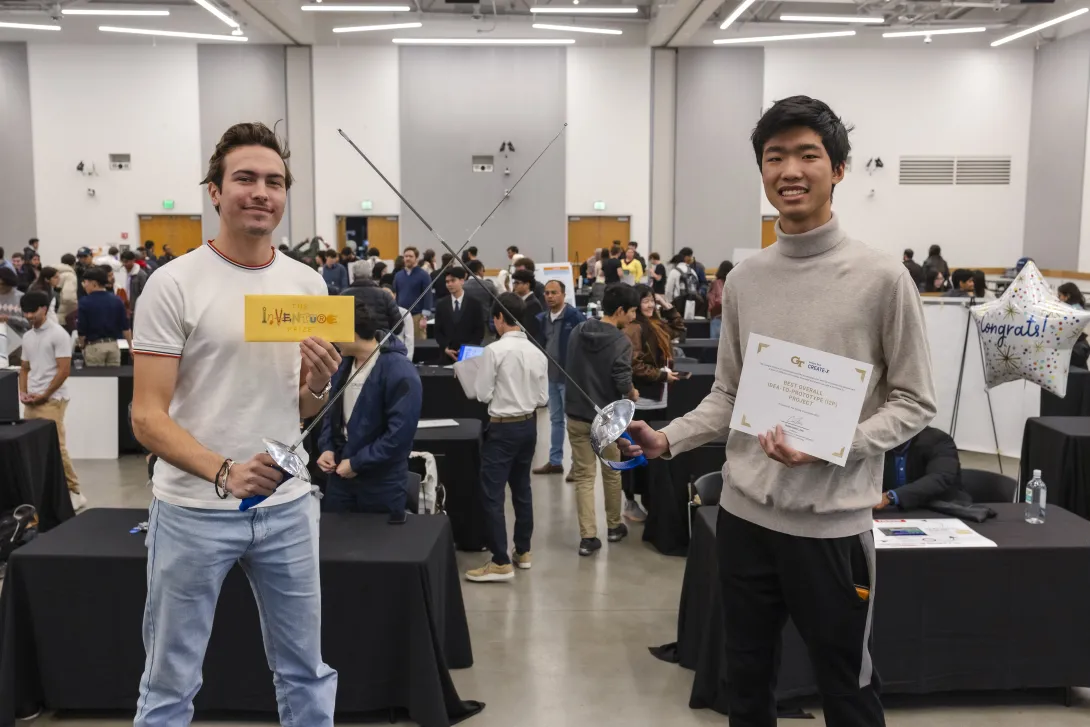
Founders of Allez Go: Adam Kulikowski and Jason Mo
Cricket powder-based protein brownies. A visualization system for fencing blades. A personalized AI application for analyzing blood work. All I2P Showcase prototypes. See what Georgia Tech students have been developing this semester at the Fall 2025 Idea to Prototype (I2P) Showcase on Tuesday, Dec. 2, at 5 p.m. in the Marcus Nanotechnology Building. This year, attendees will have even more original inventions to view, with over 60 teams displaying prototypes.
The event marks the culmination of the semester-long I2P course, where undergraduate students develop functional prototypes aimed at solving real-world problems. Prototypes this semester include a smart military drone, a gentler device for cervical cancer screening, a rotating espresso station, tools to keep AI safe, compact data centers, systems that simulate cyberattacks to help companies strengthen their defenses, and many more.
The showcase is free and open to students, faculty, staff, and members of the local community.
Winning teams will receive prizes and a “golden ticket” into CREATE-X’s Startup Launch, a summer accelerator that provides optional seed funding, accounting and legal service credits, mentorship, and more to help students turn their prototypes into viable startups.
This is a free event, and refreshments will be provided. Register for the Fall 2025 I2P Showcase today!
News Contact
Breanna Durham
Marketing Strategist
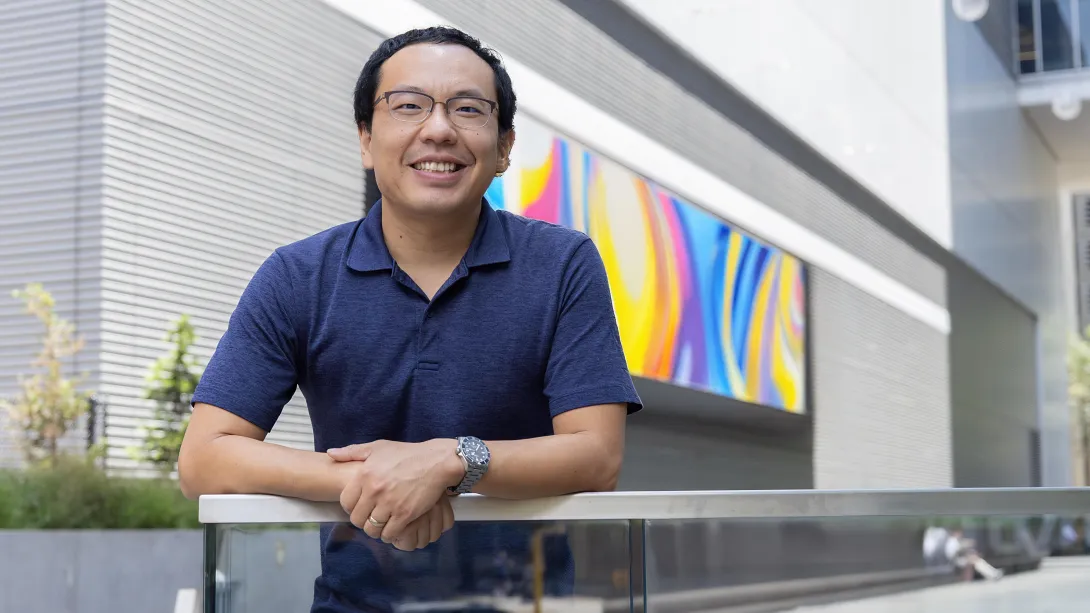
Assistant Professor Frank Li standing outside of the Coda Building in Tech Square. Photos by Terence Rushin/College of Computing
Although they are currently essential to online security and privacy, the days of relying on password protection may be numbered, thanks to Assistant Professor Frank Li and his National Science Foundation (NSF) CAREER Award project.
While passwords have security limitations and can be challenging to use, emerging technologies such as Fast IDentity Online 2 (FIDO2) and other passkey authentication methods provide strong security and usability. For example, if you have ever used your smartphone’s facial recognition feature to log in to your bank account instead of typing out the password, you have used a FIDO2 passkey.
Users and online services, however, have been slow to adopt the new technology despite the benefits. Li’s NSF CAREER Award project addresses this challenge. Along with advancing the technology, Li will also advocate for its use.
“We are not assuming that this technology is coming,” said Li. “It is already here. The challenge is to get people to use this technology.”
This up-and-coming technology has been part of Li’s research for some time. His prior work provided a new security analysis of the FIDO2 authentication protocol, which includes passkeys.
Li’s CAREER project will investigate real-world uses of FIDO2/passkeys and security and usability issues that can arise. A goal of his research is to identify and resolve problems before they become widespread and more difficult to address.
“There’s still a lot to do when it comes to authentication research, and there’s even more to be done with passkeys,” he said.
“Online authentication is a core function needed for online security. Making any changes to it will have huge implications. For example, accounts that send spam and phishing attacks are often accounts with compromised passwords. A passwordless future will reduce that threat.”
The final component of Li’s CAREER Award is an educational outreach program. The NSF wants researchers to inspire the next generation of scientists as a part of their projects. Li plans to reach out to Atlanta high schools and engage their computer science programs.
NSF CAREER Awards are prestigious federal grants given to early career academic faculty and are widely recognized as a career defining moment. Li’s project will be conducted in the School of Cybersecurity and Privacy as well as the School of Electrical and Computer Engineering.
News Contact
John Popham Communications Officer II | School of Cybersecurity and Privacy

When Microsoft announced it was ending support for Windows 10 last week, about 40 percent of all Windows users faced limited options.
While some of those users can upgrade to Windows 11, hundreds of millions of devices don’t meet the technical requirements.
Those users might be wondering what else they can do besides throwing away their current device and buying a new one or risking running outdated software on it.
The tech conglomerate faced backlash from environmental and cybersecurity experts after informing Windows users that it would cease providing updates for Windows 10.
These experts have warned that rendering hundreds of millions of devices practically useless will worsen the ever-growing problem with electronic waste (e-waste) and leave users who can't upgrade vulnerable to cybersecurity threats.
Researchers from Georgia Tech’s School of Interactive Computing (SIC) and School of Cybersecurity and Privacy (SCP) echo those concerns.
Forcing users to replace their devices means that up to 240 million old devices, according to one analysis, will inevitably end up in landfills.
“The problem of e-waste raises the question of why and how these technologies become obsolete,” said Cindy Lin, a Stephen Fleming Early Career Assistant Professor in SIC.
Lin studies data structures and environmental governance in Southeast Asia and the U.S.
“Scholarship in human-computer interaction (HCI) on repair reveals that many of these technologies suffer from planned obsolescence,” she said. “This means that companies have designed products with a short lifespan, increasing consumption and waste simultaneously.”
When e-waste is dumped in landfills, the organic materials within devices decompose, producing methane, a potent greenhouse gas. And with every discarded device comes the need to produce new ones. The raw materials of these devices are mined, refined, and processed, consuming enormous amounts of energy through the burning of fossil fuels.
The Problem With Hackers
Though Microsoft said it will continue to provide Windows 10 security updates for one year, users are still being pressured to upgrade. By this time next year, if users still haven’t upgraded to Windows 11, they can expect to become easy targets for cyber criminals.
For example, users could receive phishing emails claiming to be from Microsoft about security updates from hackers pretending to be Microsoft.
“The cybersecurity implications are very serious because new vulnerabilities of Windows 10 will go unpatched for a large part of the user base of this system,” said Mustaque Ahamad, Regents’ Entrepreneur Professor and interim chair of SCP.
“These users will become targets of hackers and cyber criminals who will be able to exploit these vulnerabilities. This will make these machines more prone to attacks such as ransomware and data exfiltration.”
What Can Users Do?
Buying a new device typically costs around $300 at the low end, while some gaming computers can exceed $2,500.
Josiah Hester, an associate professor in the School of IC who researches computing and sustainability, said users who want to avoid discarding their devices can install Linux Mint, a free universal operating system.
“I would hope that instead of discarding, people might see this as an opportunity to go into a more open ecosystem like Linux Mint, which was designed for Windows users,” Hester said.
“So much perfectly good hardware is obsolesced by force, when users are more than willing to give it a second life, either through ending support on the software side, subscription services that require certain versions of an OS, or even building the hardware or low-level functions that reduce the autonomy of device owners.”
Linux Mint is open source and offers its own suite of software products, including a word processor. It also has a built-in security system. It requires 2GB of RAM, 20GB of disk space, and 1024x768 resolution to operate.
On a systemic level, Lin and Hester said people can support organizations that advocate for right to repair and legislation that protects consumers from planned obsolescence.
“HCI studies of informal economies of improvisation and repair have demonstrated that technologies have a longer lifecycle if we have access to expertise on how to repair them without facing penalties such as copyright violations,” Lin said.
“The ongoing right-to-repair movement in the US shows promise in making technology repairable and, in turn, more sustainable.”
News Contact
Nathan Deen
College of Computing
Georgia Tech
Instructors creating online courses have long faced a tradeoff: use text-based materials that are easy to update, or invest in engaging but time-consuming video formats. As a result, learners often get either flexibility or immersion, but rarely both.
“In a field that moves as fast as artificial intelligence, it’s important to be able to update material frequently,” says David Joyner, executive director of online education in the College of Computing. “That’s usually a problem because re-recording means going back into the studio and trying to make the new content fit in with the old.”
Joyner’s latest massive open online course (MOOC), Foundations of Generative AI, uses artificial intelligence to solve that challenge. Images for the course are created using Sora and DALL·E 3, while early drafts of quizzes were generated by GPT-5. The course also uses Grady, an AI autograder that provides feedback on open-ended essays.
The most striking innovation is DAI-vid (pronounced day-eye-vid), a video avatar of Joyner that leads the instruction. To create it, Joyner uploaded a five-minute clip of himself to the generative AI platform HeyGen, along with course scripts and other inputs. The result is a lifelike digital instructor who can let Joyner update his lessons far more easily.
“With AI, we can just modify the text and have the updated video pop right out,” Joyner says. “It takes minutes at my desk instead of an hour in the studio.”
This approach allows Joyner to keep course materials current and produce new videos entirely on his own. “It’s strange, but in a lot of ways this course feels more like it’s mine than the ones where I’m on camera,” he says. “Because AI lets me handle every part of production myself, the finished product feels like my complete work.”
Joyner sees this experiment as an example of AI’s potential to enhance human talent rather than replace it. “Give me AI and I can do five times more than I could alone,” he says. “But give it to our professional video producers, and they will still far outpace me, because expertise matters most. AI just amplifies it.”
Foundations of Generative AI is now available on edX, and the same material is also part of the OMSCS course CS7637: Knowledge-Based AI.
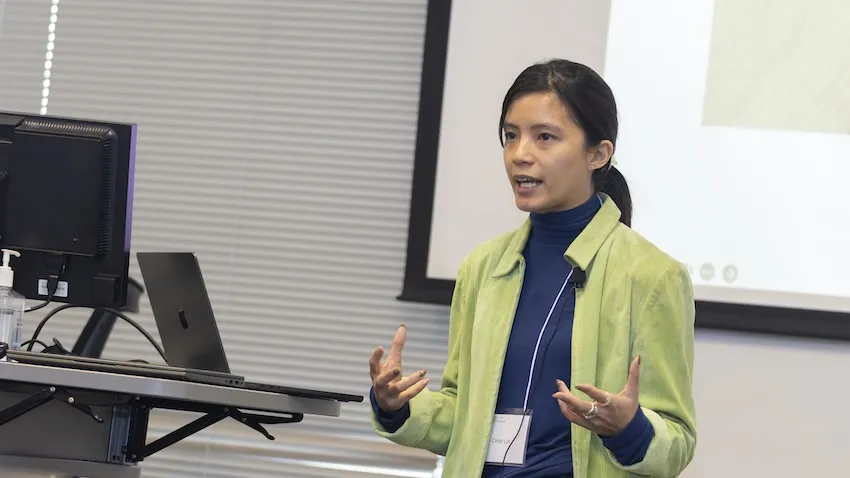
Three School of Interactive Computing researchers were chosen for paper presentations at one of the most selective and unique computing conferences in the world.
The Aarhus Conference, hosted by Aarhus University in Denmark, has been held every decade since 1975, addressing the most urgent and vital issues in computing worldwide.
The latest conference, titled Computing (X) Crisis, took place in August and featured presentations, critiques, and workshops that explored computing’s influence on the human condition in a world filled with crises.
Assistant Professor Cindy Lin, Associate Professor Lynn Dombrowski, and School of Interactive Computing Professor and Chair Shaowen Bardzell authored the paper Whose, Which, and What Crisis? A Critical Analysis of Crisis in Computing Supply Chains. It was one of only 15 papers selected by conference organizers.
In the paper, in which Lin is credited as the lead author, the researchers advance a theoretical framework for understanding crises that impact the computing supply chain.
Bardzell, who served as program chair of the 2015 Aarhus Conference, approached Dombrowski and Lin about collaborating on a paper submission. Bardzell said the conference gets more than 100 submissions and has a minuscule acceptance rate.
“I knew I was going to go no matter what because I enjoyed it so much 10 years ago,” Bardzell said. “I was fortunate to come together with Lynn and Cindy. We spent six months reading, thinking, and debating together every week, and it was a pleasure to write it together.”
The authors identified common themes in areas they were already researching and examined how these themes affected the computing supply chain.
“We wanted to think about what this word means in relation to computing,” Dombrowski said. “Who gets to take advantage of a crisis, or who can construct a crisis in relation to computing? What’s not being talked about when we use that word?”
Lin is studying the rise of data centers and their impact on the environment and consumers. Dombrowski is an expert on the labor market and unjust labor practices. Bardzell has conducted extensive research on how chip manufacturing affects farming and agriculture in her homeland of Taiwan.
“We don’t often think about computing research as intergenerational colleagues working together,” Lin said. “I feel like the three of us represent very interesting generations of computing research that’s tied to critically thinking about the social and political aspects of computing. Each of us has different ways of thinking about those things.”
In the paper, the three authors discuss the concept of “against crisis thinking,” which emphasizes that crises affecting the computing supply chain aren’t self-evident phenomena. Human-computer interaction scholars, they say, should pay more attention to how the word “crisis” is introduced into public discourse and how it can be exploited by powerful actors and impact marginalized communities.
“Some players get to declare what is a crisis and whom it affects,” Lin said. “They create solutions to resolve the crisis, but they might not address what a chronic experience of a crisis may be.”
Although Bardzell said she considers it an honor to present at a conference that is so selective and is held only once a decade, she was encouraged to be among researchers dedicated to solving pressing societal and planetary issues.
“Academia can appear as a cutthroat environment where you’re trying to establish your brand and be known for XYZ,” Bardzell said. “At Aarhus, there was a strong sense of community and working alongside each other, and we’re better because of the people who work alongside us.”
Lin agreed and said that participating in Aarhus is different from the annual conferences where the researchers normally submit papers.
“There’s something special about reflecting every 10 years,” Lin said. “It shows how much has changed but also how much things have remained the same.”
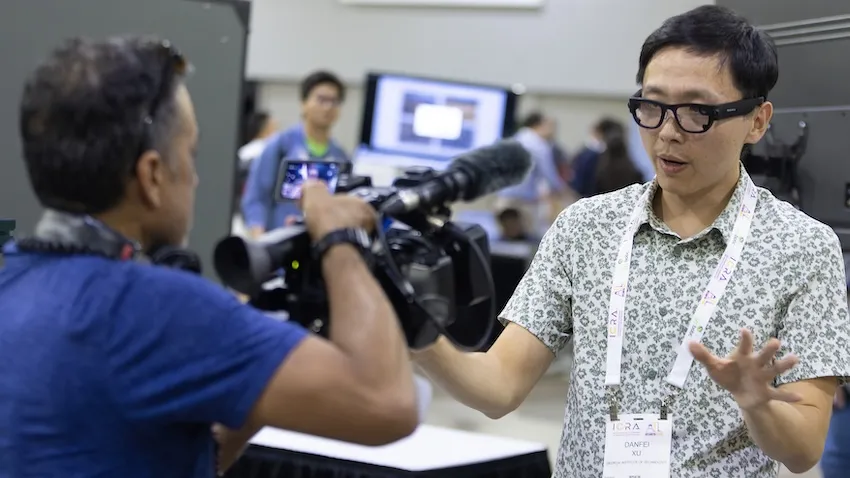
Practice may not make perfect for robots, but new machine learning models from Georgia Tech are allowing them to improve their skillsets to more effectively assist humans in the real world.
Danfei Xu, an assistant professor in Georgia Tech’s School of Interactive Computing, is introducing new models that provide robots with “on-the-job” training.
The National Science Foundation (NSF) awarded Xu its CAREER award given to early career faculty. The award will enable Xu to expand his research and refine his models, which could accelerate the process of robot deployment and alleviate manufacturers from the burden of achieving perfection.
“The main problem we’re trying to tackle is how to allow robots to learn on the job,” Xu said. “How should it self-improve based on the performance or the new requirements or new user preferences in each home or working environment? You cannot expect a robot manufacturer to program all of that.
“The challenging thing about robotics is that the robot must get feedback from the physical environment. It must try to solve a problem to understand the limits of its abilities so it can decide how to improve its own performance.”
As with humans, Xu views practice as the most effective way for a robot to improve a skill. His models train the robot to identify the point at which it failed in its task performance.
“It identifies that skill and sets up an environment where it can practice,” he said. “If it needs to improve opening a drawer, it will navigate itself to the drawer and practice opening it.”
The models allow the robot to split tasks into smaller parts and evaluate its own skill level using reward functions. Cooking dinner, for example, can be divided into steps like turning on the stove and opening the fridge, which are necessary to achieve the overall goal.
“Planning is a complex problem because you must predict what’s going to happen in the physical world,” Xu said. “We use machine learning techniques that our group has developed over the past two years, using generated models to generate positive futures. They’re very good at modeling long-horizon phenomena.
“The robot knows when it’s failed because there’s a value that tells it how well it performed the task and whether it received its reward. While we don’t know how to tell the robot why it failed, we have ways for it to improve its skills based on that measurement.”
One of the biggest barriers that keeps many robots from being made available for public use is the pressure on manufacturers to make the robot as close to perfect as possible at deployment. Xu said it’s more practical to accept that robots will have learning gaps that need to be filled and to implement more efficient real-world learning models.
“We work under the pressure of getting everything correct before deployment,” he said. “We need to meet the basic safety requirements, but in terms of competence, it is difficult to get that perfect at deployment. This takes some of the pressure off because it will be able to self-adapt.”
Virtual Workspace for Data Workers
Yalong Yang, another assistant professor in the School of IC, also received the NSF CAREER Award for a research proposal that will design augmented and virtual reality (AR/VR) workspaces for data workers.
“In 10 years, I envision everyone will use AR/VR in their office, and it will replace their laptop or their monitor,” Yang said.
Yang said he is also working with Google on the project and using Google Gemini to bring conventional applications to immersive space, with data tools being the most complicated systems to re-design for immersive environments.
The immersive workspace and interface will also enable teams of data workers to collaborate and share their data in real-time.
“I want to support the end-to-end process,” Yang said. “We have visualization tools for data, but it’s not enough. Data science is a pipeline — from collecting data to processing, visualizing, modeling and then communicating. If you only support one, people will need to switch to other platforms for the other steps.”
Yang also noted that prior research has shown that VR can enhance cognitive abilities, such as memory and attention and support multitasking. The results of his project could lead to maximizing worker efficiency without them feeling strained.
“We all have a cognitive limit in our working memory. Using AR/VR can increase those limits and process more information. We can expand people’s spatial ability to help them build a better mental model of the data presented to them.”
Yang was also recently named a 2025 Google Research Scholar as he seeks to build a new artificial intelligence (AI) tool that converts mobile apps into 3D immersive environments.

Graphic Representation of networked system: Adobe Stock
A recently awarded $20 million NSF Nexus Supercomputer grant to Georgia Tech and partner institutes promises to bring incredible computing power to the CODA building. But what makes this supercomputer different and how will it impact research in labs on campus, across disciplinary units, and across institutions?
Purpose Built for AI Discovery
Nexus is Georgia Tech’s next-generation supercomputer, replacing the HIVE. Most operational high-performance computing systems utilized for research were designed before the explosion in Machine Learning and AI. This revolution has already shown successes for scientific research and data analysis in many domains, but the compute power, complex connectivity, and data storage needs for these systems have limited their access to the academic research community. The Nexus supercomputer design process retained a robust HPC system as a base while integrating artificial intelligence, machine learning and large-scale data science analysis from the ground up.
Expert Support for Faculty and Researchers
The Institute for Data Engineering and Science (IDEaS) and the College of Computing house the Center for Artificial Intelligence in Science and Engineering (ARTISAN) group. This team has collective experience in working with national computational, cloud, commercial and institutional resources for computational activities, and decades of experience in scientific tools that aid in assisting both teaching and research faculty. Nexus is the next logical step, bringing together everything they’ve learned to build a national resource optimized for the future of AI-driven science.
Principal Research Scientist for the ARTISAN team, Suresh Marru, highlighted the need for this new resource, “AI is a core part of the Nexus vision. Today, researchers often spend more time setting up experiments, managing data, or figuring out how to run jobs on remote clusters than doing science. With Nexus, we’re flipping that script. By embedding AI into the platform, we help automate routine tasks, suggest optimal ways to run simulations, and even assist in generating input or analyzing results. This means researchers can move faster from question to insight. Instead of wrestling with infrastructure, they can focus on discovery.”
An Accessible AI Resource for GT & US Scientific Research
90% of Nexus capacity will be made available to the national research community through the NSF Advanced Computing Systems & Services (ACSS) program. Researchers from across the country, at universities, labs, and institutions of all sizes, will have access to this next-generation AI-ready supercomputer. For Georgia Tech research faculty and staff, the new system has multiple benefits:
- 10% of the time on the machine will be available for use by Georgia Tech researchers
- Nexus will allow GT researchers a chance to try out the latest hardware for AI computing
- Thanks to cyberinfrastructure tools from the ARTISAN group, Nexus will be easier to access than previous NSF supercomputers
Interim Executive Director of IDEaS and Regents' Professor David Sherrill notes, "Nexus brings Georgia Tech's leadership in research computing to a whole new level. It will be the first NSF Category I Supercomputer hosted on Georgia Tech's campus. The Nexus hardware and software will boost research in the foundations of AI, and applications of AI in science and engineering."