
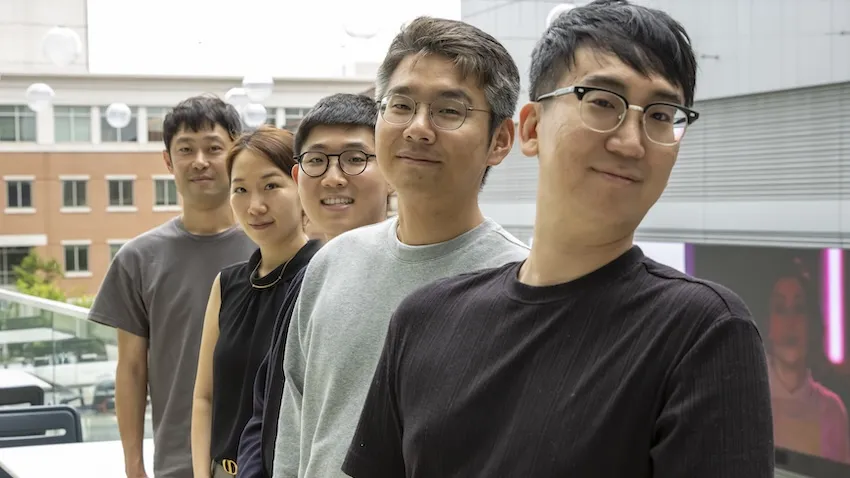
School of Interactive Computing Assistant Professor Sehoon Ha, Neuromeka researchers Joonho Lee and Yunho Kim, School of IC Assistant Professor Jennifer Kim, and Electronics and Telecommunications Research Institute researcher Dongyeop Kang, are collaborating to develop a medical assistant robot to support doctors and nurses in Korea. Photo by Nathan Deen/College of Computing.
Overwhelmed doctors and nurses struggling to provide adequate patient care in South Korea are getting support from Georgia Tech and Korean-based researchers through an AI-powered robotic medical assistant.
Top South Korean research institutes have enlisted Georgia Tech researchers Sehoon Ha and Jennifer G. Kim to develop artificial intelligence (AI) to help the humanoid assistant navigate hospitals and interact with doctors, nurses, and patients.
Ha and Kim will partner with Neuromeka, a South Korean robotics company, on a five-year, 10 billion won (about $7.2 million US) grant from the South Korean government. Georgia Tech will receive about $1.8 million of the grant.
Ha and Kim, assistant professors in the School of Interactive Computing, will lead Tech’s efforts and also work with researchers from the Korea Advanced Institute of Science and Technology and the Electronics and Telecommunications Research Institute.
Neuromeka has built industrial robots since its founding in 2013 and recently decided to expand into humanoid service robots.
Lee, the group leader of the humanoid medical assistant project, said he fielded partnership requests from many academic researchers. Ha and Kim stood out as an ideal match because of their robotics, AI, and human-computer interaction expertise.
For Ha, the project is an opportunity to test navigation and control algorithms he’s developed through research that earned him the National Science Foundation CAREER Award. Ha combines computer simulation and real-world training data to make robots more deployable in high-stress, chaotic environments.
“Dr. Ha has everything we want to put into our system, including his navigation policies,” Lee said. “He works with robots and AI, and there weren’t many candidates in that space. We needed a collaborator who can create the software and has experience running it on robots.”
Ha said he is already considering how his algorithms could scale beyond hospitals and become a universal means of robot navigation in unstructured real-world environments.
“For now, we’re focusing on a customized navigation model for Korean environments, but there are ways to transfer the data set to different environments, such as the U.S. or European healthcare systems,” Ha said.
“The final product can be deployed to other systems and industries. It can help industrial workers at factories, retail stores, any place where workers can get overwhelmed by a high volume of tasks.”
Kim will focus on making the robot’s design and interaction features more human. She’ll develop a large-language model (LLM) AI system to communicate with patients, nurses, and doctors. She’ll also develop an app that will allow users to input their commands and queries.
“This project is not just about controlling robots, which is why Dr. Kim’s expertise in human-computer interaction design through natural language was essential.,” Lee said.
Kim is interviewing stakeholders from three South Korean hospitals to identify service and care pain points. The issues she’s identified so far relate to doctor-patient communication, a lack of emotional support for patients, and an excessive number of small tasks that consume nurses’ time.
“Our goal is to develop this robot in a very human-centered way,” she said. “One way is to give patients a way to communicate about the quality of their care and how the robot can support their emotional well-being.
“We found that patients often hesitate to ask busy nurses for small things like getting a cup of water. We believe this is an area a robot can support.”
The robot’s hardware will be built in Korea, while Ha and Kim will develop the software in the U.S.
Jong-hoon Park, CEO of Neuromeka, said in a press release the goal is to have a commercialized product as soon as possible.
“Through this project, we will solve problems that existing collaborative robots could not,” Park said. “We expect the medical AI humanoid robot technology being developed will contribute to reducing the daily work burden of medical and healthcare workers in the field.”
An algorithmic breakthrough from School of Interactive Computing researchers that earned a Meta partnershipdrew more attention at the IEEE International Conference on Robotics and Automation (ICRA).
Meta announced in February its partnership with the labs of professors Danfei Xu and Judy Hoffman on a novel computer vision-based algorithm called EgoMimic. It enables robots to learn new skills by imitating human tasks from first-person video footage captured by Meta’s Aria smart glasses.
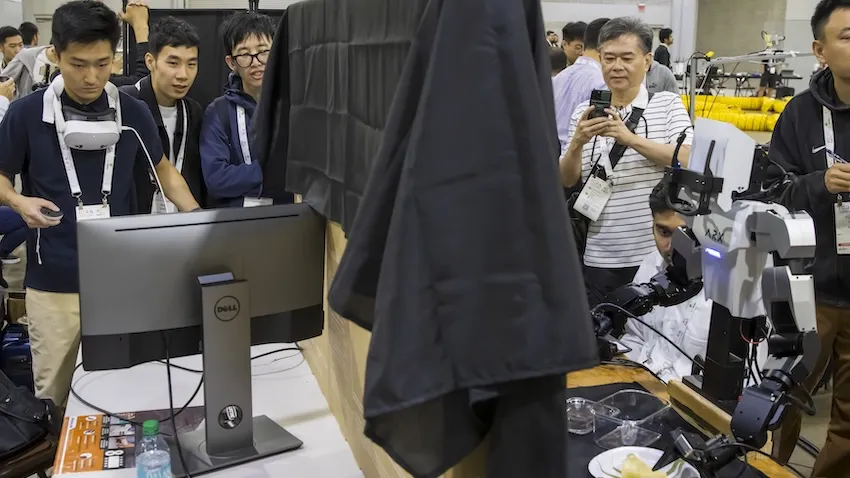
Xu’s Robot Learning and Reasoning Lab (RL2) displayed EgoMimic in action at ICRA May 19-23 at the World Congress Center in Atlanta.
Lawrence Zhu, Pranav Kuppili, and Patcharapong “Elmo” Aphiwetsa — students from Xu’s lab — used Egomimic to compete in a robot teleoperation contest at ICRA. The team finished second in the event titled What Bimanual Teleoperation and Learning from Demonstration Can Do Today, earning a $10,000 cash prize.
Teams were challenged to perform tasks by remotely controlling a robot gripper. The robot had to fold a tablecloth, open a vacuum-sealed container, place an object into the container, and then reseal it in succession without any errors.
Teams completed the tasks as many times as possible in 30 minutes, earning points for each successful attempt.
The competition also offered different challenge levels that increased the points awarded. Teams could directly operate the robot with a full workstation view and receive one point for each task completion. Or, as the RL2 team chose, teams could opt for the second challenge level.
The second level required an operator to control the task with no view of the workstation except for what was provided to through a video feed. The RL2 team completed the task seven times and received double points for the challenge level.
The third challenge level required teams to operate remotely from another location. At this level, teams could earn four times the number of points for each successful task completed. The fourth level challenged teams to deploy an algorithm for task performance and awarded eight points for each completion.
Using two of Meta’s Quest wireless controllers, Zhu controlled the robot under the direction of Aphiwetsa, while Kuppili monitored the coding from his laptop.
“It’s physically difficult to teleoperate for half an hour,” Zhu said. “My hands were shaking from holding the controllers in the air for that long.”
Being in constant communication with Aphiwetsa helped him stay focused throughout the contest.
“I helped him strategize the teleoperation and noticed he could skip some of the steps in the folding,” Aphiwetsa said. “There were many ways to do it, so I just told him what he could fix and how to do it faster.”
Zhu said he and his team had intended to tackle the fourth challenge level with the EgoMimic algorithm. However, due to unexpected time constraints, they decided to switch to the second level the day before the competition due to unexpected time constraints.
“I think we realized the day before the competition training the robot on our model would take a huge amount of time,” Zhu said. “We decided to go for the teleoperation and started practicing.”
He said the team wants to tackle the highest challenge level and use a training model for next year’s ICRA competition in Vienna, Austria.
ICRA is the world’s largest robotics conference, and Atlanta hosted the event for the third time in its history, drawing a record-breaking attendance of over 7,000.

Smoke cloud rising from a brush wildfire burning in San Francisco, California (Source: Adobe Stock)
You’re managing the Texas Panhandle’s power grid. Heavy winds are blowing, and a worn-out utility pole ignites a fire by crashing onto a transmission line. Luckily, the fire department arrives quickly, putting out the fire before it spreads to nearby cities. But the same thing may happen again with gusty conditions predicted for the next 24 hours. Should you shut off miles of power lines to reduce that risk, causing outages for thousands of residents? Should you add batteries to the grid or move some power lines underground to lessen the impact of future fires? That sounds useful, but paying for these upgrades would require raising electricity rates.
Players of the Current Crisis video game are pondering these questions, similar to professional grid managers during the Texas Smokehouse Creek fire in 2024. But the players did not purchase Current Crisis at a run-of-the-mill gaming store. They might have played it at Georgia Tech’s Dataseum, which featured the game in a recent exhibition. Or they might have helped develop it in weekly meetings with Daniel Molzahn, associate professor in the School of Electrical and Computer Engineering and EPIcenter initiative lead.
“Current Crisis started as a computer simulation I programmed in Summer 2020 for a senior-level course I taught that fall,” says Molzahn. “My students had to dispatch crews to maintain or repair a simplified model of the Georgia power grid. In the middle of the Covid-19 pandemic, each dispatch had a risk of infection and quarantine, which meant losing the crew for the rest of that round. The students had a fixed budget to balance two competing goals: operating a power system with minimal outages and keeping the repair crews healthy.”
The class project was popular, and its scope began to grow. Molzahn proposed turning his simulation into a video game in a July 2021 grant application to the National Science Foundation. He received the five-year award that fall and launched his “Vertically Integrated Project” on power grid gaming the following spring. It soon attracted about 35 students per semester, from sophomores to those pursuing graduate degrees in various disciplines. Most students stay for three to four semesters.
Tristan Ziegler joined the VIP as a computational media sophomore in Spring 2022 — and still works on it three years later as a professional programmer. “I found the project by searching for ‘game’ on the VIP website,” says Ziegler, who graduated in 2024. “It offered much more freedom than traditional classes but still allowed me to earn credits and grades, unlike a student organization where you volunteer your time.”
The students quickly discovered the benefits of working toward a shared goal in smaller groups, focused on coding, grid modeling, graphic design, or artistic creativity. Some volunteered to lead initiatives, such as organizing the Dataseum exhibition or the 2025 Seth Bonder summer camps, where they will teach high schoolers the basics of game programming.
Another long-term member of the VIP team is Ryan Piansky, a doctoral student, who studies the resilience of power grids to wildfires. He combines well-known engineering tools — algorithms for finding a mathematically optimal problem solution — with historical wildfire data to evaluate grid management decisions.
“I have examined if policies based on established engineering principles help the people who need the most help, reduce the risk of outages broadly across the whole grid, and optimally allocate limited resources,” explains Piansky, who works in Molzahn's research lab. “To do that, I combine power grid models with realistic wildfire simulations to assess if those policies would likely generate desirable outcomes in a range of plausible scenarios.”
The VIP work on grid modeling has informed Piansky’s research, but the climate models he uses to mimic the spread of wildfires are too complex for a fast-moving video game. That’s why he has helped the students develop simplified versions of these models. Humidity and vegetation, for example, influence both real fires and those popping up in Current Crisis.
Piansky’s research is part of Molzahn’s long-term goal: developing computer tools that help professional grid managers improve the grid’s resilience to natural disasters — from pandemics and wildfires to hurricanes, heat waves and floods.
“We plan to record the choices made by Current Crisis players in crowdsourced datasets that will support our research,” says Molzahn. “By using these datasets to train machine-learning algorithms, we can harness the power of AI to develop better disaster response policies.” (The European Space Agency uses a similar gamification strategy to map moon craters.)
The project’s benefits go well beyond these research contributions. Its educational value includes experience working in multidisciplinary teams of students at different levels and leadership development. Molzahn also hopes the game will help build public acceptance of disruptive actions during real disasters.
“Recognizing the tradeoffs inherent in grid management is important, whether it’s understanding why power shutoffs reduce fire risks or why service restorations are time-consuming,” says Molzahn. “This may also generate broader public support for electricity rate increases and tax allocations to pay for infrastructure hardening.”
Written by: Silke Schmidt
News Contact
Story Written by: Silke Schmidt
Priya Devarajan || Research Communications Program Manager
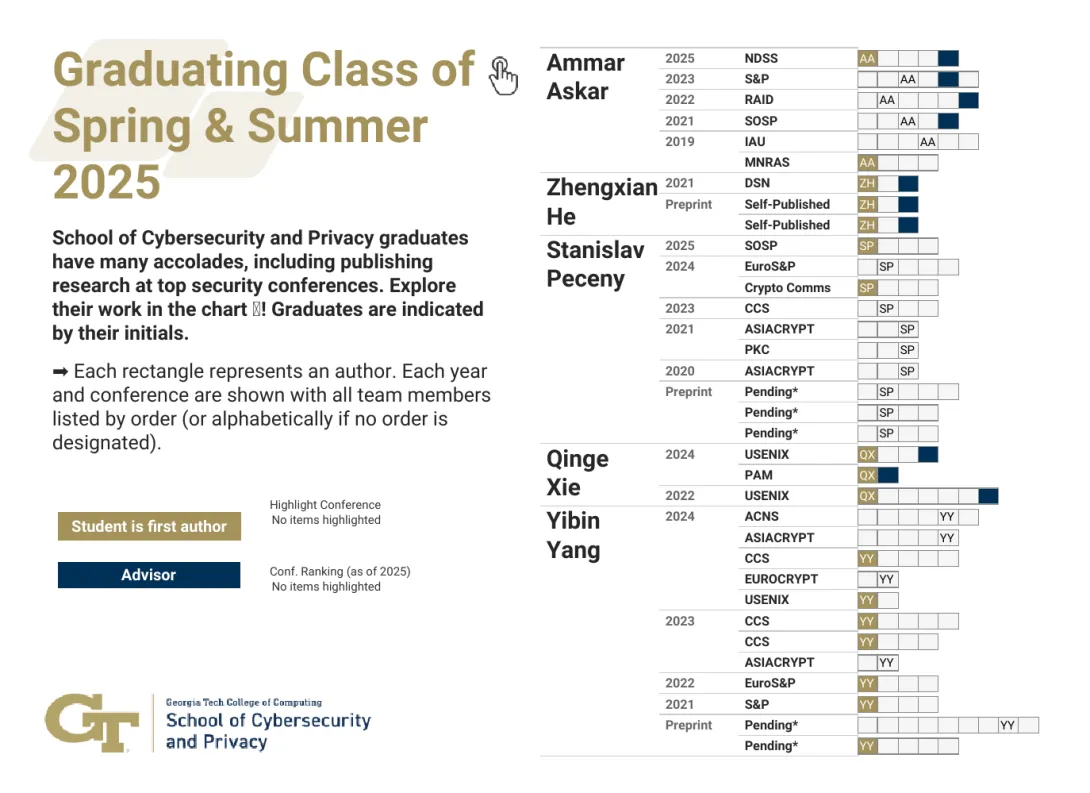
The School of Cybersecurity and Privacy at Georgia Tech is proud to recognize the accomplishments of five doctoral students who finished their doctoral programs in Spring 2025. These scholars have advanced critical research in software security, cryptography, and privacy, collectively publishing 34 papers, most of which appear in top-tier venues.
Ammar Askar developed new tools for software security in multi-language systems, including a concolic execution engine powered by large language models. He highlighted DEFCON 2021, which he attended with the Systems Software and Security Lab (SSLab), as a favorite memory.
Zhengxian He persevered through the pandemic to lead a major project with an industry partner, achieving strong research outcomes. He will be joining Amazon and fondly remembers watching sunsets from the CODA building.
Stanislav Peceny focused on secure multiparty computation (MPC), designing high-performance cryptographic protocols that improve efficiency by up to 1000x. He’s known for his creativity in both research and life, naming avocado trees after famous mathematicians and enjoying research discussions on the CODA rooftop.
Qinge Xie impressed faculty with her adaptability across multiple domains. Her advisor praised her independence and technical range, noting her ability to pivot seamlessly between complex research challenges.
Yibin Yang contributed to the advancement of zero-knowledge proofs and MPC, building toolchains that are faster and more usable than existing systems. His work earned a Distinguished Paper Award at ACM CCS 2023, and he also served as an RSAC Security Scholar. Yang enjoyed teaching and engaging with younger students, especially through events like Math Kangaroo.
Faculty mentors included Regents’ Entrepreneur Mustaque Ahamad, Professors Taesoo Kim and Vladimir Kolesnikov, and Assistant Professor Frank Li, who played vital roles in guiding the graduates’ research journeys.
Learn more about the graduates and their mentors on the 2025 Ph.D. graduate microsite.
News Contact
JP Popham, Communications Officer II
College of Computing | School of Cybersecurity and Privacy
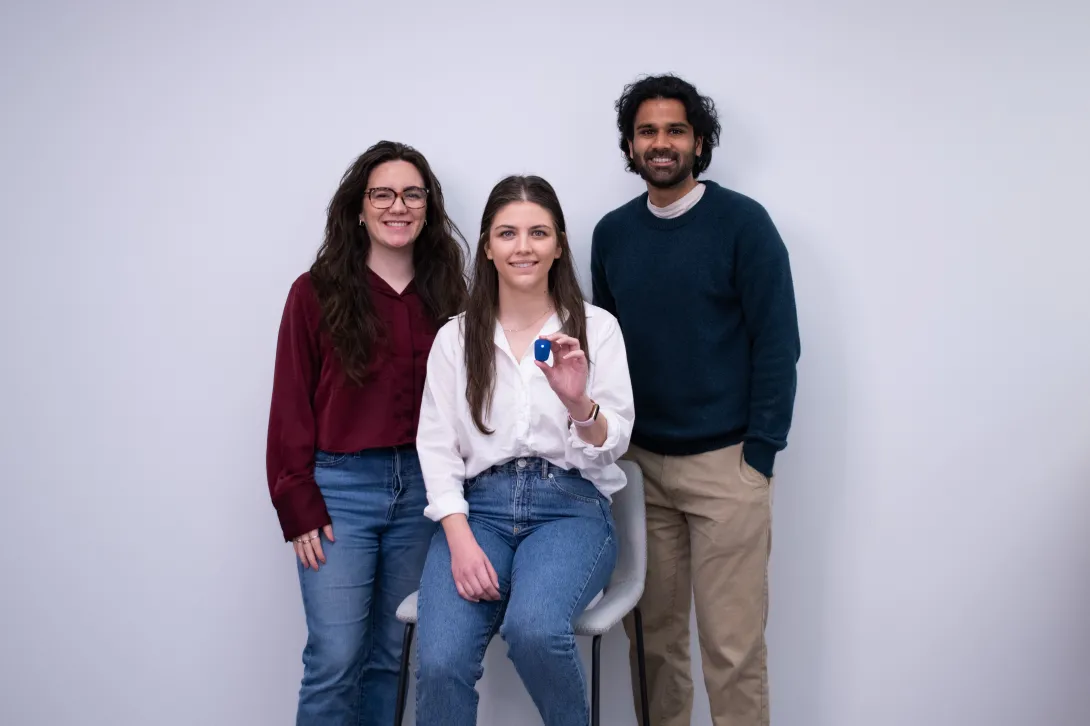
From left to right, Stridelink Founders Cassandra McIltrot , Marzeah “Zea” Khorramabadi, and Neel Narvekar. Khorramabadi is holding one of their sensors, a device like a watch.
According to the National Institutes of Health, nearly one-fourth of the U.S. population over age 45 suffers from foot and ankle issues, which reduce their quality of life, adversely affect walking and other daily functions, and increase the risk of falls.
For orthopedic patients recovering from surgery, walking properly can speed recovery, enabling them to more quickly regain mobility and quality of life. Walking issues or problems with one’s gait can also indicate larger medical problems, from vascular disease to brain, nerve, or spinal cord injuries.
Three alumni from Georgia Tech’s School of Electrical and Computer Engineering and School of Bioengineering hope to help doctors and patients analyze walking patterns through their wearable sensor startup, StrideLink.
“In the same way a cardiologist puts an EKG on you to monitor your heart, we essentially have designed that for walking ability,” says StrideLink founder and CEO Marzeah “Zea” Khorramabadi.
Initially targeting orthopedic practices for their platform, the HIPAA-compliant system wirelessly analyzes patients’ gaits to help doctors remotely monitor their walking ability before and after surgery to better address issues and provide more personalized treatment.
The 26-year-old Georgia Tech graduate of computer engineering founded StrideLink in 2021 with two other Tech students: Cassandra McIltrot, a 2022 biomedical and medical engineering graduate, and Neel Narvekar, who completed his computer engineering studies in 2021.
Since starting StrideLink, the three have raised just under $1 million in pre-seed funding and are now starting their seed funding push.
McIltrot, 24, serves as research director at StrideLink. She says talking to surgeons, physical therapists, and patients was invaluable in building the StrideLink platform, which includes a physical sensor that connects via Bluetooth to a mobile platform. Orthopedic physicians can then access a secure interface to view their patients’ gait data.
“Being able to learn from all those people helped us build something that will bring value,” she says.
Narvekar, the startup’s CTO, calls the technology “a game-changer,” noting, “For the first time, we can widely collect clinically relevant gait data. Starting in orthopedics, this means we can build datasets to predict recovery timelines, identify when patients are off track, and intervene before adverse events occur. Ultimately, this will pave the way for improved care across a range of health conditions."
The enterprising entrepreneurs didn’t do it alone. They leveraged CREATE-X, which supports students in launching successful startups through education, coaching, funding, and other resources.
Below, Khorramabadi and McIltrot share more about their journey as members of the first cohort of CREATE-X’s Female Founders program in Fall 2020. In Summer 2021, the duo completed Startup Launch, a 12-week summer accelerator that helps students launch startups.
Did you two always want to start your own business?
Khorramabadi: It was kind of inevitable for Cassie and me. My dad immigrated from Iran and met my mom here. He started his own business selling cars. So, I grew up with a family that was running a small business. I’ve always had that in me, and it was the expectation that I would go to college. I picked Georgia Tech specifically because they had showcased the CREATE-X program during the tour.
McIltrot: My dad had a construction consulting business, and my mom was a nurse. That’s where the medical influence came from for me. He’s also an engineer. The summer that we decided to pursue this, I was doing research on stroke rehab at Emory.
How did you come up with your big idea?
Khorramabadi: In the middle of the pandemic, there was a lot of emphasis on technology — leaving the clinic and being in a patient's home. How are we going to deliver healthcare effectively when patients aren't directly in front of their doctor?
At the same time, Cassie was doing stroke research, and there was a lot around how heavily walking ability, walking patterns, or your gait is affected. We talked to healthcare professionals, physical therapists, surgeons, everyone. And it was clear that there was a pretty big gap in the market in terms of the technology that would serve these patients who have any symptoms that show up in their walking ability. It wasn’t measured at all. So, we ended up landing on a gait monitor as a solution.
We realized there was a very immediate, straightforward need for our product in orthopedics. If you're getting a knee replacement, ankle, or foot surgery, it's valuable to be able to put this product on a patient preoperatively to better prepare them for surgery. Surgeons can take real measurements of what their patients’ walking ability looks like before surgery and then track them throughout the entirety of their post-op recovery, which can be three months, six months, or even 12 months.
How does the solution work?
Khorramabadi: We designed our platform from the ground up. Our physical sensor connects to a mobile application. That mobile application connects to an entire cloud architecture that has processing servers and database storage. On the physician side, we have an interface for them to view data that fits into their workflow, including receiving insurance reimbursement. The technology component was designed in-house by Neil and me, given our backgrounds in computer engineering.
Are you using AI or advanced analytics in your platform?
Khorramabadi: We have a lot of very advanced data processing methods that are entirely proprietary to our system. We’ve acquired enough data from all of the patients we've seen with Emory, and now we're tracking patients remotely, where we are starting to use real clinical data to train AI to deliver a performance score to these patients. It’s essentially one number that rates how you’re doing related to a healthy or normal gait. We're already using AI right now, and that's something that's going to be released with our product within the next six months.
Where are you in terms of product maturity?
Khorramabadi: We recently started with our first fully remote full-time customer. Before that, we were doing research with another physician at Emory, where they had used it for over a year. At this point, they've tracked over 250 patients, where they put the sensors on at their pre-op appointment and then track them during post-op follow-ups.
They weren’t sent home with the sensors until our sensor was FDA-listed last year, and then we started our first pilot with a private practice in Amelia Island, Florida, last October. That has gone incredibly well, so we just expanded to an orthopedic practice in Alabama, and we should be getting two more practices started in 2025. We've solidified the product fit, and we’re now at the point of scaling it. We also have a research partnership with Children's Hospital Colorado to work on a pediatrics application.
What was most helpful about the CREATE-X programs you participated in at Georgia Tech?
Khorramabadi: Georgia Tech makes exploring doing a startup easy and low-risk for any student. The fact that it was so accessible was monumental early on. In terms of programming, the most valuable part was the emphasis on customer discovery. They did a good job, saying, “You don't know what to build until you talk to enough customers.”
We needed a mentor as part of our first startup class, and we read how James Stubbs, a tenured professor in biomedical engineering, was a previous founder. He’d done a couple of medical device companies that had been acquired. At our first meeting, he told us we need to talk to people. From a business standpoint, it made more sense for us to go to orthopedics rather than physical therapy for a whole host of reasons. But the biggest takeaway of talking to customers was a very consistent experience with both the Startup Launch and the Female Founders program.
McIltrot: The Female Founders program did a fantastic job of that, where we set goals as teams and were encouraged to talk to as many people we think are going to be our customers. We then met as a group and presented what we learned.
So you have to get out of get out of your comfort zone, and not be shy about engaging with people. Cassie, what was the big benefit for you?
McIltrot: We were the first cohort for Female Founders. We checked in every week with our team. Everyone would talk about what they learned that week while talking to people. We were the only medical-focused startup in the program, but being able to share the experience of how we approached people allowed us to learn from each other. We like keeping up with each other on LinkedIn. We learned one of the people in our cohort just closed a funding round.
Is having a community of other women entrepreneurs helpful?
Khorramabadi: Definitely. We’ve gotten a lot out of building a network, especially coming from starting this out of college, where you don't have any industry connections built up yet.
What has been the biggest value from your experience participating in Startup Launch?
Khorramabadi: Networking has been the biggest value for both Startup Launch and Female Founders. Both of those programs emphasized networking and customer discovery. Being involved in both programs at the same time kept us focused on that.
Startup Launch was a good crash course in how you set up your company from a legal aspect, as well as the conversations you need to have with your co-founders, and this is how you pitch and how you raise investment. All these topics are very foreign, and there's not a lot of good information out there on them. So, it was important to have that in the program. It was also nice to connect with Georgia Tech founders who had started companies and seen some success. The program brought them in to talk to us and share what they'd learned. It was nice to have that extra guidance.
What is the biggest benefit of your innovation?
Khorramabadi: The biggest value is knowing how you're doing right now, and also, if you're not doing well, your physician being able to make changes quickly to your plan of care. The platform also lets patients realize what may be contributing to their getting reinjured or having a slower recovery.
What has been the impact of your platform to date?
Khorramabadi: We've already seen the immediate ROI in terms of patients just feeling much better and much more comfortable in their recovery and being able to push themselves a little bit further than they would have otherwise, because they know they have this product that's tracking them, and they know their physician also is tracking them.
On the physician side, there's a lot of incentive for them, because they see this as a tool to stay connected with their patients, which is incredibly valuable for them for delivering the best care or best experience for those patients. Also, this product is now covered by Medicare, CIGNA, and United Healthcare.
McIltrot: One of the things we have heard from patients is they’re using this to instill confidence in their walking ability and their recovery. Because these recovery timelines could be six months to a year to multiple years long, being able to have something that shows how much you've been able to improve is invaluable.
Our future vision is being able to put this on a patient and have a projected recovery laid out. One day, this device could provide recommendations on what went wrong and how to fix it. Being proactive with the care that we deliver to patients is the end goal.
Any advice for Georgia Tech students thinking about taking an innovative idea to market?
Khorramabadi: Go for it. Startups are always a risk, and Georgia Tech provides you with a safety net to take that risk. If you have an idea on how to solve a problem, why wait? Don't hesitate.
If you are looking for a supportive community to help you start your entrepreneurial journey, applications for the Female Founders Program are open until May 19 for Summer 2025. Apply for Female Founders today and over the summer learn entrepreneurship from an all-female coaching team, network with experts and successful entrepreneurs, build your network, and access funding to kick off a startup. Admissions are rolling.
For those interested in seeing the latest startups coming out of CREATE-X, join us for Demo Day 2025! On Aug. 28 at 5 p.m., over 100 startups will fill Exhibition Hall, debuting technologies from clean tech to fashion. Register today for this free event that attracts over 1,500 attendees, from business leaders to enthusiasts, and see how our founders are tackling issues across industries.
News Contact
Written By Anne Wainscott-Sargent
Internal Contact:
Breanna Durham
Marketing Strategist
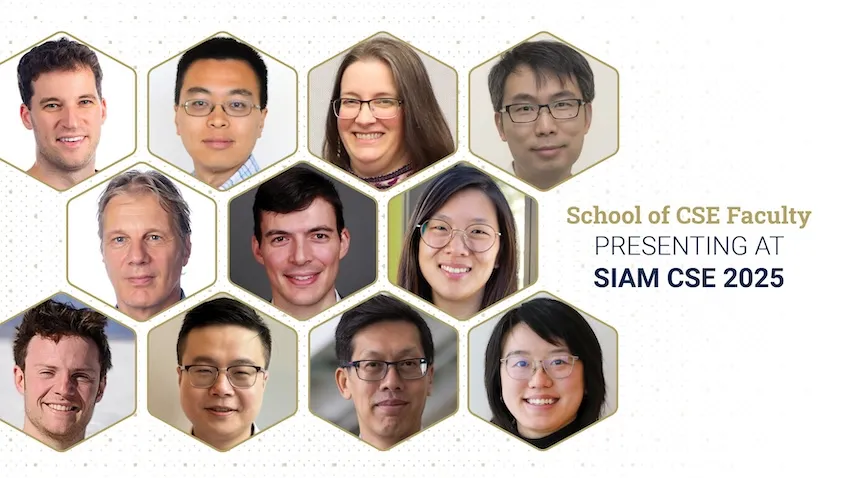
Many communities rely on insights from computer-based models and simulations. This week, a nest of Georgia Tech experts are swarming an international conference to present their latest advancements in these tools, which offer solutions to pressing challenges in science and engineering.
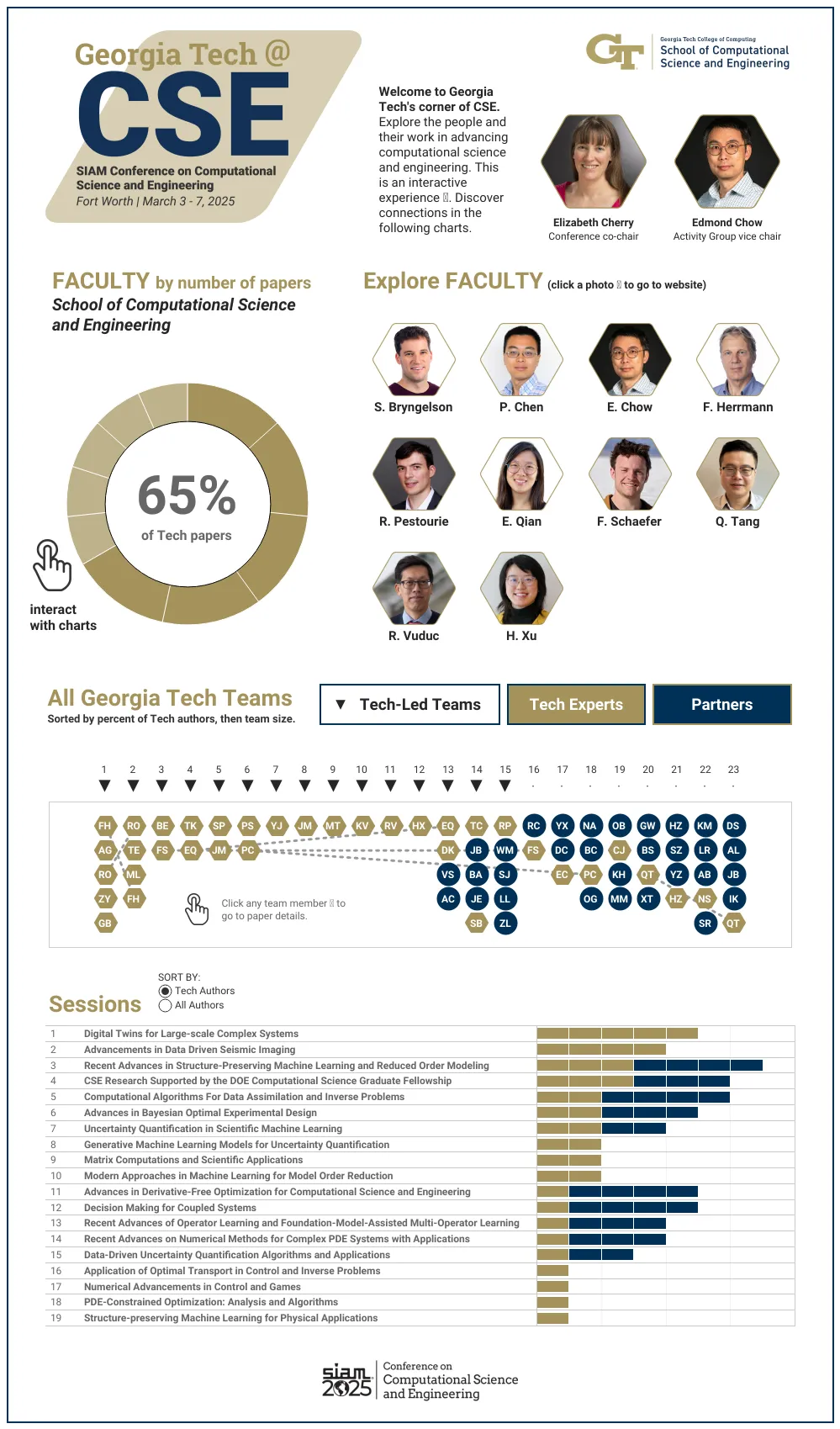
Students and faculty from the School of Computational Science and Engineering (CSE) are leading the Georgia Tech contingent at the SIAM Conference on Computational Science and Engineering (CSE25). The Society of Industrial and Applied Mathematics (SIAM) organizes CSE25, occurring March 3-7 in Fort Worth, Texas.
At CSE25, the School of CSE researchers are presenting papers that apply computing approaches to varying fields, including:
- Experiment designs to accelerate the discovery of material properties
- Machine learning approaches to model and predict weather forecasting and coastal flooding
- Virtual models that replicate subsurface geological formations used to store captured carbon dioxide
- Optimizing systems for imaging and optical chemistry
- Plasma physics during nuclear fusion reactions
[Related: GT CSE at SIAM CSE25 Interactive Graphic]
“In CSE, researchers from different disciplines work together to develop new computational methods that we could not have developed alone,” said School of CSE Professor Edmond Chow.
“These methods enable new science and engineering to be performed using computation.”
CSE is a discipline dedicated to advancing computational techniques to study and analyze scientific and engineering systems. CSE complements theory and experimentation as modes of scientific discovery.
Held every other year, CSE25 is the primary conference for the SIAM Activity Group on Computational Science and Engineering (SIAG CSE). School of CSE faculty serve in key roles in leading the group and preparing for the conference.
In December, SIAG CSE members elected Chow to a two-year term as the group’s vice chair. This election comes after Chow completed a term as the SIAG CSE program director.
School of CSE Associate Professor Elizabeth Cherry has co-chaired the CSE25 organizing committee since the last conference in 2023. Later that year, SIAM members reelected Cherry to a second, three-year term as a council member at large.
At Georgia Tech, Chow serves as the associate chair of the School of CSE. Cherry, who recently became the associate dean for graduate education of the College of Computing, continues as the director of CSE programs.
“With our strong emphasis on developing and applying computational tools and techniques to solve real-world problems, researchers in the School of CSE are well positioned to serve as leaders in computational science and engineering both within Georgia Tech and in the broader professional community,” Cherry said.
Georgia Tech’s School of CSE was first organized as a division in 2005, becoming one of the world’s first academic departments devoted to the discipline. The division reorganized as a school in 2010 after establishing the flagship CSE Ph.D. and M.S. programs, hiring nine faculty members, and attaining substantial research funding.
Ten School of CSE faculty members are presenting research at CSE25, representing one-third of the School’s faculty body. Of the 23 accepted papers written by Georgia Tech researchers, 15 originate from School of CSE authors.
The list of School of CSE researchers, paper titles, and abstracts includes:
Bayesian Optimal Design Accelerates Discovery of Material Properties from Bubble Dynamics
Postdoctoral Fellow Tianyi Chu, Joseph Beckett, Bachir Abeid, and Jonathan Estrada (University of Michigan), Assistant Professor Spencer Bryngelson
[Abstract]
Latent-EnSF: A Latent Ensemble Score Filter for High-Dimensional Data Assimilation with Sparse Observation Data
Ph.D. student Phillip Si, Assistant Professor Peng Chen
[Abstract]
A Goal-Oriented Quadratic Latent Dynamic Network Surrogate Model for Parameterized Systems
Yuhang Li, Stefan Henneking, Omar Ghattas (University of Texas at Austin), Assistant Professor Peng Chen
[Abstract]
Posterior Covariance Structures in Gaussian Processes
Yuanzhe Xi (Emory University), Difeng Cai (Southern Methodist University), Professor Edmond Chow
[Abstract]
Robust Digital Twin for Geological Carbon Storage
Professor Felix Herrmann, Ph.D. student Abhinav Gahlot, alumnus Rafael Orozco (Ph.D. CSE-CSE 2024), alumnus Ziyi (Francis) Yin (Ph.D. CSE-CSE 2024), and Ph.D. candidate Grant Bruer
[Abstract]
Industry-Scale Uncertainty-Aware Full Waveform Inference with Generative Models
Rafael Orozco, Ph.D. student Tuna Erdinc, alumnus Mathias Louboutin (Ph.D. CS-CSE 2020), and Professor Felix Herrmann
[Abstract]
Optimizing Coupled Systems: Insights from Co-Design Imaging and Optical Chemistry
Assistant Professor Raphaël Pestourie, Wenchao Ma and Steven Johnson (MIT), Lu Lu (Yale University), Zin Lin (Virginia Tech)
[Abstract]
Multifidelity Linear Regression for Scientific Machine Learning from Scarce Data
Assistant Professor Elizabeth Qian, Ph.D. student Dayoung Kang, Vignesh Sella, Anirban Chaudhuri and Anirban Chaudhuri (University of Texas at Austin)
[Abstract]
LyapInf: Data-Driven Estimation of Stability Guarantees for Nonlinear Dynamical Systems
Ph.D. candidate Tomoki Koike and Assistant Professor Elizabeth Qian
[Abstract]
The Information Geometric Regularization of the Euler Equation
Alumnus Ruijia Cao (B.S. CS 2024), Assistant Professor Florian Schäfer
[Abstract]
Maximum Likelihood Discretization of the Transport Equation
Ph.D. student Brook Eyob, Assistant Professor Florian Schäfer
[Abstract]
Intelligent Attractors for Singularly Perturbed Dynamical Systems
Daniel A. Serino (Los Alamos National Laboratory), Allen Alvarez Loya (University of Colorado Boulder), Joshua W. Burby, Ioannis G. Kevrekidis (Johns Hopkins University), Assistant Professor Qi Tang (Session Co-Organizer)
[Abstract]
Accurate Discretizations and Efficient AMG Solvers for Extremely Anisotropic Diffusion Via Hyperbolic Operators
Golo Wimmer, Ben Southworth, Xianzhu Tang (LANL), Assistant Professor Qi Tang
[Abstract]
Randomized Linear Algebra for Problems in Graph Analytics
Professor Rich Vuduc
[Abstract]
Improving Spgemm Performance Through Reordering and Cluster-Wise Computation
Assistant Professor Helen Xu
[Abstract]
News Contact
Bryant Wine, Communications Officer
bryant.wine@cc.gatech.edu
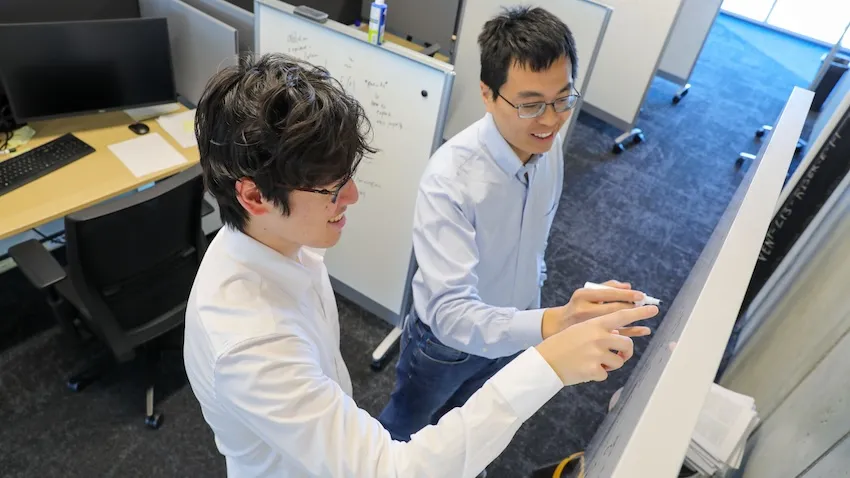
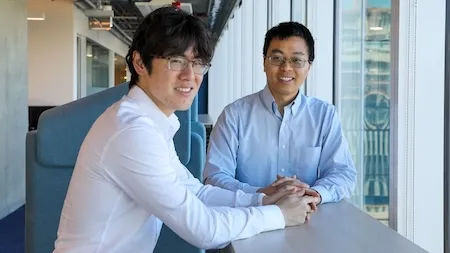
Successful test results of a new machine learning (ML) technique developed at Georgia Tech could help communities prepare for extreme weather and coastal flooding. The approach could also be applied to other models that predict how natural systems impact society.
Ph.D. student Phillip Si and Assistant Professor Peng Chen developed Latent-EnSF, a technique that improves how ML models assimilate data to make predictions.
In experiments predicting medium-range weather forecasting and shallow water wave propagation, Latent-EnSF demonstrated higher accuracy, faster convergence, and greater efficiency than existing methods for sparse data assimilation.
“We are currently involved in an NSF-funded project aimed at providing real-time information on extreme flooding events in Pinellas County, Florida,” said Si, who studies computational science and engineering (CSE).
“We're actively working on integrating Latent-EnSF into the system, which will facilitate accurate and synchronized modeling of natural disasters. This initiative aims to enhance community preparedness and safety measures in response to flooding risks.”
Latent-EnSF outperformed three comparable models in assimilation speed, accuracy, and efficiency in shallow water wave propagation experiments. These tests show models can make better and faster predictions of coastal flood waves, tides, and tsunamis.
In experiments on medium-range weather forecasting, Latent-EnSF surpassed the same three control models in accuracy, convergence, and time. Additionally, this test demonstrated Latent-EnSF's scalability compared to other methods.
These promising results support using ML models to simulate climate, weather, and other complex systems.
Traditionally, such studies require employment of large, energy-intensive supercomputers. However, advances like Latent-EnSF are making smaller, more efficient ML models feasible for these purposes.
The Georgia Tech team mentioned this comparison in its paper. It takes hours for the European Center for Medium-Range Weather Forecasts computer to run its simulations. Conversely, the ML model FourCastNet calculated the same forecast in seconds.
“Resolution, complexity, and data-diversity will continue to increase into the future,” said Chen, an assistant professor in the School of CSE.
“To keep pace with this trend, we believe that ML models and ML-based data assimilation methods will become indispensable for studying large-scale complex systems.”
Data assimilation is the process by which models continuously ingest new, real-world data to update predictions. This data is often sparse, meaning it is limited, incomplete, or unevenly distributed over time.
Latent-EnSF builds on the Ensemble Filter Scores (EnSF) model developed by Florida State University and Oak Ridge National Laboratory researchers.
EnSF’s strength is that it assimilates data with many features and unpredictable relationships between data points. However, integrating sparse data leads to lost information and knowledge gaps in the model. Also, such large models may stop learning entirely from small amounts of sparse data.
The Georgia Tech researchers employ two variational autoencoders (VAEs) in Latent-EnSF to help ML models integrate and use real-world data. The VAEs encode sparse data and predictive models together in the same space to assimilate data more accurately and efficiently.
Integrating models with new methods, like Latent-EnSF, accelerates data assimilation. Producing accurate predictions more quickly during real-world crises could save lives and property for communities.
To share Latent-EnSF to the broader research community, Chen and Si presented their paper at the SIAM Conference on Computational Science and Engineering (CSE25). The Society of Industrial and Applied Mathematics (SIAM) organized CSE25, held March 3-7 in Fort Worth, Texas.
Chen was one of ten School of CSE faculty members who presented research at CSE25, representing one-third of the School’s faculty body. Latent-EnSF was one of 15 papers by School of CSE authors and one of 23 Georgia Tech papers presented at the conference.
The pair will also present Latent-EnSF at the upcoming International Conference on Learning Representations (ICLR 2025). Occurring April 24-28 in Singapore, ICLR is one of the world’s most prestigious conferences dedicated to artificial intelligence research.
“We hope to bring attention to experts and domain scientists the exciting area of ML-based data assimilation by presenting our paper,” Chen said. “Our work offers a new solution to address some of the key shortcomings in the area for broader applications.”
News Contact
Bryant Wine, Communications Officer
bryant.wine@cc.gatech.edu
Florian Schäfer leads the “Matter and Information” research initiative for the Institute for Matter and Systems at Georgia Tech. In this role, his research focuses on numerical analysis, computational statistics, multi-agent optimization, and game-theoretic approaches in deep learning. Schäfer is an assistant professor in the School of Computational Science and Engineering.
In this brief Q&A, Schäfer discusses his research focus, how it relates to Matter and Systems’ core research focuses, and the national impact of this initiative.
What is your field of expertise and at what point in your life did you first become interested in this area?
I work on using statistical insights for designing algorithms to design physical systems. I can trace my interest in the interplay between physical systems and information processes all the way to high school times, when I was fascinated by the question of what it is that makes us think of some complex physical systems as "computers," but not of others.
What questions or challenges sparked your current research?
Simulating physics is in many ways like statistical analysis with data produced by computation. My aim is to understand the implications of this perspective for algorithm design in scientific computing.
Matter and systems refer to the transformational technological and societal systems that arise from the convergence of innovative materials, devices, and processes. Why is your initiative important to the development of the IMS research strategy?
An exciting current development is the two-fold convergence of physical and information sciences: The use of statistical /machine learning approaches for physical simulation and of new physical processes for computation. IMS is the perfect environment pursuing this goal.
What are the broader global and social benefits of the research you and your team conduct?
The main societal contribution of my research is the efficient and reliable simulation of complex engineering system to aid the development of improved designs.
What are your plans for engaging a wider Georgia Tech faculty pool with the Institute for Matter and Systems research?
I plan to engage researchers across GT through reading groups and seminars, with the goal of converging on a sufficiently concrete idea for an externally funded project. I hope that this will serve as a nucleus for exploring the use of novel physical processes for computation.
News Contact
Amelia Neumeister | Research Communications Program Manager
Many communities rely on insights from computer-based models and simulations. This week, a nest of Georgia Tech experts are swarming an international conference to present their latest advancements in these tools, which offer solutions to pressing challenges in science and engineering.
Students and faculty from the School of Computational Science and Engineering (CSE) are leading the Georgia Tech contingent at the SIAM Conference on Computational Science and Engineering (CSE25). The Society of Industrial and Applied Mathematics (SIAM) organizes CSE25, occurring March 3-7 in Fort Worth, Texas.
At CSE25, the School of CSE researchers are presenting papers that apply computing approaches to varying fields, including:
- Experiment designs to accelerate the discovery of material properties
- Machine learning approaches to model and predict weather forecasting and coastal flooding
- Virtual models that replicate subsurface geological formations used to store captured carbon dioxide
- Optimizing systems for imaging and optical chemistry
- Plasma physics during nuclear fusion reactions
[Related: GT CSE at SIAM CSE25 Interactive Graphic]
“In CSE, researchers from different disciplines work together to develop new computational methods that we could not have developed alone,” said School of CSE Professor Edmond Chow.
“These methods enable new science and engineering to be performed using computation.”
CSE is a discipline dedicated to advancing computational techniques to study and analyze scientific and engineering systems. CSE complements theory and experimentation as modes of scientific discovery.
Held every other year, CSE25 is the primary conference for the SIAM Activity Group on Computational Science and Engineering (SIAG CSE). School of CSE faculty serve in key roles in leading the group and preparing for the conference.
In December, SIAG CSE members elected Chow to a two-year term as the group’s vice chair. This election comes after Chow completed a term as the SIAG CSE program director.
School of CSE Associate Professor Elizabeth Cherry has co-chaired the CSE25 organizing committee since the last conference in 2023. Later that year, SIAM members reelected Cherry to a second, three-year term as a council member at large.
At Georgia Tech, Chow serves as the associate chair of the School of CSE. Cherry, who recently became the associate dean for graduate education of the College of Computing, continues as the director of CSE programs.
“With our strong emphasis on developing and applying computational tools and techniques to solve real-world problems, researchers in the School of CSE are well positioned to serve as leaders in computational science and engineering both within Georgia Tech and in the broader professional community,” Cherry said.
Georgia Tech’s School of CSE was first organized as a division in 2005, becoming one of the world’s first academic departments devoted to the discipline. The division reorganized as a school in 2010 after establishing the flagship CSE Ph.D. and M.S. programs, hiring nine faculty members, and attaining substantial research funding.
Ten School of CSE faculty members are presenting research at CSE25, representing one-third of the School’s faculty body. Of the 23 accepted papers written by Georgia Tech researchers, 15 originate from School of CSE authors.
The list of School of CSE researchers, paper titles, and abstracts includes:
Bayesian Optimal Design Accelerates Discovery of Material Properties from Bubble Dynamics
Postdoctoral Fellow Tianyi Chu, Joseph Beckett, Bachir Abeid, and Jonathan Estrada (University of Michigan), Assistant Professor Spencer Bryngelson
[Abstract]
Latent-EnSF: A Latent Ensemble Score Filter for High-Dimensional Data Assimilation with Sparse Observation Data
Ph.D. student Phillip Si, Assistant Professor Peng Chen
[Abstract]
A Goal-Oriented Quadratic Latent Dynamic Network Surrogate Model for Parameterized Systems
Yuhang Li, Stefan Henneking, Omar Ghattas (University of Texas at Austin), Assistant Professor Peng Chen
[Abstract]
Posterior Covariance Structures in Gaussian Processes
Yuanzhe Xi (Emory University), Difeng Cai (Southern Methodist University), Professor Edmond Chow
[Abstract]
Robust Digital Twin for Geological Carbon Storage
Professor Felix Herrmann, Ph.D. student Abhinav Gahlot, alumnus Rafael Orozco (Ph.D. CSE-CSE 2024), alumnus Ziyi (Francis) Yin (Ph.D. CSE-CSE 2024), and Ph.D. candidate Grant Bruer
[Abstract]
Industry-Scale Uncertainty-Aware Full Waveform Inference with Generative Models
Rafael Orozco, Ph.D. student Tuna Erdinc, alumnus Mathias Louboutin (Ph.D. CS-CSE 2020), and Professor Felix Herrmann
[Abstract]
Optimizing Coupled Systems: Insights from Co-Design Imaging and Optical Chemistry
Assistant Professor Raphaël Pestourie, Wenchao Ma and Steven Johnson (MIT), Lu Lu (Yale University), Zin Lin (Virginia Tech)
[Abstract]
Multifidelity Linear Regression for Scientific Machine Learning from Scarce Data
Assistant Professor Elizabeth Qian, Ph.D. student Dayoung Kang, Vignesh Sella, Anirban Chaudhuri and Anirban Chaudhuri (University of Texas at Austin)
[Abstract]
LyapInf: Data-Driven Estimation of Stability Guarantees for Nonlinear Dynamical Systems
Ph.D. candidate Tomoki Koike and Assistant Professor Elizabeth Qian
[Abstract]
The Information Geometric Regularization of the Euler Equation
Alumnus Ruijia Cao (B.S. CS 2024), Assistant Professor Florian Schäfer
[Abstract]
Maximum Likelihood Discretization of the Transport Equation
Ph.D. student Brook Eyob, Assistant Professor Florian Schäfer
[Abstract]
Intelligent Attractors for Singularly Perturbed Dynamical Systems
Daniel A. Serino (Los Alamos National Laboratory), Allen Alvarez Loya (University of Colorado Boulder), Joshua W. Burby, Ioannis G. Kevrekidis (Johns Hopkins University), Assistant Professor Qi Tang (Session Co-Organizer)
[Abstract]
Accurate Discretizations and Efficient AMG Solvers for Extremely Anisotropic Diffusion Via Hyperbolic Operators
Golo Wimmer, Ben Southworth, Xianzhu Tang (LANL), Assistant Professor Qi Tang
[Abstract]
Randomized Linear Algebra for Problems in Graph Analytics
Professor Rich Vuduc
[Abstract]
Improving Spgemm Performance Through Reordering and Cluster-Wise Computation
Assistant Professor Helen Xu
[Abstract]
News Contact
Bryant Wine, Communications Officer
bryant.wine@cc.gatech.edu
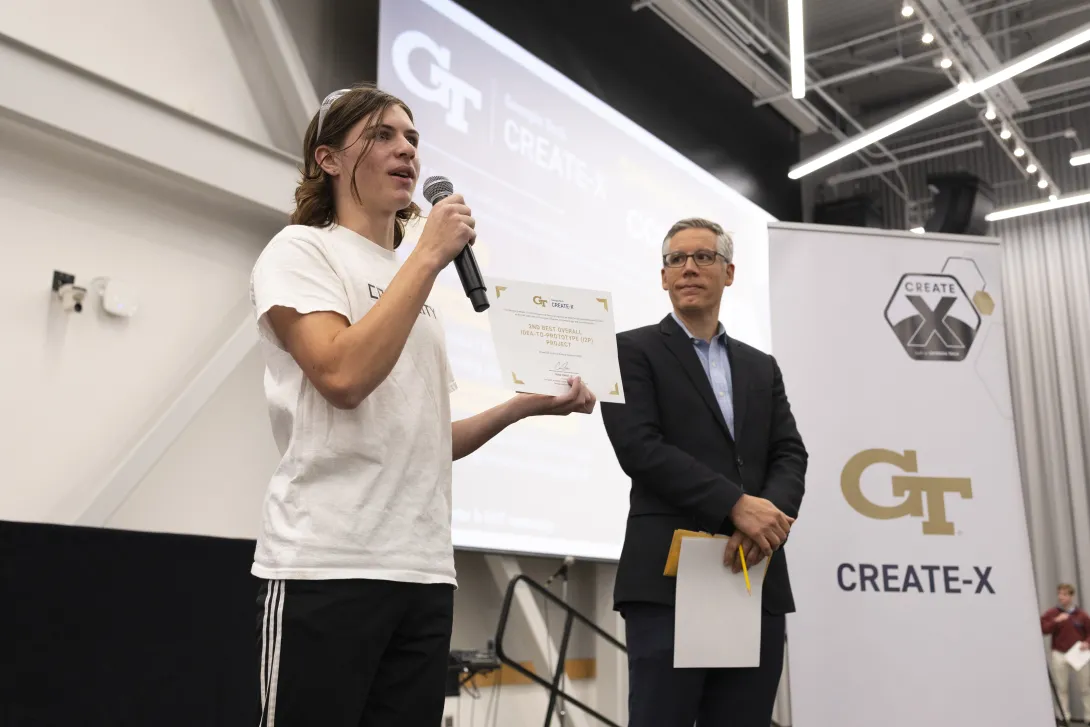
Calla Scotch, Sophomore, Mechanical Engineering and Materials Science and Engineering, speaks about their win with Team Convexity at the Fall 2024 I2P Showcase.
On April 21 at 5 p.m. in the Marcus Nanotechnology Building Atrium, dozens of teams will present prototypes at the Spring 2025 Idea to Prototype (I2P) Showcase. They will be vying for a chance to get a golden ticket in CREATE-X’s Startup Launch program, which gives participants $5,000 in optional seed funding and $150,000 in in-kind services like accounting and legal services, mentorship, and entrepreneurial education, among other benefits.
The I2P course, where these students develop their prototypes, offers research credit for undergraduate students up to $500 in reimbursement for physical material expenses and faculty mentorship. It’s open three times a year, in the spring, summer, and fall. Both undergraduate and graduate students can take the course, and students can take it up two times.
Convexity Electronics finished in second place at the Fall 2024 I2P Showcase. The company delivers smaller, faster, and more cost-effective circuit boards compared to traditional lithography-based methods. We delved into the team’s journey, challenges, and aspirations in this exclusive Q&A with one of its founders, Calla Scotch.
Q&A with Team Convexity's Calla Scotch
Team Members:
Calla Scotch, Sophomore, Mechanical Engineering and Materials Science and Engineering
Atharva Lele, Sophomore, Engineering
Anuj Pandey, Junior, Mechanical Engineering
Why did you pursue your startup?
It’s so complex. There are so many routes, and it's so new in terms of how many people are working on it. One day I woke up and couldn't stop thinking about it, then I couldn't sleep about it, and then I couldn't stop working on it. It was one of those things where I couldn't stop.
Traditionally, circuit boards — the stuff that's in your phones, computers, cameras, cars, everything — are made entirely subtractively. You have your block of material and cut away the stuff you don't want. It's a well-thought-out manufacturing process, but it's mostly very expensive and very slow. The materials and electronics manufacturing industry hasn't changed in about 30 years because it's been optimized as much as it can be.
What is your goal with Convexity?
To take that subtractive process and, instead of doing that, build the same circuits additively. I'm working on 3D printing the insulative base material, then 3D printing the conductive material, then using an electrical process to take those conductive materials and convert them into copper. And then doing layer after layer after layer to make the same circuits that someone in a subtractive process would do.
If you have traditional manufacturing, it takes about two weeks to ship from China, and it takes about a week to make a lab. My goal would be to make them in about five hours and then courier them over the same day. You don't need a big serial manufacturing facility if someone needs 6,000 boards. You don't have 6,000 printers in one room; all your printers are connected to the cloud. You could even go from 2D electronics to three-dimensional electronics. We just want to make more, smaller, faster, and cheaper than traditional manufacturing.
What surprised you about I2P?
How much time it took out of my day and how much I didn't want to do as much homework anymore. It made me want to focus all of my time on this and on how many different avenues there were to do what I wanted to do. I probably went through 30 different iterations of completely different scientific topics. I think because of how many options there were and how crazy scientifically advanced each of them was, it is what keeps me going.
What was your favorite part about I2P?
I did I2P for two semesters, and the best thing about it is getting to work on your own project and your own research for class credit.
What was challenging about building your prototype over the semester?
Sifting through all the research and development that has gone into this field. Electronics manufacturing has been around for a long time, and there's a lot of research and patents to work through and build on. I feel like I spent half my time coming up with ideas and the other half building the physical printer.
What would you say to students who are interested in entrepreneurship?
I can't tell you how much I've learned just by doing. Outside of that, talk to people. Just go out and talk to people. Ask people questions. Have your problem and get their input and insight on it, because how we make smart decisions and make startups that people want is by asking people what they want.
Cheer on Convexity as they pitch their prototype at the final round of the InVenture Prize, on March 12, at 7:30p.m., in the Ferst Theater of Arts. During this competition, the largest of its kind in the nation, a panel of celebrity judges and experts in science, technology, and venture capital will judge undergraduate teams competing for $35,000, including $5,000 for the People’s Choice award. Through audience voting, you get to advance the projects you support. Request your free InVenture Prize tickets today.
Want to be part of the next wave of technological advancements? Register for the Spring 2025 I2P Showcase to see our latest cohort of I2P inventors and their prototypes. Consider joining I2P for Summer or Fall 2025. For more information, visit the I2P program website.
News Contact
Breanna Durham
Marketing Strategist