

The general theme of the journal is the development and solution of problems that are adequately motivated to deal with important aspects of the design and/or analysis of transportation systems.

Srinivas Peeta, the Frederick R. Dickerson Chair in Transportation Systems at Georgia Tech’s School of Civil and Environmental Engineering, has been appointed Co-Editor-in-Chief of Transportation Research Part B: Methodological. This prestigious journal focuses on the mathematical and analytical foundations of transportation systems, addressing critical challenges in areas such as traffic flow, network design, control and scheduling, optimization, queuing theory, logistics, and behavioral modeling.
Transportation Research Part B complements other journals in the series—Part A (Policy and Practice), Part C (Emerging Technologies), and Part D (Transport and Environment)—forming a comprehensive suite of publications that collectively represent the forefront of transportation science. The journal serves a diverse and specialized audience, including operations researchers, logisticians, economists, econometricians, mathematical modelers, transportation engineers, geographers, and planners.
Professor Peeta brings decades of experience to this role. His research spans dynamic traffic assignment, congestion mitigation, and the development of resilient transportation networks. His association with Transportation Research Part B began in the early 1990s as a reviewer, and he has since published approximately 25 papers in the journal. Since 2019, he has served as an Associate Editor, playing a key role in managing the editorial process and upholding the journal’s high standards.
Please join us in congratulating Professor Peeta for this well-earned recognition. We are confident he will continue to guide Transportation Research Part B with excellence and vision, shaping the future of transportation research.
News Contact
info@scl.gatech.edu
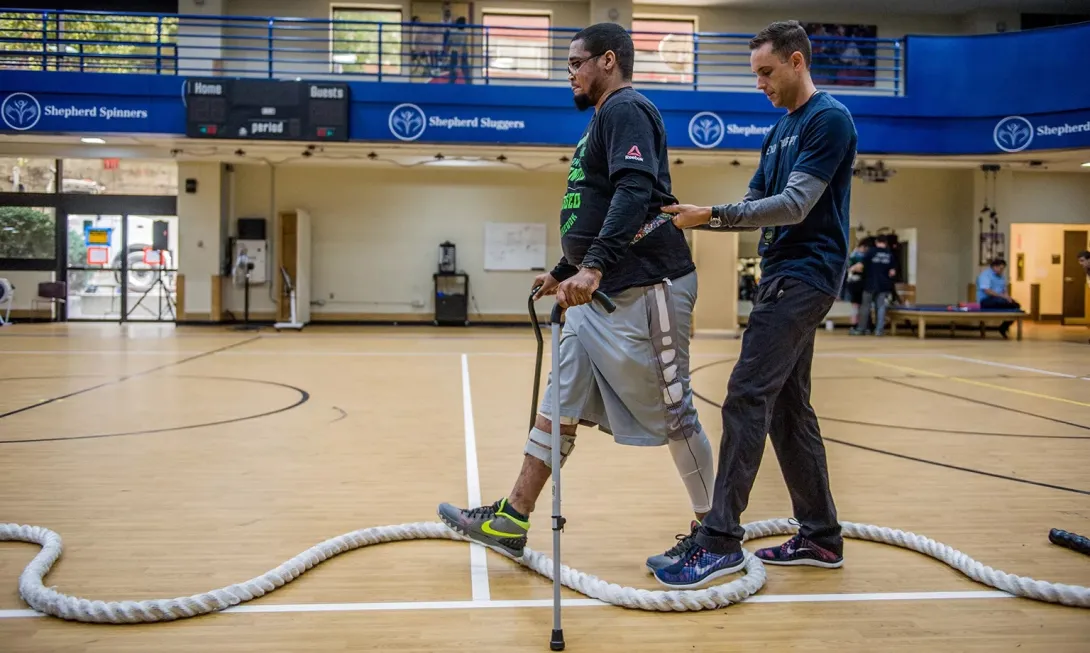
The seed grants will fund projects focused on enhancing wheelchair seating surfaces, supporting stroke patients as they transition home from rehabilitation, assessing lower limb exoskeleton technologies, and exploring the use of AI in remote rehab settings. Photo: Shepherd Center.
Georgia Tech and Shepherd Center recently awarded four seed grants totaling nearly $200,000 to researchers focusing on projects that will advance discoveries in neurorehabilitation, including acquired brain injury, spinal cord injury, multiple sclerosis, chronic pain, and other neurological conditions.
The Georgia Tech-Shepherd Center Seed Grant Program is part of an ongoing partnership between the two institutions that started in 2023 with the goal of advancing rehabilitative patient care and research.
“The seed grant program is intended to stimulate new interdisciplinary research collaborations by providing seed funding to obtain preliminary data or prototypes necessary for the submission of an external grant or industry opportunities,” says Deborah Backus, vice president of Research and Innovation at Shepherd Center. “As two leading research institutions, we know the potential for advancing rehabilitation therapies is even greater when we work together. We look forward to the solutions, treatments, and therapies that emerge from these initial seed grants.”
Experts from both institutions evaluated and scored seed grant applications based on the research’s innovation, approach, and potential for training opportunities, as well as its anticipated impact, prospects for commercial translation, and strategy for securing continued funding. This year, each awardee team received close to $50,000.
“We are very excited to launch this new seed grant program, which will spur ideas and propel research forward,” said Michelle LaPlaca, professor in the Coulter Department of Biomedical Engineering and the Georgia Tech lead of the Collaborative. “The complementary expertise of Georgia Tech and Shepherd Center researchers, combined with the motivation to find solutions for individuals with neurological injury and disability, is a winning formula for innovation.”
"Offering new hope for neurorehabilitation patients requires bringing together interdisciplinary researchers to explore new and creative ideas,” adds Chris Rozell, Julian T. Hightower Chaired professor in the School of Electrical and Computer Engineering and the inaugural executive director of the Institute of Neuroscience, Neurotechnology, and Society (INNS) at Georgia Tech. “I'm excited to see the talent at these world class institutions coming together to develop new solutions for these complex problems."
This year’s seed grants were awarded to the following projects:
- Proof of Concept Development of the Recovery Cushion – Stephen Sprigle, professor, School of Industrial Design and School of Mechanical Engineering, Georgia Tech; Jennifer Cowhig, research physical therapist, Shepherd Center.
- Paving a Smooth Path from Hospital to Home: A Feasibility Study of an Integrated Smart Transitional Home Lab to Support Stroke Rehabilitation Patients’ Transition to Home – John Morris, senior clinical research scientist, Shepherd Center; Hui Cai, professor in the School of Architecture, executive director of the SimTigrate Design Center, Georgia Tech.
- A Comparative Analysis of Lower-Limb Exoskeleton Technology for Non-Ambulatory Individuals with Spinal Cord Injury – Maegan Tucker, assistant professor, School of Electrical and Computer Engineering and School of Mechanical Engineering, Georgia Tech; Nicholas Evans (AP 2023), clinical research scientist, Shepherd Center.
- Improving Accessibility and Precision in Neurorehabilitation at the Point of Care with AI-Driven Remote Therapeutic Monitoring Solutions – Brad Willingham, clinical research scientist, director of Multiple Sclerosis Research, Shepherd Center; May Dongmei Wang, professor, Wallace H. Coulter Department of Biomedical Engineering, Georgia Tech.
News Contact
Kerry Ludlam
Director of Communications
Shepherd Center
Audra Davidson
Research Communications Program Manager
Institute for Neuroscience, Neurotechnology, and Society

Research into tailored assistive and rehabilitative devices has seen recent advancements but the goal remains out of reach due to the sparsity of data on how humans learn complex balance tasks. To address this gap, a collaborating team of interdisciplinary faculty from Florida State University and Georgia Tech have been awarded ~$798,000 by the NSF to launch a study to better understand human motor learning as well as gain greater understanding into human robot interaction dynamics during the learning process.
Led by PI: Taylor Higgins, Assistant Professor, FAMU-FSU Department of Mechanical Engineering, partnering with Co-PIs Shreyas Kousik, Assistant Professor, Georgia Tech, George W. Woodruff School of Mechanical Engineering, and Brady DeCouto, Assistant Professor, FSU Anne Spencer Daves College of Education, Health, and Human Sciences, the research will use the acquisition of unicycle riding skill by participants to gain a better grasp on human motor learning in tasks requiring balance and complex movement in space. Although it might sound a bit odd, the fact that most people don’t know how to ride a unicycle, and the fact that it requires balance, mean that the data will cover the learning process from novice to skilled across the participant pool.
Using data acquired from human participants, the team will develop a “robotics assistive unicycle” that will be used in the training of the next pool of novice unicycle riders. This is to gauge if, and how rapidly, human motor learning outcomes improve with the assistive unicycle. The participants that engage with the robotic unicycle will also give valuable insight into developing effective human-robot collaboration strategies.
The fact that deciding to get on a unicycle requires a bit of bravery might not be great for the participants, but it’s great for the research team. The project will also allow exploration into the interconnection between anxiety and human motor learning to discover possible alleviation strategies, thus increasing the likelihood of positive outcomes for future patients and consumers of these devices.
Author
-Christa M. Ernst
This Article Refers to NSF Award # 2449160
News Contact

From the humble beginnings of the three-wheeled Benz Patent-Motorwagen in 1886, the automobile has been a continuous story of technological progress. Each era has seen cars push the boundaries of innovation, evolving from early mechanical systems into sophisticated, computer-driven machines.
We’re now in a new generation of automobiles, where roadways are increasingly shared by electric vehicles (EVs) and autonomous vehicles (AVs).
EVs are projected to dominate global car sales by 2030, according to an RMI report. Meanwhile, AVs are gradually entering the mainstream, with 37 percent of new passenger cars expected to be equipped with advanced driver-assistance technologies by 2035, according to McKinsey & Company.
Georgia Tech School of Electrical and Computer Engineering (ECE) researchers are at the forefront of advanced automotive technologies, working on everything from electric engines and computer vision, to modernizing the power grid to support EV charging.
Given current advancements and future possibilities, ECE is helping bring the future car into view, though many surprises and uncertainties remain. Learn what's on the horizon on the ECE Newspage.
News Contact
Zachary Winiecki (zwiniecki3@gatech.edu)
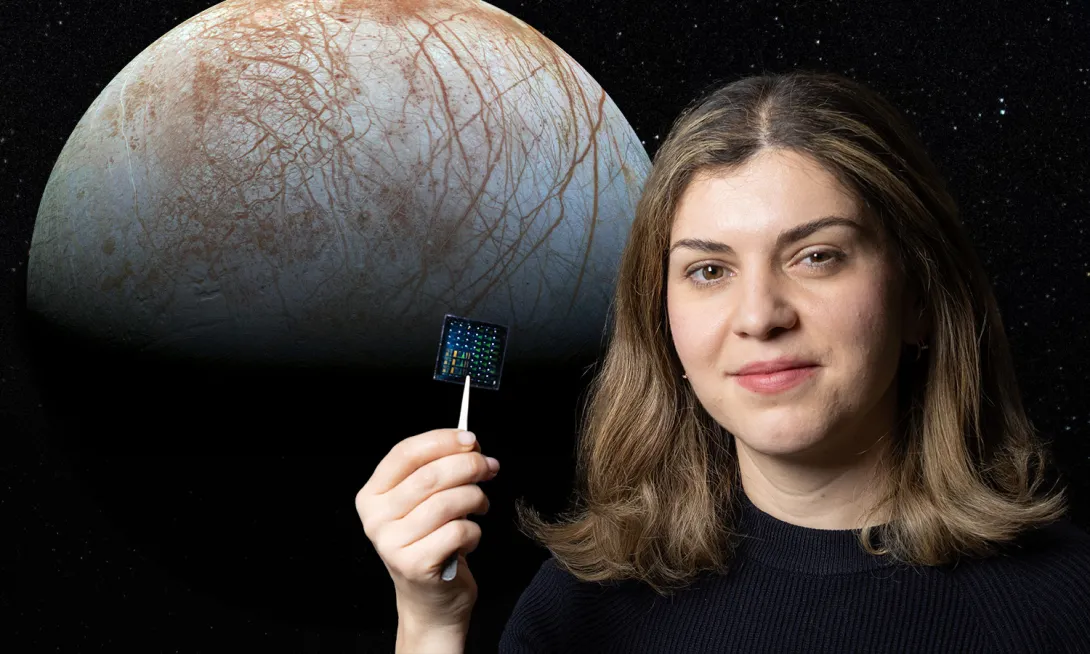
Right now, about 70 million miles away, a Ramblin’ Wreck from Georgia Tech streaks through the cosmos. It’s a briefcase-sized spacecraft called Lunar Flashlight that was assembled in a Georgia Tech Research Institute (GTRI) cleanroom in 2021, then launched aboard a SpaceX rocket in 2022.
The plan was to send Lunar Flashlight to the moon, where the spacecraft would shoot lasers at its south pole in a search for frozen water. Mission control for the flight was on Georgia Tech’s campus, where students in the Daniel Guggenheim School of Aerospace Engineering (AE) sat in the figurative driver’s seat. They worked for several months in 2023 to coax the craft toward its intended orbit in coordination with NASA’s Jet Propulsion Lab (JPL).
A faulty propulsion system kept the CubeSat from reaching its goal. Disappointing, to be sure, but it opened a new series of opportunities for the student controllers. When it was clear Lunar Flashlight wouldn’t reach the moon and instead settle into an orbit of the sun, JPL turned over ownership to Georgia Tech. It’s now the only higher education institution that has controlled an interplanetary spacecraft.
Lunar Flashlight’s initial orbit, planned destination, and current whereabouts mirrors much of the College of Engineering’s research in space technology. Some faculty are focused on projects in low earth orbit (LEO). Others have an eye on the moon. A third group is looking well beyond our small area of the solar system.
No matter the distance, though, each of these Georgia Tech engineers is working toward a new era of exploration and scientific discovery.
News Contact
Jason Maderer
College of Engineering
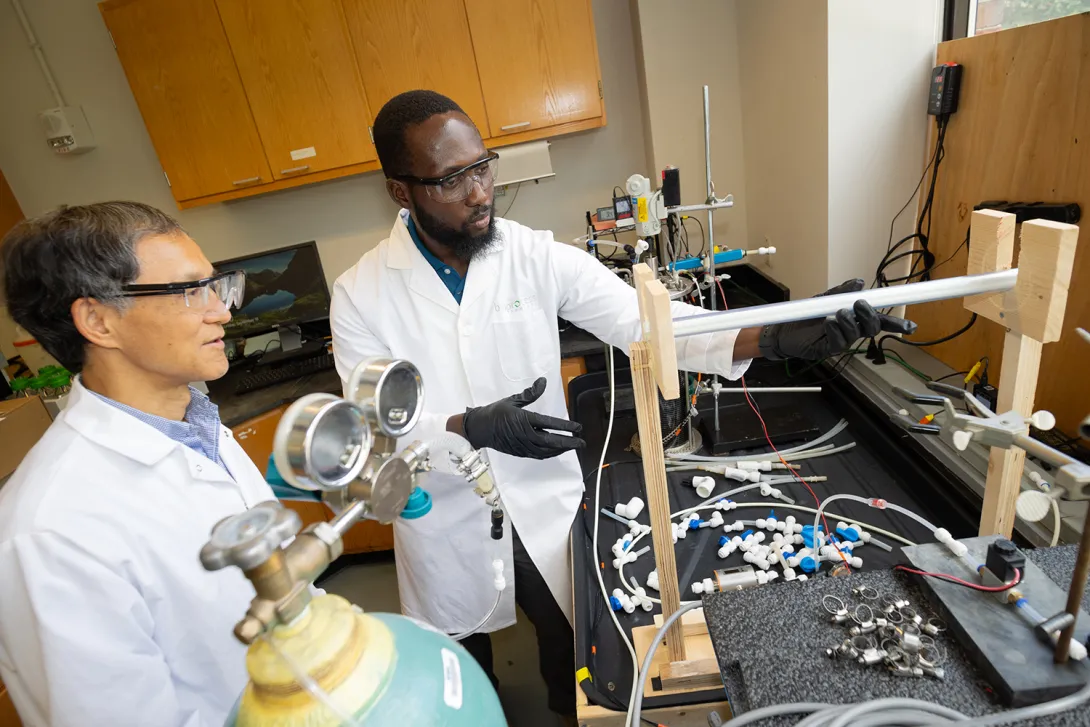
Professor Yongsheng Chen (left) and Ph.D. student Ahmed Yunus work with a wastewater reactor system in the lab. (Photo: Candler Hobbs)
A charcoal-like material made from leaves and branches that collect on forest floors could be a cheap, sustainable way to keep pollution from washing off roadways and into Georgia’s lakes and rivers.
Engineers at Georgia Tech and Georgia Southern University have found that this biological charcoal, or biochar, can be mixed with soil and used along roadways to catch grimy rainwater and filter it naturally before it pollutes surface water.
Their tests found the biochar effectively cleans contaminants from the rainwater and works just as well in the sandy soils of the coastal plain as in the clays of north Georgia. Their biochar-soil mixture can be easily substituted for expensive material mined from the earth that’s typically used on roads.
Though they focused on Georgia, the researchers said the findings could easily apply across the U.S., providing a simple, natural way to keep road pollutants out of water sources. They published their approach in the Journal of Environmental Management.
Learn about their system on the College of Engineering website.
News Contact
Joshua Stewart
College of Engineering
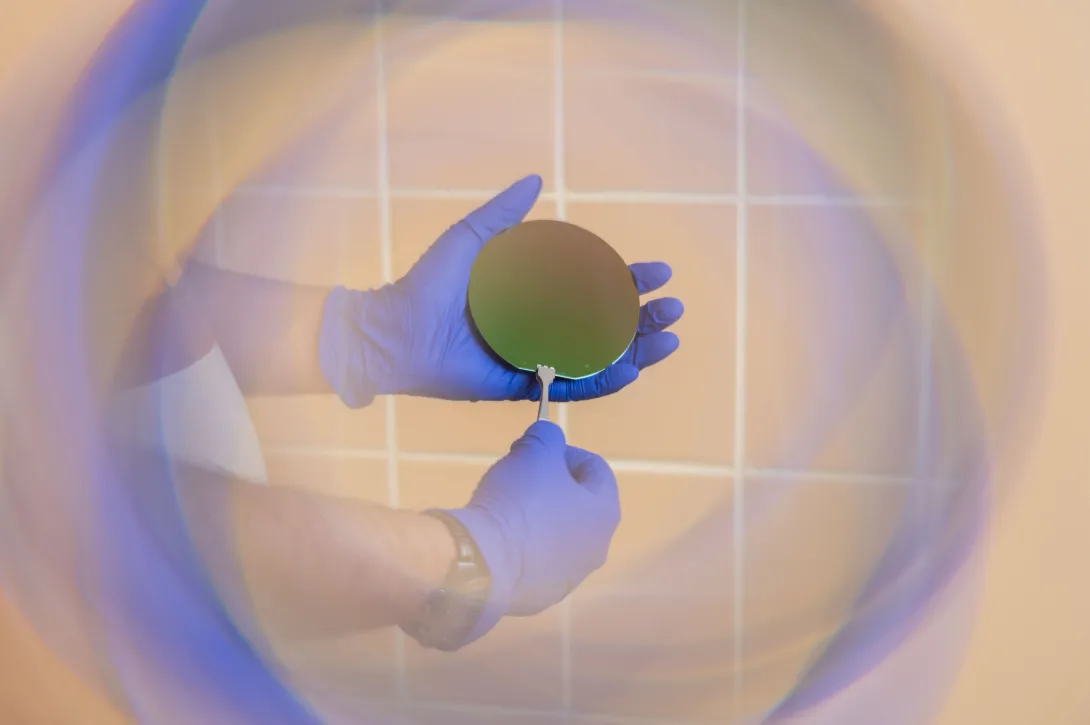
Silicon-on-insulator (SOI) wafer used in a multi-chip module featuring 3D optical interconnects. (Photo: Allison Carter)

A schematic illustration of a multi-chip structure with 3D optical routing. The key parts of Adibi's proposed system are: 1) multi-layer planar waveguides, 2) free-form couplers, and 3) a dense vertical waveguide array.
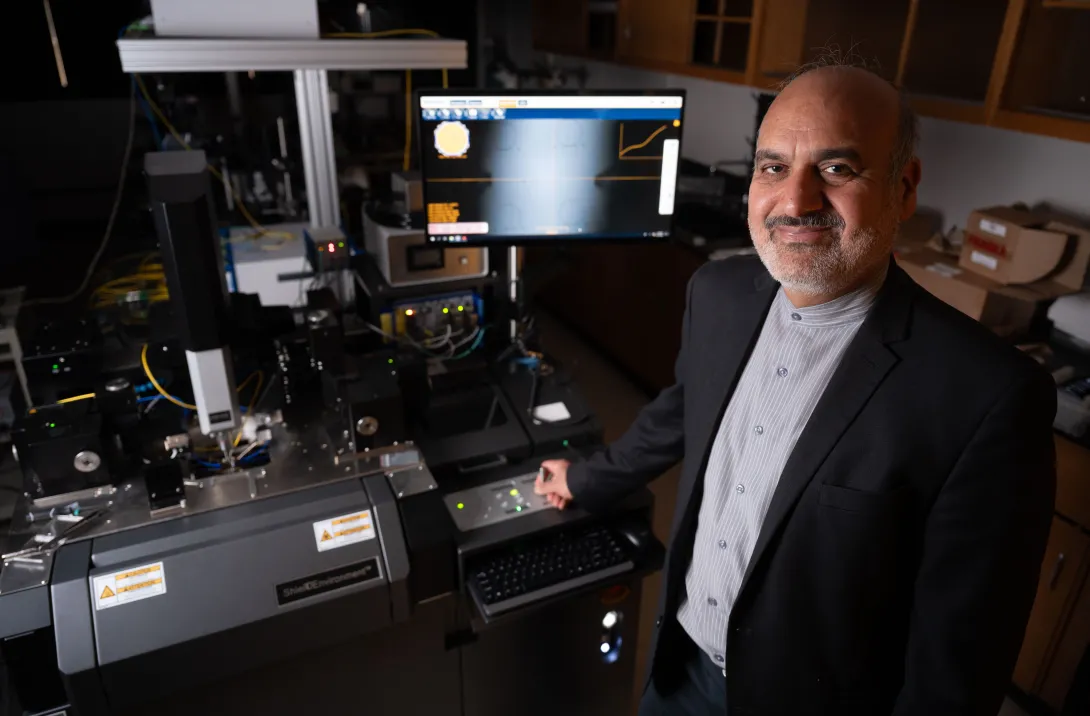
By combining advanced optical techniques, Professor Ali Adibi’s 3D optical routing systems looks to enable vertical chip integration in a way not previously achieved. (Photo: Allison Carter)
The future of computing is lit, literally.
As microchips grow more complex and data demands intensify, traditional electrical connections are hitting their limits. Speed is king in today’s digital systems, but a major bottleneck remains in how quickly information can move between components like processors and memory.
This lag is one of the most pressing challenges in advanced hardware design. While processors continue to accelerate, the links that connect them can't keep pace.
Georgia Tech researcher Ali Adibi is addressing this problem with $5.3 million in funding over three years from the Defense Advanced Research Projects Agency (DARPA). His project is part of DARPA’s Heterogeneous Adaptively Produced Photonic Interfaces (HAPPI) program, which aims to dramatically boost the speed and density of data transmission within microsystems by using light instead of electricity.
“Optical solutions are highly advantageous for providing the required data rates and power consumptions, and our project is formed to address the most important challenges for achieving the system-level performance,” said Adibi, a professor and Joseph M. Pettit Chair in the School of Electrical and Computer Engineering.
The project brings together a multidisciplinary team, including collaborators from the Massachusetts Institute of Technology, University of Florida, NY CREATES, and NHanced Semiconductors, Inc.
Going Vertical
Unlike traditional optical communication, which connects systems across distances, this project focuses on enabling ultra-fast, low-loss communication withinelectronic systems.
The key innovation is vertically connecting electronic chips in a compact stack. This design helps overcome the limitations of planar optical routing geometries (layouts that guide light horizontally across a chip) which are often not compatible with the dense, 3D chip architectures needed for next-generation computing.
Adibi’s team is developing a novel 3D optical routing system that can transmit data with minimal loss, high bandwidth, and compact components. The system is designed to scale to large arrays of interconnected chips with minimal interference between data channels.
Smarter Design with Machine Learning
At the heart of the project is the use of machine learning (ML) to help design and optimize the light-based communication system.
ML is used to shape and fine-tune the tiny structures that guide light through and between chips. This includes finding the best sizes, shapes, and layouts for components like couplers and waveguides, so they can be made smaller, work more efficiently, and fit into dense chip layouts.
“Designing a complete, scalable 3D optical routing structure involves innumerable variables,” Adibi said. “Machine learning helps us navigate that complexity and find solutions that would be nearly impossible to identify manually.”
Tiny "Mirrors"
Another key innovation involves specialized optical structures, or what Adibi refers to as “artificial mirrors”.
The tiny, precisely shaped structures, called metagratings, are embedded in the chip material to redirect light vertically between layers with minimal loss. These components are designed to guide light efficiently in tight spaces, helping connect stacked chips without losing signal strength.
“Imagine light traveling through a chip and suddenly being redirected straight up. That’s the kind of precise control we’re achieving,” Adibi explained.
These innovations, along with advanced techniques for building vertical light paths through thick silicon layers and new packaging solutions that keep components precisely aligned, have shown promise on their own. But combining them is what enables dense, high-speed, low-loss communication between vertically stacked chips, something that no system has achieved before, according to Adibi.
“As with any complex system, success depends on how well everything is structured and optimized,” he said. “Once everything is in alignment, data can move faster, more efficiently, and with less energy consumption for communicating each bit of data.”
About the Research
This research is supported by the Defense Advanced Research Projects Agency (DARPA) Heterogeneous Adaptively Produced Photonic Interfaces (HAPPI) program. Notice ID DARPA-SN-24-105.
News Contact
Dan Watson

As strange as it sounds, the key to understanding life’s origins might lie in artificial intelligence. At least, according to a new approached being pursued by researchers at Georgia Tech.
School of Electrical and Computer Engineering (ECE) Assistant Professor Amirali Aghazadeh and Ph.D. student Daniel Saeedi have developed AstroAgents, an AI system that analyzes mass spectrometry data — detailed chemical compositions from meteorites and Earth soil samples — to generate novel hypotheses about the origins of life on the planet.
What sets AstroAgents apart is its use of agentic AI. Unlike traditional AI systems that perform fixed tasks, this agentic system is designed to pursue a scientific goal. It draws from astrobiology literature, interprets complex data, and proposes original ideas that researchers can investigate further.
Their paper, recently featured in the journal "Nature", is opening new possibilities for how scientists explore questions that have remained unanswered for decades.
In a special Q&A, Aghazadeh and Saeedi explain how AstroAgents analyzes space chemistry, what it’s revealing about the possible origins of life on Earth, and what they hope to explore next.
News Contact
Dan Watson

Fan Zhang, Assistant Professor of Mechanical Engineering at Georgia Tech Receives National Engineering Achievement Award from ANS.
Fan Zhang, assistant professor in the George W. Woodruff School of Mechanical Engineering, has received the 2025 Landis Young Member Engineering Achievement Award from the American Nuclear Society (ANS).
The award recognizes young members for outstanding achievements in which engineering knowledge is effectively applied to yield an engineering concept, design, safety improvement, method of analysis, or product utilized in nuclear power research and development or commercial application.
Zhang was selected by the ANS Honors and Awards Committee for her pioneering contributions to nuclear cybersecurity through innovative machine learning (ML) approaches, development of patent-pending technology, and efforts to establish Georgia Tech as a leader in the field. The award also recognizes her collaboration with the International Atomic Energy Agency and her groundbreaking research on robot-assisted nuclear power plant monitoring, which improves safety and efficiency and demonstrates exceptional impact on global nuclear security.
Zhang serves as the director of the Intelligence for Advanced Nuclear (iFAN) Lab at Georgia Tech. Her research primarily focuses on nuclear cybersecurity, online monitoring, fault detection, digital twins, AI/ML, and robotics. Her work on robot-assisted nuclear power plant monitoring, which combines these cross-cutting areas, could significantly reduce human worker presence in harsh and potentially hazardous environments and improve the efficiency of plant operation. The work was supported by the inaugural Department of Energy Office of Nuclear Energy Distinguished Early Career Award.
News Contact
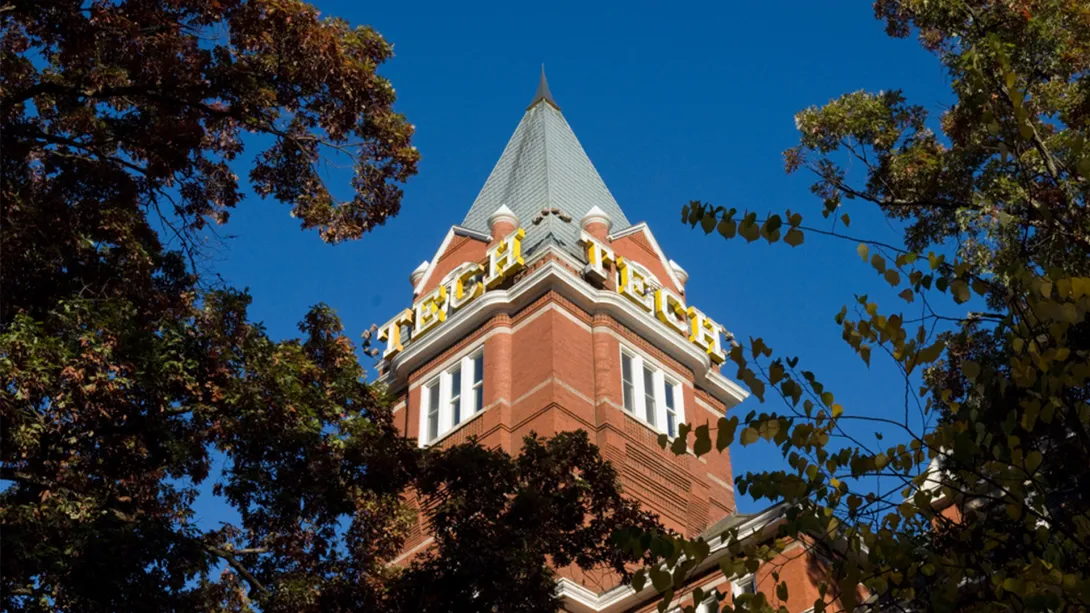
Georgia Tech has launched two new Interdisciplinary Research Institutes (IRIs): The Institute for Neuroscience, Neurotechnology, and Society (INNS) and the Space Research Institute (SRI).
The new institutes focus on expanding breakthroughs in neuroscience and space, two areas where research and federal funding are anticipated to remain strong. Both fields are poised to influence research in everything from healthcare and ethics to exploration and innovation. This expansion of Georgia Tech’s research enterprise represents the Institute’s commitment to research that will shape the future.
“At Georgia Tech, innovation flourishes where disciplines converge. With the launch of the Space Research Institute and the Institute for Neuroscience, Neurotechnology, and Society, we’re uniting experts across fields to take on some of humanity’s most profound questions. Even as we are tightening our belts in anticipation of potential federal R&D budget actions, we also are investing in areas where non-federal funding sources will grow and where big impacts are possible,” said Executive Vice President for Research Tim Lieuwen. "These institutes are about advancing knowledge — and using it to improve lives, inspire future generations, and help shape a better future for us all.”
Both INNS and SRI grew out of faculty-led initiatives shaped by a strategic planning process and campus-wide collaboration. Their evolution into formal institutes underscores the strength and momentum of Georgia Tech’s interdisciplinary research enterprise.
Georgia Tech’s 11 IRIs support collaboration between researchers and students across the Institute’s seven colleges, the Georgia Tech Research Institute (GTRI), national laboratories, and corporate entities to tackle critical topics of strategic significance for the Institute as well as for local, state, national, and international communities.
"IRIs bring together Georgia Tech researchers making them more competitive and successful in solving research challenges, especially across disciplinary boundaries,” said Julia Kubanek, vice president of interdisciplinary research. “We're making these new investments in neuro- and space-related fields to publicly showcase impactful discoveries and developments led by Georgia Tech faculty, attract new partners and collaborators, and pursue alternative funding strategies at a time of federal funding uncertainty."
The Space Research Institute
The Space Research Institute will connect faculty, students, and staff who share a passion for space exploration and discovery. They will investigate a wide variety of space-related topics, exploring how space influences and intersects with the human experience. The SRI fosters a collaborative community including scientific, engineering, cultural, and commercial research that pursues broadly integrated, innovative projects.
SRI is the hub for all things space-related at Georgia Tech. It connects the Institute’s schools, colleges, research institutes, and labs to lead conversations about space in the state of Georgia and the world. Working in partnership with academics, business partners, philanthropists, students, and governments, Georgia Tech is committed to staying at the forefront of space-related innovation.
The SRI will build upon the collaborative work of the Space Research Initiative, the first step in formalizing Georgia Tech’s broad interdisciplinary space research community. The Initiative brought together researchers from across campus and was guided by input from Georgia Tech stakeholders and external partners. It was led by an executive committee including Glenn Lightsey, John W. Young Chair Professor in the Daniel Guggenheim School of Aerospace Engineering; Mariel Borowitz, associate professor in the Sam Nunn School of International Affairs; and Jennifer Glass, associate professor in the School of Earth and Atmospheric Sciences. Beginning July 1, W. Jud Ready, a principal research engineer in GTRI’s Electro-Optical Systems Laboratory, will serve as the inaugural executive director of the Space Research Institute.
To receive the latest updates on space research and innovation at Georgia Tech, join the SRI mailing list.
The Institute for Neuroscience, Neurotechnology, and Society
The Institute for Neuroscience, Neurotechnology, and Society (INNS) is dedicated to advancing neuroscience and neurotechnology to improve society through discovery, innovation, and engagement. INNS brings together researchers from neuroscience, engineering, computing, ethics, public policy, and the humanities to explore the brain and nervous system while addressing the societal and ethical dimensions of neuro-related research.
INNS builds on a foundation established over a decade ago, which first led to the GT-Neuro Initiative and later evolved into the Neuro Next Initiative. Over the past two years, this effort has culminated in the development of a comprehensive plan for an IRI, guided by an executive committee composed of faculty and staff from across Georgia Tech. The committee included Simon Sponberg, Dunn Family Associate Professor in the School of Physics and the School of Biological Sciences; Christopher Rozell, Julian T. Hightower Chaired Professor in the School of Electrical and Computer Engineering; Jennifer Singh, associate professor in the School of History and Sociology; and Sarah Peterson, Neuro Next Initiative program manager. Their leadership shaped the vision for a research community both scientifically ambitious and socially responsive.
INNS will serve as a dynamic hub for interdisciplinary collaboration across the full spectrum of brain-related research — from biological foundations to behavior and cognition, and from fundamental research to medical innovations that advance human flourishing. Research areas will encompass the foundations of human intelligence and movement, bio-inspired design and neurotechnology development, and the ethical dimensions of a neuro-connected future.
By integrating technical innovation with human-centered inquiry, INNS is committed to ensuring that advances in neuroscience and neurotechnology are developed and applied ethically and responsibly. Through fostering innovation, cultivating interdisciplinary expertise, and engaging with the public, the institute seeks to shape a future where advancements in neuroscience and neurotechnology serve the greater good. INNS also aims to deepen Georgia Tech’s collaborations with clinical, academic, and industry partners, creating new pathways for translational research and real-world impact.
An internal search for INNS’s inaugural executive director is in the final stages, with an announcement expected soon.
Join our mailing list to receive the latest updates on everything neuro at Georgia Tech.
News Contact
Laurie Haigh
Research Communications